If your Toyota Camry stalls when you slow down or stop, first note how it dies. A shaking, falling-RPM stall usually points toward idle airflow, an intake or PCV leak, EVAP purge flow, a misfire, or an incorrect air-fuel mixture. A clean, instant shutdown points more toward a crank/cam signal, power or ground fault, fuel-injection interruption, or another system suddenly loading the engine. Start by saving OBD-II codes and freeze-frame data, then use the symptom pattern to choose the next test instead of replacing parts.
Last updated: July 31, 2026
Editorial basis: This guide uses Toyota owner guidance, Toyota service-information diagnostic categories, CARB OBD guidance, NHTSA recall resources, and FTC repair guidance. It does not claim a hands-on diagnosis of a specific vehicle.
Affiliate disclosure: As an Amazon Associate, AutoReviewNest earns from qualifying purchases. This does not affect editorial independence or the price you pay.
Quick Answer
A Toyota Camry that stalls at stops most often has an airflow, idle-control, vacuum/PCV, EVAP purge, ignition, fuel-mixture, sensor, or low-voltage problem. Check codes before cleaning or disconnecting anything. Then match the stall to the conditions: after battery service, after refueling, only in Drive, when the A/C engages, or as the vehicle rolls to zero. Stop driving if it stalls repeatedly in traffic.
Key Takeaways
- Save stored and pending codes, freeze-frame data, and fuel trims before clearing codes or disconnecting the battery.
- Positive fuel-trim correction mainly at idle favors an intake leak after the MAF sensor; lean correction mainly under higher load makes restricted fuel delivery more suspicious.
- Stalling that begins after a battery disconnect or throttle-body service may involve a loose intake connection, changed learned airflow, or a model-specific idle-learning requirement.
- Stalling after refueling raises the priority of EVAP purge testing; stalling only as the car rolls to a stop can also require an automatic-transmission load check.
- On a Camry Hybrid, the gasoline engine may stop normally while the READY indicator remains on. Treat it as a fault when READY turns off, propulsion is lost, or a warning appears.
- Repeated stalling, a fuel smell, a flashing check-engine light, smoke, or stalling in traffic requires professional diagnosis before normal driving continues.
At a Glance
| Time Required | About 15–30 minutes for code capture and visual checks; longer for smoke, circuit, fuel-pressure, or transmission testing |
| Difficulty | Beginner to intermediate, depending on the test |
| Tools Needed | OBD-II scanner, flashlight, throttle-body cleaner, MAF-safe cleaner, basic hand tools, multimeter, and smoke tester or professional leak test when needed |
| Cost | Basic checks may require only scanner access or cleaning supplies; diagnostic and repair costs vary by cause, model year, and labor market |
Warning: If the Camry stalls while moving, loses power steering/brake assist, smells like fuel, shows smoke, or has a flashing check-engine light, pull over safely, turn on the hazard lights, and arrange a tow or professional inspection. Do not keep driving a car that may stall in traffic.
Why a Toyota Camry Stalls at Stops

A gasoline Camry stalls at stops when engine torque falls below the load needed to keep it idling. The loss can come from insufficient measured air, unmetered air, an overly rich or lean mixture, weak or missing spark, incorrect valve timing, low compression, unstable voltage, or a sudden load from the A/C, power steering, or automatic transmission.
The way RPM falls is useful. If the engine shakes and fades, investigate combustion, airflow, fuel trims, purge flow, injectors, ignition, and compression. If it shuts off abruptly without much vibration, prioritize crank/cam signals, ECM power and grounds, fuel-injection interruption, and wiring. If it stalls only as road speed reaches zero but idles normally in Park, include automatic-transmission load in the test plan.
Note: Camry designs vary. Older models may use a separate idle air control valve, while many newer models control idle through the electronic throttle body. On a Camry Hybrid, the gasoline engine can stop and restart normally while the READY indicator stays on. Do not service orange high-voltage cables or hybrid components as a DIY stalling test.
Which Stall Pattern Matches Your Camry?
Use the condition that triggers the stall to shorten the test list. These patterns do not prove a failed part, but they show where to begin.
| When It Stalls | Higher-Priority Checks | Best First Evidence |
|---|---|---|
| Immediately after battery disconnect or throttle-body service | Loose intake hose, unplugged MAF, throttle deposits, learned idle values | Recheck everything touched, save codes, then follow model-specific idle-learning guidance |
| Soon after refueling | EVAP purge valve stuck open, purge hose, excessive fuel vapor, fuel quality | EVAP codes, purge command/data, fuel trims, repeatable after-fill pattern |
| When shifted into Drive or Reverse, or when A/C switches on | Idle control, throttle deposits, vacuum leak, low voltage, excessive accessory or A/T load | Warm idle RPM, load response, charging data, intake smoke test |
| Shakes or misfires before dying | Spark plugs, coils, injectors, air-fuel ratio, compression, valve timing | Misfire counters, fuel trims, plug inspection, cylinder contribution/compression test |
| Shuts off cleanly with little warning | Crank/cam signal, ECM power/ground, fuel-injection interruption, wiring | Freeze-frame/history data, RPM signal during stall, power and ground tests |
| Only as the vehicle rolls to a complete stop | Idle airflow plus automatic-transmission or torque-converter load | Compare Park/Neutral behavior with Drive and road-speed deceleration; use transmission-capable scan data |
| Hybrid gasoline engine stops but READY stays on | Usually normal hybrid operation | Confirm READY remains on, propulsion is available, and no warning message appears |
Start With This Diagnostic Order
Use this order so you do not waste money replacing good parts:
| Step | What to Check | Why It Matters |
|---|---|---|
| 1 | Safety, warning lights, fuel smell, overheating | Confirms whether the car is safe to test |
| 2 | OBD-II stored and pending codes | Shows which system the ECU is flagging |
| 3 | Air filter, intake boot, clamps, vacuum hoses | Finds leaks and restrictions that upset idle |
| 4 | Throttle body, MAF sensor, idle-control parts | Corrects common low-idle airflow problems |
| 5 | Spark plugs, coils, misfire data | Rules out weak ignition at low RPM |
| 6 | EVAP purge, PCV system, injectors, fuel trims, and fuel pressure | Separates mixture-control faults from a true supply problem |
| 7 | Crank/cam signals, ECM power/grounds, charging system, and A/T load | Finds abrupt shutdown, low-voltage, or transmission-load faults |
Inspect Throttle Body, MAF, Intake Tube, and Air Filter
Airflow problems are a smart first stop because they are common, visible, and often inexpensive to fix. Inspect the throttle body, mass airflow sensor, intake tube, hose clamps, and air filter before buying parts.
| Component | Action |
|---|---|
| Throttle body | Look for carbon around the bore and plate; clean gently with throttle-body cleaner |
| MAF sensor | Inspect the connector and scan data first; if contaminated, use only MAF-safe cleaner and do not touch the sensing element |
| Intake tube | Check for cracks, soft spots, loose clamps, and tears after the MAF sensor |
| Air filter | Replace if dirty, oil-soaked, collapsed, or the wrong size |
| Vacuum and PCV hoses | Inspect for brittle rubber, missing caps, split elbows, disconnected lines, and a damaged brake-booster hose |
A torn intake boot, PCV hose, or other leak after the MAF sensor can let unmeasured air enter the engine. A useful live-data pattern is fuel-trim correction that is strongly positive at idle but improves as RPM rises. That pattern makes an intake leak more likely than a weak fuel pump.
Pro Tip: Before cleaning anything, take photos of hose routing and electrical connectors. Many “new” idle problems after a repair are caused by a loose clamp, unplugged sensor, or vacuum hose left off during reassembly.
[Products Worth Considering]

This professional compression tester kit helps diagnose engine health quickly and accurately in gasoline-powered cars, trucks, ATVs, and small engines. The fluorescent triple-scale gauge improves readability in low light, while the built-in Schrader valve, safety release, and included adapters make testing simple, stable, and reliable.

This ignition coil pack and pre-gapped spark plug set is designed for select 3.5L V6 Toyota and Lexus models, helping restore smooth engine performance and reliable starting. Built to meet or exceed OEM specifications, it can help fix common issues like misfires, rough idle, poor fuel economy, and reduced power. The complete 6-piece set offers a convenient replacement solution for compatible vehicles.

This automotive electrical disconnect pliers set makes it easier to remove stubborn wire connectors, fuel injector plugs, ignition coil connectors, and other tight-fitting automotive terminals without damage. Built from high-carbon steel with comfortable anti-slip handles, the tools are designed for durability, control, and one-handed use in narrow spaces. The set includes multiple disconnect and separator tools plus hose clamp pliers to help with a wide range of vehicle repair tasks.
How Do You Check Idle Control and Throttle Relearn Safely?
Idle control keeps the engine running when your foot is off the accelerator. Depending on the year and engine, your Camry may use a separate IAC valve or rely on the electronic throttle body to control idle speed.
[Products Worth Considering]

This set of ignition coil packs is designed for a range of compatible Toyota, Scion, and Lexus 2.4L vehicles, helping restore smooth starting and consistent engine performance. Built to meet or exceed OE specifications, these coils are intended to improve ignition reliability, reduce misfires, and support better fuel efficiency. The direct-fit design makes installation straightforward, and the package includes four coil packs with warranty support.

This set of four ignition coils is designed to restore smooth engine performance and reliable starting for compatible Toyota, Scion, and Lexus applications. Built to meet or exceed OE specifications, these coil packs help reduce misfires, hesitation, and check engine light issues while supporting stronger ignition output. The direct-fit design makes installation straightforward, and the package includes a warranty for added peace of mind.

This ignition coil and iridium spark plug kit is designed to restore smooth engine performance, reliable starts, and efficient combustion for compatible Toyota models. Built for a precise fit across select Camry, RAV4, Sienna, Highlander, and Venza applications, it helps improve idle stability, fuel economy, and emissions. The kit includes durable replacement parts backed by a one-year unlimited-mileage guarantee for added confidence on the road.
Clean the IAC Valve if Your Camry Has One
If your model uses an idle air control valve, carbon buildup can make the valve stick. A sticking IAC may cause low idle, surging, rough idle, or stalling when the car is stopped in gear.
Remove and clean it only if your service procedure allows it. Protect the electrical connector, use the correct cleaner, avoid soaking electronics, and reinstall the gasket correctly. If the idle remains unstable after cleaning, test the valve and wiring before replacing it.
Check Throttle Body Function
On many newer Camrys, the throttle body does the idle-control work. Carbon around the throttle plate can reduce airflow at idle. Clean the bore carefully without forcing the throttle plate by hand unless the service procedure allows it.
After cleaning, some Camrys require learned-value reset or idle learning, and the procedure varies by year, engine, and repair performed. Recheck the intake assembly first, then use the dedicated Camry throttle-body relearn guide as an overview and confirm the exact procedure in Toyota’s Technical Information System. Do not use a universal pedal sequence copied from another vehicle.
Inspect EGR-Related Problems
If your exact engine uses an EGR system, an EGR valve that sticks open can dilute the idle mixture and make the engine stumble or stall. Do not assume every Camry generation uses the same EGR layout. Check model-specific service information, related codes, vacuum lines or wiring, and scan-tool command data before replacing an EGR part.
How Do You Check Camry Fuel Delivery and Ignition?
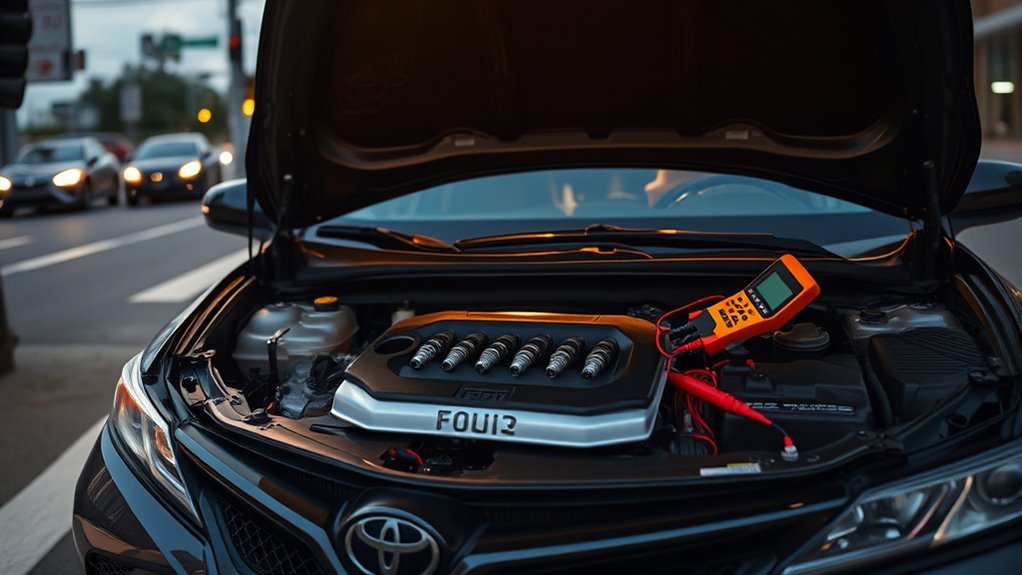
If airflow checks do not reveal the problem, use fuel trims, misfire data, and the exact stall condition to choose between fuel delivery and ignition tests. A lean condition limited mainly to idle favors unmetered air. Lean correction that appears mainly under higher load makes a restricted pump, filter, or fuel supply more suspicious. A shaking stall with rising cylinder misfire counts points toward ignition, injection, or compression.
[Products Worth Considering]

This complete ignition kit includes six direct replacement coil packs and six pre-gapped iridium spark plugs designed for select Toyota and Lexus 3.5L V6 vehicles. It can help address misfires, rough idle, hard starting, hesitation, and check engine light issues caused by worn ignition components while supporting smooth, reliable engine performance. Built for easy installation and backed by testing, warranty coverage, and technical support, it is a convenient tune-up solution.

This ignition coil pack and spark plug set is designed to restore strong spark, smoother starts, and reliable engine performance for a wide range of Toyota, Lexus, Pontiac, and Scion vehicles. Built with durable materials and engineered to meet or exceed OE standards, it helps improve combustion efficiency and long-term dependability. The kit includes four ignition coils and four spark plugs for a convenient all-in-one replacement solution.

This 4-piece automotive electrical disconnect pliers set helps safely remove stubborn push-tab connectors from mass air flow sensors, fuel injectors, and ignition coils without damaging delicate tabs. It includes straight and 60-degree angled pliers, a hose clamp plier, and a dual-ended terminal pin remover to handle a wide range of under-hood wiring tasks. Organized in a rugged storage case, it is built for mechanics and DIYers who need reliable access to tight engine bay spaces.
Fuel Pump Health
A weak pump, restricted filter or strainer, poor pump ground, failing relay, injector problem, or contaminated fuel can cause stalling. Do not diagnose the pump from sound alone. Compare commanded and actual pressure where supported, or test fuel pressure at the specified point using the procedure and specification for the exact engine.
Warning: Fuel systems can stay pressurized after the engine is off. Work only in a ventilated area, keep sparks and flames away, wear eye protection, and do not open fuel lines unless you know the correct pressure-relief procedure.
| Test | What You Want | Next Step |
|---|---|---|
| Fuel pressure | Pressure within the exact spec for your engine | If low, test pump power/ground before replacing the pump |
| Filter or strainer | No flow restriction | Replace restricted serviceable filters |
| Pump wiring | Clean terminals and stable voltage | Repair corroded connectors or weak grounds |
EVAP Purge and PCV Checks
A purge valve that is stuck open can feed too much fuel vapor into the intake at idle. Raise this test on the list when the Camry stalls or starts hard soon after refueling, fuel trims swing rich or unstable, or EVAP purge codes are present. Check the purge hose, electrical command, and whether flow continues when the valve should be closed.
A split PCV hose or intake-side PCV leak can create the opposite problem by admitting unmetered air. Inspect the hose and connections, and include them in a low-pressure smoke test. Do not clamp or disconnect emissions hoses as a permanent fix.
Automatic-Transmission or Torque-Converter Load
If the engine idles normally in Park or Neutral but repeatedly stalls as the vehicle reaches zero speed in Drive, ask for an automatic-transmission load check. A torque-converter clutch or another A/T control fault can keep excessive load on the engine during deceleration, similar to stopping a manual-transmission car without releasing the clutch. This is less common than an intake or idle-control fault, but it is an important branch when the symptom is tied precisely to road speed and gear.
Ignition Coil Condition
Weak ignition coils can cause misfires at idle, hesitation, poor acceleration, and stalling. Inspect coils for cracks, swelling, corrosion, oil contamination, and carbon tracking. Misfire codes can range from P0300 for random/multiple misfire through cylinder-specific codes such as P0301–P0306, depending on the engine.
Do not replace every coil automatically. Use live misfire counters, connector and circuit checks, plug condition, and a controlled coil swap only when the service procedure and access make it safe.
Spark Plugs & Wires
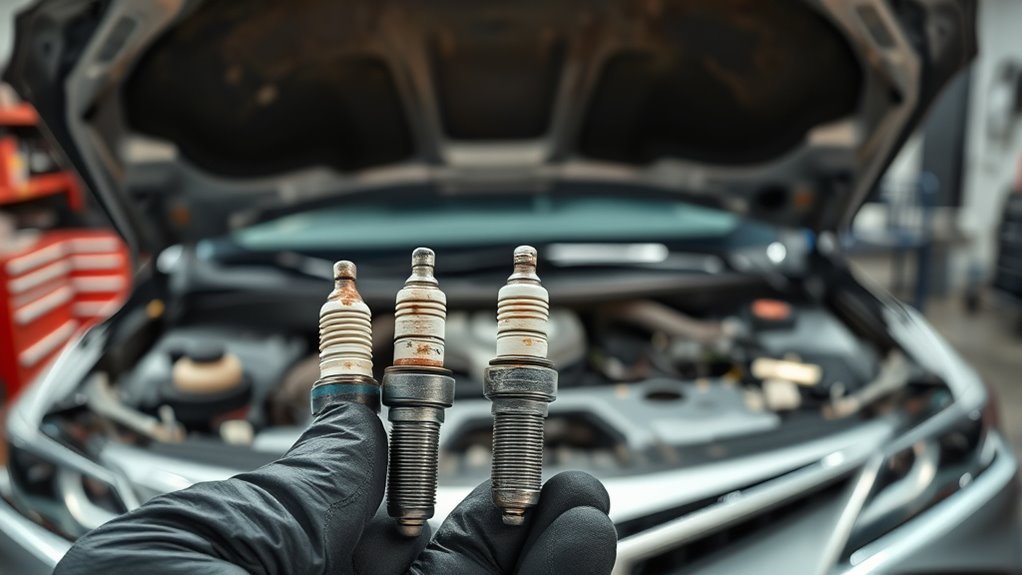
Worn spark plugs can cause rough idle, hard starts, misfires, and stalling. Toyota’s general consumer guidance says spark plugs often last around 80,000 miles, but the maintenance interval for a specific Camry can differ by engine and model year. Follow the vehicle’s maintenance guide and review Toyota’s spark-plug guidance.
Use the correct plug type and gap for your exact Camry year and engine. Many modern Camrys use coil-on-plug ignition and do not have traditional spark plug wires, while older models may still have wires that can crack, corrode, or develop high resistance.
Which Codes and Electrical Clues Matter Most?
Sensors tell the engine computer how much fuel and spark timing to use. A bad signal can make the engine stall even when the mechanical parts are fine.
| Code or Symptom | Likely Area | What to Check |
|---|---|---|
| P0101 / P0102 / P0103 | MAF sensor or intake air leak | MAF connector, intake boot, sensor contamination |
| P0171 | Lean condition | Vacuum leak, unmetered air, low fuel pressure |
| P0300–P0306 | Misfire | Spark plugs, coils, compression, injector operation |
| P0335 | Crankshaft position sensor circuit | Sensor, wiring, connector, signal dropout |
| P0340 | Camshaft position sensor circuit | Sensor, wiring, timing signal |
| P0441 or purge-flow fault | EVAP purge system | Purge valve stuck open, hose routing, wiring, purge command and flow |
| P0505 or idle-control code | Idle control system | IAC valve if equipped, throttle body, wiring, learned values |
| P1603 / P160300 on supported Toyota applications | Engine-stall history | Freeze-frame or stall-history data, fuel level, RPM drop pattern, power and signal loss |
OBD-II systems monitor emission-related components and alert the driver when a fault is detected. Learn more from the California Air Resources Board OBD program and Toyota’s Camry emission inspection and maintenance information.
Codes are a starting point, not a final diagnosis. A MAF code can come from sensor contamination, a cracked intake boot, poor wiring, or air entering after the sensor. A stall can also occur without a generic code, so save pending codes, enhanced Toyota data, freeze-frame information, and the exact RPM-drop pattern before clearing anything.
Battery, Charging System, and Grounds
Low system voltage, a loose terminal, a weak ground, or a failing charging system can interrupt sensor, throttle, fuel-pump, or ECM operation. Check terminals and main grounds, test the 12-volt battery, and verify charging behavior with the procedure for your gasoline or hybrid model.
A parasitic draw is relevant when the battery repeatedly goes dead while parked, but it is not a leading explanation for a Camry that stalls only at stops while the charging system remains healthy. Do not place a meter in series and then crank or start the vehicle.
How Can You Diagnose a Camry Stall at Home?
You can narrow the problem at home with a few careful tests. Start with evidence that does not disturb the fault, and stop when the next step requires opening a pressurized fuel system, working near moving parts, or entering a hybrid high-voltage area.
1. Record the Exact Stall Pattern
Note engine temperature, fuel level, whether the car was just refueled, selected gear, A/C status, warning lights, whether the engine shook, and whether it restarted immediately. This condition map is often more useful than a parts list.
2. Run an OBD-II Scan
Scan for stored, pending, and permanent codes. Write them down before clearing anything. Also look at freeze-frame data, fuel trims, idle RPM, coolant temperature, MAF readings, and misfire counters if your scanner supports live data.
3. Look for Intake and Vacuum Leaks
A smoke test is the cleanest way to find hidden leaks. Pay close attention to the intake boot, vacuum hoses, brake booster hose, PCV hose, and gasket areas. If you use any spray or mist method, keep it away from hot exhaust parts and electrical connectors, and never use flammable sprays around ignition sources.
4. Test Throttle and Idle Response
From the driver’s seat, watch warm idle RPM in Park and then with the brake firmly applied in Drive. Switch the A/C on and off once. If RPM drops sharply or the engine stalls as load is added, focus on idle control, throttle deposits, intake leaks, charging voltage, and excessive A/T or accessory load. Do not perform this check if the vehicle may move unexpectedly.
5. Check Electrical Health
Measure 12-volt battery and charging-system behavior using the correct procedure for the powertrain. Inspect grounds and main cables for looseness, corrosion, heat damage, or voltage drop. Do not assume one universal running-voltage number applies to every hybrid and conventional Camry charging strategy.
Check for Recalls and Service Information
Before paying for a major repair, check whether your Camry has an open recall or service campaign. Use the VIN lookup at NHTSA.gov/recalls, then check Toyota’s owner resources or ask a Toyota dealer to review your VIN.
A recall is not the most common reason for a stall, but it is worth checking because safety recalls are tied to specific VINs and are handled through the manufacturer process. NHTSA also lets owners report safety problems if they believe a defect may exist.
When to See a Mechanic: What to Ask, Costs, Dealer vs Independent

If basic checks do not find the cause, get a professional diagnosis before replacing parts. A good shop can test fuel pressure, smoke-test the intake, command idle-control components with a scan tool, inspect live sensor data, and verify crank/cam signals.
A written diagnostic plan is better than a parts list. Ask the shop what tests will confirm the failure before authorizing repairs.
- Ask what tests they will run. Good answers include scan data, smoke test, fuel-pressure test, charging-system test, and circuit checks.
- Ask for the exact codes and freeze-frame data. This helps separate real faults from guesses.
- Ask for a written estimate. The FTC’s Auto Repair Basics recommends comparing shops and understanding the work before authorizing it.
- Ask whether diagnosis applies to your exact model year and engine. Camry idle-control, ignition, and hybrid systems differ by generation.
- Choose the right shop. A dealer may be best for software updates, warranty concerns, hybrid-system issues, or VIN-specific campaigns. A trusted independent shop may be more cost-effective for intake leaks, ignition, fuel-pressure testing, and routine repairs.
Ask the shop for its diagnostic rate, what tests are included, and whether any part of that fee applies to the approved repair. For a stop-only stall, the written plan should explain how the shop will separate an intake/idle fault from EVAP purge, ignition, fuel delivery, crank/cam signal, charging, and automatic-transmission load.
Preventive Maintenance and Routine Checks to Avoid Future Stalls
Prevention is mostly about keeping air, fuel, spark, and voltage stable. Follow the maintenance schedule for your Camry’s year and engine. Toyota’s owner information says scheduled maintenance should be performed at the specified intervals in the maintenance guide, and general problems should be brought to a Toyota dealer or qualified service shop for advice.
Use this simple routine:
- Inspect the air filter housing, intake tube, clamps, PCV hose, and visible vacuum lines during routine service.
- Clean the throttle body only when deposits are visible or diagnosis supports restricted idle airflow.
- Use the correct spark plugs and replace them at the scheduled interval.
- Keep battery terminals clean and tight.
- Scan the car when the check-engine light appears instead of clearing codes blindly.
- Record mileage, codes, symptoms, weather, fuel level, and repairs so patterns are easier to spot.
You can find Toyota owner manuals and maintenance information through Toyota’s manuals and warranties portal.
Frequently Asked Questions
What causes a Toyota Camry to stall when coming to a stop?
Common causes include throttle-body deposits, an idle-control fault, an intake or PCV leak, EVAP purge flow, MAF or other sensor errors, misfires, injector or fuel-supply problems, crank/cam signal loss, low voltage, and excessive automatic-transmission load. The stall pattern and scan data determine which branch to test first.
How do I diagnose a Camry stalling problem at home?
Record when and how it stalls, save stored and pending codes plus freeze-frame data, inspect the intake and PCV hoses, check visible throttle deposits, review fuel trims and misfire data, and test the 12-volt electrical system. Leave pressurized fuel, advanced circuit, transmission, and hybrid high-voltage tests to a qualified technician.
Can a dirty throttle body make a Camry stall at stops?
Yes. Deposits around the bore and throttle plate can reduce or distort idle airflow. Clean only when deposits are present, avoid forcing an electronic plate against resistance, recheck every intake connection, and use the model-specific learned-value or idle-learning procedure when required.
Why does my Camry stall after the battery was disconnected?
The timing suggests a disturbed intake connection, low battery voltage, throttle deposits that no longer match learned airflow, or an idle-learning requirement. Recheck the air duct, clamps, MAF connector, vacuum hoses, and battery condition before assuming the throttle body failed.
Why does my Camry stall after refueling?
A repeatable after-refueling stall raises suspicion of an EVAP purge valve stuck open, a purge-control or hose fault, excessive vapor from topping off, or contaminated fuel. Save EVAP codes and fuel-trim data and have purge flow tested rather than replacing the valve from the symptom alone.
Can a transmission problem make a Camry stall when stopping?
Yes, although it is less common than an airflow or idle-control fault. If the engine idles normally in Park or Neutral but stalls as road speed reaches zero in Drive, a shop should evaluate automatic-transmission load and torque-converter clutch operation with transmission-capable scan data.
Can bad spark plugs cause stalling at idle?
Yes. Worn, fouled, damaged, or incorrect spark plugs can cause misfires, rough idle, hard starts, and stalling. Use the plug type, gap, torque, and service interval specified for the exact Camry engine instead of applying a universal mileage or gap.
Is a Camry Hybrid stalling when its gasoline engine stops at a light?
Usually not. The gasoline engine can stop normally while the hybrid system remains operational. Check the READY indicator: if it stays on, propulsion remains available, and no warning appears, the stop may be normal. Loss of READY, propulsion, or a warning message requires diagnosis.
Is it safe to keep driving if my Camry stalls at red lights?
No when it repeats, happens in traffic, or comes with a flashing check-engine light, fuel smell, smoke, overheating, steering or brake-assist loss, or a difficult restart. Move out of traffic if possible and arrange diagnosis or towing before normal driving continues.
Conclusion
If your Camry stalls at stops, preserve the evidence first: record the exact condition, save codes and freeze-frame data, then inspect the intake, PCV and vacuum hoses, throttle body, purge system, ignition, fuel trims, charging system, and relevant sensor signals. Add automatic-transmission load to the plan when it stalls only as road speed reaches zero. The correct fix comes from reproducing and measuring the fault, not swapping parts. Repeated or unsafe stalling requires professional diagnosis.
Sources
- Toyota Technical Information System — official source for Toyota repair manuals, wiring diagrams, service bulletins, and model-specific diagnostics.
- Toyota Camry Owner’s Manual: Emission Inspection and Maintenance Programs — supports OBD/MIL guidance.
- Toyota Camry Owner’s Manual: Maintenance Requirements — supports following the model-specific maintenance schedule.
- Toyota Camry Owner’s Manual: General Maintenance — supports professional inspection when a problem is noticed.
- Toyota: How Often To Change Spark Plugs — supports the general lifespan statement and the need to follow vehicle-specific guidance.
- Toyota USA Newsroom: Not All Hybrids Created Equal — supports normal gasoline-engine stop/start behavior in Toyota full hybrids.
- California Air Resources Board: On-Board Diagnostic Program — supports the OBD system explanation.
- NHTSA Recall Lookup — supports VIN-based recall checking and safety-problem reporting.
- FTC: Auto Repair Basics — supports written estimates, shop comparison, and informed repair authorization.