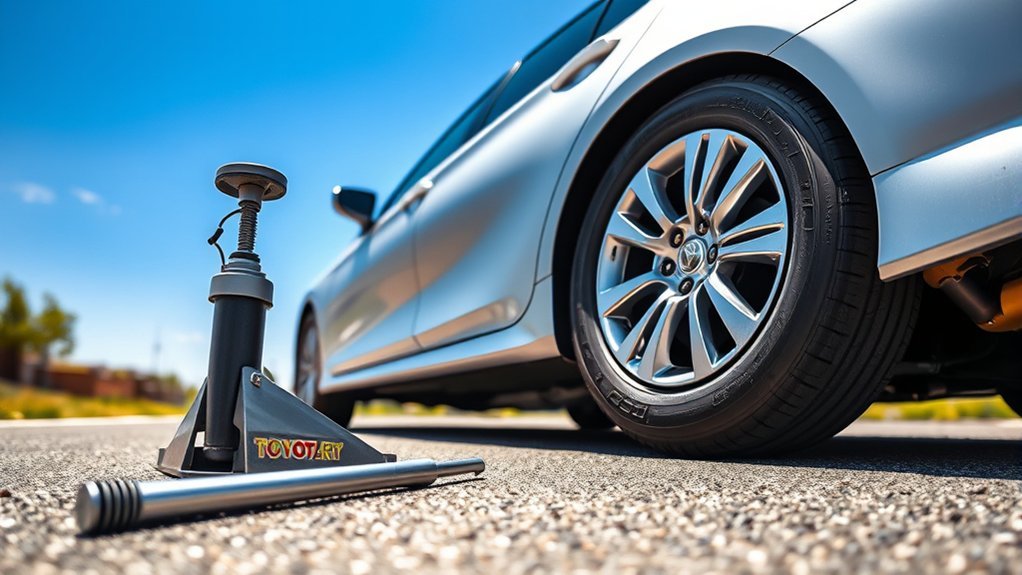
A flat tire on your Toyota Camry is stressful, but the job is manageable if you slow down, choose a safe spot, and use the spare tire and jack correctly. This guide applies to Toyota Camry models that are equipped with a spare tire. Some vehicles may have a repair kit instead, so always confirm what is in your trunk before you need it.
Quick Answer
To change a flat tire on a Toyota Camry, park on a hard, flat surface, set the parking brake, turn on the hazard lights, loosen the wheel nuts, lift the car at the correct jacking point, install the spare tire, tighten the nuts in a crisscross pattern, and drive carefully to a tire shop.
Key Takeaways
- Do not keep driving on a flat tire; pull over only when it is safe to do so.
- Loosen the wheel nuts before raising the Camry, then tighten them fully after the car is back on the ground.
- Use only the Toyota-approved jacking points shown in your owner’s manual.
- A compact spare is temporary. Keep your speed low and go directly to a repair facility.
- Check your spare tire pressure regularly so it is ready before an emergency.
At a Glance
| Time Required | 20–40 minutes |
| Difficulty | Moderate beginner task |
| Tools Needed | Spare tire, jack, wheel-nut wrench, jack handle, wheel-lock key or adapter socket if equipped, tire pressure gauge, wheel chocks if available |
| Cost | $0 if your spare and tools are already in the vehicle; repair or replacement cost depends on tire damage |
What Tools You Need to Change a Flat Tire
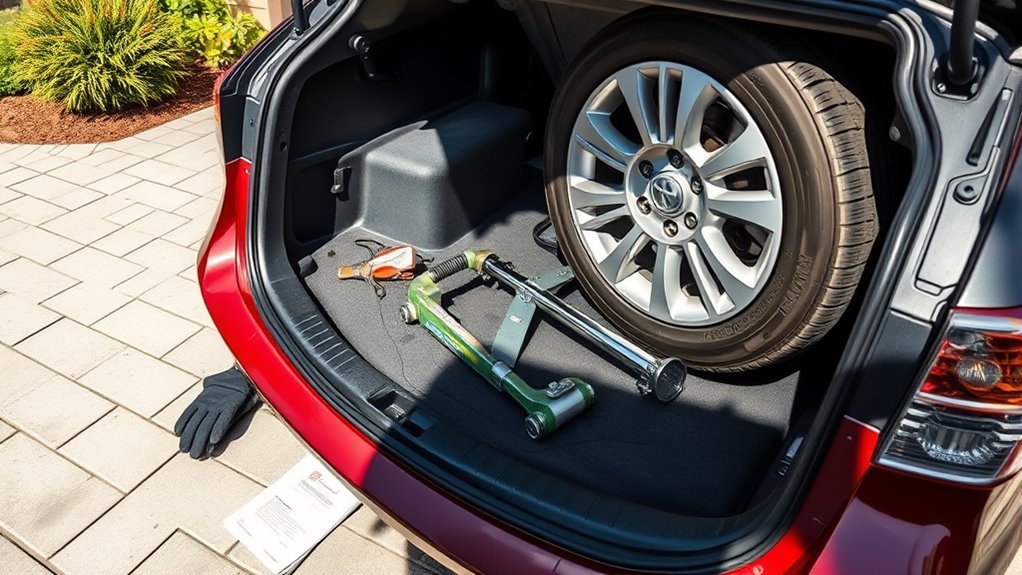
To change a flat tire on your Toyota Camry, start by gathering the tools stored in or near the trunk floor compartment. Most Camry models with a spare include a jack, jack handle, wheel-nut wrench, and spare tire. If your wheels use locking lug nuts, you will also need the wheel-lock key or adapter socket.
It is also smart to keep a few extra emergency items in the car: gloves, a flashlight, reflective triangles or flares, a tire pressure gauge, and wheel chocks. These are not always included with the car, but they make the job safer and easier.
Note: If your Camry does not have a spare tire, check the trunk for a tire repair kit or inflator. Follow the instructions in that kit and call roadside assistance if the tire has sidewall damage, a large puncture, or will not hold air.
Before You Start: Safety Checklist
Safety matters more than speed. Toyota’s owner guidance for a flat tire starts with getting the vehicle stopped in a safe place on a hard, flat surface, setting the parking brake, shifting to Park, turning off the vehicle, and switching on the emergency flashers. You can review Toyota’s current owner-manual guidance at Toyota Owners.
Warning: Do not change a tire on a narrow shoulder, soft ground, a steep slope, or anywhere traffic puts you at risk. Turn on your hazard lights, stay clear of traffic, and call roadside assistance if the location is unsafe.
Before lifting the car, place wheel chocks in front of and behind the tire diagonally opposite the flat tire if you have them. For example, if the front left tire is flat, chock the rear right tire. This helps reduce vehicle movement while the Camry is on the jack.
How to Access Your Spare Tire and Tools
To access your spare tire and tools in a Toyota Camry, open the trunk fully and lift the trunk floor cover. The spare tire is usually under the floor panel, and the jack and tool set are stored nearby. Exact placement can vary by model year, so check your owner’s manual if the layout looks different.
Locate Tools Efficiently
Lift the trunk floor cover and look for the spare tire, jack handle, wheel-nut wrench, and any adapter socket or wheel-lock key. Keep these pieces together while you work so nothing rolls under the car or gets left behind.
| Tool | Typical Location |
|---|---|
| Spare Tire | Under the trunk floor panel |
| Jack Handle | Beneath or beside the trunk floor cover |
| Wheel-Nut Wrench | Stored with the jack tools |
| Adapter Socket or Wheel-Lock Key | In the tool compartment, glove box, or with the wheel-lock kit if equipped |
| Jack | In the trunk-side storage area or near the spare tire compartment |
Open Trunk Properly
Open the trunk lid fully so it does not fall while you are reaching into the cargo area. Remove loose cargo from the trunk floor. Then lift the floor cover and set it aside or secure it so you can reach the spare and tools without bending or twisting awkwardly.
Remove Spare Tire Cover
If a retainer bolt or spare tire cover holds the spare in place, loosen it by hand or with the appropriate tool. Remove any spacer carefully, then lift the spare tire out of the well. Before installing it, check the sidewall for cracks, bulges, or obvious damage. If the spare looks unsafe or is flat, call for help instead of driving on it.
Step-by-Step Guide to Changing a Flat Tire
Follow these steps in order. The key is to loosen the wheel nuts while the flat tire is still touching the ground, raise the vehicle only at the correct jacking point, then tighten the spare securely before driving.
- Park safely. Move to a safe, hard, flat surface. Shift to Park, set the parking brake, turn off the engine or hybrid system, and turn on the emergency flashers.
- Get the spare and tools. Remove the spare tire, jack, jack handle, and wheel-nut wrench from the trunk.
- Chock the opposite wheel. If you have wheel chocks, place them at the tire diagonally opposite the flat.
- Loosen the wheel nuts. Place the wrench on each wheel nut and turn counterclockwise. Loosen each nut about one turn, but do not remove the nuts yet.
- Position the jack. Find the Toyota-approved jacking point near the flat tire. Use the reinforced notch or jacking area shown in your owner’s manual.
- Raise the Camry. Crank the jack slowly until the flat tire is just off the ground. Do not put any part of your body under the vehicle while it is supported only by the jack.
- Remove the flat tire. Remove the wheel nuts the rest of the way and place them somewhere clean. Pull the flat tire straight off the wheel studs.
- Install the spare tire. Line up the spare with the wheel studs and slide it on fully. Hand-thread each wheel nut to avoid cross-threading.
- Snug the wheel nuts. Use the wrench to tighten the nuts lightly in a crisscross pattern while the car is still raised.
- Lower the vehicle. Lower the Camry until the spare tire touches the ground and the vehicle is stable, then fully lower it.
- Final-tighten the nuts. Tighten the wheel nuts in a crisscross pattern. If you have a torque wrench, use the torque specification in your owner’s manual. Many Camry manuals list 76 ft-lb (103 N·m), but confirm the correct spec for your exact year and trim.
- Store everything. Put the flat tire, jack, wrench, and trunk parts back securely before driving.
Pro Tip: Push down on the wheel-nut wrench with steady body weight instead of jerking it. If a nut will not loosen, stop and call for help rather than risking injury or damaging the wheel studs.
Using the Jack Safely
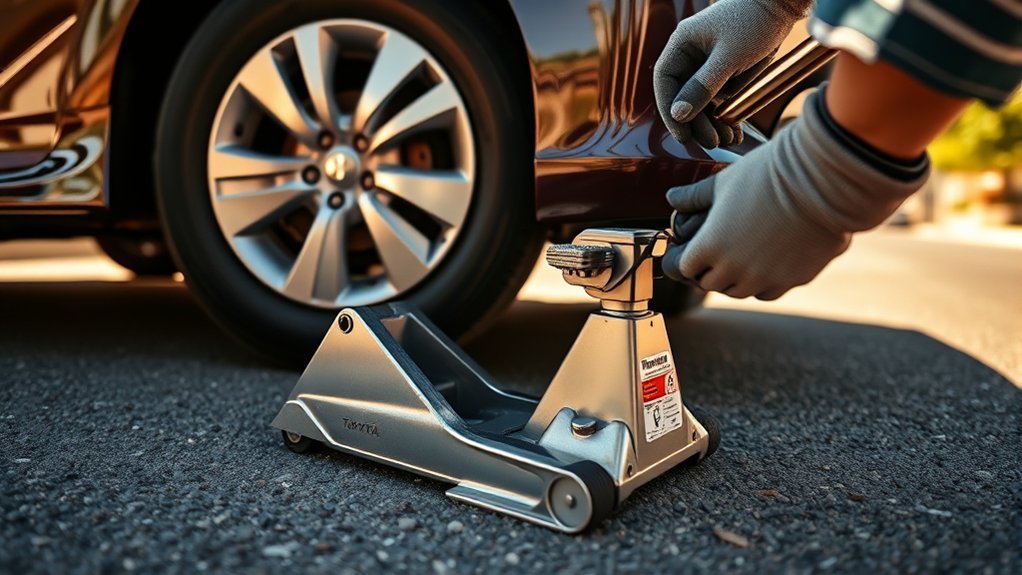
The jack is designed to lift the vehicle only long enough to change the tire. It is not a support stand, and it should never be used on soft dirt, gravel, a slope, or an uneven shoulder.
Place the jack under the proper jacking point near the flat tire. Toyota marks the correct lift areas along the lower body pinch welds, but the exact shape and location can vary by model year. If you cannot identify the correct point, use the owner’s manual or call roadside assistance.
Raise the vehicle slowly. Stop as soon as the flat tire clears the ground enough to remove it. Lifting the car higher than needed makes the setup less stable.
Warning: Never crawl under the Camry while it is held up only by the emergency jack. If anything shifts, the vehicle can fall without warning.
Installing the Spare Tire: Tips for a Secure Fit
When you install the spare tire, make sure it sits flat against the wheel hub. Dirt, rust flakes, or a crooked wheel can keep the spare from seating correctly.
- Check the spare’s condition. Look for cracks, bulges, exposed cords, or severe aging before mounting it.
- Line up the wheel holes. Slide the spare straight onto the wheel studs without forcing it.
- Start all nuts by hand. Hand-threading reduces the risk of cross-threading.
- Use a crisscross pattern. Tighten one nut, then the nut across from it, moving around the wheel evenly.
- Torque after lowering. The final tightening should happen when the tire is on the ground and cannot spin.
A spare tire is a temporary way to get out of danger and reach service. It is not a replacement for repairing or replacing the damaged tire.
Lowering Your Vehicle and Checking the Spare
After the spare is mounted and the wheel nuts are snug, lower the vehicle slowly until the tire touches the ground. Tighten the wheel nuts in a crisscross pattern, then lower the jack completely and remove it.
Before driving, check the spare tire pressure if you have a gauge. The correct pressure is listed on your Camry’s Tire and Loading Information label or in the owner’s manual. NHTSA advises drivers to check all tires, including the spare, when the tires are cold and to use the manufacturer’s recommended pressure rather than the number molded on the tire sidewall. You can review this guidance on NHTSA’s TireWise tire safety page.
If the spare is visibly low, damaged, or too old to trust, do not drive on it. Call roadside assistance or arrange a tow.
Driving on a Compact Spare Tire
Most compact spares are smaller and less durable than a regular tire. They change the way the vehicle handles, brakes, and rides. Keep your speed low, avoid hard braking and sharp turns, and drive directly to a tire repair shop.
AAA advises that temporary spares are not permanent replacements and that drivers should generally stay at or below 50 mph and limit driving to 50 miles or less. Federal rules for certain spare tire assemblies also require temporary-use and 50 mph labeling. For more details, see AAA’s spare tire guidance and 49 CFR 571.110.
Note: If your Camry has all-wheel drive, mismatched tire size can be especially hard on the drivetrain. Use the compact spare only as directed in your owner’s manual and replace the damaged tire as soon as possible.
Repair, Replace, or Dispose of Your Flat Tire Responsibly
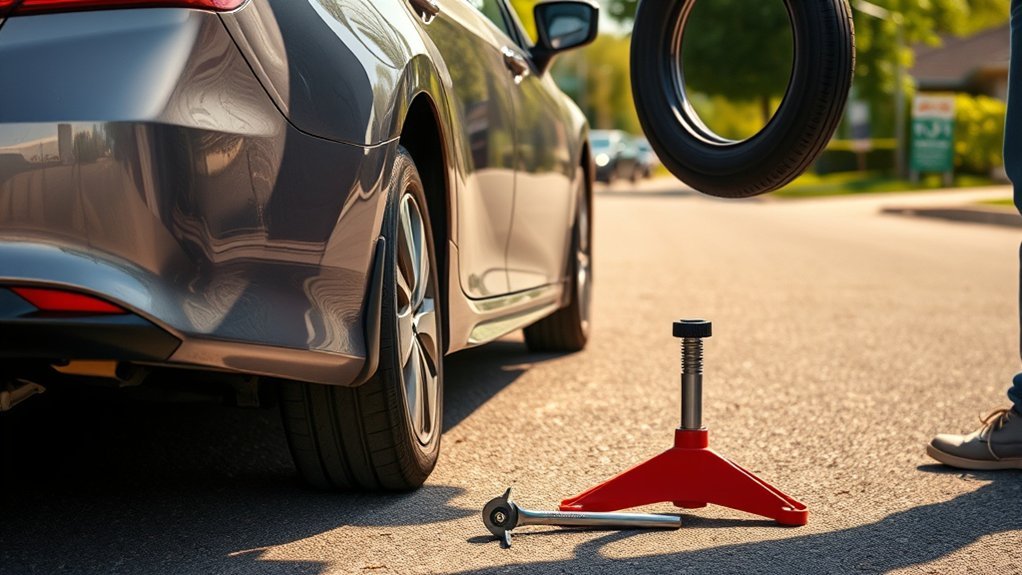
Not every flat tire needs to be thrown away. A tire shop may be able to repair a small puncture in the tread area if the tire was not driven on while flat and the sidewall is not damaged. If the tire is shredded, cracked, sidewall-damaged, or worn out, it should be replaced and recycled properly.
Recycling Options Available
Many tire retailers accept old tires when you buy a replacement. Some communities also offer tire collection events or recycling drop-off locations. The U.S. Environmental Protection Agency says surplus tires may be returned to a tire retailer or a local recycling facility that accepts tires, but you should confirm quantity limits and local rules first. See the EPA’s scrap tire recycling FAQ for more disposal options.
Local Disposal Regulations
Do not place a used tire in regular household trash unless your local waste authority specifically allows it. Tire disposal rules vary by city and state, and some areas charge a small disposal fee. When in doubt, call your local solid waste office, recycling center, or tire retailer.
How to Keep Your Spare Tire in Top Shape
Your spare tire is only useful if it has air, is not damaged, and can be safely installed. Add it to your normal maintenance routine instead of waiting until a roadside emergency.
- Check pressure monthly. Use a tire pressure gauge when the spare is cold. Follow the pressure listed on the vehicle placard or in the owner’s manual.
- Inspect for aging. Look for sidewall cracks, bulges, tread separation, or dry rubber.
- Check the DOT date code. NHTSA notes that some vehicle and tire manufacturers recommend replacing tires that are six to 10 years old, regardless of tread wear.
- Keep the tools complete. Make sure the jack, handle, wrench, and wheel-lock key are in the vehicle.
- Do not rotate a compact spare into regular use. Only a full-size matching spare may be rotated into service if your owner’s manual and tire shop say it is appropriate.
How to Prevent Flat Tires in the Future
You cannot prevent every nail or pothole, but basic tire care reduces the odds of a roadside problem. Check tire pressure monthly, inspect tread depth, rotate tires on the schedule in your owner’s manual, and replace tires that are worn, cracked, or repeatedly losing air.
Pay attention to the tire pressure warning light. It is a warning system, not a replacement for regular checks with a gauge. If the light comes on repeatedly after inflation, have the tire inspected for a slow leak.
Practicing Your Tire-Changing Skills
The best time to learn your Camry’s spare tire setup is in your driveway during the day, not at night on the shoulder of a busy road. Open the trunk, locate the spare, identify the jack points, and practice fitting the jack without lifting the car.
You do not need to remove a wheel during practice. The goal is to know where everything is, how the jack handle fits, and where the owner’s manual shows the lift points. After practice, return every tool to its storage location so the kit is complete for an emergency.
Roadside Assistance Tips
Call roadside assistance if you feel unsafe, cannot loosen the wheel nuts, cannot find the jack point, the spare is flat, or traffic is too close. It is also better to call for help if the vehicle is on soft ground, the shoulder is narrow, or the weather makes the job risky.
When to Call for Help
Stay inside the vehicle with your seat belt on if you are stopped near moving traffic and it is safer than standing outside. Turn on your hazard lights and give the roadside assistance operator your exact location, direction of travel, vehicle description, and which tire is flat.
Essential Emergency Kit Items
A good emergency kit for your Toyota Camry should include a flashlight, reflective warning triangle or flares, gloves, a tire pressure gauge, a first-aid kit, water, a phone charger, and basic hand wipes. These small items can make a tire change safer and less frustrating.
Frequently Asked Questions
How do I know if my spare tire is safe to use?
Check the spare for proper air pressure, visible cracks, bulges, exposed cords, and severe age-related wear. If it is flat, damaged, or too old to trust, do not drive on it. Use roadside assistance instead.
Can I drive on a spare tire long-term?
No. A compact spare is for temporary emergency use only. Drive carefully and go directly to a tire shop. A full-size matching spare may be usable longer, but only if it matches the other tires and your owner’s manual allows it.
How fast can I drive on a Toyota Camry compact spare?
Follow the warning on the spare tire and your owner’s manual. Most temporary spares should be kept at 50 mph or less and used only long enough to reach a repair facility.
What if my jack fails while lifting the car?
Move away from the vehicle immediately and do not try to catch or stabilize it. If the jack slips, the ground is unstable, or the car shifts, stop the job and call roadside assistance.
Are there different types of spare tires?
Yes. Common types include compact temporary spares, full-size matching spares, full-size non-matching spares, and repair kits with sealant or an inflator. Your Camry’s trunk setup depends on model year, trim, and equipment.
How can I prevent flat tires in the future?
Check tire pressure monthly, inspect tread and sidewalls, rotate tires on schedule, avoid road debris when possible, and replace tires that are worn or repeatedly losing air.
Conclusion
Changing a flat tire on a Toyota Camry comes down to safe setup, correct jack placement, even wheel-nut tightening, and careful driving afterward. If the location is unsafe, the spare is damaged, or you are unsure about any step, call roadside assistance. A compact spare can get you moving again, but it is only a short-term solution until the damaged tire is repaired or replaced.
Sources
- Toyota Owners — 2025 Camry Hybrid: If You Have a Flat Tire — backs up Toyota-specific emergency steps and flat-tire procedure.
- NHTSA TireWise — backs up tire pressure, tread, TPMS, and tire aging guidance.
- AAA Club Alliance — How Far Can You Really Drive on a Spare Tire? — backs up compact spare speed and distance limits.
- 49 CFR 571.110 — backs up federal spare tire labeling requirements for temporary-use and 50 mph warnings.
- U.S. EPA Scrap Tire FAQ — backs up responsible tire recycling and disposal options.