You’ll find the Camry hybrid battery is a modular, series‑wired high‑voltage pack (200+ V) built from Li‑ion or NiMH subassemblies, with robust bus bars and insulated connectors delivering torque assist and regenerative capture. A junction block houses relays, pre‑charge resistors and diagnostics; the hybrid computer monitors individual cell voltages, limits output on faults and logs events. Dedicated fans, sensors and air channels manage temperature to prevent degradation. Continue for component‑level details and maintenance guidance.
What the Camry Hybrid Battery Is and Why It Matters
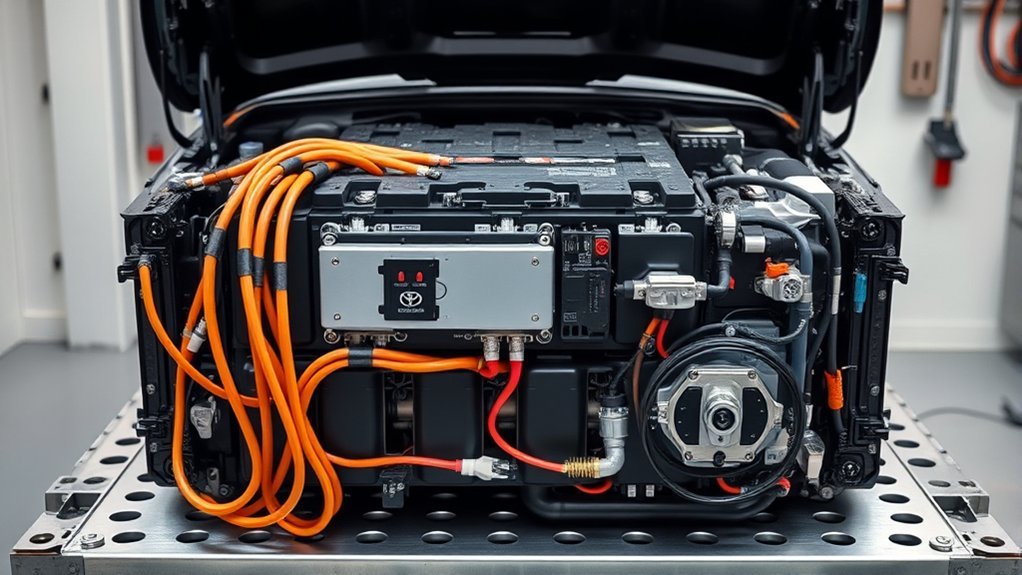
Think of the Camry Hybrid battery as the high-voltage core of the hybrid system: a typically lithium-ion pack delivering over 200 volts through many small cells wired in series to maximize energy density and compactness. You rely on this pack to start the vehicle, power the inverter, and shift primary load away from the 12-volt system once active. Its architecture prioritizes hybrid efficiency by optimizing voltage and cell count for torque assist and regenerative capture. Temperature management is integral: a dedicated cooling fan plus sensors modulate airflow to keep cells within narrow thermal windows, directly affecting battery longevity and real-world performance. The vehicle’s control unit continuously monitors individual cell voltages; deviations beyond thresholds produce diagnostic codes so you can intervene before failure. Treat the battery as a controllable subsystem—maintain proper thermal pathways, heed warnings promptly, and you’ll preserve both efficiency and freedom from unexpected downtime.
Camry Hybrid Battery Pack Construction: Modules, Wiring & Junction Block
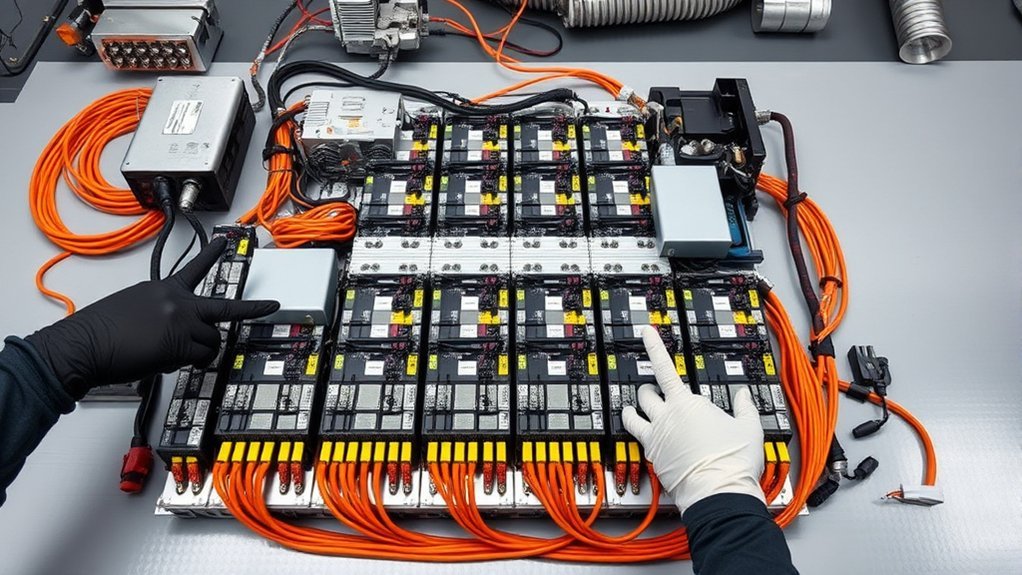
The Camry Hybrid’s battery pack is a modular, series-wired assembly that delivers the pack-level voltage and provides built-in safety and thermal management. You’ll see that module design uses discrete subassemblies of cells wired in series to reach pack voltages typically above 200 V. This modular approach makes replacement, diagnostics, and scaling predictable and efficient.
Wiring configurations inside the pack include robust high-voltage bus bars, insulated connectors, and routed harnesses that minimize resistance and heat concentration. You’ll rely on the junction block as the centralized node: it houses key relays and pre-charge resistors that limit inrush current and protect components during connection events. Air channels between modules provide continuous cooling, maintaining cell temperature uniformity and preserving capacity under load.
The system-focused layout prioritizes safety, serviceability, and performance. You can trace power flow and identify failure points quickly because the module design and wiring configurations follow repeatable, documented patterns for liberation-minded maintenance and confident operation.
Electrical Controls for the Camry Hybrid Battery: Computer, Relays & Safety Circuits
Because the hybrid computer coordinates high-voltage distribution, relays, and diagnostic checks, you’ll see the Camry Hybrid’s electrical control system act as the pack’s active safety and performance manager. You rely on the computer to monitor individual cell voltages, trigger warning codes for anomalies, and command relay activation sequences that connect or isolate the pack. During start-up the system main relays are activated to run safety checks, including insulation verification of high-voltage wiring to prevent arcing and shock hazards. Safety circuits incorporate a service plug and mechanical disconnects so you can de-energize the battery for maintenance, though residual voltage precautions remain necessary. The computer logs faults, limits pack output when discrepancies exceed thresholds, and coordinates with vehicle systems to maintain drivability. You get closed-loop control: voltage monitoring, fault detection, and controlled relay activation drive predictable responses. This architecture frees you from uncertainty by prioritizing safe, measurable operation and controlled intervention when the pack deviates from spec.
Thermal Management: Fans, Sensors, Airflow & Cooling Strategy
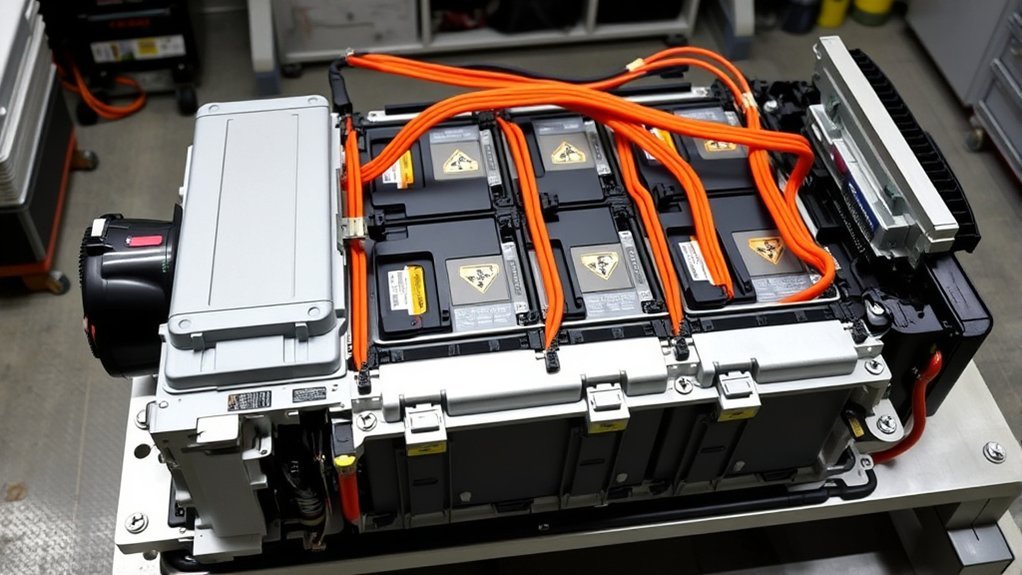
When temperatures rise inside the pack, the Camry Hybrid’s dedicated cooling fan and distributed temperature sensors work together to preserve cell performance and longevity: sensors feed real-time data to the control logic, which steps fan speed up or down and routes cooler cabin air while exhausting hot air to maintain the target temperature band. You’ll rely on precise temperature sensors placed through the module stack; they report gradients so control logic can modulate fan efficiency versus noise and power draw. The fan circulates conditioned air across cells; airflow paths and an exhaust outlet remove heat continuously. A junction block with relays and a pre-charge resistor integrates cooling commands with electrical safety, preventing inrush and enabling coordinated shutdowns under fault conditions. This strategy minimizes hot spots, reduces capacity fade, and deters thermal runaway by increasing airflow as sensors detect rises. You get deterministic thermal behavior: measured inputs, controlled actuation, and predictable battery life outcomes that support independent mobility and reduced dependency.
Battery Types: Li‑Ion vs NiMH – Pros, Trade‑Offs & Toyota’s Choice
Managing pack temperature directly affects which battery chemistry Toyota selects for a hybrid—thermal behavior, packaging, and lifecycle performance shape the choice between Li‑ion and NiMH. You’ll see Toyota favor Li‑ion where weight, compactness, and higher energy efficiency improve system performance; Li‑ion runs at higher voltages (often >200 V), uses many small cells in series, and supports two‑stack layouts that boost power density and extend battery lifespan. NiMH remains in platforms prioritizing proven reliability and tolerance to varied thermal conditions despite lower energy density and greater mass.
- Li‑ion: lighter, higher energy efficiency, longer battery lifespan, compact packaging for newer models.
- NiMH: heavier, bulkier, robust in early designs, tolerant to abuse with established field data.
- Toyota’s trade‑off: choose chemistry by system constraints—safety margins, thermal control capability, packaging, and lifecycle targets—so you get optimized performance without unnecessary risk.
Signs of Failure, Owner Maintenance Tips, and Safe Service Practices
If you monitor your Camry’s hybrid system proactively, you’ll catch early failure signs like service messages (e.g., “replace hybrid battery pack”), unusual state-of-charge swings, or cell voltage imbalances exceeding roughly 0.1–0.3 V between modules. Those failure indicators correlate with diminished pack capacity and can precede full malfunction. Monitor voltages and state-of-charge trends regularly; log values and compare modules to detect drift.
For maintenance practices, keep the pack charged during long storage to prevent cell voltage collapse. Use only specialized hybrid battery chargers—ordinary chargers can damage cells and void protections. When servicing, disconnect the service plug to reduce risk, but acknowledge residual high‑voltage exposure remains; use insulated tools, HV-rated PPE, and follow Toyota procedures or qualified technicians. Avoid DIY high-voltage disassembly unless trained. These steps let you retain control of system health, minimize failure probability, and sustain the freedom to operate your vehicle reliably.
Frequently Asked Questions
What Are the Components of a Hybrid Battery?
You get cells, cell stacks, battery types (NiMH or lithium‑ion), cooling fan and sensors, a junction block with relays and pre‑charge resistor, and an energy management system that monitors, balances, and controls power flow for efficient autonomy.
How Does the Toyota Camry Hybrid Battery Work?
You get about 44 mpg overall while the battery manages energy: it stores regenerative braking energy, supplies the inverter for propulsion, monitors cell voltages for battery efficiency, and cools cells to preserve performance and autonomy.
Does the Toyota Camry Hybrid Have Two Batteries?
Yes—you’ve got two battery types: a high‑voltage pack (NiMH or Li‑ion) for propulsion and a 12‑volt for auxiliaries. This dual system delivers hybrid advantages: efficiency, regenerative energy use, and reliable electrical subsystem support.
Conclusion
You now know how the Camry Hybrid battery’s modules, wiring, controls and cooling work together—and why Toyota picked its chemistry for real-world tradeoffs. When components fail, symptoms and safe service steps point the way to diagnosis and repair. Treat the pack like a precision system: inspect connections, monitor temps and error codes, and follow isolation procedures. Like two synchronized fans pushing the same airflow, electrical and thermal systems must match to keep range, performance and safety intact.