A Toyota Camry radiator can last a long time, but it is not a lifetime part. Mileage, age, coolant condition, heat cycles, road salt, collision damage, and plastic-tank wear all matter. The safest way to judge radiator health is to watch for leaks, overheating, coolant loss, corrosion, and changes in coolant color before a small cooling-system problem becomes engine damage.
Quick Answer
A Toyota Camry radiator often lasts beyond 100,000 miles and can last 10–15+ years, with some lasting 20 years or more. Toyota does not publish a fixed radiator replacement interval, so coolant service, leak checks, corrosion checks, and prompt overheating diagnosis matter more than mileage alone.
Key Takeaways
- A Camry radiator does not have a universal replacement mileage; replace it when it leaks, clogs, corrodes, cracks, or cannot control temperature.
- For recent Camry models, Toyota lists initial engine/intercooler coolant replacement at 100,000 miles or 120 months, then every 50,000 miles or 60 months after that.
- Never open the radiator cap or coolant reservoir when the engine is hot. Pressurized coolant can cause severe burns.
- Bright puddles, white or pink crust, sweet antifreeze odor, rusty coolant, repeated coolant loss, steam, or a temperature warning all need quick attention.
- Radiator replacement cost varies by year and shop, but current Toyota Camry estimates commonly land around the high hundreds to low thousands.
How Long Does a Toyota Camry Radiator Usually Last?
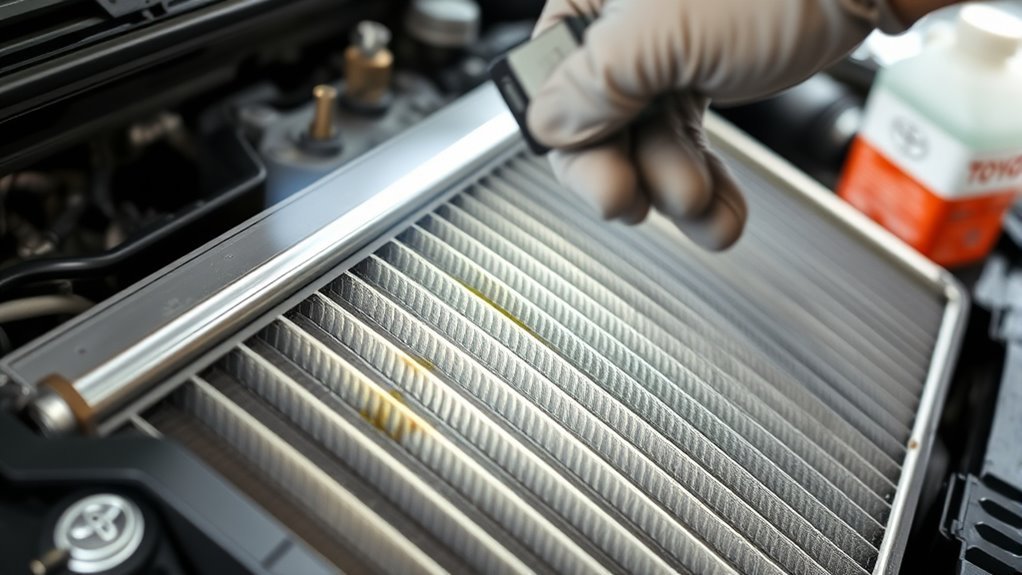
A well-maintained Toyota Camry radiator often lasts well past 100,000 miles. In years, many last 10–15+ years, and some original radiators make it much longer. Still, “25 years” should be treated as possible, not guaranteed. Radiators fail earlier when coolant is neglected, the plastic end tanks become brittle, the core corrodes, road debris damages the fins, or repeated overheating stresses the system.
Toyota’s maintenance schedule is built around inspection and coolant service rather than a fixed radiator replacement date. In the 2025 Toyota Camry Warranty and Maintenance Guide, Toyota lists initial engine/intercooler coolant replacement at 100,000 miles or 120 months, then every 50,000 miles or 60 months after that. Older Camry model years can differ, so always check your exact owner’s manual or maintenance guide.
Note: Some newer Camry models, especially hybrid models, may have more than one cooling circuit. Check the engine coolant and any inverter/intercooler coolant guidance for your specific model year.
Top Warning Signs Your Camry Radiator Is Failing
Radiator problems usually show up as heat, leaks, smell, residue, or coolant changes. Do not wait for a complete failure. A small coolant leak can turn into overheating quickly, especially in traffic or hot weather.
Warning: Never remove the radiator cap or coolant reservoir cap when the engine is hot. Let the engine cool completely first. Hot pressurized coolant can spray out and cause serious burns.
[Products Worth Considering]

Ensure accurate engine cooling with Toyota's genuine water temperature sensor, designed for precise coolant monitoring and reliable performance. This OEM part fits seamlessly into your vehicle, offering durability and consistent temperature readings for optimal engine health.
This genuine Toyota fuel tank cap assembly ensures a perfect fit for your vehicle, delivering reliable sealing and protection against fuel leaks. It meets OEM specifications, offering Toyota‑quality assurance and a manufacturer warranty for peace of mind. Ideal for drivers seeking authentic parts that maintain performance and safety.

Secure your vehicle's fuel tank with this durable ABS locking gas cap that provides a tight, waterproof seal to prevent leaks and theft. The key‑operated lock offers peace of mind while meeting OEM part numbers for a wide range of makes and models. Ideal for harsh weather conditions, it protects the tank from rust and corrosion, ensuring safe and reliable driving.
Engine Overheating Alerts
A rising temperature gauge, temperature warning light, warning message, steam from under the hood, or repeated temperature spikes can mean the radiator is not removing heat properly. It can also point to low coolant, a stuck thermostat, a bad radiator cap, a weak water pump, a cooling fan issue, a clogged radiator, or air trapped in the system.
If the warning light comes on or the gauge climbs above its normal range, pull over safely, turn off the air conditioning, and shut the engine off as soon as it is safe. Do not keep driving to “see if it gets better.” Overheating can warp engine parts and lead to head gasket failure.
Visible Coolant Leaks
Bright pink, red, green, orange, or yellow fluid under the front of the car can be coolant. Toyota Super Long Life Coolant is commonly pink, but coolant color can vary if the system has been serviced with a different compatible fluid. Look for wet areas or dried crust around the radiator seams, hose ends, drain plug, radiator cap area, and lower splash shield.
A leak at a clamp or hose may be a hose repair. A leak from the radiator core or plastic tank seam usually points toward radiator replacement.
Coolant Level Keeps Dropping
If the coolant reservoir drops repeatedly, do not just keep topping it off. Coolant has to be going somewhere. It may be leaking externally, evaporating from a hot leak, entering the engine through a head gasket problem, or escaping through a weak cap. A shop can pressure-test the cooling system to find the source.
Sweet Smell, Steam, or Crusty Residue
A sweet antifreeze smell after driving often means coolant is leaking onto a hot surface. White, pink, green, or orange crust near the radiator, hose ends, or thermostat housing is dried coolant residue. Steam from the front of the engine bay is more urgent and should be treated as an overheating warning.
Diagnosing Overheating: Thermostat, Water Pump, Radiator, or Head Gasket?
Overheating does not automatically mean the radiator itself is bad. The cooling system works as a chain. Coolant, thermostat, radiator cap, water pump, radiator, fans, hoses, and engine sealing all have to work together.
Thermostat Failure Signs
A thermostat stuck closed can stop coolant from circulating through the radiator, causing the temperature to climb quickly. A thermostat stuck open can make the engine take too long to warm up and may reduce heater performance. Common clues include temperature swings, quick overheating after startup, or inconsistent cabin heat.
Thermostat testing and replacement are straightforward for a technician, but access varies by model year and engine. If the thermostat is replaced, the system should be refilled with the correct coolant and bled properly to remove air.
Water Pump Symptoms
A weak or failing water pump can cause overheating even when the radiator is fine. Watch for grinding or whining near the pump area, coolant residue around the pump, overheating at idle or under load, or poor coolant circulation. On some engines, pump replacement is more involved because of belt or timing-component access.
Radiator Cap, Cooling Fan, and Clogged Core Issues
A bad radiator cap may not hold pressure, which lowers the boiling point of the coolant and can cause overflow or overheating. A cooling fan problem often shows up in stop-and-go traffic because there is not enough natural airflow through the radiator. A clogged or debris-filled radiator core can reduce heat transfer even if there are no visible leaks.
- Check whether the cooling fan cycles on at operating temperature.
- Inspect the front of the radiator and condenser for leaves, bugs, bags, or packed dirt.
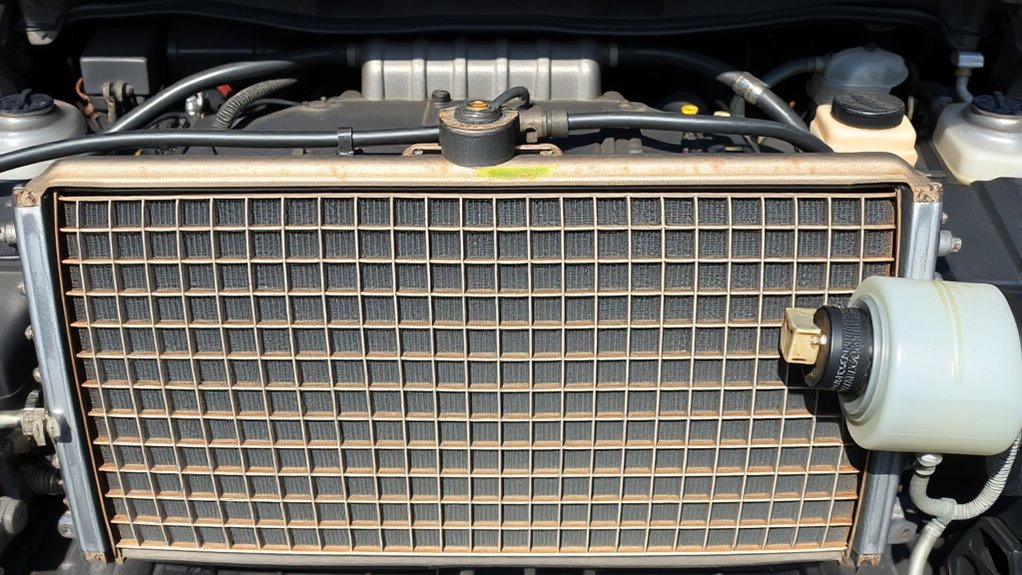
- Look for bent fins or corrosion on the radiator core.
- Ask for a pressure test if coolant loss is not obvious.
- Ask for a flow or temperature-drop check if the radiator may be clogged internally.
Head Gasket Indicators
A head gasket problem is more serious than a radiator leak. Warning signs include persistent overheating, white exhaust smoke, coolant loss with no obvious external leak, bubbling in the coolant reservoir, milky oil, or a sweet smell from the exhaust. A technician can use a cooling-system pressure test or a chemical block test to check for combustion gases in the coolant.
Warning: If your Camry overheats repeatedly or you see milky oil, do not keep driving. Have it towed or inspected before more engine damage occurs.
Camry Radiator Leaks: How to Identify and Locate Them
Start with the simplest checks while the engine is cold. Use a flashlight and look from above and below the front of the engine bay. If you cannot see the source, park on clean cardboard overnight. The drip location can help separate a radiator leak from a hose, water pump, reservoir, or heater-hose leak.
- Check the coolant reservoir level when the engine is cold.
- Look around the radiator seams and plastic end tanks for wetness or crust.
- Inspect upper and lower radiator hoses for swelling, cracking, oil contamination, soft spots, or loose clamps.
- Look under the front bumper and splash shield for coolant trails.
- Smell near the front of the engine bay for a sweet antifreeze odor after driving.
- Have the system pressure-tested if the level drops but no puddle appears.
Pro Tip: Take a clear photo of the coolant reservoir level when the engine is cold. Compare it a few days later. A slow drop is easier to spot when you have a reference point.
What Coolant Condition Tells You About Radiator Health
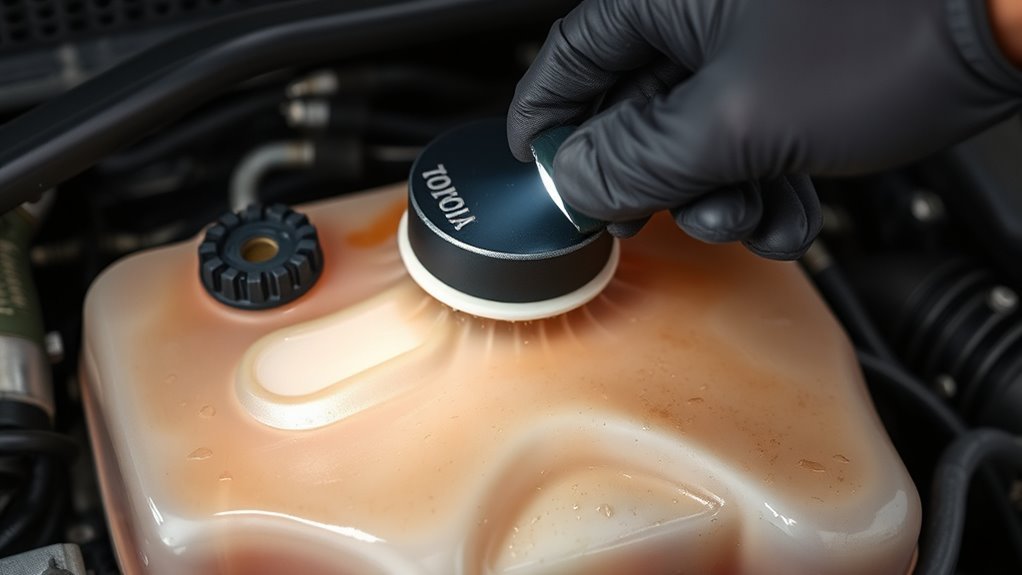
Coolant condition is one of the quickest clues to radiator health. Clean coolant should look bright and clear, not muddy, rusty, oily, or full of particles. Rusty or brown coolant can point to corrosion. Cloudy coolant or visible sediment can reduce heat transfer and clog narrow radiator passages. Milky coolant may mean oil contamination and needs urgent diagnosis.
For many Toyota models, Toyota Super Long Life Coolant is the correct type, but always verify the coolant specification for your exact Camry year. Mixing incompatible coolant types can reduce corrosion protection and create deposits.
Coolant that is low, rusty, oily, cloudy, or repeatedly disappearing is not normal. It is a warning sign, not a maintenance detail to ignore.
Simple Checks and Maintenance to Extend Radiator Life
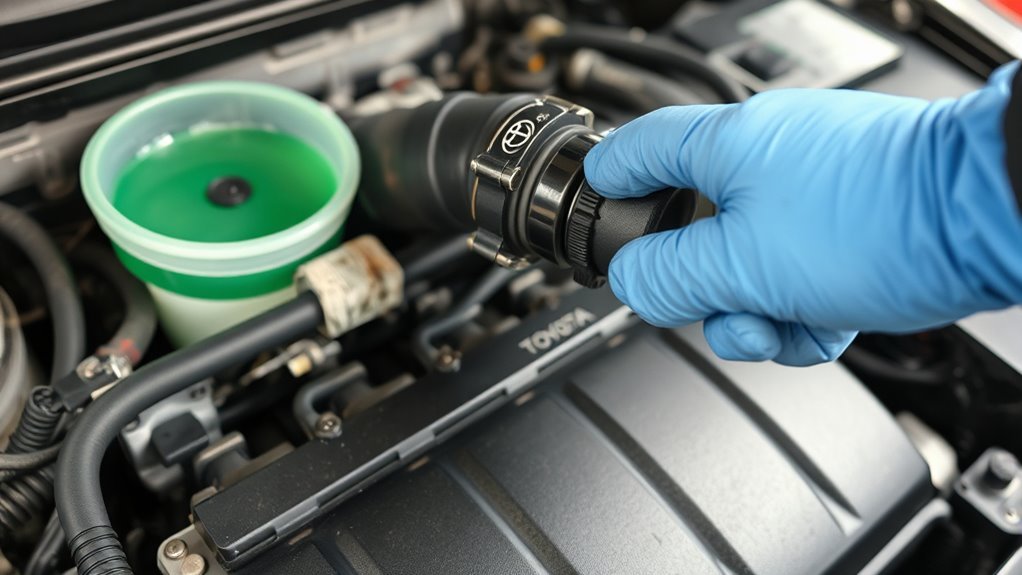
At a Glance
| Time Required | 10–15 minutes for a basic cold-engine inspection |
| Difficulty | Easy for visual checks; professional help for pressure testing or overheating diagnosis |
| Tools Needed | Flashlight, gloves, clean rag, cardboard, and the correct Toyota-compatible coolant if topping off is needed |
| Cost | Usually free for inspection; coolant top-off varies; radiator replacement often costs hundreds to over $1,000 depending on year and shop |
Run this quick checklist once a month and before long trips:
- Check the coolant level cold. The reservoir should be between the low and full marks when the engine is cold.
- Check coolant color and clarity. Look for rust, cloudiness, oiliness, or floating debris.
- Inspect hoses. Replace hoses that are cracked, swollen, oil-soaked, hard, mushy, or leaking at the ends.
- Look at the radiator core. Bent fins, corrosion, damp areas, or impact damage reduce cooling performance.
- Check for drips. Look under the car after it has been parked overnight.
- Watch the temperature behavior. Any new overheating, warning light, or repeated temperature swing needs diagnosis.
- Follow the coolant interval. For recent Camry models, use Toyota’s 100,000-mile/120-month initial coolant replacement interval and 50,000-mile/60-month interval afterward unless your manual says otherwise.
[Products Worth Considering]

These durable PVC cup holder inserts provide a non‑slip, waterproof surface that keeps drinks stable and prevents spills while protecting the cup holder from scratches and...
When to Replace Hoses, the Water Pump, or the Whole Radiator
Do not replace the radiator until you know the source of the problem. Many “radiator problems” are actually hose, cap, fan, thermostat, or water pump problems. Use the symptoms to decide what to inspect first.
| Symptom | Likely Area | Best Next Step |
|---|---|---|
| Cracked, swollen, or soft hoses | Radiator hoses | Replace hoses and clamps; refill and bleed the system. |
| Leak from radiator seam or plastic tank | Radiator assembly | Replacement is usually more reliable than patching. |
| Coolant residue near pump or bearing noise | Water pump | Inspect pump, belt drive, and coolant circulation. |
| Overheats mostly in traffic | Cooling fan or airflow | Test fan operation and inspect radiator/condenser blockage. |
| Rusty coolant or poor heat transfer | Old coolant, corrosion, clogged radiator | Flush only if appropriate; inspect for internal corrosion or clogging. |
| Milky oil, white smoke, bubbling coolant | Possible head gasket issue | Stop driving and get a professional diagnosis. |
When a radiator is replaced, it is smart to inspect the hoses, clamps, radiator cap, thermostat, and coolant condition at the same time. Reusing weak hoses with a new radiator can cause another leak soon after the repair.
Deciding: Repair, Replace, or Get a Second Opinion
A loose clamp, bad cap, or cracked hose can be a smaller repair. A leaking radiator tank, corroded core, repeated overheating, or internal clog usually makes replacement the safer choice. If a shop recommends a radiator but you do not see a leak or the car has not overheated, ask for the test results: pressure-test reading, leak location, coolant condition, and temperature diagnosis.
Current RepairPal estimates for Toyota Camry radiator replacement average about $896–$1,067, not including taxes, fees, location differences, or related repairs. Independent shops, dealers, aftermarket parts, OEM parts, hoses, coolant, and labor rates can move the price up or down.
Note: A second opinion is worth getting when the car is not overheating, the coolant level is stable, or the shop cannot show the leak location. It is not worth delaying if the car is actively overheating or losing coolant quickly.
Coolant Safety and Disposal
Coolant is not just colored water. Many coolants contain ethylene glycol, which is hazardous and should be kept away from children, pets, soil, and storm drains. Wipe spills quickly, store used coolant in a sealed container, and follow local disposal rules.
The U.S. Environmental Protection Agency notes that used antifreeze may require regulated handling because it can contain contaminants. The Occupational Safety and Health Administration lists ethylene glycol as a chemical hazard. Take used coolant to a local household hazardous waste program, recycling center, or repair shop that accepts antifreeze.
Frequently Asked Questions
How long does a Toyota Camry radiator last?
A Toyota Camry radiator often lasts beyond 100,000 miles and may last 10–15+ years or longer with clean coolant and regular inspections. Some last 20 years or more, but replacement is based on condition, not a fixed age.
How much does it cost to replace a Toyota Camry radiator?
Cost depends on model year, labor rate, parts choice, coolant, and related repairs. RepairPal currently estimates Toyota Camry radiator replacement at about $896–$1,067 on average, before taxes, fees, and location-specific adjustments.
What coolant should I use in a Toyota Camry?
Many Toyota Camry models use Toyota Super Long Life Coolant or an equivalent coolant that meets Toyota’s specification. Check your exact model-year owner’s manual before mixing or replacing coolant.
Can I drive my Camry with a small radiator leak?
It is risky. A small leak can turn into rapid coolant loss and overheating. If the temperature warning comes on, steam appears, or coolant is dropping quickly, stop driving and have the car inspected or towed.
Should I replace the thermostat when replacing the radiator?
Not always, but it is worth inspecting. Replace the thermostat if it is sticking, old, difficult to access later, or connected to the overheating problem. Also inspect hoses, clamps, radiator cap, and coolant condition.
How often should Camry coolant be changed?
For recent Camry models, Toyota lists the first engine/intercooler coolant replacement at 100,000 miles or 120 months, then every 50,000 miles or 60 months afterward. Your exact model-year maintenance guide is the final source.
Conclusion
A Toyota Camry radiator can last many years, but it needs clean coolant, good hoses, proper airflow, and quick attention when leaks or overheating appear. Check the coolant level and condition regularly, follow Toyota’s coolant service interval for your model year, and do not ignore sweet smells, bright puddles, crusty residue, rusty coolant, or temperature warnings. Replacing a weak radiator before it fails is far cheaper than repairing an overheated engine.
Sources
- Toyota 2025 Camry Warranty and Maintenance Guide — coolant replacement interval and cooling-system inspection schedule.
- Toyota Super Long Life Coolant — Toyota coolant product information.
- RepairPal Toyota Camry Radiator Replacement Cost Estimate — current radiator replacement cost range.
- U.S. EPA Used Antifreeze Disposal Fact Sheet — used antifreeze handling and disposal considerations.
- OSHA Ethylene Glycol Chemical Data — coolant chemical hazard reference.