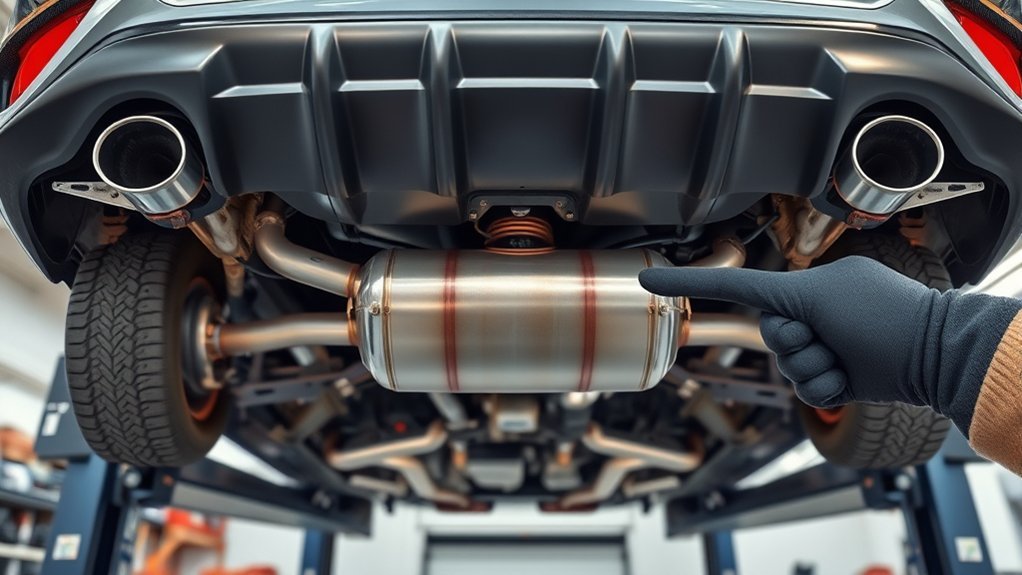
Your Camry’s catalytic converter is part of the exhaust and emissions system. Its job is to help convert carbon monoxide (CO), unburned hydrocarbons (HC), and nitrogen oxides (NOx) into less harmful exhaust gases before they leave the tailpipe. On a Toyota Camry, the exact converter location depends on the model year, engine, emissions package, and whether the car has one or more converter assemblies.
Quick Answer
A Toyota Camry catalytic converter uses a ceramic honeycomb coated with precious metals to clean exhaust gases. Some Camrys have a converter built into the exhaust manifold, some use a front-pipe converter, and some configurations use more than one. Failure usually shows up as a check-engine light, poor acceleration, rotten-egg smell, rattling, or failed emissions test.
Key Takeaways
- A Camry’s catalytic converter changes CO, HC, and NOx into less harmful gases through oxidation and reduction reactions.
- Location is not the same on every Camry. Check by VIN, engine, and emissions label before buying parts.
- Common warning signs include code P0420 or P0430, sluggish acceleration, sulfur smell, rattling, poor fuel economy, and failed emissions testing.
- Misfires, oil burning, coolant leaks, rich fuel mixtures, and exhaust leaks can destroy a new converter if you do not fix the root cause first.
- Removing or bypassing a catalytic converter on a street vehicle is emissions tampering and can be illegal.
At a Glance
| Time Required | 15–45 minutes for basic checks; longer for backpressure testing or part replacement |
| Difficulty | Beginner for visual and code checks; intermediate to advanced for under-car diagnostics |
| Tools Needed | OBD-II scanner, flashlight, gloves, infrared thermometer, jack stands or ramps, and possibly a backpressure gauge |
| Cost | Basic diagnosis can be low-cost; professional replacement often runs into the thousands depending on year, engine, labor, and emissions rules |
Warning: Catalytic converters get extremely hot. Do not touch the converter, exhaust manifold, or front pipe until the vehicle has cooled fully. If you inspect underneath the car, support it with rated jack stands or ramps on level ground—never rely on a jack alone.
Where the Catalytic Converter Sits on a Toyota Camry
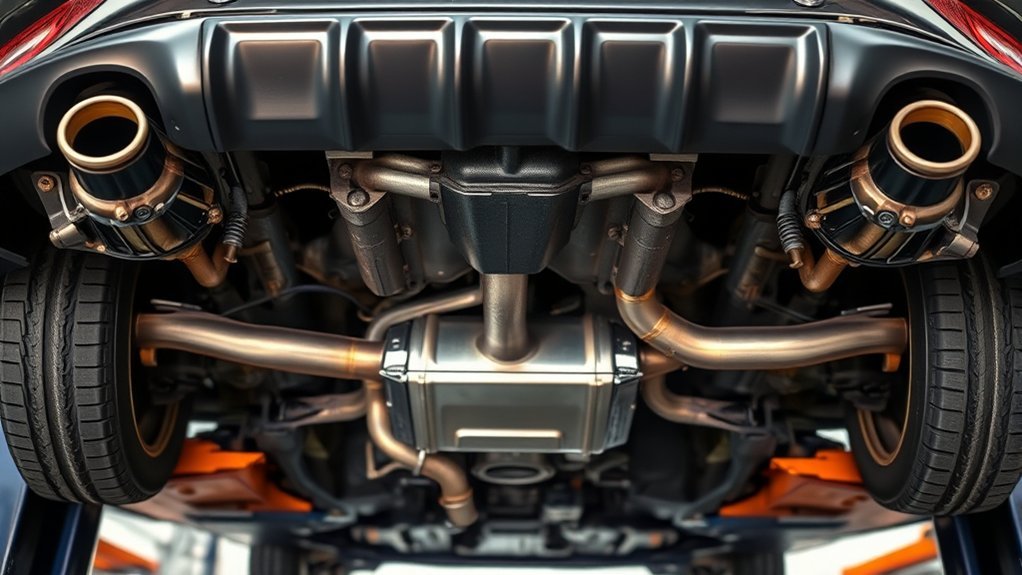
On a Toyota Camry, the catalytic converter is in the exhaust path, but the exact location is not identical on every model. Many Camrys use a close-coupled converter near the engine so it can heat up quickly. Some Toyota parts are listed as an Exhaust Manifold Converter Sub-Assembly, meaning the manifold and converter work together in one assembly. Other Camrys also use a converter or converter section in the front exhaust pipe.
The safest way to identify the correct converter is to check the vehicle’s year, engine size, emissions label, and VIN. A 4-cylinder Camry, V6 Camry, hybrid Camry, California-emissions Camry, and federal-emissions Camry may not use the same parts.
In general, you can find the converter by tracing the exhaust from the engine toward the rear of the car. Look for a larger stainless-steel canister or manifold-mounted assembly with oxygen or air-fuel sensors before and after it. The upstream sensor helps the engine computer control fuel mixture, while the downstream oxygen sensor helps monitor converter efficiency.
Note: If you are buying a replacement converter, do not order by appearance alone. Match the part by VIN, emissions certification, engine, and local emissions rules.
What a Camry’s Catalytic Converter Actually Does
A Camry’s catalytic converter is an emissions-control device. It does not filter exhaust like a screen. Instead, it uses chemical reactions on a catalyst surface to change harmful exhaust compounds into less harmful gases.
A modern three-way catalytic converter targets three main pollutants:
- Carbon monoxide (CO): a toxic gas created by incomplete combustion.
- Unburned hydrocarbons (HC): leftover fuel vapors that contribute to smog.
- Nitrogen oxides (NOx): gases formed under high combustion temperatures.
Inside the converter, CO is oxidized into carbon dioxide, hydrocarbons are oxidized into carbon dioxide and water, and NOx is reduced into nitrogen and oxygen. This process works best after the converter reaches operating temperature and the engine is running correctly.
Gasoline engines often target a stoichiometric air-fuel mixture around 14.7:1 during closed-loop operation, but real-world mixture changes during warm-up, heavy acceleration, deceleration, and load changes. That is why the engine computer constantly uses sensor feedback to adjust fueling.
Inside the Camry Converter: Shell, Honeycomb, and Precious Metals
From the outside, a converter looks like a sealed metal canister or manifold-mounted chamber. Inside, it is a carefully built thermal and chemical system.
Shell and Insulation
The outer shell is usually stainless steel because it must handle heat, vibration, road splash, and corrosion. Inside the shell, a mat or insulation layer holds the fragile catalyst substrate in place. That support matters because the core expands and contracts as the exhaust heats and cools.
If the shell is crushed, rusted through, cut open, or overheated, the converter may leak, rattle, or restrict exhaust flow. A damaged shell can also cause inspection failure even if the engine still runs.
Honeycomb Catalyst Structure
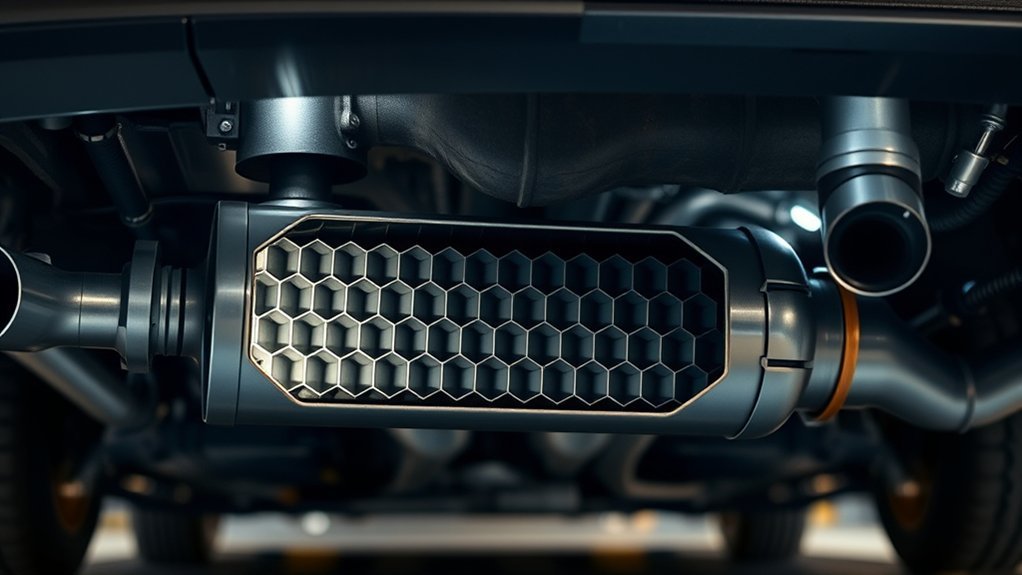
The converter’s core is commonly a ceramic honeycomb. The honeycomb design creates many small passages, giving the exhaust a large catalyst surface area without blocking normal flow.
- Ceramic substrate: supports the catalyst coating.
- Small passages: expose exhaust gas to more surface area.
- Support mat: cushions the core and holds it in place.
- Balanced flow: helps reduce emissions without creating excessive backpressure.
When the honeycomb melts, breaks, or clogs, the converter can no longer flow or convert exhaust properly. That is when you may notice power loss, rattling, or a check-engine light.
Precious Metal Coating
The honeycomb is coated with catalyst materials that commonly include platinum, palladium, and rhodium. These metals speed up oxidation and reduction reactions without being consumed in the same way fuel is consumed.
Those precious metals are also a major reason catalytic converters are expensive and are sometimes targeted for theft. If your Camry suddenly sounds much louder than normal, especially after being parked, inspect for a missing or cut-out converter before assuming it is a muffler problem.
How the Converter Turns CO, HC, and NOx Into Safer Gases
A three-way catalytic converter performs two main reaction types at nearly the same time: reduction and oxidation. The result is cleaner exhaust when the engine, sensors, and converter are all working properly.
Reduction and Oxidation Stages
The reduction stage helps break down NOx. In simplified terms, it separates nitrogen and oxygen so nitrogen can leave as N2, a normal part of the air.
The oxidation stage helps convert carbon monoxide into carbon dioxide and unburned hydrocarbons into carbon dioxide and water vapor.
- NOx reduction: helps turn nitrogen oxides into nitrogen and oxygen.
- CO oxidation: helps turn carbon monoxide into carbon dioxide.
- HC oxidation: helps turn unburned fuel compounds into carbon dioxide and water.
- Sensor control: uses air-fuel and oxygen-sensor feedback to keep the system in the correct range.
Precious Metal Catalysts
Platinum and palladium are especially useful for oxidation reactions, while rhodium is especially important for NOx reduction. The converter needs heat, proper exhaust flow, and a healthy engine to keep those catalyst surfaces working.
If raw fuel, oil, coolant, silicone sealants, or other contaminants enter the exhaust, the catalyst coating can become poisoned or overheated. That is why a converter replacement should never be treated as a stand-alone repair until the cause of failure is found.
A catalytic converter usually fails because something upstream went wrong first: misfires, rich running, oil burning, coolant leaks, or exhaust leaks can all shorten converter life.
Symptoms of a Failing Catalytic Converter on a Camry
A failing Camry catalytic converter can show up as a drivability problem, an emissions problem, or both. The most common signs include:
- Check-engine light: common converter-related codes include P0420, P0430, P0421, and P0422.
- Sluggish acceleration: a restricted converter can create backpressure and make the engine feel choked.
- Poor fuel economy: often caused by the same engine fault that damaged the converter.
- Rotten-egg or sulfur smell: can happen when exhaust gases are not being processed correctly.
- Rattling under the car: may point to a broken honeycomb core or loose heat shield.
- Failed emissions test: the converter may not be cleaning exhaust well enough.
- Louder exhaust: may indicate theft, a cut pipe, or a major exhaust leak rather than internal converter failure.
Pro Tip: A P0420 code does not automatically mean “replace the catalytic converter.” Exhaust leaks, bad sensors, misfires, fuel-trim problems, and oil burning can all trigger or contribute to catalyst-efficiency codes.
Common Causes of Catalytic Converter Damage on Camrys
The converter sits directly in the exhaust stream, so it is affected by whatever comes out of the engine. The most common causes of damage include:
- Engine misfires: send unburned fuel into the exhaust, where it can overheat the converter.
- Rich fuel mixture: can overload the catalyst with fuel and raise converter temperature.
- Oil burning: coats the catalyst and reduces its working surface.
- Coolant leaks: from head-gasket or internal engine issues can contaminate the converter.
- Exhaust leaks: can skew oxygen-sensor readings and cause false diagnosis.
- Physical damage: road impact, theft attempts, rust, or crushed pipes can restrict flow.
- Wrong replacement part: an incorrect or noncompliant converter may fail inspection or set new codes.
Fix these problems before replacing the converter. Installing a new converter without correcting a misfire, oil-consumption issue, or rich-running condition can ruin the new part quickly.
How the Camry’s Air-Fuel and Rear O2 Sensors Reveal Converter Problems
Your Camry uses sensor feedback to control fuel mixture and monitor catalyst performance. The exact sensor names and layout vary by model year and engine, but the basic idea is similar:
- Upstream air-fuel or oxygen sensor: reports exhaust oxygen before the converter so the engine computer can adjust fueling.
- Downstream oxygen sensor: monitors exhaust after the converter to help judge converter efficiency.
- Engine computer: compares sensor behavior and may set catalyst-efficiency codes if the downstream signal looks too similar to the upstream signal.
A healthy converter tends to smooth out oxygen changes after the exhaust passes through it. When the downstream oxygen sensor switches too much, responds too quickly, or reports unexpected oxygen levels, the computer may decide the catalyst is not storing oxygen and cleaning exhaust effectively.
However, sensor data must be interpreted with fuel trims, misfire history, exhaust leaks, engine temperature, and readiness monitors. A single sensor graph is not enough to condemn an expensive converter.
Common OBD Codes for Camry Catalytic Converter Problems
An OBD-II scanner is one of the best first tools for diagnosing converter trouble. Watch for these codes:
- P0420: Catalyst system efficiency below threshold, usually Bank 1.
- P0430: Catalyst system efficiency below threshold, usually Bank 2 on V6 engines.
- P0421: Warm-up catalyst efficiency below threshold.
- P0422: Main catalyst efficiency below threshold.
- Misfire codes such as P0300–P0306: must be fixed before replacing the converter.
- Fuel-trim or oxygen-sensor codes: may indicate a root cause rather than a bad converter.
If the check-engine light is on, the car may fail an emissions inspection even if it seems to drive normally. Do not clear codes just before testing; the readiness monitors need time to run again.
How to Check a Camry’s Catalytic Converter Yourself (Diagnostics & DIY)
You can do several basic checks at home before paying for a replacement. These checks help you decide whether the converter is likely failing or whether another problem is causing the symptoms.
Step 1: Scan for Codes and Freeze-Frame Data
Use an OBD-II scanner to read stored, pending, and permanent codes. Write down the codes before clearing anything. Freeze-frame data can show engine speed, load, coolant temperature, and fuel-trim conditions when the fault was recorded.
Step 2: Check for Engine Problems First
Look for misfires, rough idle, oil consumption, coolant loss, vacuum leaks, or fuel-trim problems. If the engine is not running correctly, fix that first. A converter cannot survive long behind a poorly running engine.
Step 3: Inspect the Exhaust System
When the car is cool and safely supported, inspect the converter area with a flashlight. Look for dents, holes, missing sections, cut pipes, fresh welds, loose shields, or black soot around joints. Soot can reveal an exhaust leak that may confuse sensor readings.
Step 4: Listen for Rattles
A light rattle from the converter area can mean the internal substrate has broken apart. Confirm the sound is not coming from a loose heat shield, hanger, or pipe before replacing the converter.
Step 5: Compare Temperatures Carefully
An infrared thermometer can compare inlet and outlet temperature after the engine is warm. A working converter often runs hotter at the outlet than at the inlet, but temperature readings vary with engine load, idle time, airflow, converter design, and measurement angle. Use this as supporting evidence, not a final verdict.
Step 6: Have Backpressure Tested if Power Is Low
If the Camry has weak acceleration, stalls under load, or feels like it cannot breathe, a shop can test exhaust backpressure. This is one of the better ways to confirm a restricted converter or clogged exhaust section.
Warning: Do not drill holes, hollow out the converter, install oxygen-sensor spacers to hide a code, or remove the converter for street use. Those fixes can violate emissions laws and create inspection problems.
Replacement and Repair Options for Camry Converters: Costs and When to Call a Shop
Once diagnosis points to a failed converter, you have three main paths: OEM replacement, compliant aftermarket replacement, or repairing the underlying issue if the converter itself has not failed yet.
Current published estimates for a Toyota Camry catalytic converter replacement often fall around the low-to-mid $2,000 range, with variation by model year, engine, state emissions rules, part availability, labor rate, and whether the converter is manifold-integrated or part of the front exhaust pipe. For example, RepairPal’s Toyota Camry estimate lists an average range of $1,827–$2,165 before taxes, fees, and location-specific factors.
OEM Replacement
An OEM converter is the safest fitment choice when emissions compliance matters. It usually costs more, but it is built for the exact vehicle configuration when ordered correctly by VIN.
Aftermarket Replacement
An aftermarket converter can cost less, but it must be legal for your state and exact vehicle. In California, the Bureau of Automotive Repair says the replacement must be OEM or a California Air Resources Board-approved aftermarket converter with an Executive Order number that meets the exact requirements for the vehicle.
Cleaning or Temporary Fixes
Fuel additives or “converter cleaners” may help only in limited cases where the problem is minor contamination and the engine is otherwise healthy. They cannot repair a melted honeycomb, broken substrate, missing converter, failed precious-metal coating, or illegal replacement part.
Check Warranty Before Paying
Before approving a costly replacement, check your warranty booklet and mileage. Federal emissions warranty rules list catalytic converters and related components among major emission-control parts with 8-year/80,000-mile coverage for applicable light-duty vehicles. Coverage details can vary by vehicle, state, and failure cause, so confirm with Toyota or a dealer before paying out of pocket.
When to Call a Shop
Call a qualified shop if the check-engine light returns after basic repairs, the car has serious power loss, the exhaust is extremely hot, you smell fuel, the converter is missing, or an emissions inspection is coming up. A shop can verify sensor data, fuel trims, misfires, leaks, and backpressure before replacing an expensive part.
Can a Toyota Camry Run Without a Catalytic Converter?
A Camry may physically run if the catalytic converter is missing, but that does not mean it is safe, legal, or acceptable for street use. A missing converter can make the exhaust much louder, trigger the check-engine light, cause emissions-test failure, and expose you to legal trouble. It can also change exhaust flow and sensor behavior in ways that make diagnosis harder.
For a street-driven Camry, replace a missing or failed converter with the correct legal part rather than bypassing it.
Frequently Asked Questions
What are the three functions of a catalytic converter?
A three-way catalytic converter reduces NOx into nitrogen and oxygen, oxidizes carbon monoxide into carbon dioxide, and oxidizes unburned hydrocarbons into carbon dioxide and water vapor.
How do I know if my Toyota Camry catalytic converter is bad?
Common signs include a check-engine light with P0420 or P0430, failed emissions test, sluggish acceleration, rotten-egg smell, rattling from the converter area, or excessive exhaust backpressure. Confirm the diagnosis before replacement because sensor faults, exhaust leaks, and misfires can mimic converter failure.
Can a Toyota run without a catalytic converter?
It may run, but a street vehicle should not be driven without the correct catalytic converter. Removal or bypassing can violate emissions laws, trigger the check-engine light, make the car fail inspection, and create loud exhaust noise.
How does a catalytic converter work step by step?
Hot exhaust enters the converter, passes through a catalyst-coated honeycomb, and reacts on the precious-metal surface. NOx is reduced, while CO and hydrocarbons are oxidized. The downstream oxygen sensor then helps the engine computer monitor whether the converter is working efficiently.
Is a Toyota Camry catalytic converter covered under warranty?
It may be, depending on age, mileage, state rules, and failure cause. Federal emissions warranty rules include catalytic converters and related components among major emission-control parts with 8-year/80,000-mile coverage for applicable light-duty vehicles. Check the warranty booklet or ask a Toyota dealer before paying for replacement.
Can catalytic converter cleaner fix a P0420 code?
Sometimes it may temporarily help if the issue is light contamination, but it will not fix a melted core, broken honeycomb, missing converter, exhaust leak, bad sensor, or worn-out catalyst. Diagnose the root cause before spending money on parts or additives.
Conclusion
A Toyota Camry catalytic converter is more than a simple exhaust canister. It is a heat-sensitive emissions device that uses a catalyst-coated honeycomb to reduce CO, HC, and NOx. The big takeaway is that location and replacement parts vary by Camry year, engine, VIN, and emissions package, so do not guess.
If your Camry has a check-engine light, poor acceleration, sulfur smell, rattling, or a failed emissions test, start with codes, fuel trims, misfire checks, exhaust-leak inspection, and sensor data. Replace the converter only after confirming the failure and fixing the root cause. For expensive repairs, check emissions warranty coverage and local legal requirements before approving the job.
Sources
- LibreTexts — Catalytic Converters — backs up oxidation and reduction reaction basics.
- Toyota Autoparts — Exhaust Manifold Converter Sub-Assembly #25051-0V040 — supports model-specific manifold-integrated converter design.
- U.S. EPA — Tampering and Aftermarket Defeat Devices — supports emissions-tampering legal warning.
- California Bureau of Automotive Repair — Catalytic Converter Theft and Smog Check Program — supports California replacement requirements.
- eCFR — 40 CFR § 85.2103 Emission Warranty — supports emissions-warranty coverage for catalytic converters.
- RepairPal — Toyota Camry Catalytic Converter Replacement Cost — supports current repair-cost estimates and symptom context.