What’s in This Article
- What “Roof Rack Weight Limit” Means for a Toyota RAV4
- Find Your RAV4’s Roof Load Limits
- Dynamic vs. Static Limits: RTT Implications
- How to Calculate Your RAV4 Roof Load
- Why Crossbar and Rail Ratings Control Safety
- When to Upgrade to a High-Capacity RAV4 Rack
- How to Distribute Load Safely Across Rails and Fixings
- Real-World Risks: Wind, Speed, Fatigue, and Wear
- Decision Checklist: Can You Safely Use an RTT on Your RAV4?
- Frequently Asked Questions
Your RAV4‘s roof rack carries a dynamic (driving) limit of about 165 lb (75 kg) and a much higher static (stationary) capacity of around 528 lb (240 kg). Keep your dynamic load under that lower figure any time the vehicle moves. Factor in rack hardware, tent weight, and occupant weight, distribute mass evenly across crossbars and rails, and inspect mounts and fasteners before every trip. If your margins are close to the limit, a high-capacity aftermarket rack is the safer option.
Quick Answer
According to Toyota’s published specifications, the RAV4 roof rack supports up to 165 lb (75 kg) while driving and approximately 528 lb (240 kg) when parked. Always check your owner’s manual for your specific trim’s exact figures. Include the rack, tent, and all occupants when calculating your total load, and never exceed the driving limit while in motion.
Key Takeaways
- The RAV4 dynamic (driving) roof rack limit is approximately 165 lb (75 kg) — treat this as a hard ceiling any time the vehicle moves.
- The static (parked) limit runs roughly three to five times higher, around 528 lb (240 kg), and applies when the vehicle is stationary with a tent deployed and occupied.
- Always add up rack hardware, tent weight, and occupant weight before committing to a rooftop tent setup.
- Distribute load evenly across all crossbars, torque all fasteners to manufacturer spec, and inspect mounts before every trip.
- If your loads consistently approach the stock limit, upgrade to a certified aftermarket rack with a higher rated capacity.
What “Roof Rack Weight Limit” Means for a Toyota RAV4
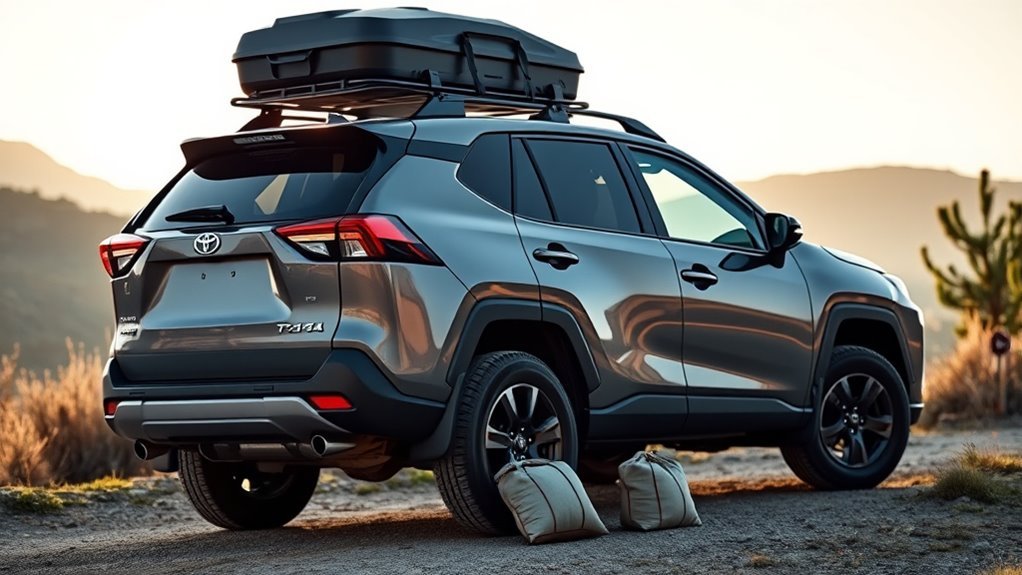
The roof rack weight limit defines the maximum load your RAV4 can carry on its roof without affecting handling or safety. For most RAV4 models, the dynamic limit while driving is 165 lb (75 kg). That number is your planning baseline for any rooftop load.
Static limits apply only when the vehicle is parked. They run roughly three to five times higher than the dynamic figure. But they don’t protect you while you’re moving.
Keep total payload within the dynamic limit, distribute weight evenly, and inspect every mount before you drive. Never treat a small overage as acceptable. Even modest excess weight raises the risk of structural fatigue and unpredictable handling at speed.
Find Your RAV4’s roof load Limits
You need to know both the dynamic roof load (about 165 lb / 75 kg while driving) and the static load (up to approximately 240 kg / 528 lb when parked) before planning any roof cargo. Start with your owner’s manual — it’s the authoritative source and lists model-year-specific limits for your trim. If the specs aren’t clear, contact a Toyota dealer or certified technician to confirm the exact figures for your vehicle.
Note: Some RAV4 trims, including the Adventure and TRD Off-Road, may carry a slightly higher dynamic rating (up to 80 kg / 176 lb). Always confirm the exact figure for your model year and trim in your owner’s manual before loading.
Where to Find Your RAV4’s Load Ratings
Your owner’s manual is the first and most reliable place to look. It lists both the dynamic (driving) and static (stationary) limits for your specific model year and trim. Use that as your baseline, then cross-check with the door jamb placard or glovebox sticker for quick on-hand reference.
- Check the owner’s manual for model-year-specific dynamic and static limits.
- Look for a load placard on the driver’s door jamb or inside the glovebox — it may list roof load figures.
- Visit the manufacturer’s website or a verified vehicle spec database and enter your model and year.
- Compare static vs. dynamic figures: static often runs three to five times higher and applies only when parked.
- Browse owner forums for real-world setups, installation notes, and model-specific caveats.
- Cross-check aftermarket rack and accessory load ratings against the vehicle’s stated roof limits.
Dynamic vs. Static Limits: RTT Implications
The RAV4’s roof carries a dynamic limit of roughly 165 lb (75 kg) while driving. Mounting a rooftop tent (RTT) introduces a second constraint: the static limit that applies when the tent is deployed with occupants inside. Treat these two limits as separate requirements, not interchangeable ones.
| Condition | Load Type | Implication |
|---|---|---|
| Driving | Dynamic (~165 lb / 75 kg) | Affects handling and stability |
| Stationary | Static (~528 lb / 240 kg) | Supports tent plus occupants |
| Occupants in tent | Added static load | Must count toward total |
| Exceeding dynamic limit | Dynamic breach | Reduced vehicle control |
| Exceeding static limit | Structural overload | Risk of roof or rack damage |
Measure your tent’s packed weight, count your expected occupants, and verify both totals against the relevant limit before driving or sleeping on the roof. Use conservative margins. If you’re close to either threshold, reduce gear weight or consider a higher-rated aftermarket rack.
How to Calculate Your RAV4 Roof Load
Before mounting a rooftop tent, add up every component that loads the roof: the packed RTT (typically around 52 kg / 115 lb), mounting hardware, crossbars, gear bags, and the maximum expected occupant weight when the tent is deployed. Compare that total against both limits: 75 kg (165 lb) dynamic for driving and approximately 240 kg (528 lb) static for a parked, occupied tent.
- List tent, hardware, and gear masses to calculate a clear total weight.
- Check that driving total against the 75 kg dynamic limit before every trip.
- Add expected occupant weight and check the combined total against the static limit before sleeping in the tent.
- Distribute weight evenly front-to-back to reduce bending stress on crossbars.
- Secure all items tightly so nothing shifts and creates unexpected load spikes during driving.
- If totals approach any limit, move gear into the cabin or choose a lighter tent.
Pro tip: Keep a simple spreadsheet with your tent weight, hardware weight, and typical occupant weights so you can verify load totals in seconds before any trip without recalculating from scratch.
Here’s a practical example: a 52 kg RTT plus two occupants at a combined 210 kg already reaches 262 kg, which exceeds the typical 240 kg static limit. Factor in mounting hardware and the total climbs higher still. Always run the numbers before committing to a setup.
[Products Worth Considering]

Upgrade your vehicle's cargo capacity with these heavy‑duty aluminum roof crossbars that lock securely and reduce wind noise. The aerodynamic design and adjustable width provide a quiet, stable platform for luggage up to 260 lb, while the easy‑install kit and labeled front and rear bars simplify setup. Ideal for Toyota Grand Highlander and Lexus TX models from 2024‑2026 with flush side rails.

Upgrade your RAV4 roof rack with these heavy‑duty aluminum crossbars featuring an anti‑theft lock and tie‑down loops for secure cargo transport. The matte‑powder‑coated bars resist corrosion and reduce wind noise, while easy installation fits existing rails without drilling. Ideal for bike mounts, roof boxes, kayaks and more.
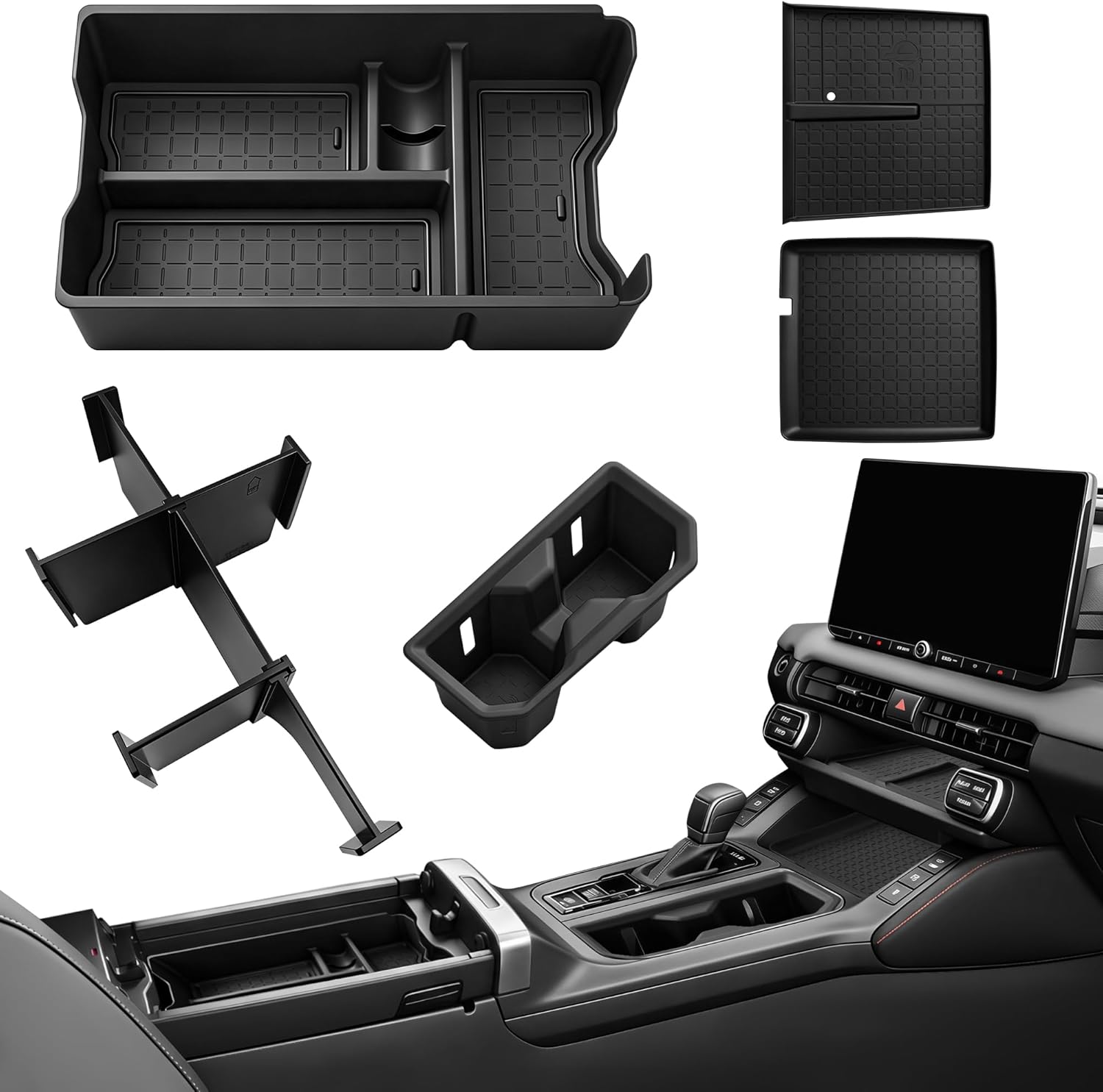
The QINQINTU center console organizer tray is custom‑engineered for the 2026 Toyota RAV4, delivering a seamless OEM‑fit that maximizes storage and adds a discreet hidden compartment. Its double‑layer silicone liner absorbs vibrations for a quiet ride, while the included cup‑holder liner keeps the interior tidy and easy to clean.
Why Crossbar and Rail Ratings Control Safety

Crossbars and roof rails form the primary load path between your equipment and the vehicle’s structure. Their rated capacities set the real limit for both driving and static use, regardless of what the roof structure itself might theoretically support.
Manufacturers test and publish these ratings based on bending stiffness, ultimate strength, and fatigue life under repeated dynamic loads. Stick to them. Concentrating load at one point rather than spreading it across both bars creates a bending moment the crossbar wasn’t designed to handle — and failure under load can happen without warning.
Distribute loads evenly between all bars, minimize overhang, and inspect attachment points and fasteners regularly for deformation or corrosion. Aligning your load plan with rated capacities reduces failure risk and keeps vehicle handling predictable.
When to Upgrade to a High-Capacity RAV4 Rack
Consider upgrading when your planned load approaches or exceeds the stock dynamic limit of 165 lb (75 kg). A higher-rated rack prevents accelerated wear on factory rails and gives you more margin for heavier adventure gear without sacrificing safety.
- Your RTT, occupants, and gear together approach the stock dynamic limit.
- You frequently carry heavy equipment or multiple people’s gear on extended trips.
- You want higher static and dynamic margins for off-road or rough-terrain travel.
- You plan to add accessories that require stronger mounting points and materials.
- You want a long-term solution that prevents gradual degradation of factory rails.
Choose an aftermarket rack with certified load ratings — some reach 600 lb or more. Evaluate rack materials, corrosion resistance, and installation requirements. Confirm that the rack’s ratings meet or exceed your calculated total load before purchasing.
[Products Worth Considering]

The Autovir windscreen shade offers full windshield coverage for Toyota RAV4 models from 2019 to 2026, blocking up to 99.95% of UV rays and reducing interior heat. Its multi‑layer reflective material provides SPF 100 and UPF 80+ protection while keeping the dashboard, seats, and steering wheel cooler. The foldable design installs quickly and stores conveniently in the glove box, and reinforced stitching ensures long‑lasting durability for daily use.

This adapter provides reliable 5V/2A power to dash cams in Toyota and Lexus models equipped with the TSS 2.5 Lane Trace System. It includes three cables—Mini USB, Type‑C, and Micro USB—to match various dash cam connectors, and powers devices only when the ignition is on for safe operation. Plug‑and‑play installation makes it easy to set up, and the gray 12‑pin connector is simple to locate in compatible vehicles.

BETTER THAN THE ORIGINAL OEM ONE .Optimized re-designed from the original OEM new RAV4 crossbar by added metal mechanism lock system ,this upgrade offers durable and 100% secure for anti-theft. (Not Fit 2024 LE/ Adventure/TRD Off-Road/Hybrid Woodland Edition)
How to Distribute Load Safely Across Rails and Fixings
Distributing load evenly across rails and attachment points protects structural integrity and keeps vehicle handling predictable. Place mass over multiple crossbars and factory mounting points instead of concentrating weight at a single location. Keep the total dynamic load under 165 lb and verify tent plus occupant weight against static ratings before each use.
Follow these installation practices: align mounts with reinforced roof rails, torque all fasteners to manufacturer specs, and use spreader plates where needed to widen load paths. Stow heavier items as low and centered on the rack footprint as possible to minimize center-of-gravity shift.
After installation, check straps, brackets, and interface hardware for even tension and zero play. Inspect load distribution periodically and after any hard maneuvers or off-road driving.
[Products Worth Considering]
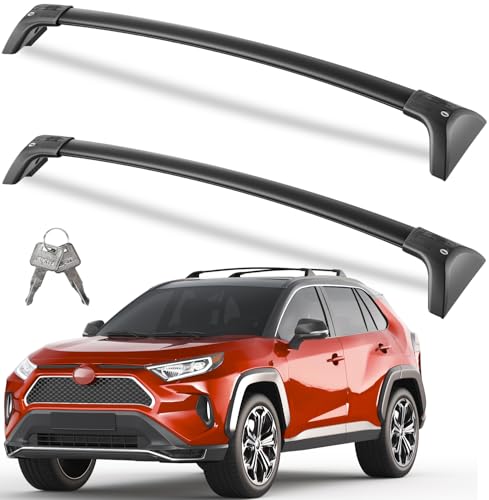
【100% Secure and Heavy Duty】 Upgraded with Metal Mechanism Lock& Key that offers 100% secure for anti-theft and durable. Die-Casting Mould Aluminum Base + 2.4mm Thickness Aluminum Body that Offers Max Loading up to 260lb. Black Powder Coated Aluminum Body Offers Non-Corrosion for Entire Life Time.

BETTER THAN THE ORIGINAL OEM ONE .Optimized re-designed from the original OEM new RAV4 crossbar by added tie-down loop feature +metal mechanism lock system ,this upgrade offers durable and 100% secure for anti-theft. (Not Fit 2024 LE/ Adventure/TRD Off-Road/Hybrid Woodland Edition)

Anti-Theft Upgrade with Metal Lock System: Optimized and re-engineered from the original OEM design, these crossbars feature a robust metal locking mechanism for 100% theft prevention. Durable and tamper-proof, they secure cargo like bikes, skis, or rooftop carriers while driving or parked. *Note: Not compatible with 2024 2025 LE/Adventure/TRD Off-Road/Hybrid Woodland Edition.*
Real-World Risks: Wind, Speed, Fatigue, and Wear

Proper load distribution and fastening are just the starting point. Real-world forces act on a loaded RAV4 roof constantly while driving. Wind resistance and speed-induced aerodynamic lift amplify the effective load on your anchors well beyond the static weight of the cargo itself.
Warning: At highway speeds, aerodynamic lift and drag can push the effective roof load well above your cargo’s actual weight — reduce speed when carrying loads near the dynamic limit, and avoid sustained high-speed driving with a rooftop tent installed.
- High speeds increase aerodynamic lift and drag, raising effective loads on anchor points.
- Wind gusts generate transient force spikes that concentrate stress at fixing points.
- Repeated heavy use causes cumulative metal fatigue — inspect for cracks or deformation regularly.
- Amplified effective weight from wind can push loads beyond the rated dynamic capacity.
- Track fastener torque, surface corrosion, and bracket condition to catch wear before it becomes a failure.
Stay within dynamic specs, conduct regular inspections, and adjust your speed and load when conditions demand it.
Decision Checklist: Can You Safely Use an RTT on Your RAV4?
Before mounting any rooftop tent, compare the vehicle’s dynamic limit to its static rating to understand on-road versus parked allowances. Then calculate the total loaded weight — tent, crossbars, mounting hardware, and expected occupant weight — and verify it stays under the dynamic limit for driving. Finally, inspect the rack, mounts, and fasteners for rated capacity, corrosion, or fatigue before first use.
Check Dynamic Versus Static
Compare the RAV4’s dynamic roof load (about 165 lb / 75 kg while driving) to the static load allowance (roughly three to five times higher, around 240 kg / 528 lb). Account for the tent’s packed weight, all occupants, and mounting hardware. Exceeding the static limit can compromise structural integrity and occupant safety. If margins are tight, get professional verification before proceeding.
- Verify vehicle roof and rack ratings for your specific trim.
- Weigh tent, hardware, and occupants separately.
- Compare your driving total against the dynamic limit.
- Compare your parked total (with occupants) against the static limit.
- Seek professional assessment if totals are close to either limit.
Calculate Total Loaded Weight
Start by adding every component that loads the rack: the packed RTT (typically ~52 kg / 115 lb), mounting hardware, crossbars, panniers, and the maximum expected occupant weight. Compare that total against both limits: 75 kg (165 lb) dynamic for driving and 240 kg (528 lb) static for a parked tent with occupants.
Target a tent plus gear weight in the 43–57 kg (95–125 lb) range so occupants fit within static capacity. For example, a 52 kg RTT plus 210 kg of occupants reaches 262 kg — already above the 240 kg static limit. Uneven loading across crossbars concentrates stress further, raising the risk. If your totals approach any limit, ground-mount the RTT or remove gear from the rack before sleeping in it.
Inspect Rack and Fixings
Check every attachment point where the rack meets the RAV4’s body — bolt heads, welds, and mounting brackets must be tight, corrosion-free, and show no elongation or cracking. Any play, stripped threads, or rust-through means stop and repair before loading. If aftermarket components are in use, get professional verification that their rated capacities match your calculated total loaded weight.
Verify fastener torque to spec, inspect crossbars for fatigue, and confirm even spacing to distribute RTT load. Schedule inspections before and after trips, especially when loads approach static or dynamic limits.
- Torque all fasteners to manufacturer specification.
- Inspect welds and brackets for cracks or deformation.
- Check crossbars for bending or surface wear.
- Confirm even load distribution across all bars.
- Schedule and log routine rack maintenance after every major trip.
Frequently Asked Questions
What is the RAV4 roof rack weight limit while driving?
The dynamic (driving) limit for most RAV4 models is about 165 lb (75 kg). That’s the maximum you can carry on the roof while the vehicle moves. Treat it as a hard ceiling, not a guideline. Exceeding it raises handling risk and accelerates wear on crossbars and mounts over time.
Can you put a rooftop tent on a RAV4?
Yes, but you need to check both limits first. The packed tent must stay under the 165 lb dynamic limit for driving. With occupants inside while parked, the combined total must stay under the static limit (roughly 528 lb / 240 kg). Many mid-weight rooftop tents work within these figures, but confirm your specific tent’s packed weight before buying.
What happens if you exceed the RAV4’s roof rack weight limit?
Going over the dynamic limit increases aerodynamic lift, reduces braking effectiveness, and raises the risk of crossbar or mount failure while driving. Repeated overloading causes metal fatigue over time. Beyond safety risks, exceeding stated limits can void your vehicle warranty and affect insurance coverage in an accident.
Safety Disclaimer: This article is for informational purposes only and does not constitute professional mechanical or safety advice. Roof load limits vary by model, trim, and market. Always consult your owner’s manual and a qualified Toyota technician before mounting any roof load system, particularly a rooftop tent with occupants.
Conclusion
Fitting a rooftop tent on a RAV4 is entirely practical — but only after you’ve checked the numbers. The 165 lb dynamic limit governs everything while you’re driving. The static limit governs everything while you’re parked with occupants in the tent. Neither figure is optional.
Distribute weight across all crossbars, torque fasteners to spec, and run load calculations before every new setup. Reduce speed on the highway with a loaded rack, inspect for fatigue and corrosion regularly, and upgrade to a higher-rated rack if your margins are consistently tight. Use the checklist before every trip — it’s the simplest way to keep your gear and your vehicle in good shape for the long run.
References
- Toyota RAV4 Owner’s Manual — Toyota Motor Corporation. Available via Toyota’s owner portal; select your specific model and model year for load specifications.
- Vehicle Safety Standards — National Highway Traffic Safety Administration (NHTSA). Federal agency governing roof strength, structural load, and passenger vehicle safety testing requirements in the United States.