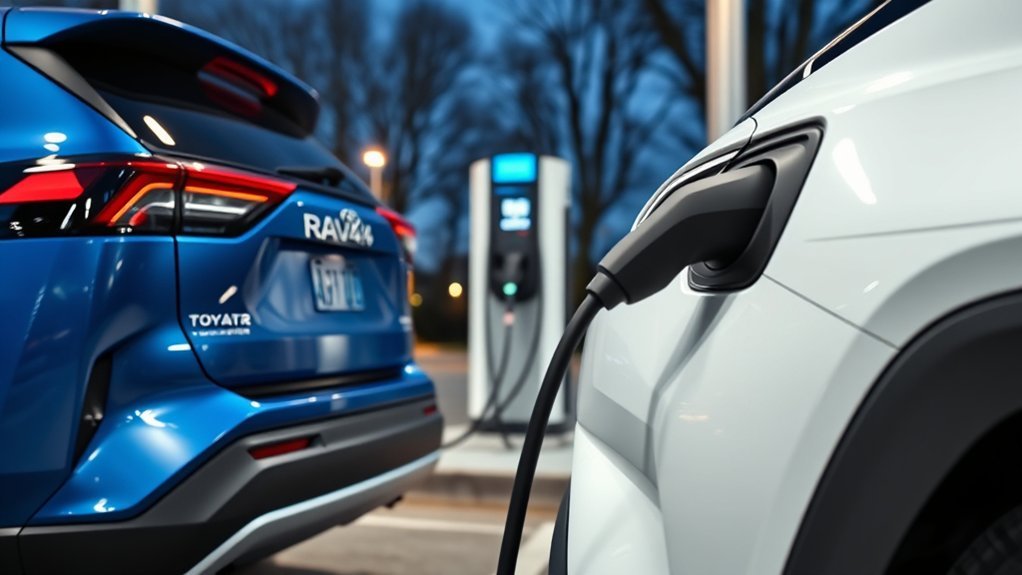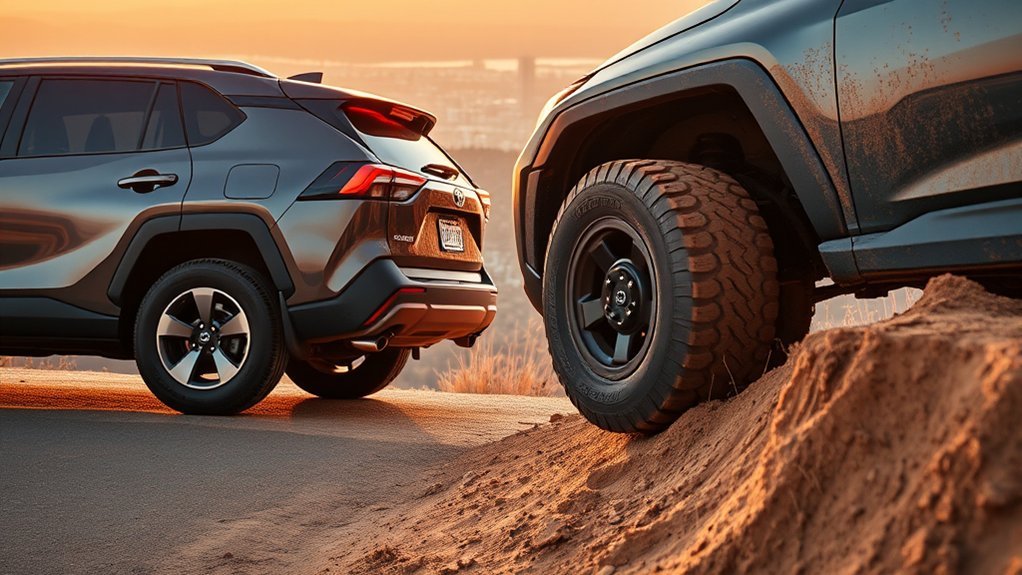
The RAV4 uses a full‑time AWD system that automatically shifts torque front‑to‑rear for grip, so you get steady handling on pavement, better traction in snow, and competence on gravel or dirt without flipping switches. It lacks low‑range gears and locking diffs found in true 4WD, so it won’t handle deep mud, steep technical trails, or rock‑crawling. Use proper tires and modes to maximize it, and keep going to learn smart upgrades and when to choose true 4WD.
Quick Answer: Is the RAV4 AWD or 4WD – And What That Means for You

Wondering whether your RAV4 is AWD or 4WD—and what that actually means for you? You’ve got a full-time AWD system—often called 4WD in casual talk—that automatically sends power to all four wheels to boost traction control and stability. You don’t have to flip switches or shift into a special mode; the system runs continuously, reallocating torque as conditions demand. That means you’re freed from constant micromanagement when roads get wet, snowy, or slick. Remember: this AWD is tuned for light off-road use and improved everyday handling, not for rock-crawling or serious overlanding. In normal driving it balances power roughly evenly—about 25% per wheel—so you get predictable grip without fuss. If you crave liberation, this setup lets you focus on movement and choice rather than mechanical chores, while accepting the tradeoff that it lacks the rugged, selectable hardware of dedicated off-road 4WD rigs.
How RAV4 AWD Works (Hardware & Software Basics)
Because the RAV4’s AWD works continuously, you don’t have to think about shifting or flipping switches—the system’s hardware and control software collaborate to keep traction where it’s needed. You get a full-time AWD setup that sends power to all four wheels, with roughly 25% delivered to each wheel in steady driving. A center coupling detects slip and reallocates torque to the rear wheels instantly, so you stay moving without fuss.
The RAV4’s full-time AWD quietly balances power to all four wheels, shifting torque instantly for confident traction.
The basics you should know:
- Center coupling: senses wheel slip and shifts torque rearward for stability.
- Traction control integration: braking and engine management work with AWD mechanics to counter slip.
- Manual lock (older models): gives extra bite when conditions demand it.
This system emphasizes on-road performance and light off-road freedom rather than extreme trail use. You’ll appreciate the seamless control—hardware, sensors, and software working together so you can focus on the road and your next move.
RAV4 AWD: Strengths and Limits on Pavement, Snow, and Light Off‑Road
When roads are wet, snowy, or lightly rutted, the RAV4’s full‑time AWD steps in to keep you moving by balancing torque roughly evenly across all four wheels and shifting more to the rear when slip is detected. You get confident pavement performance for daily driving, with traction management that reduces wheelspin during acceleration and in corners. In snow handling the system excels for commuting and clearing light drifts, though it’s a soft‑roader—not a substitute for dedicated 4WD in severe terrain. For light off road capabilities—gravel, dirt tracks, and shallow ruts—you’ll usually be fine, but limits appear on steep, rocky, or deep‑mud routes.
| Strength | What it means for you |
|---|---|
| Pavement performance | Stable grip, predictable handling |
| Snow handling | Good for commutes, not extreme snowpacks |
| Light off road capabilities | Handles trails, avoids serious obstacles |
| Traction management | Auto torque redistribution, less driver effort |
Trust the RAV4 AWD for liberation on everyday roads and modest adventures; respect its boundaries.
When to Pick Real 4WD: Off‑Road Scenarios & Warning Signs
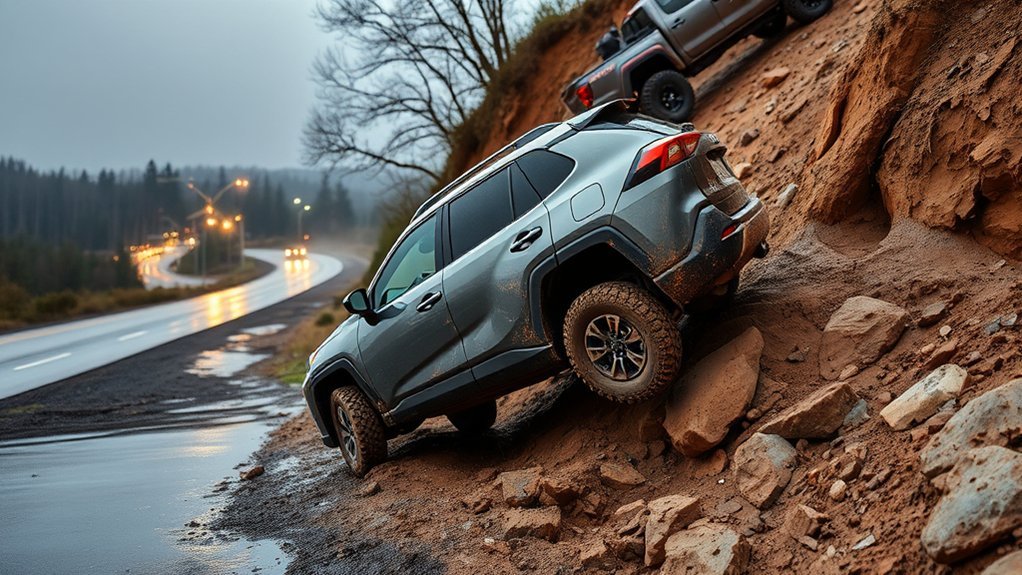
If you routinely tackle deep mud, steep inclines, or rocky trails, you should choose a vehicle with a real 4WD system rather than the RAV4’s light-duty AWD. When off road conditions get serious, real 4WD gives selectable drive modes and locking differentials that you’ll need for sustained traction and control. You want a system that lets you engage low range and force power where it’s required, not an AWD that redistributes torque after slipping begins.
For serious off‑road work—deep mud, steep climbs, rocky trails—choose true 4WD with low range and locking diffs, not light AWD
- Deep mud and saturated trails — AWD often gets overwhelmed; a true 4WD’s torque distribution and locks keep you moving.
- Steep, technical climbs or descents — low-range gearing and selectable modes let you control momentum without burning the drivetrain.
- Rocky, uneven terrain — locking differentials and rigid axles maintain traction where AWD’s on-demand system can’t.
Warning signs: frequent stalls, getting stuck in snow or mud, and consistent wheel spin mean your current AWD faces traction challenges. If your adventures are regular, choose liberation with genuine 4WD.
[Products Worth Considering]

Protect your Toyota RAV4 interior with this custom‑fit windshield sun shade that blocks 99% of harmful UV rays and reduces cabin heat. The mirror cut‑out ensures a seamless fit without gaps, while durable 240T polyester and bendable wire keep it sturdy through repeated use. Foldable and stored in a convenient pouch, it offers easy installation and removal for everyday comfort.

The Autovir windscreen shade offers full windshield coverage for Toyota RAV4 models from 2019 to 2026, blocking up to 99.95% of UV rays and reducing interior heat. Its multi‑layer reflective material provides SPF 100 and UPF 80+ protection while keeping the dashboard, seats, and steering wheel cooler. The foldable design installs quickly and stores conveniently in the glove box, and reinforced stitching ensures long‑lasting durability for daily use.

The Pigenius windshield sunshade protects your Tundra's interior from heat and UV damage while keeping the cabin cool. Its accordion design folds easily for storage and quick setup, and the triple‑laminate construction provides durable, reflective protection. Ideal for long trips and daily commutes, it guards dashboards, seats, and steering wheels from sun‑related wear.
Quick Decision Checklist: Is RAV4 AWD Enough for Your Needs?
Ask whether your daily routes and typical weather — rain, light snow, slick city streets — fit the RAV4’s full‑time AWD, which automatically balances power for stable, confident driving. If you only need reliable traction for commuting and occasional gravel or mild trails, AWD will usually be enough. But if your plans include heavy off‑roading or extreme terrain, you’ll want a true 4WD system instead.
Daily Driving & Weather
Although the RAV4’s AWD won’t conquer hardcore trails, it gives you confident traction for daily driving in rain, light snow, and slick urban roads by automatically sending power to the wheels that need it. For urban commuting and occasional trips in adverse weather, AWD boosts stability and reduces slip without driver intervention. You’ll still want to plan: leave extra stopping distance, watch for black ice, and avoid deep ruts.
- Choose winter tires for true grip gains — they improve braking and cornering far more than AWD alone.
- RAV4 AWD handles wet/slushy surfaces and light off-pavement work, but it’s tuned for on-road use.
- If you crave freedom to explore extreme trails, consider a dedicated 4WD platform instead.
Serious Off-Road Needs
When you’re weighing whether a RAV4’s AWD will meet your off-road needs, think about the worst terrain you plan to tackle and how often you’ll do it. You’ll get a capable, automatic AWD that improves grip on slick roads and handles light off-road conditions, but it’s not built for sustained, aggressive trails. If your trips include frequent mud, deep ruts, steep rock crawling, or long remote routes, the RAV4’s lack of low-range gearing and rugged components becomes a limiting factor. Assess terrain challenges honestly: occasional forest tracks and snow banks? AWD is liberating and efficient. Regular, demanding expeditions? Opt for true 4WD with heavier-duty drivetrain and clearance to guarantee safety and capability.
Driving Tips, Tires & Settings to Get the Most From RAV4 AWD
Start with the basics: keep your tires and settings in top shape so the RAV4’s AWD can do its job—use high-quality all-season or winter tires for better grip, monitor tire pressure and tread depth regularly, and use the Drive Mode Selector (Eco, Sport, Snow) to match conditions. You’ll rely on the AWD’s automatic power distribution, so good tire maintenance and smart use of driving modes free you to go farther with confidence.
- Rotate and inspect tires every 5,000–7,500 miles to keep wear even and AWD balanced.
- Check tire pressure monthly and after temperature swings; low pressure reduces traction and wastes fuel.
- Use Snow mode on slippery roads for crisper throttle mapping and more cautious torque distribution.
Drive smoothly: avoid sudden steering or throttle inputs that can unsettle traction control. Engage AWD for light off-road or poor roads, but don’t push it into serious off-roading. These habits preserve freedom and protect your vehicle.
[Products Worth Considering]

The Autorder windshield sun shade umbrella provides full coverage for Toyota RAV4 models from 2019 to 2026, blocking heat and UV rays with its advanced ice crystal material. Its ten reinforced skeletons and anti‑puncture edges ensure durability and stability, while the effortless umbrella‑style deployment and compact storage bag make it convenient for everyday use. Keep your car interior cool and protected from sun damage with this easy‑setup, high‑performance sunshade.

The KDOWES front windshield sun shade offers a custom fit for Toyota RAV4 SUVs, featuring a double‑layer heat shield that blocks up to 99% of solar rays and reduces interior temperature by up to 40°F. Reinforced steel rings and Velcro fasteners ensure easy installation and a secure fit, while the foldable cartilage steel ring allows convenient storage. This high‑quality, reflective fabric protects upholstery, dashboard, and electronics from UV damage, keeping the cabin cool and comfortable.
Upgrades & Alternatives for RAV4 Owners (Mods, Trims, or Switching to 4WD)
Keeping tires, pressures, and drive modes tuned will take you far, but if you want more capability or utility there are clear upgrade paths to evaluate. You can pursue suspension upgrades and Tire options to boost traction and ground clearance; aftermarket shocks, springs, and all-terrain tires give your RAV4 more confidence on rough tracks while keeping daily comfort acceptable. Trim comparisons matter: moving to a TRD Off-Road or higher RAV4 trim adds features like multi-terrain select and extra clearance without heavy mods. For greater utility enhancements add skid plates, roof racks, and cargo systems to protect gear and expand range. If you regularly face severe terrain, don’t fight the platform — consider switching to a true 4WD Toyota (Tacoma, 4Runner, Land Cruiser) for robust low-range capability and durability. Choose upgrades that match your missions: light mods for freedom and versatility, or a vehicle change when you need uncompromising off-road performance.
Frequently Asked Questions
Which Is Better, AWD or 4WD Toyota?
AWD’s better for most drivers: it boosts weather adaptability, fuel efficiency, lower maintenance costs, and daily driving conditions; 4WD wins off road capability, towing capacity, and rugged performance—choose based on performance comparison and your user preferences.
Conclusion
You’ve got a capable AWD RAV4 that handles rain, light snow, and gravel with confidence, but it isn’t a substitute for true 4WD if you’re planning serious rock crawling, deep mud, or frequent steep, technical trails. Think of AWD as a smart partner—great for everyday unpredictability—while full 4WD is a specialist for extreme conditions. Match your choice to your adventures, pick the right tires and settings, and you’ll get the performance you actually need.