If your RAV4’s steering wheel vibrates, start by assuming tires, brakes, or drivetrain and check those first. You’ll inspect tire pressure, balance, and wear, verify wheel alignment and lug torque, spin wheels for bearing roughness, and feel for brake pulsation under braking (warped rotors). On acceleration, check CV joints and drive unit mounts for play. Replace or balance tires, machine or swap rotors, and tighten or replace worn suspension/drivetrain parts—keep going to get step‑by‑step checks and cost guidance.
RAV4 Vibration: Quick Urgency Checklist

Start with the basics: check tire balance and pressure, then verify wheel alignment and inspect visible suspension components. You’ll prioritize immediate, high-risk vibration sources: unbalanced tires that amplify with speed, alignment faults that make the vehicle pull or vibrate during straight driving or cornering, and suspension parts showing play or noise when you turn or hit bumps. Use targeted troubleshooting tips: spin and visually inspect tires for uneven wear, perform a rapid wobble test at low speed, and feel for pull or steering resistance. If vibrations appear during braking, tag rotors and pads as urgent—warped rotors demand prompt replacement. Monitor tire wear patterns regularly; they reveal chronic alignment or rotation neglect that compounds vibrations. Act decisively: document findings, isolate the most likely source, and prioritize repairs that restore stable control. You want freedom from vibration—so be methodical, efficient, and uncompromising in remediation.
How to Tell: Tires vs Brakes vs Drivetrain
When you feel vibration through the steering wheel or floor, narrow it down by matching when it occurs: at speed, under braking, or during acceleration. If vibration grows with speed and is centered in the steering wheel, suspect tire issues — unbalanced or worn tires, and check tire alignment and balance first. If vibration appears only when you brake, it likely stems from the brake system: warped rotors or uneven pads; also confirm brake fluid condition as part of brake health. If vibration intensifies under acceleration or at specific RPMs, focus on drivetrain components like CV joints, driveshafts, or motor mounts — inspect for play, torn boots, or mounting deterioration. Use symptom analysis to prioritize inspections: speed-related = tires/suspension, braking-related = brakes, acceleration-related = drivetrain. A targeted inspection of tires, brakes, and drivetrain isolates the source efficiently, freeing you from guesswork and moving toward the correct repair.
Fast DIY Checks: Tires, Wheels, and Suspension to Try at Home
Start by checking tire pressure at all four corners and adjust to the manufacturer’s PSI; uneven pressure often amplifies steering vibration. Inspect wheel weights and tire tread for missing weights or asymmetric wear that indicate imbalance. Jack the front end and test for suspension play by moving the wheel and feeling for looseness in ball joints and tie rods.
Check Tire Pressure
1 quick pressure check with a reliable gauge can often pinpoint the simplest cause of steering-wheel vibration: incorrect tire inflation. You’ll practice basic tire maintenance and pressure monitoring to reclaim control. Measure cold pressure at all four corners, compare values to the driver-door placard or owner’s manual, and correct under- or over-inflation to spec. Visually scan tread for uneven wear patterns like scalloping or cupping—these hint at balance or alignment faults but start with pressure. Inspect wheels for obvious bends or cracks that could compromise handling. Rotate tires every 5,000–7,000 miles to equalize wear and reduce vibration risk. If proper inflation and rotation don’t stop the shake, escalate to balance and alignment diagnostics.
Inspect Wheel Weights
Anyone can spot a missing or loose wheel weight with a quick visual check; they’re small but essential for tire balance and preventing steering-wheel vibration after rotations or mountings. You’ll inspect each rim edge for clipped or adhesive weights and note any gaps that disrupt weight placement. Check tire sidewalls for bulges or damage that can mimic imbalance. Confirm lug nuts are torqued to spec—uneven torque introduces wobble that masks true wheel balance issues. Rotate tires every 5,000–7,000 miles to sustain even wear and reduce vibration recurrence. If a weight’s missing or adhesive has failed, replace or reweight the wheel promptly. This diagnostic, hands-on step frees you from needless shop trips and isolates balance before deeper suspension checks.
Test Suspension Play
Check for play by firmly grasping each front tire and rocking it side-to-side; any noticeable movement usually points to worn tie rods, ball joints, or loose wheel bearings that’ll need more inspection or replacement. Then jack the front, spin each wheel to feel binding or roughness—signs in wheel bearings or other suspension components. Inspect CV boots for tears and listen for clicking on tight turns. Push down on the front corners; excessive rebound indicates worn shocks or struts. Confirm lug nuts are torqued. Use wear indicators and visual checks to free yourself from uncertainty and act decisively.
| Symptom | Meaning |
|---|---|
| Side-to-side play | Tie rod/ball joint wear |
| Rough spin | Bearing or component failure |
| Torn CV boot/click | CV joint wear |
| Excess rebound | Shock/strut wear |
Tire & Wheel Fixes: Balancing, Rotation, Replacement, and Wheel Integrity
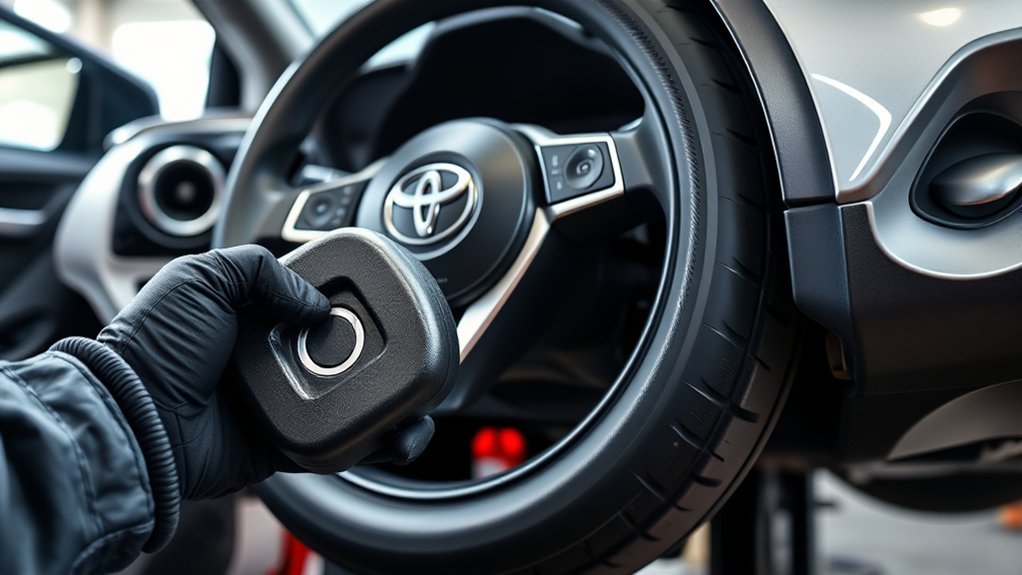
When steering-wheel vibration shows up, start by verifying tire balance, rotation history, age, and wheel condition—imbalances, uneven wear, aged rubber, or bent rims are the most common causes and each requires a specific corrective action. You’ll apply tire maintenance discipline: verify balance after any tire work, check rotation intervals (5,000–7,000 miles), and replace tires showing age-related deterioration even if tread depth seems adequate. Inspect wheels visually and by runout test; bent or cracked rims demand straightening or replacement. Uneven wear patterns like scalloping/cupping point toward wheel alignment or other systemic issues that feed vibration.
- Rebalance wheels after mounting or when vibration begins.
- Rotate tires on schedule to prevent localized wear.
- Replace tires older than six years or with compromised rubber.
- Repair or replace wheels with radial runout, bends, or cracks.
You’ll act decisively, reclaim smoothness, and reject lingering vibration that undermines driving freedom.
Brake Repairs and Suspension Fixes That Stop Steering-Wheel Shake
Inspect the braking and suspension systems promptly—warped rotors, unevenly worn pads, or failing ball joints and struts are common sources of steering-wheel shake and demand targeted repairs. You’ll diagnose vibration by feeling it during braking versus at speed; braking-induced shake points to rotor or pad issues. Warped brake rotors often require brake rotor replacement to restore smooth deceleration. Replace uneven pads and resurface or replace rotors when runout exceeds spec.
If vibrations persist independent of braking, perform a suspension component inspection: check ball joints, control arms, bushings, and struts for play, wear, or leaks. Replace worn ball joints and struts to regain steering stability. After repairs, verify wheel alignment and torque of wheel fasteners; misalignment can magnify brake-related vibration and undermines suspension fixes. Maintain regular inspections and timely component replacement to prevent escalation. You’ll regain control and confidence when braking and steering respond without harmonic feedback.
[Products Worth Considering]

Protect your Toyota RAV4 interior with this custom‑fit windshield sun shade that blocks 99% of harmful UV rays and reduces cabin heat. The mirror cut‑out ensures a seamless fit without gaps, while durable 240T polyester and bendable wire keep it sturdy through repeated use. Foldable and stored in a convenient pouch, it offers easy installation and removal for everyday comfort.

The Autovir windscreen shade offers full windshield coverage for Toyota RAV4 models from 2019 to 2026, blocking up to 99.95% of UV rays and reducing interior heat. Its multi‑layer reflective material provides SPF 100 and UPF 80+ protection while keeping the dashboard, seats, and steering wheel cooler. The foldable design installs quickly and stores conveniently in the glove box, and reinforced stitching ensures long‑lasting durability for daily use.

The Autopect side window sunshade sock screen-shade provides universal, elasticized mesh protection for car, truck, SUV, and van side windows. It filters UV rays, keeps interiors cool, and offers privacy while allowing fresh breezes and bug protection. Easy no‑tool installation and a compact drawstring pouch make it portable for travel and camping.
Drivetrain Checks: CV Joints, Motor/Drive Unit, and Transmission Shudder
Check the CV joints first: worn joints will vibrate under acceleration and often click on tight turns, so inspect boots for tears and play at the joint. Verify the drive unit mounting for excessive movement—loose clevis mounts or bushings transmit acceleration shudder into the steering. Finally, note transmission shudder symptoms (steering-wheel vibration during gear shifts or steady acceleration), which often point to degraded fluid or torque converter issues.
CV Joint Wear Signs
Although vibration during acceleration—particularly between 50–70 mph—often points to tire or balance issues, persistent shaking that grows with throttle can indicate CV joint wear. You should perform a CV joint inspection as part of Symptoms diagnosis when vibrations persist after tire checks. Look for audible and visual cues that free you from guesswork:
- Clicking or popping when turning, a classic sign of internal CV joint damage.
- Torn CV boots or grease leakage, which accelerates wear and contamination.
- Vibration that intensifies with throttle but not with steering input, isolating drivetrain load.
- Reduced stability or shudder under acceleration, signaling advanced joint degradation.
Replace worn joints promptly to restore stability and prevent cascading drivetrain failure.
Drive Unit Movement
If you’ve ruled out tires and CV joints as the source of acceleration vibration, look next at drive unit movement—excessive play in the motor/transaxle mounts or worn drivetrain components will transmit shake into the steering wheel at highway speeds. You’ll perform a focused drive unit inspection: hold the steering wheel steady, apply light throttle, and watch for unit climb or lateral play at the engine/transaxle junction. Combine that with vibration analysis at 50–70 mph to correlate movement with steering input. Check motor mounts for cracked rubber or loose fasteners, inspect tie rods, wheel bearings and suspension bushings for play, and verify CV joints aren’t the hidden cause. Regular transmission-fluid checks can reveal contamination contributing to drivetrain roughness. Act to free yourself from recurring vibration.
Transmission Shudder Symptoms
When you feel a distinct vibration through the steering wheel during acceleration—most often between 50–70 mph and that eases when you lift off the throttle—suspect transmission shudder alongside drivetrain issues like worn CV joints or loose motor mounts. You want clear steps to reclaim control: prioritize transmission maintenance and targeted drivetrain diagnostics to isolate the fault.
- Check for shudder during steady throttle; note RPM and speed range.
- Inspect CV joints for play and clicking on tight turns; replace if degraded.
- Examine motor/drive unit mounts for excessive movement and secure or replace them.
- Drain and replace old transmission fluid; verify torque converter and valve body function.
Act on measured findings; systematic checks free you from recurring vibration and restore confident driving.
What to Ask Your Mechanic and Expected Costs/Timelines

Want to know exactly what’s causing the steering-wheel vibration? Ask your mechanic to check tire alignment and perform a suspension inspection immediately. Start with tire condition and balance—unbalanced or worn tires are common, quick fixes with low parts costs. Request a wheel alignment estimate: typical service runs $75–$100 and usually finishes in under an hour.
Specify a focused suspension inspection of ball joints, struts, and mounts; worn components can produce persistent vibration and may cost $200–$1,000 to repair depending on parts and labor. If vibration appears when braking, ask for rotor and pad measurements—warped rotors often require replacement, roughly $300–$500 and a few hours of shop time.
Demand a written breakdown of labor and parts costs, estimated timelines, and urgency level for each repair. That transparency lets you prioritize repairs, avoid escalation, and reclaim control of your driving experience.
Frequently Asked Questions
How to Get Rid of Steering Wheel Vibrations?
Balance tires, fix wheel alignment, inspect steering components and suspension issues, and address brake problems; adjust driving habits, rotate tires, and replace worn parts so you reclaim control and stop vibrations for good.
Conclusion
You’re close to pinpointing the shake—and ignoring it risks getting worse. Start with tires and wheels, then move to brakes, suspension, CV joints, and the drive unit; each has distinct symptoms you can test quickly. If balancing, rotation, or simple repairs don’t stop the vibration, don’t delay: a drivetrain or transmission issue needs pro diagnosis. Get clear answers on parts, labor, and test drives so you’re not surprised when the real cause shows up.