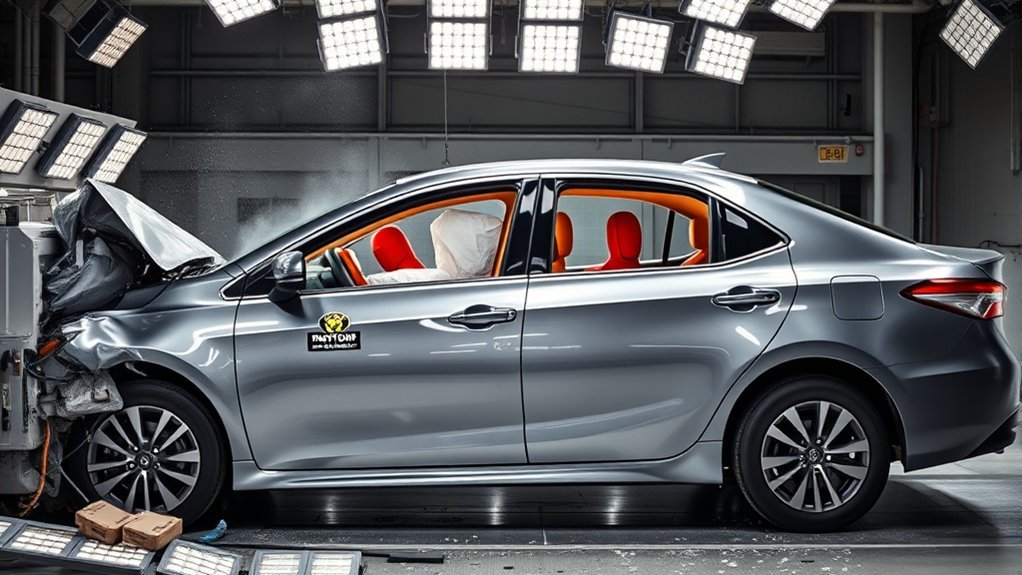
The 2025 Toyota Camry boasts impressive safety test scores, including a 5-Star Overall Safety Rating from NHTSA and “Good” ratings from IIHS for crashworthiness. It excels in driver and passenger protection with small overlap ratings of 1.0 and 1.3, respectively. Advanced features like Toyota Safety Sense 3.0 enhance collision avoidance and pedestrian detection. Along with a solid child occupant protection score of 87%, the Camry ranks high in safety. Discover more key aspects that define its safety performance.
What Makes the 2025 Toyota Camry a Safe Choice?
When considering a midsize sedan, the 2025 Toyota Camry stands out as a safe choice due to its impressive crash test ratings and advanced safety features. It scored well in crash tests, achieving a driver-side small overlap rating of 1.0 and a passenger-side rating of 1.3, highlighting its strong crashworthiness. The standard Toyota Safety Sense 3.0 enhances safety further by effectively preventing collisions, including detecting pedestrians at speeds up to 25 mph.
In terms of occupant protection, the Camry’s robust airbag system and technologies like lane departure alerts and automatic emergency braking work together to minimize injury risks. Significantly, it scored 87% for child occupant protection, showcasing its commitment to safety for all passengers. Additionally, the LED projector headlights provide fair to good visibility, ensuring safer driving conditions. Overall, the 2025 Toyota Camry is engineered to prioritize your safety on the road.
How Do NHTSA and IIHS Ratings Compare?
Understanding how the 2025 Toyota Camry measures up in safety ratings involves comparing assessments from two prominent organizations: the National Highway Traffic Safety Administration (NHTSA) and the Insurance Institute for Highway Safety (IIHS). The NHTSA employs a 5-star rating system that evaluates frontal crash tests, side-impact tests, and rollover evaluations, awarding the Camry a 5-Star Overall Safety Rating. In contrast, the IIHS utilizes a different methodology, focusing on small overlap front tests and headlight performance, with the Camry earning a “Good” rating in crashworthiness.
While NHTSA criteria prioritize crash performance, IIHS ratings also incorporate crash avoidance technologies, recognizing the Camry’s advanced safety systems, particularly through the Toyota Safety Sense 3.0 package. It’s important to highlight that these ratings may not be directly comparable due to their differing criteria and methodologies, reflecting the ongoing evolution of safety standards. This makes the Camry a strong contender in its class.
Key Advanced Safety Features of the 2025 Toyota Camry
The 2025 Toyota Camry stands out with its extensive suite of advanced safety features, designed to enhance driver and passenger protection. Equipped with the Toyota Safety Sense 3.0 system, this model includes automatic emergency braking and pedestrian detection, greatly improving collision mitigation. Lane departure alert with steering assist actively helps you stay centered in your lane, reducing the risk of unintended lane changes.
Additionally, the Camry features a thorough airbag system, including dual frontal, side chest, and knee airbags, ensuring extensive occupant protection in crashes. The speed assistance system with speed sign recognition keeps you informed of current speed limits, encouraging compliance. Moreover, the Camry has demonstrated impressive vehicle-to-vehicle crash prevention capabilities, effectively avoiding collisions in tests conducted at various speeds. With these features, the 2025 Camry not only prioritizes your safety but also offers a more liberated driving experience.
How Safe Is the Toyota Camry?
While evaluating the safety of the 2025 Toyota Camry, you’ll find that it excels in various crash test ratings and advanced safety features. Its impressive scores highlight the effectiveness of Toyota’s safety innovations, which contribute to reduced collision statistics.
| Safety Feature | Evaluation |
|---|---|
| IIHS Moderate Overlap Test | Good |
| Child Occupant Protection | 87% |
| Automatic Emergency Braking | Good |
| Pedestrian Avoidance | Effective |
The Camry’s structural integrity and advanced systems, like standard Toyota Safety Sense 3.0, effectively prevent vehicle-to-vehicle collisions and enhance pedestrian safety. With a combined small overlap rating of 1.0 and 1.3, this sedan minimizes risks of head, neck, and chest injuries. The vehicle’s commitment to safety makes it a top contender in its class, ensuring peace of mind for you and your passengers.
Real-World Crash Avoidance Performance of the Camry?
The 2025 Toyota Camry showcases impressive real-world crash avoidance performance, particularly with its Toyota Safety Sense 3.0 system. In various tests, it effectively avoided collisions with vehicles and pedestrians, demonstrating strong capabilities at critical speeds. These metrics highlight the Camry’s advanced technology in enhancing safety during everyday driving scenarios.
Effective Collision Avoidance Systems
In evaluating the effectiveness of the 2025 Toyota Camry’s collision avoidance systems, it’s clear that these technologies greatly enhance real-world safety. The Standard Toyota Safety Sense 3.0 system excels in collision detection, demonstrating reliable outcomes in vehicle-to-vehicle tests at various speeds, including 31, 37, and 43 mph. In pedestrian scenarios, it effectively avoided collisions at 12 mph and 25 mph, showcasing its responsiveness to vulnerable road users. High beams improved visibility, aiding collision avoidance during parallel adult crossing tests at 25 mph. Additionally, the semitrailer warning system provided timely alerts, enhancing system reliability. With features like autonomous emergency braking and forward collision warning, the Camry effectively reduces speed during impending collisions, reinforcing its commitment to safety.
Real-World Performance Metrics
Considering the 2025 Toyota Camry’s real-world performance metrics, it’s evident that its crash avoidance systems greatly boost safety. In real-world scenarios, the Camry’s front crash prevention system effectively avoided collisions at 12 mph and 25 mph during pedestrian tests. At vehicle-to-vehicle evaluations, it provided timely warnings and successfully prevented collisions at speeds of 31 mph, 37 mph, and 43 mph. Standard features like the Toyota Safety Sense 3.0, which includes automatic emergency braking and forward collision warning, enhance its collision avoidance capabilities. Additionally, the Camry scored 87% in child occupant protection, underscoring its commitment to safety for younger passengers. Overall, the Camry’s systems offer essential protection for both drivers and vulnerable road users.
What to Look for in Used Camrys?
When you’re shopping for a used Toyota Camry, prioritize safety ratings and key features. Check the model’s history for recalls and repairs, especially those involving critical safety components. Focus on models from 2018 to 2020, as they offer advanced safety technologies that enhance overall protection.
Safety Ratings History
As you evaluate used Toyota Camrys, it’s crucial to examine the safety ratings history to guarantee you’re making an informed decision. The 2018–2024 models stand out with a 5-star overall safety rating from NHTSA and an IIHS Top Safety Pick+ designation, reflecting considerable safety technology advancements. In contrast, models from 2012–2017 also achieved 5 stars, thanks to the introduction of Toyota Safety Sense. However, the 2012-2014 Camrys earned only 4 stars, particularly underperforming in small overlap tests. Older models (2007–2011) generally received 4 stars but lacked modern active safety features and faced notable recalls. Historical safety comparisons reveal that prioritizing newer models can enhance your safety assurance considerably.
Key Safety Features
To guarantee you’re selecting a safe used Toyota Camry, focus on key safety features that enhance protection and driving confidence. Look for models equipped with Toyota Safety Sense, which includes active safety features like the Pre-Collision System with Pedestrian Detection and Lane Departure Alert. A good crash test rating is essential; aim for 5 stars from NHTSA and Top Safety Pick+ from IIHS. Advanced safety features, such as automatic emergency braking and adaptive cruise control, should be standard in models from 2018 onward. Additionally, verify the presence of a thorough airbag system, including dual frontal, side, and knee airbags, to guarantee robust passive safety. Finally, research the vehicle’s history for any relevant recalls to confirm its safe operation.
Recall and Repair Records
Checking recall and repair records is essential for guaranteeing the safety and reliability of a used Toyota Camry. Start by focusing on recall awareness, especially for models from 2007 to 2017, where Takata airbags might pose risks. Verify that any necessary repairs for unintended acceleration issues, particularly in 2007 to 2010 models, have been completed. Utilize the National Highway Traffic Safety Administration (NHTSA) website to look up the specific VIN of the Camry for detailed recall information and repair history. Be cautious with models from 2007 to 2011, as they often lack modern safety technology and have a higher incidence of safety-related recalls. Ascertain the car has undergone repair verification, especially regarding safety sensor recalibration, to maintain system effectiveness.
Frequently Asked Questions
What Is the Safety Rating on a Toyota Camry?
The Toyota Camry scores well in safety ratings, excelling in crash tests. It features advanced safety measures like automatic emergency braking, ensuring strong protection for both drivers and passengers in various collision scenarios.
What Is a Good Safety Score for a Car?
A good safety score is like a superhero’s shield, protecting you on the road. Look for a 5-star rating from crash testing organizations, ensuring excellent performance in collisions and advanced safety features to keep you safe.
Is the Toyota Camry Reliability Score Out of 100?
The Toyota Camry typically scores around 80-85 out of 100 for reliability. To guarantee long-term durability, follow Camry maintenance tips like regular oil changes and tire rotations, enhancing both performance and longevity.
What’s the Most Common Problem With a Toyota Camry?
The most common problems with your Toyota Camry include engine issues and brake problems. These can lead to costly repairs and affect your overall driving experience, so addressing them promptly is essential for safety and reliability.
Conclusion
To summarize, the 2025 Toyota Camry stands out as a beacon of safety in its class. With impressive NHTSA and IIHS ratings, it combines advanced safety features with real-world performance to protect you and your passengers. When considering a used Camry, keep an eye on its safety history to guarantee it continues to shine. Ultimately, your choice in a vehicle can be the difference between a smooth ride and a bumpy road ahead.