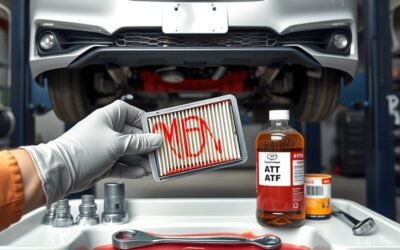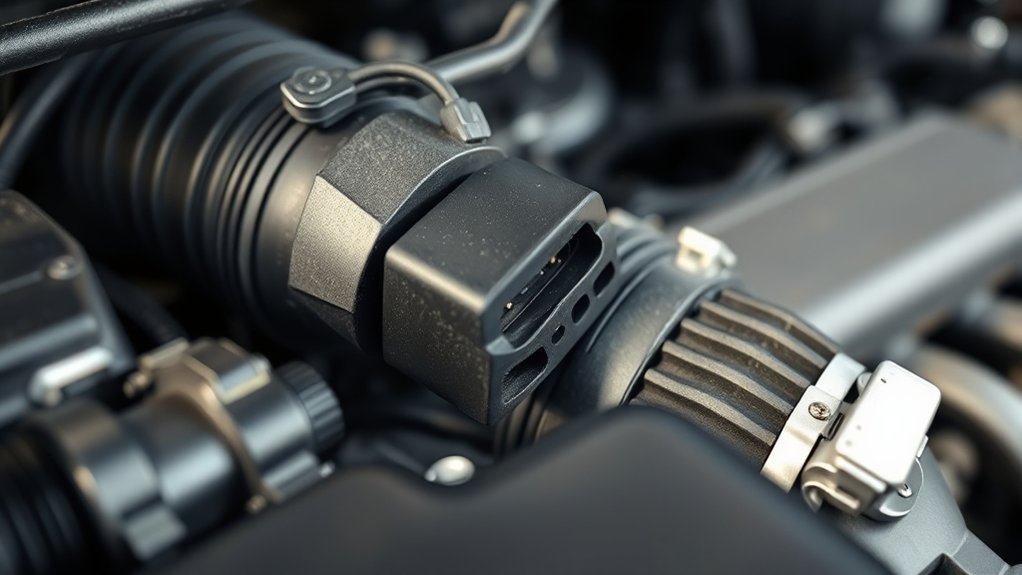
Your Camry’s hot‑wire MAF measures incoming air mass by keeping a heated element at a set temperature; incoming flow cools the wire, the sensor increases current to restore temperature, and that current — plus an integrated IAT — is converted to a conditioned signal for the PCM. The PCM uses those inputs to calculate fuel mass, set injector pulse and timing, and refine shifts. You’ll also see codes and tests for diagnosing, cleaning, or replacing the unit.
Quick Signs Your Camry MAF Is Failing
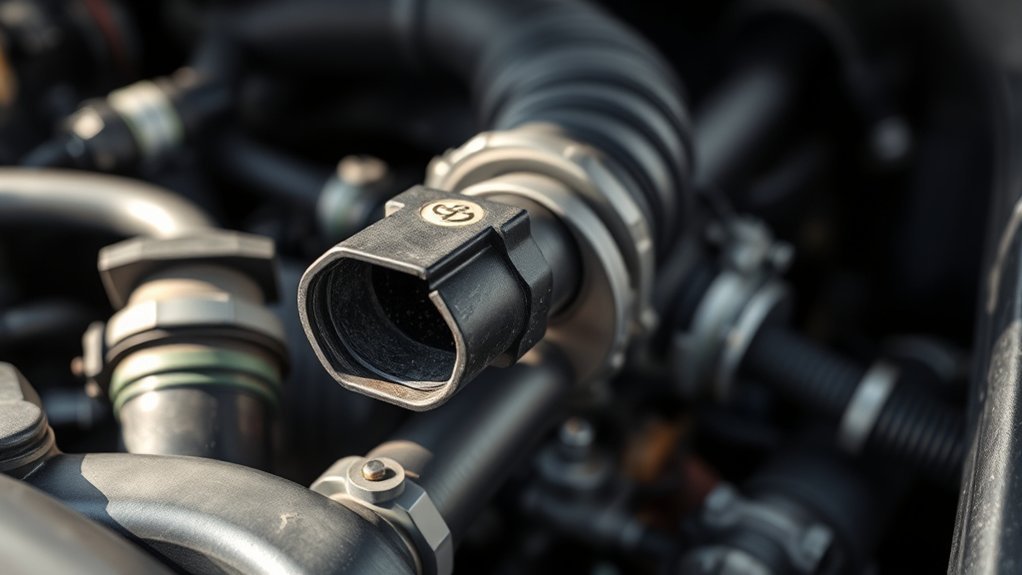
Notice something off with your Camry? You’re looking for clear, actionable indicators of MAF sensor issues. First, check the dash for a check engine light and note codes like P0100, P0102, or P0171; these narrow the fault to airflow sensing. Next, observe idle quality: rough idling or stalling at low RPMs signals contaminated or failing circuitry. When accelerating, watch for a hesitation or lack of engine power—this shows the ECU is compensating for bad airflow data. If starting becomes difficult or erratic, the MAF element may be damaged or obstructed. Monitor fuel use: an unexplained rise in consumption without driving changes points to incorrect air‑fuel ratios from MAF errors. Finally, perform a scan‑tool test: read live airflow values across idle and higher RPMs; irregular or flat readings confirm a malfunctioning sensor. Act on these diagnostics to reclaim reliable engine performance and vehicle autonomy.
How the Camry’s Hot‑Wire MAF and IAT Work
If you’ve spotted the signs of a failing MAF, the next step is understanding how the Camry’s hot‑wire MAF and integrated IAT produce the airflow data the PCM uses. You’ll see a heated wire exposed to intake flow; hot wire technology keeps that element at a set temperature. As intake air passes, it cools the wire, and the sensor’s driver increases current to restore temperature. The required current correlates to airflow measurement: more current equals higher mass flow.
The assembly includes an IAT element that measures incoming air temperature alongside the hot wire’s current demand. An onboard electronic chip converts current and temperature readings into a conditioned digital signal. You can rely on that signal to represent both mass and temperature of incoming charge. Maintain the sensors clean and secure; their accuracy directly prevents stalling, power loss, and trigger codes. Follow procedural checks when suspecting faults to reclaim control of engine performance.
How the Camry PCM Uses MAF Data
When the Camry’s PCM receives MAF and IAT inputs, it calculates the exact fuel mass and adjusts injector pulse width to hold the target air‑fuel ratio, so you get efficient combustion and consistent drivability. You’ll see the PCM adjustments act on several systems: it alters injector timing/duration, compensates for air density changes, and refines transmission shift logic to preserve responsiveness and fuel efficiency. You follow a clear feedback loop: sensor → PCM calculation → actuator command → measured response.
- Monitor airflow and temperature inputs continuously to recalculate fuel mass.
- Modify injector pulse width in real time for stoichiometry and load changes.
- Adjust automatic transmission shift points based on measured intake flow.
- Flag anomalous MAF readings to initiate diagnostics and protect the engine.
Operate with intent: the PCM uses MAF data to maintain liberated control over combustion and drivability, prioritizing efficiency and adaptive performance without compromise.
Camry MAF Symptoms and Trouble Codes to Watch
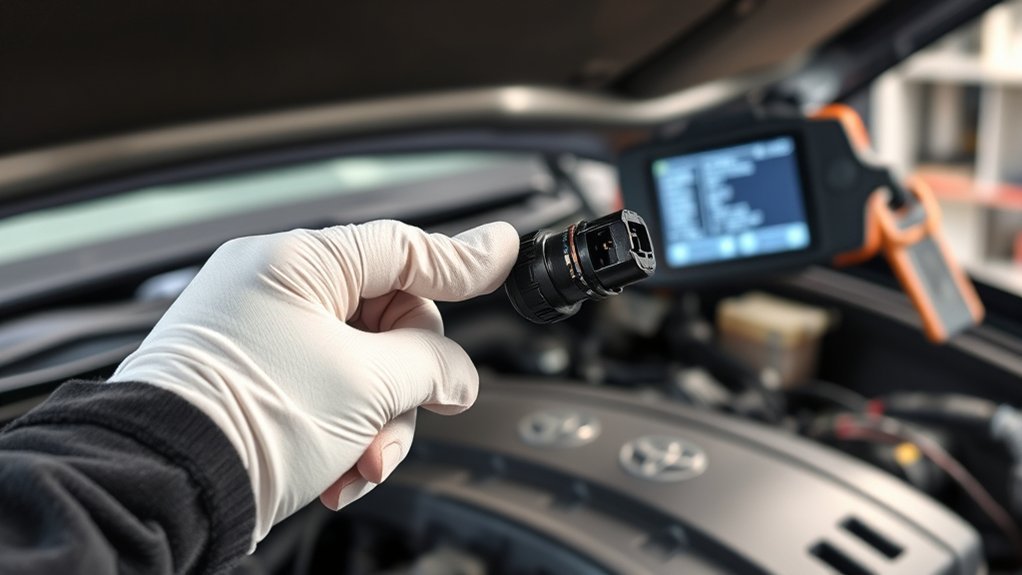
Now that you know how the PCM uses MAF data to control fuel and drivability, watch for specific symptoms and codes that indicate the sensor isn’t reporting correctly. You’ll see stalling, lack of power during acceleration, rough idling, inconsistent engine performance, and reduced fuel economy when the MAF sensor degrades. Use a scan tool to capture trouble codes—common ones are P0100, P0101, P0102, P0103, and P0171—which pinpoint signal, calibration, or fuel-trim drift issues.
Procedure: prioritize codes, then verify live airflow readings at idle and under load against expected values. Check for contamination sources such as dirty intake, improper air filter installation, or wiring/connectors that alter the signal. Don’t assume the MAF is bad without correlating symptoms, codes, and airflow data. By diagnosing methodically you’ll reclaim reliable engine performance and avoid unnecessary parts replacement, preserving your autonomy over vehicle maintenance.
Test, Clean, and Replace a Camry MAF (Step‑by‑Step)
Start by verifying codes and live airflow with a scan tool, then proceed stepwise: disconnect the battery, remove the MAF from the intake housing, inspect wiring and the intake path for leaks or contamination, and test voltage/signal and airflow readings at idle and under load against factory specs. You’ll use diagnostic tools to capture live data and confirm discrepancies before acting. For cleaning, remove the sensor, hold it by the body, and spray specialized MAF cleaner on the hot wire and surrounding circuitry without touching components; let it air dry. If readings remain out of spec or physical damage exists, replace the sensor with a model-year- and engine-specific unit. Reconnect the battery, clear codes, and drive to allow PCM recalibration.
- Use a scan tool to compare airflow vs. RPM against factory charts.
- Inspect seals, clamps, and wiring harness integrity.
- Use MAF cleaner only; avoid solvents or brushes.
- Verify check-engine status and post-drive data.
This routine is sensor maintenance that frees you from guesswork.
Frequently Asked Questions
What Is the Function of the Mass Air Flow Sensor in a Toyota?
The MAF sensor measures incoming air volume so your ECM meters fuel accurately; you’ll preserve performance and freedom by prioritizing MAF sensor importance, performing routine MAF sensor cleaning, and diagnosing faults to prevent stalling.
What Are the Symptoms of a Bad Mass Air Flow Sensor?
You’ll see poor engine performance, stalling or hard starts, rough idling, reduced acceleration, and check engine light codes. For troubleshooting tips, inspect MAF sensor for contamination, wiring faults, and common issues like debris or improper installation.
How Important Is an Air Mass Flow on Camry?
You need it — essential. Picture a valve opening slowly, airflow measurement guiding fuel delivery; you’ll regain control as engine performance stabilizes, preventing stalls, rough shifts, and poor economy so you’re freed from uncertainty.
What Should My MAF Sensor Read at Idle?
At idle you should see about 2–7 g/s; verify MAF sensor calibration and confirm Idle air measurement is steady. If readings fall below 2 g/s or fluctuate, clean or test the sensor and reclaim control.
Conclusion
So your Camry’s MAF is acting up — congratulations, you’ve earned a car that guesses its own fuel needs. Follow the tests, cleanings, and replacements like a lab protocol: measure, record, rinse, retest. Heed the trouble codes and don’t improvise with mystery sprays. If readings stay wrong, swap the sensor for a known-good unit and recalibrate. Do it by the book, not by hope; precise airflow data keeps your engine humming and diagnostics honest.