
Choosing the right Toyota 4Runner brake fluid keeps your pedal firm, protects internal ABS seals, and prevents dangerous brake fade on steep grades. Most 4Runner generations require DOT 3 fluid for factory compliance, though DOT 4 is a direct glycol-based upgrade if you tow heavy loads or drive aggressively in mountain terrain. Never use silicone-based DOT 5 fluid, which damages Toyota hydraulic systems. Below, you will find the exact OEM specifications, a side-by-side boiling point comparison, and the step-by-step flush procedure for both vacuum and electro-hydraulic 4Runner brake systems.
Quick Answer: Which DOT Fluid for a 4Runner?
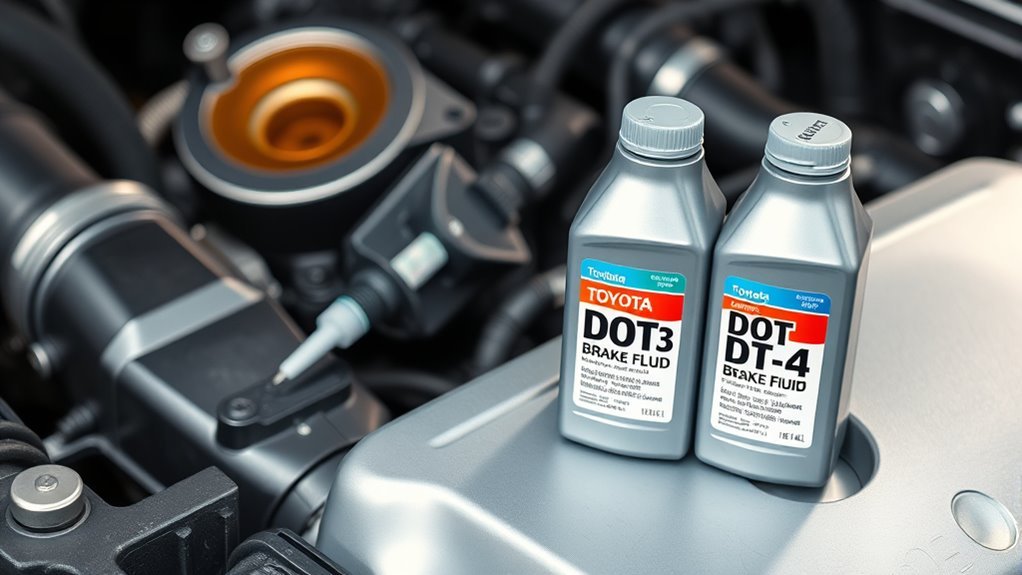
You should use FMVSS No. 116 DOT 3 (or SAE J1703) brake fluid as the standard factory fill for a Toyota 4Runner. If you tow trailers, carry heavy overland gear, or drive down long mountain passes, you can safely upgrade to DOT 4 (SAE J1704) for a higher boiling point. Avoid DOT 5 silicone fluid completely because it does not mix with glycol fluids and ruins ABS valves and rubber seals.
Because both DOT 3 and DOT 4 use a polyalkylene glycol ether base, you can top off or flush a DOT 3 system with DOT 4 without harming factory seals. However, mixing the two lowers the boiling point closer to DOT 3 levels, so a complete flush of 32 to 48 fl oz (1 to 1.5 quarts) is best when switching grades. Flush and replace your brake fluid every 2 years or 20,000 to 30,000 miles to prevent moisture buildup, internal corrosion, and vapor lock.
Which DOT Rating Does Toyota Recommend for the 4Runner?
Toyota specifies SAE J1703 or FMVSS No. 116 DOT 3 across nearly every 4Runner generation, while also approving FMVSS No. 116 DOT 4 (SAE J1704) on newer models and reservoir caps. Checking your Toyota 4Runner Owner’s Manual and the lettering stamped on the master cylinder cap confirms the exact requirement for your model year.
Dealership service departments stock Genuine Toyota DOT 3 Brake Fluid (00475-1BF03) in 12 oz bottles as the standard factory replacement. Using DOT 3 maintains predictable pedal feel in cold weather and keeps your hydraulic system aligned with factory warranty guidelines. If you step up to DOT 4 for extra heat margin, record the fluid brand, DOT rating, date, and mileage in your maintenance log so future top-offs stay consistent.
Note: On 4Runners equipped with an electro-hydraulic brake booster (all 2003–2009 4th-gen models, 2010–2024 5th-gen Trail, TRD Off-Road, TRD Pro, and Limited trims with Crawl Control or A-TRAC, and 2025+ 6th-gen models), Toyota instructs you to turn the ignition OFF and press the brake pedal 20 to 40 times to depressurize the accumulator before checking or topping off the reservoir to the MAX line.
DOT3 vs DOT4 vs DOT5: Boiling Points, Water Uptake, and Compatibility
DOT 3 and DOT 4 are glycol-ether fluids that mix safely in service, but they differ in minimum boiling temperatures, cold-weather viscosity, and moisture chemistry. Under FMVSS No. 116 federal brake fluid standards, DOT 3 must reach a minimum dry boiling point of 401°F (205°C) and a wet boiling point of 284°F (140°C), whereas DOT 4 starts at 446°F (230°C) dry and 311°F (155°C) wet.
| Fluid Grade | Chemical Base | Min. Dry Boiling Point | Min. Wet Boiling Point (3.7% H2O) | Max Viscosity at -40°F (-40°C) | 4Runner Compatibility |
|---|---|---|---|---|---|
| DOT 3 | Glycol ether | 401°F (205°C) | 284°F (140°C) | 1,500 mm²/s | Factory standard (all years) |
| DOT 4 | Glycol ether + borate esters | 446°F (230°C) | 311°F (155°C) | 1,800 mm²/s | Compatible upgrade (towing/heat) |
| DOT 5 | Silicone (di-organo polysiloxane) | 500°F (260°C) | 356°F (180°C) | 900 mm²/s | Incompatible (do not use) |
| DOT 5.1 | Glycol ether + borate esters | 500°F (260°C) | 356°F (180°C) | 900 mm²/s | Chemically compatible (extreme/cold use) |
DOT 4 adds borate esters to its glycol-ether base. Those esters chemically neutralize incoming water molecules at first, keeping the wet boiling point higher at 3.7% water content (311°F vs. 284°F for DOT 3) and resisting brake fade under repeated heavy braking. However, DOT 4 actually absorbs moisture from the atmosphere roughly 20% faster than DOT 3 over time, meaning you should never stretch service intervals past 2 years or 20,000–30,000 miles.
DOT 5 is a non-hygroscopic silicone fluid that entrains air bubbles, foams inside ABS modulators, and allows any trapped water to pool and corrode calipers at low points. Never pour DOT 5 into a 4Runner. By contrast, DOT 5.1 is a glycol-ether and borate-ester fluid that meets DOT 5 boiling and cold-viscosity targets while remaining compatible with DOT 3 and DOT 4 systems.
Pick the Right Fluid: Daily Driving, Towing, and Performance Use Cases
Match your brake fluid’s boiling point and viscosity to how you load and drive your 4Runner. A stock commuter sees far less caliper heat than an armored rig descending a mountain pass with a camper in tow.
- Daily commuting and light trails: Stick with OEM-spec DOT 3 (SAE J1703 / FMVSS No. 116). It absorbs moisture more slowly than DOT 4, maintains low viscosity in sub-zero winters, and provides plenty of thermal headroom for everyday stops.
- Heavy towing and overland builds: Upgrade to DOT 4 or a dual-rated synthetic fluid like Valvoline DOT 3 and DOT 4 brake fluid when pulling trailers up to the 4Runner’s 5,000-lb capacity or running steel bumpers, winches, and 33-inch tires. The higher 311°F+ wet boiling point prevents vapor lock on long downhill grades.
- Extreme mountain descents or spirited driving: Choose a high-temp performance DOT 4 fluid such as ATE TYP 200 DOT 4 brake fluid, which delivers a 536°F (280°C) dry boiling point and a 388°F (198°C) wet boiling point while meeting FMVSS No. 116 DOT 4 and SAE J1704 standards.
Always buy brake fluid in factory-sealed containers, open the bottle right before pouring, and discard leftover unsealed fluid that has sat on a garage shelf absorbing humidity.
Brake‑Fluid Flush: Step‑by‑Step for the 4Runner (Safety Tips & Cautions)
Flushing the brake fluid on a Toyota 4Runner takes 45 to 60 minutes and requires 32 to 48 fl oz of fresh DOT 3 or DOT 4 fluid, a 10 mm box-end or flare-nut wrench, clear 3/16-inch vinyl tubing, a catch bottle, a fluid syringe or turkey baster, nitrile gloves, and safety glasses. Before turning a wrench, check whether your 4Runner uses a conventional vacuum booster (most 5th-gen SR5 models) or an electric hydraulic booster pump (all 4th-gen models, plus 5th-gen TRD Off-Road, TRD Pro, Trail, and Limited trims).
Pro Tip: Do not combine a handheld vacuum pump with an assistant pressing the brake pedal at the same time. Choose one method: either pull fluid solo with a vacuum bleeder while the pedal stays released, or use the two-person pedal method below.
- Park and depressurize the accumulator: Park on level ground, set the parking brake, and chock the wheels. With the ignition switched OFF, press the brake pedal firmly 20 to 40 times until the pedal feels hard and the hydraulic booster accumulator is fully depressurized.
- Extract old reservoir fluid and refill: Wipe dirt off the master cylinder cap before opening it. Use a clean syringe to remove old, dark fluid from the reservoir down to the MIN line (never empty it completely), then fill to the MAX line with fresh, sealed DOT 3 or DOT 4 fluid.
- Bleed the front calipers (passenger front, then driver front): Place a 10 mm wrench on the bleeder screw and slip the clear tubing over the nipple, submerging the other end in a catch bottle holding an inch of clean brake fluid. Turn the ignition to ON (engine off). Have your assistant pump the pedal 3 to 4 times and hold it down; crack the bleeder screw 1/4 turn until fluid slows, tighten the screw before your assistant releases the pedal, and repeat until clear fluid flows free of air bubbles.
- Bleed the rear calipers (passenger rear, then driver rear): Keep the ignition switched ON (engine off) for models with the electro-hydraulic booster. Have your assistant press and hold the brake pedal down without pumping, then open the rear bleeder screw 1/4 turn—the electric accumulator pump will run automatically and push fluid through the rear line continuously. Close the valve after 5 to 10 seconds to refill the master cylinder reservoir, and repeat until the fluid runs clear. (On vacuum-booster SR5 models, use the standard pump-and-hold method at all four corners, starting at passenger rear, driver rear, passenger front, and driver front.)
- Torque the bleeder screws and set final fluid level: Tighten all four bleeder screws to 11 N·m (8 ft-lbf / 97 in-lbf), reinstall the rubber dust caps, and inspect for leaks. Turn the ignition OFF, pump the pedal 20 to 40 times to depressurize the accumulator, set the reservoir level exactly to MAX, and test for a firm brake pedal before driving.
Warning: Never let the master cylinder reservoir drop below the MIN line while bleeding. Introducing air into the master cylinder or ABS actuator requires an automated bleed procedure using Toyota Techstream diagnostic software. Immediately rinse any brake fluid spills off painted surfaces with water, and take used fluid to a household hazardous waste facility.
Frequently Asked Questions
What Is the Best Brake Fluid for a Toyota 4Runner?
FMVSS No. 116 DOT 3 brake fluid (such as Genuine Toyota 00475-1BF03 or Prestone DOT 3) is the best choice for daily-driven Toyota 4Runners because it matches factory viscosity and seal specifications. If you tow heavy trailers or drive steep mountain passes with heavy overland gear, upgrading to DOT 4 provides higher dry and wet boiling points to resist brake fade.
Which Is Better, DOT 4 or DOT 5.1 Brake Fluid?
DOT 5.1 outperforms standard DOT 4 in extreme temperatures, offering a higher minimum dry boiling point (500°F vs. 446°F) and half the cold-weather viscosity at -40°F (900 mm²/s vs. 1,800 mm²/s) for faster ABS response in freezing climates. However, standard DOT 4 is more widely available, costs less, and provides more than enough thermal margin for towing or off-road use in a 4Runner.
How Much Brake Fluid Do You Need for a 4Runner Flush?
A complete brake fluid flush on a Toyota 4Runner requires 32 to 48 fl oz (1 to 1.5 quarts) of fresh fluid. Buying one 32 oz bottle plus one 12 oz bottle (or four 12 oz OEM Toyota bottles) ensures you have enough fluid to flush the reservoir and all four caliper lines without letting the master cylinder run low.
Can You Mix DOT 3 and DOT 4 Brake Fluid in a 4Runner?
Yes, you can safely mix DOT 3 and DOT 4 brake fluid in a Toyota 4Runner because both share a compatible glycol-ether base. Keep in mind that topping off DOT 4 with DOT 3 lowers the overall boiling point of the mixture, so performing a full system flush is recommended when switching between grades.
Why Does My 4Runner Brake Booster Buzz When Bleeding the Rear Brakes?
That buzzing or whirring sound is the electric accumulator pump on 4Runners equipped with an electro-hydraulic brake booster (4th-gen models, 5th-gen TRD Off-Road, TRD Pro, Trail, and Limited trims, and 6th-gen models). When the ignition is ON and the pedal is held down, the electric pump pressurizes the rear brake circuit automatically. Avoid running the pump continuously for more than 30 to 60 seconds at a time so the motor can cool.
Conclusion
Use DOT 3 brake fluid for standard daily driving in your Toyota 4Runner, or step up to DOT 4 when towing heavy loads or descending steep off-road grades. Never use silicone DOT 5 fluid. Check your reservoir cap before buying fluid, flush the hydraulic lines every 20,000 to 30,000 miles, torque the 10 mm bleeder valves to 11 N·m (8 ft-lbf), and verify a firm brake pedal before heading out on the road.
Sources
- Toyota 4Runner Owner’s Manual: Factory FMVSS No. 116 DOT 3 specification and accumulator depressurization procedure for checking reservoir level.
- Toyota Autoparts (Genuine Toyota Brake Fluid 00475-1BF03): OEM DOT 3 brake fluid part specification and bottle size.
- Electronic Code of Federal Regulations (49 CFR § 571.116): FMVSS No. 116 minimum dry/wet equilibrium reflux boiling points and kinematic viscosity limits for DOT 3, DOT 4, DOT 5, and DOT 5.1 brake fluids.
- Valvoline Global: Dual-rated DOT 3 and DOT 4 synthetic brake fluid compatibility and moisture protection specifications.
- ATE North America: ATE TYP 200 DOT 4 high-performance brake fluid dry and wet boiling point specifications.


[…] For a deeper look at the ratings, see our 4Runner brake fluid DOT ratings guide. […]