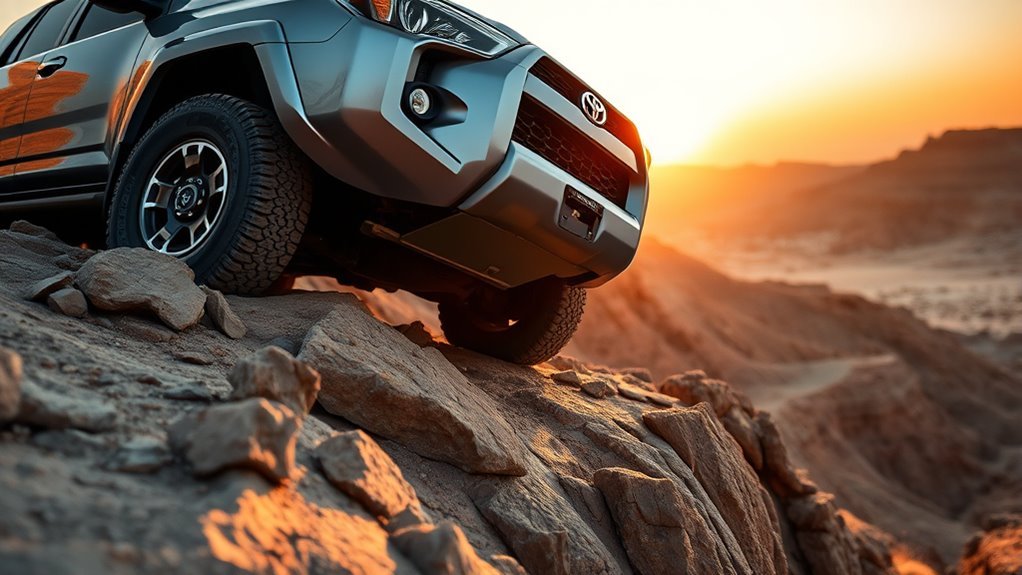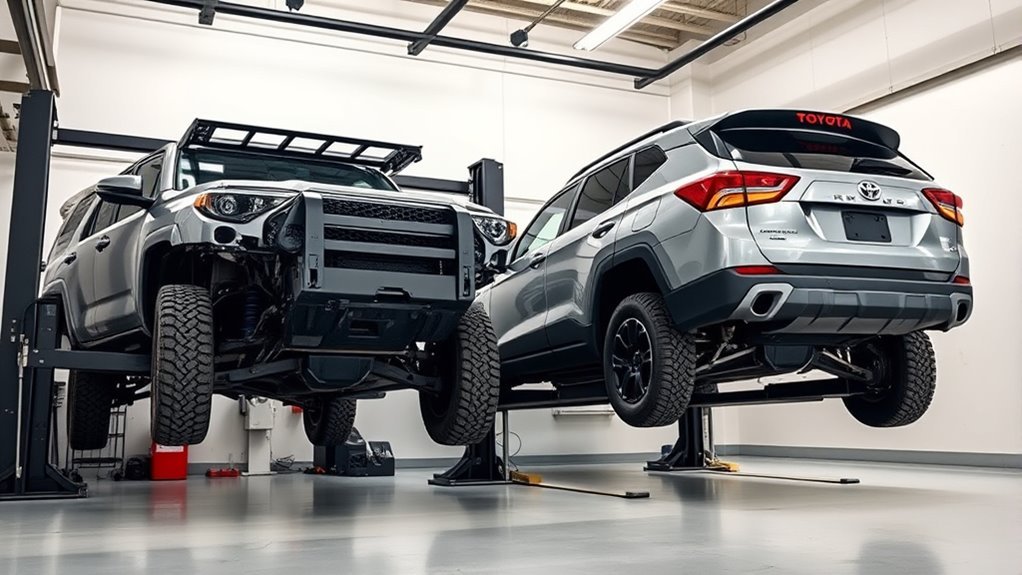
Choosing between a Toyota 4Runner vs unibody SUV comes down to whether you need a truck-based workhorse for rugged trails and heavy trailers or an efficient crossover built for paved roads. While the 4Runner rides on a separate steel ladder frame engineered for off-road punishment, unibody SUVs like the Toyota RAV4 and Highlander integrate the body and frame into one lighter shell for smoother handling and higher gas mileage.
Quick Answer
Buy a body-on-frame Toyota 4Runner if you tackle rough trails, want bolt-on off-road upgrades, or tow up to 6,000 pounds. Choose a unibody SUV like the Toyota RAV4 or Highlander if you prioritize 24 to 44 mpg fuel economy, quieter highway handling, easier parking, and maximum passenger space.
Last checked: October 17, 2026. Dates and figures were verified against official sources.
Key Takeaways
- Sixth-generation 4Runner gains: The 2025–2026 4Runner switches to Toyota’s TNGA-F boxed steel frame, boosting towing from 5,000 to 6,000 pounds and highway mileage up to 26 mpg.
- Unibody efficiency advantage: The 2026 RAV4 Hybrid achieves 38 to 44 mpg combined, and the Highlander Hybrid delivers 35 mpg combined, cutting annual fuel bills by 35% to 50%.
- True 4WD vs. AWD: The 4Runner uses a two-speed transfer case with low-range gearing and a locking rear differential, whereas unibody crossovers use on-demand all-wheel drive for wet or snowy pavement.
- Resale value surprise: Despite higher fuel consumption, the 4Runner retains 58.0% of its value after five years, outperforming almost every unibody crossover on the market.
Quick Verdict: Who Should Buy a 4Runner (BOF) vs. a Unibody SUV?
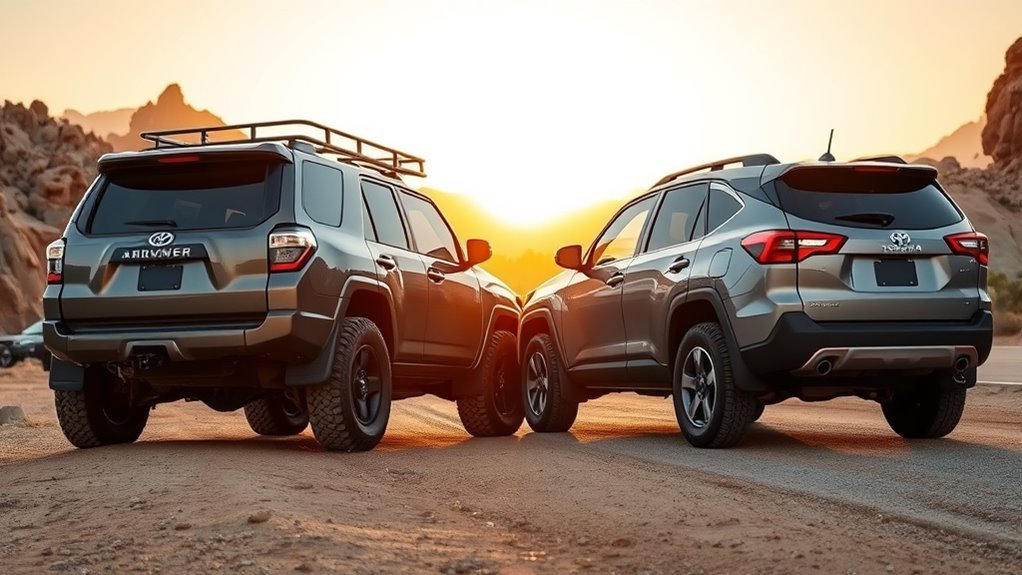
You should buy a Toyota 4Runner if you need a vehicle that tolerates rocky trails, deep ruts, and heavy tongue weights without structural fatigue. You should choose a unibody SUV like the RAV4 or Highlander if 95% of your driving happens on paved streets, school drop-off lanes, and interstate highways.
According to Toyota’s official 2026 4Runner specifications, the sixth-generation 4Runner (2025–2026) pairs its body-on-frame chassis with a 278-horsepower 2.4-liter turbocharged i-FORCE engine or a 326-horsepower i-FORCE MAX hybrid powertrain. That raises maximum towing to 6,000 pounds (up from 5,000 pounds on 2010–2024 V6 models) while preserving support for aftermarket lift kits, steel bumpers, and winches.
By contrast, a unibody SUV combines the body panels and floorpan into one single-piece structure. That design trims 500 to 900 pounds of curb weight, lowers the step-in height, widens third-row legroom, and builds computer-modeled crumple zones directly into the cabin shell for daily commuting.
| Specification (2026 Model Year) | Toyota 4Runner (i-FORCE / i-FORCE MAX) | Toyota RAV4 (Hybrid / PHEV) | Toyota Highlander (Gas / Hybrid) |
|---|---|---|---|
| Chassis Architecture | Body-on-frame (TNGA-F boxed steel ladder) | Unibody (TNGA-K compact platform) | Unibody (TNGA-K midsize platform) |
| Powertrain Output | 278 hp & 317 lb-ft / 326 hp & 465 lb-ft | 226–236 hp (Hybrid) / 324 hp (PHEV) | 265 hp & 310 lb-ft (Gas) / 243 hp (Hybrid) |
| Estimated Fuel Economy | 20/26 mpg (Gas 2WD) / 23/24 mpg (Hybrid) | 38–44 mpg combined (Hybrid) / 36–37 mpg (PHEV) | 24 mpg combined (Gas) / 35 mpg combined (Hybrid) |
| Maximum Towing Capacity | Up to 6,000 lbs (5,000 lbs on 2010–2024 V6) | 1,500 to 3,500 lbs (grade dependent) | 5,000 lbs (Gas) / 3,500 lbs (Hybrid) |
| Ground Clearance | 8.1 to 10.1 inches | 8.1 to 8.5 inches (Woodland grade) | 8.0 inches |
| Base Starting MSRP | $42,270 (SR5) / $53,490 (i-FORCE MAX) | $31,900 (Hybrid) / $41,500 (PHEV) | $46,270 (Gas AWD) / $48,020 (Hybrid AWD) |
Why Toyota Keeps the 4Runner on Body‑On‑Frame and What That Changes for You
Toyota keeps the 4Runner on a body-on-frame platform because mounting the passenger cabin on rubber bushings atop a separate, high-strength boxed steel ladder frame isolates the body from torsional twisting and rock impacts. While rival automakers moved the Nissan Pathfinder, Ford Explorer, and Chevrolet Blazer to unibody crossovers, Toyota doubled down by building the 4Runner on its global TNGA-F truck platform alongside the Tacoma, Land Cruiser, Sequoia, and Tundra.
Off‑Road Durability
A separate steel ladder frame absorbs and distributes diagonal wheel loads across heavy-gauge rails rather than sending stress through windshield pillars, door frames, and roof welds. When you drop a tire into a deep washout or scrape over a ledge, the frame takes the load while the body remains straight, ensuring your doors and tailgate still open and close smoothly on uneven ground.
Field and collision repairs are also more localized. Scraping a rocker panel or bending a bumper mount on a 4Runner rarely compromises the underlying chassis geometry, whereas twisting a unibody floorpan or subframe mount requires complex frame-rack straightening. Because the frame rails feature dedicated mounting points, bolting on frame-mounted rock sliders, steel skid plates, or a front winch requires no structural welding.
| Chassis Element | 4Runner (TNGA-F Frame) | Real-World Outcome |
|---|---|---|
| Laser-welded boxed steel frame | High torsional rigidity under load | Prevents body flex and door binding on steep obstacles |
| Up to 10.1-inch ground clearance | 33° approach / 24°–26° departure angles | Clears boulders, ruts, and steep creek banks without scraping |
| Solid rear axle with coil springs | Consistent tire contact under articulation | Maintains traction when opposite wheels travel vertically |
Towing And Payload
A separate steel frame directly improves towing stability and hitch stiffness because the receiver bolts straight into the rear frame crossmember rather than thin unibody sheet metal. On fifth-generation 4Runners (2010–2024 with the 270-horsepower 4.0-liter V6), maximum towing sits at 5,000 pounds. On sixth-generation 4Runners (2025–2026), the standard receiver hitch and high-torque turbo powertrains push the rating up to 6,000 pounds with a 600-pound maximum tongue weight.
Even when a unibody SUV matches a 5,000-pound tow rating—such as the turbocharged gas Toyota Highlander—the 4Runner handles tongue weight and unpaved boat ramps with less rear-end sag and lower transmission heat stress. Its solid rear axle and stiffer frame rails keep the trailer level over washboard roads and steep mountain grades.
Warning: Never judge towing safety by maximum trailer weight alone. Subtract the weight of all passengers, rooftop tents, steel bumpers, and cargo from your vehicle’s payload capacity (typically 1,450 to 1,650 pounds on the 4Runner) to verify it can still support a trailer’s 10% to 15% tongue weight without overloading the rear axle.
Road Performance: Handling, Ride Comfort, and Noise – 4Runner vs Unibody
On paved highways and city streets, unibody SUVs clearly outperform the 4Runner in steering precision, ride smoothness, cabin quietness, and interior space efficiency. Because the 4Runner sits higher on a heavy truck frame with a solid rear axle, it exhibits more body roll in tight corners, slight nose dive under hard braking, and firmer feedback over expansion joints.
Unibody crossovers like the RAV4 and Highlander use four-wheel independent suspension (MacPherson struts up front and a multi-link rear layout) combined with a lower center of gravity. When one rear wheel hits a pothole in a unibody SUV, it moves independently without jostling the opposite wheel or unsettling the cabin.
Body-on-frame construction gives the 4Runner unmatched trail toughness, while unibody crossovers trade extreme chassis armor for car-like handling, quieter cabins, and lower step-in height.
- Handling dynamics: Unibody platforms offer sharper turn-in, flatter cornering, and shorter braking distances on wet or dry asphalt; the 4Runner’s taller ride height and off-road tires demand slower entry speeds on highway ramps.
- Passenger comfort and space: Eliminating the separate frame rail beneath the cabin gives unibody SUVs a lower floor, easier entry for children or seniors, and noticeably more third-row legroom, while the 2025–2026 4Runner still delivers up to 88.8 to 90.2 cubic feet of cargo space with rear seats folded.
- Cabin noise and active safety: Aggressive all-terrain tires and upright bodywork increase wind and road noise in the 4Runner at 70 mph, though 2025–2026 models add standard Toyota Safety Sense 3.0 to match unibody driver-assistance features.
Off‑Road, Towing, and Durability: Where the 4Runner Clearly Wins
The 4Runner wins decisively once the pavement ends because it pairs its truck frame with mechanical four-wheel-drive hardware that unibody crossovers simply do not offer. While AWD unibody SUVs rely on clutches or rear electric motors designed for rain and light snow, four-wheel-drive 4Runners include a two-speed transfer case with true low-range gearing (4-Low).
Shifting into 4-Low multiplies engine torque at crawling speeds so you can climb rocky grades or descend steep ledges without overheating the transmission or riding the brakes. Upper off-road trims (TRD Off-Road, TRD Pro, and Trailhunter) add an electronically locking rear differential that forces both rear wheels to spin at the exact same speed even when one wheel hangs in the air.
On 2025–2026 models, Toyota also offers a push-button Stabilizer Disconnect Mechanism (SDM) that unlocks the front sway bar for greater wheel articulation over uneven boulders, alongside Multi-Terrain Select and Crawl Control. Per Toyota USA Newsroom’s 2026 RAV4 release, even the trail-focused RAV4 Woodland grade tops out at 8.5 inches of ground clearance and lacks low-range gearing or locking differentials.
Pro Tip: If you plan to fit 33-inch tires and a 2.5-inch suspension lift on a 4Runner, budget for aftermarket upper control arms at the same time. Correcting your front caster angle keeps the steering centered at highway speeds and prevents premature inner-edge tire wear.
Ownership Costs: Fuel, Maintenance, Repair, and Resale – 4Runner vs Unibody
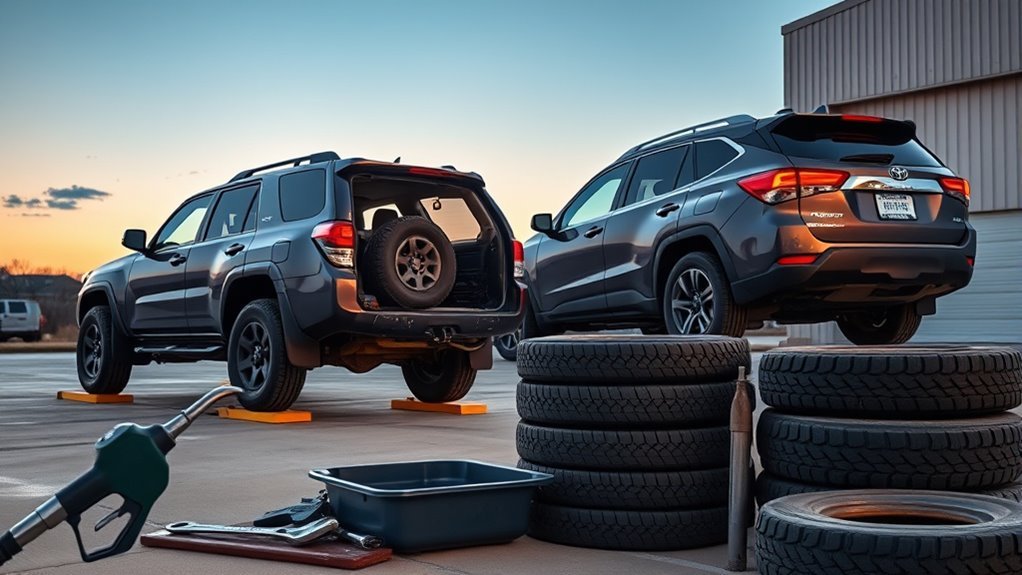
Comparing five-year ownership costs reveals a sharp trade-off: unibody SUVs save thousands of dollars at the gas pump and on tire replacements, but the Toyota 4Runner claws back much of that expense through class-leading resale value. If you drive 15,000 miles per year at $3.50 per gallon, a 4Runner averaging 22 mpg combined costs roughly $2,386 annually in fuel, compared with $1,312 for a RAV4 Hybrid averaging 40 mpg—a savings of over $5,300 across five years.
Routine maintenance also runs higher on a body-on-frame 4×4. You must service front and rear differential fluids, transfer case oil, and heavier E-load or all-terrain tires, whereas a unibody crossover requires simpler transaxle fluid changes and lighter passenger-car tires.
- Fuel economy gap: Fifth-generation 4Runners (2010–2024) return 17 mpg combined (16 city / 19 highway), while 2025–2026 models achieve 20 to 26 mpg (gas) and 23 to 24 mpg (hybrid); unibody RAV4 Hybrids reach 38 to 44 mpg combined and Highlander Hybrids hit 35 mpg combined.
- Maintenance and repair costs: Four-wheel-drive driveline fluids and larger off-road tires increase routine service bills on the 4Runner, though bolt-on frame components simplify localized underbody repairs.
- Resale value leadership: According to Kelley Blue Book’s 2026 Best Resale Value Awards, the 2026 Toyota 4Runner retains 58.0% of its original value after five years—ranking third among all vehicles sold in North America and beating almost every unibody SUV.
Note: Insurance premiums, registration fees, and fuel expenses vary significantly by state, annual mileage, and off-road accessory coverage. Always request VIN-specific insurance quotes from your provider before signing a purchase agreement.
Buying Scenarios: Which to Choose (Commuter, Camper, Hauler) + Toyota Model Recommendations
Matching the right Toyota SUV to your weekly routine prevents paying for truck hardware you never use—or getting stuck with a crossover that cannot pull your trailer. Use your primary driving environment, passenger count, and trailer gross weight to narrow your choice across Toyota’s current lineup.
| Use Case | Recommended Toyota | Primary Benefit |
|---|---|---|
| Daily commuting & family road trips | RAV4 Hybrid / Highlander | 35–44 mpg combined efficiency, quiet unibody ride, 1,500–5,000 lb towing |
| Backcountry camping & overlanding | 4Runner (TRD Off-Road / Trailhunter) | TNGA-F steel frame, 2-speed transfer case, up to 6,000 lb towing |
| Heavy boat, horse, or camper hauling | Sequoia / Tundra | Twin-turbo V6 powertrains with 9,520 lb (Sequoia) to 12,000 lb (Tundra) max towing |
For daily commuters and growing families, Toyota’s 2026 Highlander lineup specifications confirm standard all-wheel drive across every grade, with 35 mpg combined on the Hybrid (3,500-pound towing) and 5,000-pound towing on the 265-horsepower 2.4-liter turbo gas model. If you camp off the grid, carry rooftop tents, or drive rocky forest service roads, the 4Runner’s low-range transfer case and 6,000-pound tow rating make it the sweet spot.
When your travel trailer or boat exceeds 6,000 pounds loaded, step up to Toyota’s full-size TNGA-F trucks. The 2026 Sequoia pulls up to 9,520 pounds with its standard 437-horsepower i-FORCE MAX hybrid V6, while Toyota’s 2026 Tundra engineering overview highlights up to 12,000 pounds of maximum towing capacity and a standard 32.2-gallon fuel tank for long-haul range.
Frequently Asked Questions
Are Body-On-Frame SUVs Better?
Body-on-frame SUVs are better only if you need serious off-road durability, low-range four-wheel drive, aftermarket modification support, or heavy towing up to 6,000 pounds or more. For paved commuting and family trips, unibody SUVs are superior because they deliver better fuel economy, sharper handling, and a quieter ride.
Is the Toyota 4Runner Unibody or Body-On-Frame?
Every generation of the Toyota 4Runner uses body-on-frame construction, including the sixth-generation 2025 and 2026 models built on Toyota’s boxed steel TNGA-F truck platform. It shares this heavy-duty ladder-frame architecture with the Toyota Tacoma, Land Cruiser, Sequoia, and Tundra rather than car-based crossovers like the Highlander.
What Are the Disadvantages of a Unibody Frame?
The main disadvantages of a unibody frame are lower torsional resistance over severe off-road obstacles, lower towing and tongue-weight limits (typically 1,500 to 5,000 pounds), and limited support for suspension lifts or frame-mounted winches. Severe underbody impacts can also twist integrated structural panels, leading to pricier collision repairs.
Is It Better to Drive a Body-On-Frame or Unibody?
A unibody SUV is better to drive on paved roads because its lighter structure, lower center of gravity, and four-wheel independent suspension reduce body roll and road vibration. A body-on-frame SUV like the 4Runner feels firmer on pavement but drives far better over rocky trails, deep ruts, and washboard dirt roads.
How Much Can the 2026 Toyota 4Runner Tow Compared to the RAV4 and Highlander?
The 2026 Toyota 4Runner can tow up to 6,000 pounds across both its i-FORCE gas and i-FORCE MAX hybrid powertrains, up from 5,000 pounds on 2010 to 2024 V6 models. By comparison, the 2026 Highlander tows 5,000 pounds (gas) or 3,500 pounds (Hybrid), and the 2026 RAV4 tows up to 3,500 pounds.
Does the Toyota 4Runner Hold Its Value Better Than a Unibody SUV?
Yes, the Toyota 4Runner consistently holds its resale value better than almost every unibody SUV on the market. Kelley Blue Book projects the 2026 4Runner to retain 58.0% of its original value after five years of ownership, ranking third among all vehicles in North America.
Conclusion
Choosing between the Toyota 4Runner vs unibody SUV comes down to honest math about where your tires spend their miles. Pick the body-on-frame 4Runner if you need 6,000-pound towing, low-range 4WD trail capability, and 58% five-year resale retention; choose a unibody RAV4 or Highlander if you want 24 to 44 mpg efficiency and composed highway comfort. Test-drive both back-to-back over rough city streets and at 70 mph on the highway before making your final call.
Sources
- Toyota USA Newsroom – 2026 Toyota 4Runner: Supports sixth-generation TNGA-F frame specifications, i-FORCE and i-FORCE MAX horsepower and torque figures, 6,000-pound towing capacity, ground clearance, and EPA fuel economy ratings.
- Toyota USA Newsroom – 2026 Toyota RAV4: Supports 2026 RAV4 unibody TNGA-K specifications, standard hybrid and plug-in hybrid horsepower, 38–44 mpg combined fuel economy, 8.5-inch Woodland clearance, and 3,500-pound max AWD towing.
- Toyota USA Newsroom – 2026 Toyota Highlander: Supports 2026 Highlander standard AWD, 265-horsepower 2.4L turbo gas towing (5,000 pounds) and fuel economy (24 mpg combined), and Hybrid specs (35 mpg combined, 3,500-pound towing).
- Kelley Blue Book – 2026 Best Resale Value Awards: Supports the 2026 Toyota 4Runner ranking third overall in North America with 58.0% five-year value retention.
- Toyota USA Newsroom – 2026 Toyota Tundra: Supports TNGA-F full-size truck specifications, 12,000-pound maximum towing capacity, and standard 32.2-gallon fuel tank details.