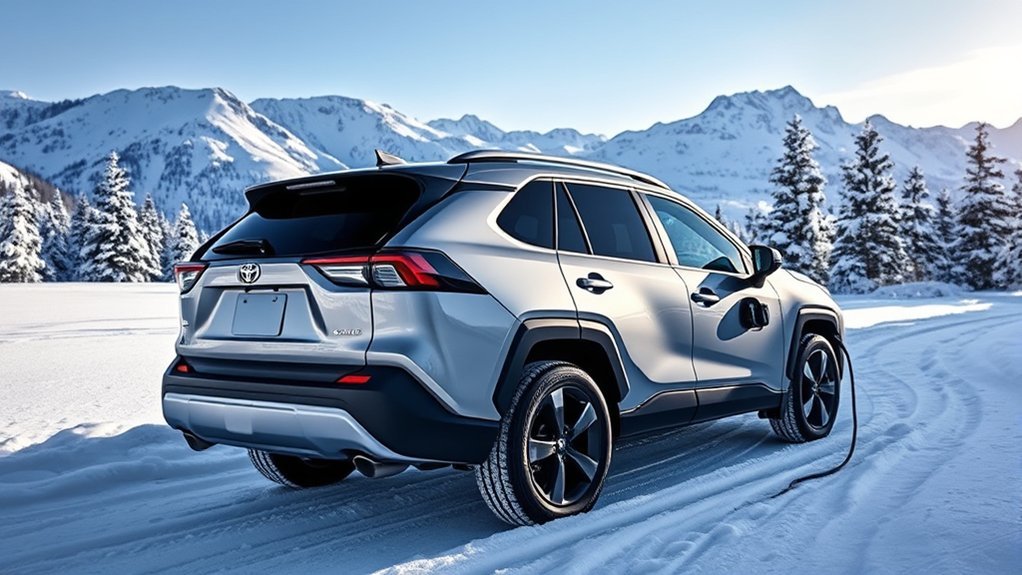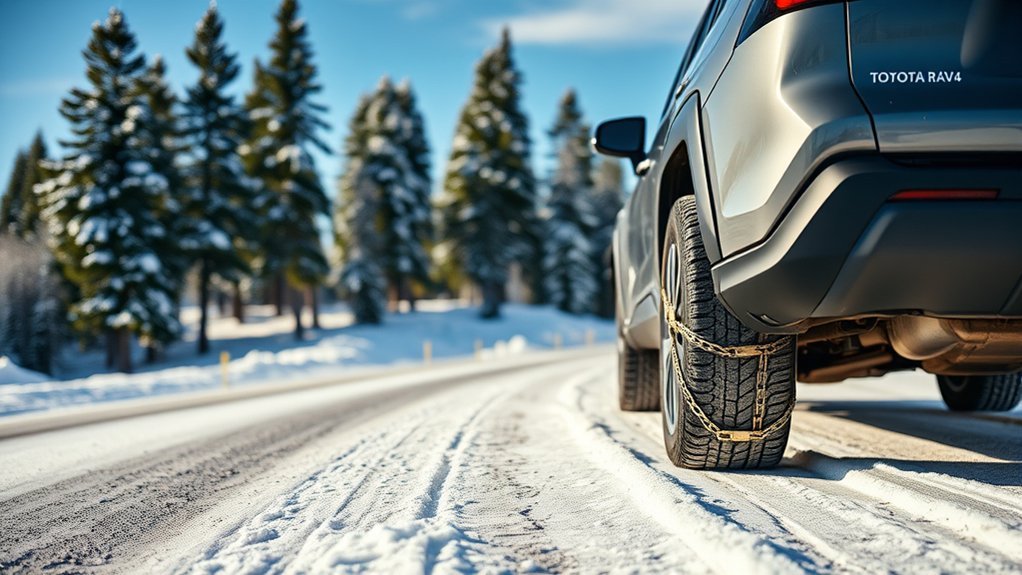
For the 2025 U.S.-market Toyota RAV4 and RAV4 Hybrid manuals cited below, compatible tire chains install on the front tires only. Toyota says chains cannot be mounted on vehicles with 235/55R19 tires; use snow tires instead. When chains are allowed, match the exact tire size, retighten them after 1/4–1/2 mile, and stay below the chain maker’s limit or 30 mph (50 km/h), whichever is lower.
This is not a universal rule for every RAV4. The exact model year, tire size, wheel-well clearance, and local chain-control rules decide whether you may use a chain, cable, or approved alternative. This guide does not verify 2026 RAV4 fitment; check that vehicle’s manual before buying a traction device.
By: [VERIFY: add real author/byline]
Last updated: July 31, 2026 · Safety guidance reviewed against the cited Toyota 2025 RAV4 manuals and current Caltrans, WSDOT, and NHTSA guidance.
Quick Answer
For chain-approved 2025 gasoline and hybrid RAV4 setups, install one matched pair on the front tires only. Do not mount chains on 2025 vehicles with 235/55R19 tires; Toyota directs those owners to use snow tires instead. A tire-size fit chart does not override the vehicle manual, and this 2025 rule should not be applied to another model year without checking its manual.
Key Takeaways
- Start with the owner’s manual and door-jamb tire placard for your exact RAV4; the chain rule is vehicle-specific, not just tire-size-specific.
- For the chain-approved 2025 RAV4 setups covered here, Toyota directs drivers to install one pair on the front tires only.
- Do not assume a cable or snow sock is automatically allowed when conventional chains are prohibited. Confirm both Toyota clearance and road-authority approval.
- Use chains only on snow- or ice-covered sections where conditions or posted rules require them, then remove them on clear pavement.
- Follow the chain maker’s speed limit or 30 mph (50 km/h), whichever is lower, and retighten after 1/4–1/2 mile.
At a Glance
| Practice | Complete a dry test-fit at home before the trip; actual roadside installation time varies by device and conditions |
| Difficulty | Moderate, mainly because cold, snow, low visibility, and traffic make the work harder |
| Equipment | Correct-size chains or an approved traction device, gloves, flashlight or headlamp, kneeling mat, storage bag, and owner’s manual |
| Buying Rule | Confirm vehicle clearance and legal acceptance before comparing brands or prices |
Model-year scope: This guide uses Toyota’s 2025 U.S.-market RAV4 and 2025 RAV4 Hybrid manuals as the exact manufacturer examples. A 2024, 2026, Prime/PHEV, Canadian-production variant, or another-market RAV4 may have different tire sizes or restrictions, so its own manual controls.
How This Guide Was Checked
This is a document-based compatibility and safety guide, not a hands-on test of a specific chain model. The guidance was cross-checked against Toyota’s cited 2025 gas and hybrid manuals, current Caltrans chain-control rules, WSDOT winter guidance, and NHTSA winter-driving data. No chain brand is endorsed.
Will Tire Chains Fit Your RAV4? A 60-Second Check
Use this order before you buy or install anything. It separates tire-size fit from vehicle clearance and legal acceptance, which are three different questions.
- Read the tire placard. Record the exact size on the driver’s door jamb and confirm the tires currently installed match it.
- Read the exact owner’s manual. Find the winter-driving or tire-chain section for your model year, powertrain, and market.
- Stop if Toyota prohibits chains. A retailer listing that matches the tire size does not prove there is safe suspension or wheel-well clearance.
- Check the route rule. Confirm whether the road requires you to carry chains, install them, or use a state-approved alternative traction device.
- Verify the device instructions. Match the exact tire size, permitted chain type, speed limit, and tensioning method.
- Test-fit at home. Check inner and outer clearance without driving on bare pavement.
| RAV4 setup | 2025 manual guidance | Next step |
|---|---|---|
| 2025 gas or hybrid without 235/55R19 tires | Correctly sized chains may be used on the front tires only | Confirm the device fit and local chain-control rule |
| 2025 gas or hybrid with 235/55R19 tires | Tire chains cannot be mounted; Toyota directs owners to use snow tires instead | Check whether the route accepts a Toyota-approved alternative traction device |
| Any other model year or market | Not established by this guide | Use that vehicle’s own manual and tire placard |
[Products Worth Considering]

This custom-fit center console organizer is designed for Toyota RAV4 2026 LE, SE, XLE Premium, Woodland, and XSE models, helping you turn cluttered storage into a neat, functional space. The double-layer design with silicone lining reduces rattles and keeps items securely separated, while the hidden compartment and included cup holder liner add privacy and convenience. It installs easily with no tools and delivers an OEM-style look that blends seamlessly with your interior.

This center console cover is designed for a custom fit on the Toyota RAV4 2026, helping protect the armrest area from dirt, pet claws, and everyday wear. Made from soft silicone, it adds comfort for your arm and a clean, stylish look to the vehicle interior while being easy to install without tools.

This keyless entry remote replacement is designed for select Toyota models and comes pre-tested with battery and electronics installed for ready-to-program convenience. It supports compatible part numbers and FCC IDs, making it a practical solution for replacing a lost or damaged fob. Programming and cutting by a qualified locksmith or dealership are required, and it is intended for regular key vehicles rather than push-start systems.
When Are Tire Chains Essential for Your RAV4?
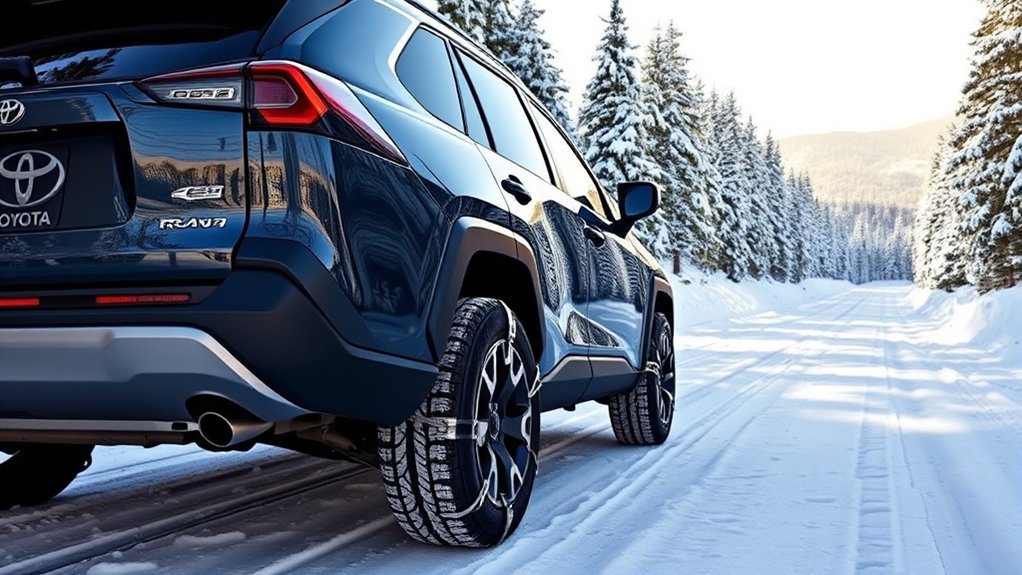
You may need tire chains or another legally approved traction device when a road is icy, snow-packed, steep, or under an active chain-control order. Posted signs and instructions from road officials control whether you must carry or install traction devices.
For example, Caltrans chain-control guidance says posted control levels and instructions from road officials govern entry into a chain-control area. The Washington State Department of Transportation publishes current mountain-pass traction and chain information. Check the authority responsible for your route before relying on AWD, snow tires, cables, or an alternative traction device.
Warning: Do not ignore Toyota’s clearance warning just because a chain appears to fit around the tire. A chain that contacts suspension, brake lines, wheel-well liners, or tire-pressure sensors can damage the vehicle and may become unsafe while driving.
Chains are most useful in short, low-speed sections where extra grip is legally required or clearly needed. They are not a replacement for careful winter driving, proper tires, and reduced speed. On long winter routes, a full set of winter tires is usually the better everyday solution.
Winter Driving Requirements for Tire Chains on RAV4s
The most important rule is simple: check your exact RAV4 owner’s manual before installing chains. Chain placement and clearance restrictions can change with the model year, drivetrain, wheel package, and tire size.
For the 2025 RAV4 covered by the cited manual, Toyota says vehicles without 235/55R19 tires may use correctly sized chains. Vehicles with 235/55R19 tires cannot mount tire chains and should use snow tires instead. Toyota also directs drivers to check local rules because chain requirements vary by location and road type.
Do not assume a cable is automatically exempt from that warning. The cited 2025 manuals do not separately authorize tire cables on the prohibited 235/55R19 setup. Treat any cable, snow sock, or external traction device as an alternative that still needs Toyota clearance confirmation and legal acceptance for the route.
Here are the key requirements to confirm before you drive:
- Your tire size: Look at the sidewall and the tire placard on the driver’s door jamb. Common RAV4 sizes vary by trim and year, and the chain must match the exact tire size.
- Your manual’s chain warning: If your manual says chains cannot be mounted on your tire size, do not install conventional chains unless Toyota or a qualified dealer confirms an approved alternative for your exact vehicle.
- Local chain laws: Chain-control rules can vary by state, highway, weather event, and posted sign. Check the state DOT before mountain travel.
- Traction-device approval: If standard chains are not allowed for your RAV4, look for approved alternatives such as low-clearance devices or textile traction devices only where local law permits them.
- Speed limits: With chains installed, Toyota says to follow the chain manufacturer’s limit or 30 mph (50 km/h), whichever is lower.
Choose the Right Winter Traction Option
| Option | Best use | Main limitation | Check first |
|---|---|---|---|
| Winter tires | Regular cold-weather driving | May not satisfy every posted chain-control level | Local rules and Toyota-approved tire size |
| Chains or cables | Short, low-speed snow or ice sections | Require enough wheel-well clearance and correct sizing | Owner’s manual, tire size, and device instructions |
| Alternative traction device | Low-clearance vehicles where an authority permits an alternative | Acceptance varies by road authority and device | Current DOT approval and exact vehicle fitment |
Note: AWD does not automatically exempt a RAV4 from chain-control rules. It can help the vehicle accelerate, but it does not remove the need for longer stopping distances on ice.
For a separate explanation of how the electronic systems respond on slick surfaces, see RAV4 traction and stability control. Those systems can assist the driver, but they do not create tire grip or override posted chain rules.
Can You Use Tire Chains on 235/55R19 RAV4 Tires?
This is where many RAV4 owners get confused. A retailer fit chart may list a chain for a 235/55R19 tire, but tire-size fit alone does not prove vehicle clearance. Toyota’s cited 2025 RAV4 manual states that tire chains cannot be mounted on vehicles with 235/55R19 tires and that snow tires should be used instead.
That does not mean every RAV4 owner is out of options in a chain-control area. It means you should not install a conventional inside-clearance chain on that tire size just because a retailer’s fit chart lists it. If your RAV4 has 235/55R19 tires, use this order of checks:
- Read your owner’s manual first. Look for the winter-driving or tire-chain section for your exact model year.
- Ask a Toyota dealer. Request VIN-specific guidance on tire-chain restrictions and any Toyota-permitted winter setup.
- Use a manufacturer fitment tool. The König snow chain configurator can help identify products by vehicle and tire size, but it should not override Toyota’s warning.
- Check whether the road authority accepts alternatives. Approval can depend on the device, road, and active chain-control level.
- Choose winter tires for normal winter driving. Toyota specifically points 235/55R19 RAV4 owners toward snow tires instead of chains.
Pro Tip: If you regularly cross chain-control routes, ask Toyota or a qualified tire professional whether your exact VIN has an approved winter wheel-and-tire combination. Do not downsize wheels or change tire dimensions solely to make chains fit.
[Products Worth Considering]

This roadside emergency kit helps drivers handle common breakdowns and winter travel issues with confidence. It includes jumper cables, a shovel, tow rope, warning triangle, first aid kit, gloves, and repair tools in a compact bag that fits easily in a trunk or storage compartment. Designed for cars, trucks, SUVs, motorcycles, and RVs, it is a practical safety companion for commuting, road trips, and everyday preparedness.

These custom-fit mud flaps are designed for Toyota RAV4 and RAV4 Hybrid models across multiple years to help protect your vehicle from snow, salt, sand, rocks, and road debris. Made from durable black ABS plastic, they offer strong resistance to wear, cold, and aging while helping keep your lower body panels cleaner. The set includes front and rear splash guards for a complete exterior protection upgrade.

This custom-fit passenger storage organizer mat is designed for the Toyota RAV4 2026 to help protect and organize the center console storage area. Made from soft silicone with an anti-slip surface, it keeps small items neatly in place while adding a clean, refined look to the interior. Installation is quick and tool-free, making it an easy upgrade for everyday convenience.
What if Chains Are Required but Toyota Prohibits Them?
Do not solve that conflict by mounting a device the vehicle manual prohibits. Check the posted control level, the road authority’s approved-device rules, and route conditions before you enter the controlled area.
- California example: Caltrans says Requirement 2 generally exempts AWD vehicles with snow-tread tires on all four wheels from installing chains, but those vehicles must carry traction devices. Requirement 3 requires chains or traction devices on all vehicles, with no exceptions.
- Washington example: WSDOT winter guidance says a manufacturer’s recommendation against chains does not waive state law and points drivers toward state-approved alternative traction devices.
- Practical choice: If no Toyota-compatible, legally accepted device is available, use another vehicle, change the route, or delay the trip rather than improvising.
Where to Install Tire Chains on a RAV4
For the chain-approved 2025 RAV4 and RAV4 Hybrid setups covered by the cited manuals, Toyota directs drivers to install tire chains on the front tires only. For another model year or market, follow that vehicle’s manual instead of assuming the same placement.
The front-tire instruction also applies to the chain-approved 2025 AWD configurations covered here. Vehicle-specific manufacturer guidance matters more than generic advice about AWD vehicles because incorrect placement can create handling or clearance problems.
For the chain-approved 2025 RAV4 setups covered here, install chains on the front tires only, tighten them securely, and retighten after driving 1/4–1/2 mile.
Installing Tire Chains on Your RAV4
Practice installing your tire chains at home before winter travel. Cold hands, low visibility, snowbanks, and passing traffic make roadside installation harder and riskier.
[Products Worth Considering]

This custom-fit two-piece door side trash can set is designed for the front doors of the 2026 Toyota RAV4, helping keep the cabin organized while adding convenient extra storage. The open-top design allows quick, one-handed disposal of trash and other small items, while the snug silicone construction stays secure without glue and is easy to remove and rinse clean.
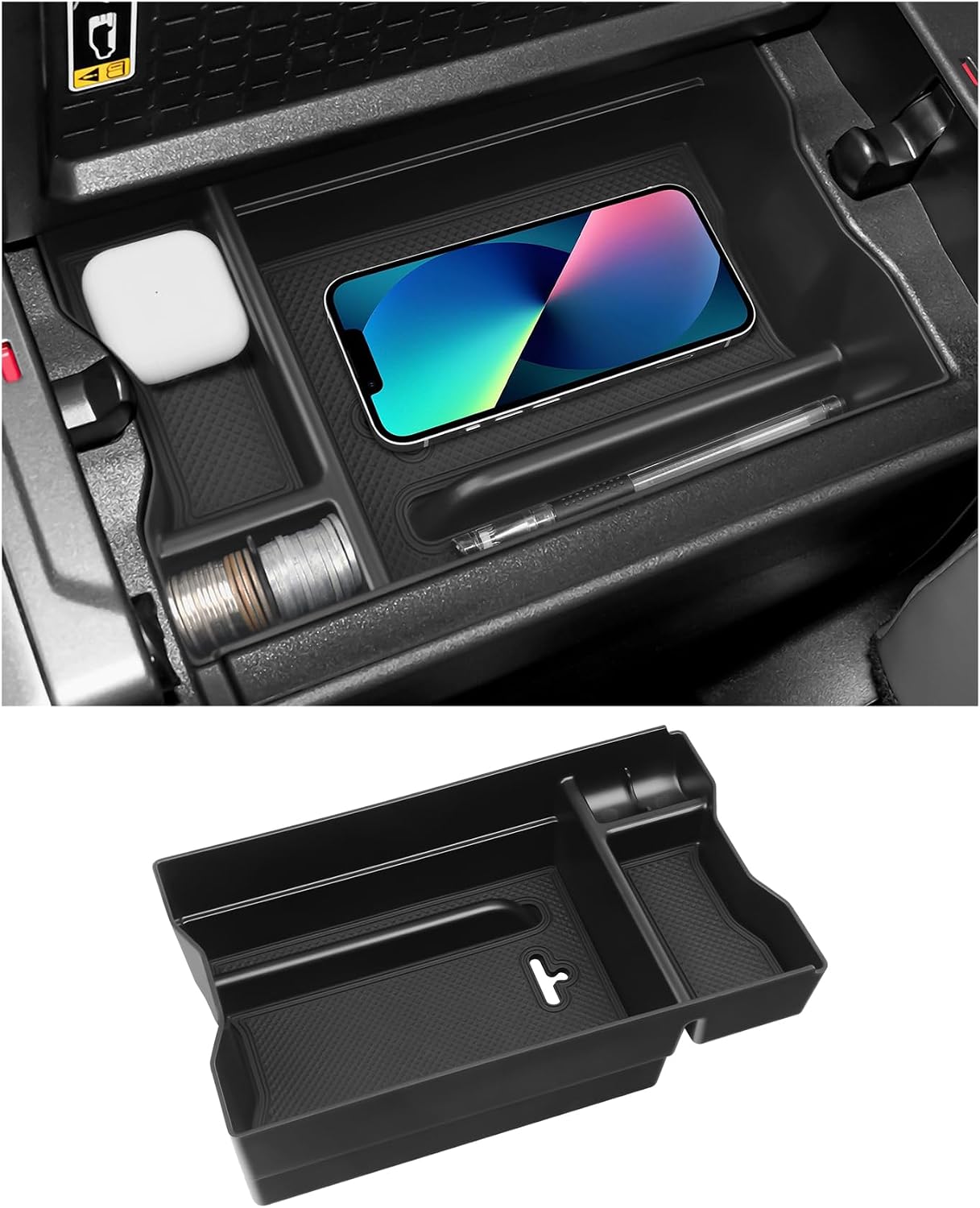
This center console organizer adds a convenient secondary storage layer to compatible Toyota RAV4 hybrid models, helping keep sunglasses, keys, coins, phones, and other small items neatly arranged. Built from durable ABS plastic with a matte finish, it fits directly into the armrest area for quick, tool-free installation and easy removal. Non-slip rubber mats help reduce sliding and noise while maximizing usable storage space inside the console.

This center console armrest cover is designed to fit the 2026 Toyota RAV4 for added comfort and a cleaner interior look. Made with breathable vegan leather and a thick cushioned feel, it helps reduce arm fatigue on long drives while protecting the console from pet paws, dirt, and sticky fingerprints. The band-secured design installs easily with no tools required and blends with the OEM-style interior.
Before You Start
- Park in a safe, flat area away from traffic.
- Turn on hazard lights if you are near a roadway.
- Shift to Park, turn the vehicle off, and set the parking brake.
- Put on gloves and use a mat so you can kneel safely.
- Untangle the chains and inspect them for broken links, worn cables, twisted sections, or damaged tensioners.
- Confirm the chains are the correct size for your tires.
Step-by-Step RAV4 Tire Chain Installation
- Lay the chains out flat. Make sure the traction side faces the road and any hooks or rough edges face away from the tire sidewall.
- Place the chain behind or over the front tire. Follow the chain manufacturer’s layout instructions because cable chains, diamond chains, and self-tensioning chains install differently.
- Connect the inside fastener first. Reach behind the tire and secure the inner connection without twisting the chain.
- Center the chain on the tread. The cross sections should sit evenly across the tire, not bunched on one shoulder.
- Connect the outside fastener. Attach the outer hook, cable, or locking mechanism according to the chain instructions.
- Tighten the chain. Use the built-in tensioner or separate tensioning device if your chain type requires one.
- Repeat on the other front tire. Install chains as a pair so the vehicle has balanced traction.
- Roll forward a short distance. Move the RAV4 slowly, stop safely, and recheck chain centering and tension.
- Retighten after 1/4–1/2 mile. The cited 2025 Toyota manuals instruct drivers to retighten after 0.5–1.0 km.
Warning: Never crawl under the vehicle while it is on a traffic shoulder or unstable snowy surface. If a chain cannot be installed safely, wait for assistance or move to a safer location.
What Should You Look for After Installing Tire Chains?
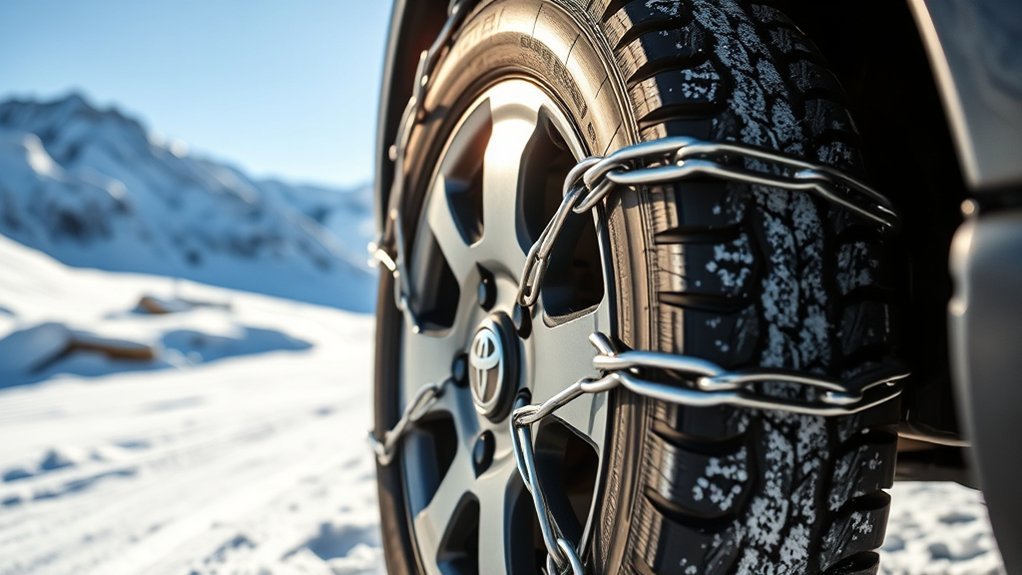
After installing tire chains, make sure they sit snugly against the tire and do not slap the wheel well, brake components, or body panels. A loose chain can damage the RAV4 and reduce traction.
Check these items before driving away:
- Chain tension: The chains should be tight, centered, and evenly spread across the tread.
- Clearance: Turn the steering wheel slightly and look for contact with suspension parts, brake lines, fender liners, or mud flaps.
- Fasteners: Confirm that every latch, hook, cable, and tensioner is fully secured.
- Movement test: Drive forward or backward a few feet, then stop and recheck the chain position.
- Warning lights: If a warning light appears after installing chains, slow down, stop safely, and inspect the setup.
The cited Toyota guidance also warns that tire-pressure warning valves and transmitters may not operate correctly while chains are fitted. A TPMS warning with chains installed does not prove the pressure is low, but it should not be ignored. Stop safely, inspect the chains, and verify tire pressure with a gauge if a warning appears or the vehicle begins to vibrate or handle abnormally.
How to Drive a RAV4 With Tire Chains Installed
Once chains are installed, drive like you are protecting both the vehicle and the road. Chains are for low-speed traction, not normal highway driving.
- Stay under the lower speed limit: Follow the chain maker’s speed rating or Toyota’s 30 mph (50 km/h) limit, whichever is lower.
- Avoid sudden inputs: Do not accelerate hard, brake sharply, or jerk the steering wheel.
- Limit driver-assist use: The cited 2025 Toyota guidance says not to use Lane Tracing Assist while driving with tire chains.
- Avoid potholes and rough pavement: Impacts can loosen or break chains.
- Remove chains on clear pavement: Chains wear quickly and can damage tires or roads when used on dry pavement.
The National Highway Traffic Safety Administration reports an estimated 101,390 police-reported crashes in snow or sleet conditions in 2023. Its guidance is direct: slow down and increase following distance because slick roads make a vehicle harder to control and stop.
How to Care for Your Tire Chains in Winter Weather
Caring for your tire chains helps them last longer and work better when you need them again. Road salt, grit, and moisture can corrode metal chains and weaken moving parts.
After each use:
- Rinse the chains with fresh water. Remove salt, mud, and road debris.
- Dry them completely. Do not store wet chains in a sealed bag.
- Inspect for damage. Look for broken links, worn rollers, frayed cables, bent hooks, and weak tensioners.
- Repack them neatly. Store each chain so it will not tangle during an emergency.
- Keep them in the cargo area during winter trips. A clean storage case keeps salt and water away from the interior.
Before the next storm, test-fit the chains again. Tire wear, replacement tires, or a wheel change can affect fit, even when the printed tire size looks the same.
Common RAV4 Tire Chain Mistakes to Avoid
- Treating the 235/55R19 warning as universal: It is confirmed in the cited 2025 manuals. Check your own model year rather than assuming the same restriction or permission.
- Buying by vehicle name only: “Fits Toyota RAV4” is not enough. Match the chain to your exact tire size and clearance requirements.
- Assuming cables are allowed when chains are not: A low-profile cable still needs vehicle clearance and route approval.
- Applying the 2025 rule to a 2026 or older RAV4: Use the manual for the exact vehicle rather than a generic RAV4 fit chart.
- Installing chains on the rear tires: For the chain-approved 2025 RAV4 setups covered here, Toyota says to install them on the front tires only.
- Driving too fast: Chains can break or damage the vehicle at higher speeds.
- Leaving chains on clear pavement: Remove them once the chain-control section ends and the road is safely clear.
- Skipping the retightening step: Chains can settle after the first short distance, so recheck them after 1/4–1/2 mile.
Frequently Asked Questions
Where do you put chains on a Toyota RAV4?
For the chain-approved 2025 RAV4 setups covered by the cited manuals, install chains on the front tires only. Check another model year’s manual before assuming the same placement.
Do you put chains on all four tires or just two?
For the chain-approved 2025 RAV4 setups covered here, use chains on the two front tires. Do not add rear chains unless the manual for your exact vehicle specifically requires them.
Can a RAV4 with 235/55R19 tires use chains?
Toyota’s cited 2025 RAV4 manual states that tire chains cannot be mounted on vehicles with 235/55R19 tires and that snow tires should be used instead. Check a different model year separately, and confirm any legal alternative with the road authority before travel.
How fast can you drive a RAV4 with tire chains?
Follow the chain manufacturer’s speed limit or Toyota’s limit of 30 mph (50 km/h), whichever is lower. Drive slower when conditions are icy, steep, crowded, or rough.
Does an AWD Toyota RAV4 still need tire chains?
Possibly. AWD may qualify for an exemption at some chain-control levels, but rules change by state, road, storm, and posted requirement. Carry the required traction device and follow signs and road officials. If chains are permitted on your exact RAV4, use the axle placement stated in its owner’s manual.
Can I use tire cables on a 235/55R19 RAV4?
Do not assume cables are allowed just because they are thinner than conventional chains. The cited 2025 RAV4 manuals prohibit tire chains on 235/55R19 vehicles and do not separately authorize cables. Confirm a Toyota-compatible alternative for your exact VIN and check whether the road authority accepts it.
How many tire chains does a 2025 RAV4 need?
For a chain-approved 2025 RAV4 setup, Toyota directs owners to install one matched pair on the two front tires. Carrying requirements can be different from installation requirements, so check the rules for the route before travel.
Are snow tires better than chains for a RAV4?
Winter tires are designed for regular cold-weather driving and work without roadside installation. Chains are temporary, low-speed traction devices for short snow- or ice-covered sections and posted chain-control areas. Some routes may still require drivers with winter tires to carry or install traction devices.
Can I use textile snow socks instead of chains?
Possibly, but only if your state or road authority accepts that device for the posted chain requirement. Some states approve alternative traction devices for vehicles that cannot use chains, while others may not. Check the local DOT before relying on snow socks.
Conclusion
Tire chains are a vehicle-specific safety item, not a universal RAV4 accessory. Start with the exact model-year manual, tire placard, and route rule. For the chain-approved 2025 setups covered here, install one pair on the front tires only, retighten after 1/4–1/2 mile, and stay below the lower of the device maker’s limit or 30 mph. If Toyota prohibits chains on your setup, confirm a Toyota-compatible and legally accepted alternative before the trip; otherwise change the route, vehicle, or timing.
Sources
- Toyota 2025 RAV4 Owner’s Manual — Winter Driving Tips — backs up tire-chain placement, 235/55R19 restrictions, chain speed limits, and retightening guidance
- Toyota 2025 RAV4 Hybrid Owner’s Manual — Winter Driving Tips — supports front-tire-only chain installation and retightening after 1/4–1/2 mile
- Caltrans Chain Controls — explains official chain-control areas and winter road restrictions
- Washington State DOT Tires & Chains — provides current traction and chain information for Washington mountain-pass travel
- WSDOT Winter Snow and Ice Preparations — explains carrying chains, practicing installation, and state-approved alternative traction devices
- NHTSA Winter Driving Tips — supports winter-driving safety, slower speeds, increased following distance, and the cited 2023 crash estimate
- König Snow Chain Configurator — supports checking chain compatibility by vehicle and tire size