By: [VERIFY: add the article’s real author name and relevant automotive credentials] · Last updated: July 14, 2026
Technical sources reviewed: Toyota owner information, U.S. EPA motor-vehicle A/C rules, and DENSO compressor-oil guidance.
Your Toyota Tacoma may be low on R-134a when three clues appear together: the under-hood label confirms R-134a, both gauge readings fit an undercharge under controlled test conditions, and a leak check finds evidence of refrigerant loss. Warm vent air or one low-side reading alone cannot confirm a low charge. A weak compressor, poor condenser airflow, a clogged cabin filter, an electrical fault, or a blend-door problem can cause similar symptoms. Confirm the refrigerant type first, diagnose both sides of the system, repair any leak, and recharge only to the hood-label weight.
Quick Answer
A Toyota Tacoma is more likely to be low on R-134a when the hood label confirms R-134a, the low and high sides are both lower than expected for the test conditions, and a leak inspection finds oily residue, dye, or another escape point. Do not diagnose by vent temperature or a single can gauge. Never add R-134a to a system labeled R-1234yf.
Key Takeaways
- Check the under-hood A/C label first. Tacoma refrigerant type and charge can vary by model year, market, and system configuration.
- No single low-side pressure proves an undercharge. Compare both sides using the test conditions and specifications for your exact model year.
- The correct refrigerant charge is measured by weight, not by “green zone” can gauges.
- If refrigerant is low, the system has leaked. Find and repair the leak before doing a full recharge.
- Use the oil type listed on the compressor label, service label, or Toyota repair information. Do not guess or mix oils.
At a Glance
| Time Required | About 15–30 minutes for basic checks; leak repair, recovery, evacuation, and recharge take longer |
| Difficulty | Moderate for diagnosis; advanced for recovery, evacuation, and charging by weight |
| Tools Needed | A/C thermometer, manifold gauge set, UV light or electronic leak detector, vacuum pump, refrigerant scale, safety glasses, gloves |
| Cost | Varies by the failed part, refrigerant type, tools required, and local labor rates |
Warning: Refrigerant is under pressure and can cause frostbite or eye injury. U.S. EPA rules prohibit intentional venting. Anyone servicing a motor-vehicle A/C system for payment must hold Section 609 certification and use approved handling equipment. Recover refrigerant before work that could release it.
How Can You Tell If Your Tacoma Is Low on R-134a?
Start by confirming that your Tacoma is an R-134a-equipped Tacoma. Toyota directs owners to the under-hood A/C label for refrigerant information. Treat that label and Toyota repair information for your exact model year as the authority for refrigerant type and charge amount. You can also locate model-year owner information through Toyota Owners Manuals and Warranties.
Once you know the system uses R-134a, look for these common signs of low refrigerant:
- Warm or only mildly cool air from the vents: Low refrigerant reduces heat transfer in the evaporator, so the air never gets cold enough.
- Both sides lower than expected: An undercharge often pulls the low and high sides below the expected range for the specified test conditions. Compare the readings with Toyota service information for your exact truck.
- Compressor operation is abnormal: Depending on the model and compressor design, a low-pressure signal may prevent operation, reduce output, or cause abnormal cycling. A control or electrical fault can produce the same symptom.
- Oily residue near hoses, fittings, condenser, compressor, or service ports: Refrigerant often carries oil with it, so oily dirt around a joint can mark a leak.
- Hissing, dye stains, or a known leak history: These are stronger clues than a single gauge reading.
Use the Three-Signal Test Before Calling It Low Refrigerant
Do not add refrigerant until the diagnosis passes all three checks below. This framework separates a likely undercharge from other faults that also produce warm air.
| Signal | What Supports Low Refrigerant | What Weakens the Diagnosis |
|---|---|---|
| 1. Correct system identified | The hood label clearly specifies R-134a. | The label specifies R-1234yf, is missing, or is unreadable. |
| 2. Pressure pattern fits | Both sides are lower than Toyota’s expected range under the required test conditions. | The high side is elevated, both sides are high, or the compressor is not pumping. |
| 3. Refrigerant-loss evidence exists | A detector, UV dye, oily residue, or repaired leak identifies an escape path. | No leak evidence appears and airflow, controls, or compressor performance has not been checked. |
Note: A low-side can gauge is a screening tool, not a full diagnosis. A restricted expansion valve, weak compressor, poor condenser airflow, or overcharge can also create confusing pressure readings.
What Refrigerant Does Your Tacoma Use?
Do not assume every Tacoma uses the same refrigerant. The fittings, labels, refrigerant, handling equipment, and oil requirements differ between R-134a and R-1234yf. EPA rules require unique fittings to reduce accidental mixing. Using the wrong refrigerant can contaminate service equipment and damage the A/C system.
Check in this order:
- Under-hood A/C label: Toyota’s manual points owners to a hood-mounted refrigerant label for the A/C system.
- Owner’s manual or digital manual: Use the Toyota manual for your exact model year.
- Compressor or service information: If the label is missing, use Toyota repair information or ask a Toyota dealer or qualified A/C shop.
- Refrigerant identifier: Shops use this tool when contamination is suspected.
Warning: Never add R-134a to a Tacoma labeled for R-1234yf. DENSO identifies ND-oil 8 as PAG 46 oil for R-134a compressors and states that it must not be used with R-1234yf. DENSO lists ND-oil 12 for compatible R-1234yf and R-134a piston or rotary compressors, but the compressor-specific instruction still controls.
How Do Refrigerant and Compressor Oil Affect Cooling?
Refrigerant and oil do two different jobs. Refrigerant moves heat from the cabin to the outside air. Compressor oil lubricates the compressor and travels through the system with the refrigerant. Too little refrigerant reduces cooling and can starve the compressor of oil circulation. Too much refrigerant raises pressure and can reduce cooling or damage components.
The oil specification is just as important as the refrigerant type. DENSO lists ND-oil 8 for certain R-134a compressors, but that does not make it universal for every Tacoma compressor. Match the oil to the compressor label, service information, and replacement-part instructions. Do not add oil merely because refrigerant is low. Add only the specified amount when oil was lost through a leak or when a component-replacement procedure calls for it.
A Tacoma A/C system is not “used up” on refrigerant. If the charge is low, refrigerant escaped somewhere, and the leak should be found before the system is refilled.
What Should You Check Before Recharging the A/C?
Before you add refrigerant, inspect the whole system. These quick checks help you avoid wasting refrigerant on a problem that is not an undercharge.
- Check cabin airflow. Replace a dirty cabin air filter and confirm the blower works on all speeds. Poor airflow can make a fully charged system feel weak.
- Inspect the condenser. Look through the grille for leaves, mud, bent fins, or damage. A condenser that cannot shed heat will raise high-side pressure and reduce cooling.
- Watch the radiator/condenser fans. With the A/C on, the fan should run as designed. Bad fan operation can mimic refrigerant trouble.
- Listen to the compressor. Grinding, knocking, or squealing can point to compressor, bearing, belt, or clutch problems where a clutch is fitted.
- Check fuses and relays. If a clutch-equipped compressor never engages, or any compressor is not commanded on, confirm the electrical side before adding refrigerant.
- Look for leaks. Check hose crimps, service ports, condenser corners, compressor shaft area, and any oily/dusty residue.
- Measure vent temperature. Record center-vent and ambient temperature using the test setup specified by Toyota for your model year. Solar load, humidity, blower speed, recirculation mode, and engine speed can change the result.
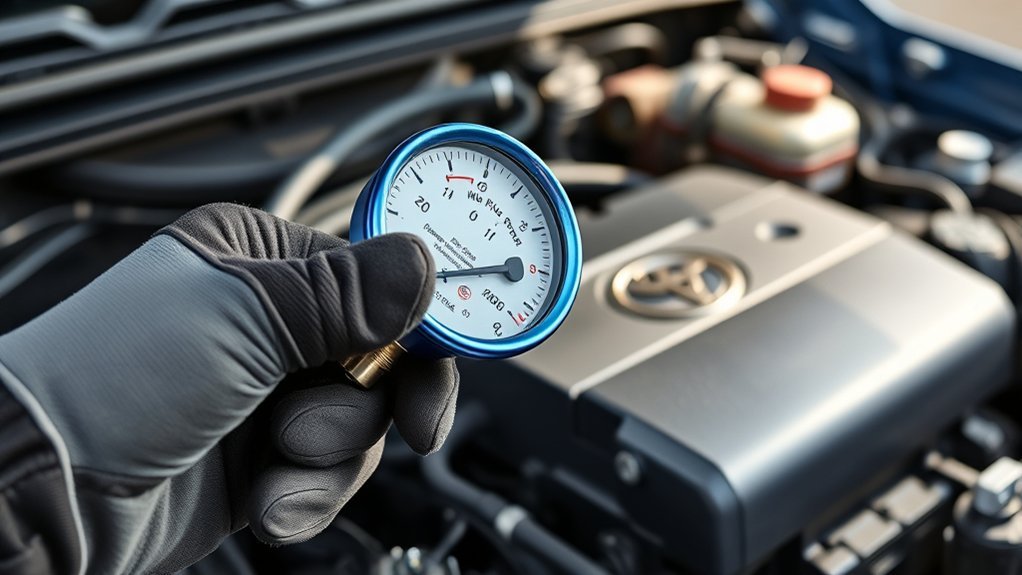
- Use manifold gauges if you have them. Read both low and high sides with the engine running and A/C commanded on. One low-side reading is not enough.
Pro Tip: Write down ambient temperature, center vent temperature, low-side pressure, high-side pressure, engine rpm, and whether the compressor was engaged. Those notes make DIY troubleshooting easier and help a shop diagnose the issue faster.
[Products Worth Considering]

This A-Premium AC expansion valve is a direct replacement designed to restore proper refrigerant flow and improve cooling performance across a wide range of compatible vehicles. Built to meet or exceed OEM quality standards, it features precision internal components for reliable operation and long-lasting durability. It is supported by an unlimited-mileage warranty for added peace of mind.

This A/C condenser hard line lock clamp clip set helps secure air conditioning lines for reliable performance and a proper fit on compatible Toyota vehicles. Designed to replace the specified OE part number, it offers durable snap-on installation and dependable support for maintaining the A/C system. The two-pack provides both a replacement and a spare for convenient repairs.

This front windshield washer nozzles kit is designed to help restore proper spray performance for a wide range of Toyota, Lexus, and Scion vehicles. Made from durable plastic for reliable replacement use, it offers an easy way to refresh worn or damaged washer nozzles and improve windshield cleaning coverage. The kit includes two nozzles and is a practical fitment solution for many popular models and years.
What Do Low-Side and High-Side Gauge Patterns Mean?
Gauge readings change with outside temperature, humidity, engine speed, airflow across the condenser, and whether the compressor is running. That is why one low-side reading is only a clue, not a complete diagnosis.
| Gauge Pattern | Possible Meaning | What to Do Next |
|---|---|---|
| Low side low, high side low | Often low refrigerant charge | Leak test, repair leak, evacuate, recharge by weight |
| Low side high, high side low | Weak compressor or control issue | Check compressor operation and control signals |
| Low side low, high side high | Restriction or metering-device problem | Check for restrictions and abnormal temperature changes across lines and the metering device |
| Both sides high | Overcharge, air in system, or poor condenser cooling | Do not add refrigerant; recover and diagnose properly |
| Both sides equal with compressor commanded on | Compressor not pumping or not engaging | Check electrical command, pressure-sensor data, clutch operation where fitted, and compressor condition |
If you only have a single low-side charging hose, treat it as a limited screening tool. It cannot confirm the correct charge amount, show the high-side condition, or separate an undercharge from several airflow, restriction, control, and compressor faults.
How Much R-134a and Compressor Oil Does a Tacoma Need?
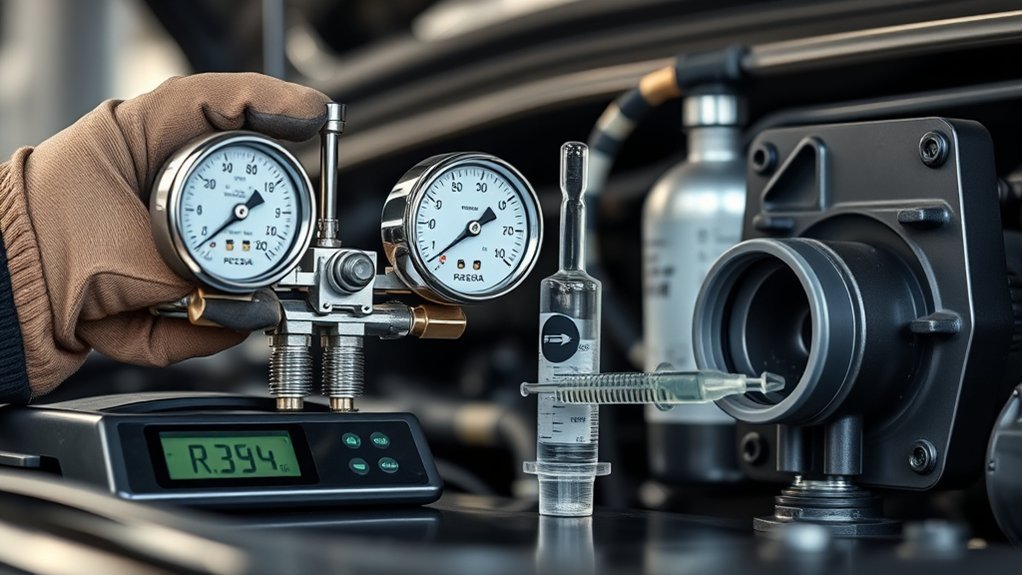
The correct charge is the exact amount printed on your Tacoma’s A/C service label or specified in Toyota repair information. Do not use a universal Tacoma capacity because the refrigerant type and charge can differ by model year, market, and system configuration. Record the label value before recovery, then charge that amount by weight with a calibrated scale.
Measure these items precisely:
- Refrigerant type: R-134a only if the label says R-134a. Use R-1234yf only if the label says R-1234yf.
- Refrigerant amount: Charge by weight with a calibrated scale after proper recovery, vacuum, and leak repair.
- Oil type: Use the compressor or Toyota specification, such as the correct DENSO ND oil or other listed PAG oil for that exact system.
- Oil amount: Add only the amount lost or the amount specified for a replaced component. Too much oil reduces cooling performance.
- Vacuum hold: After opening the system, evacuate moisture and air, then confirm the system holds vacuum before charging.
Note: Topping off may restore cooling briefly, but it does not fix the leak. A proper repair includes leak diagnosis, part repair or replacement, evacuation, a vacuum-hold check, and charging to the label amount by weight.
[Products Worth Considering]

This plug-and-play AC button switch is designed to replace a faulty factory air conditioner switch in compatible Toyota vehicles. It installs easily without tools and is made to match the original part for a seamless fit and reliable operation. Built from durable ABS plastic, it offers a dependable replacement backed by warranty support and fitment guidance.

This professional water pump kit is designed as a direct OE replacement for select Toyota and Lexus 3.5L V6 vehicles, helping restore reliable engine cooling performance. Built to strict quality standards and tested for leak-free operation, it includes the necessary gasket for easier installation and a secure fit. It offers a practical upgrade for drivers seeking dependable cooling system maintenance and long-lasting performance.
How Do You Find an A/C Refrigerant Leak?
If your Tacoma is low on R-134a, focus on finding the leak. Common leak points include service valve cores, condenser seams, hose crimps, compressor shaft seals, O-rings, and the evaporator. A wet or oily spot is not proof by itself, but it is a strong reason to inspect that area closely.
Use one or more of these methods:
- Visual inspection: Look for oily residue, dust stuck to oil, green/yellow dye stains, or damage from road debris.
- UV dye: If dye is already in the system, use a UV light and yellow glasses. Do not add dye repeatedly.
- Electronic leak detector: Move slowly around fittings, condenser, compressor, evaporator drain, and service ports.
- Nitrogen pressure test: A shop can pressure-test an empty system safely with dry nitrogen. Do not pressure-test with oxygen or compressed air.
- Vacuum decay test: Pulling a vacuum and watching for loss helps detect larger leaks, but it may miss leaks that show only under pressure.
[Products Worth Considering]

Upgraded version of WJL-6000. Traditional corona sensor with updated analogue circuit, fast triggers on R11, R22, R134A, R404a, R410A and all halogenated refrigerants including HFCs, CFCs,HCFCs and blends.

Professional AC Leak Detector Kit: Designed specifically for detecting automotive air conditioner leak, Vansky AC leak detector flashlight incorporates cutting-edge R&D technologies. Equipped with 68 high-quality LED beads, it can accurately pinpoint leaks, even in garage or indoor space. Compared to other flashlights, Vansky optimized ultraviolet light operates at a level 40% brighter, setting it apart in brightness.
How Should an R-134a Tacoma Be Recharged Safely?
A precise recharge is not just “add a can until it feels cold.” The better process is:
- Confirm the Tacoma’s refrigerant type and charge weight from the under-hood label.
- Recover any remaining refrigerant with approved equipment if the system must be opened.
- Repair the leak or replace the failed component.
- Replace seals, O-rings, or the receiver/drier or desiccant bag when required by the repair procedure.
- Add the correct type and amount of oil only if oil was lost or a part was replaced.
- Pull a deep vacuum with a vacuum pump to remove air and moisture.
- Confirm the system holds vacuum.
- Charge the exact refrigerant weight with a scale.
- Run the A/C and record center vent temperature, low-side pressure, high-side pressure, and compressor operation.
Warning: Do not open the high-side valve while charging from a small refrigerant can with the engine running. Follow the manifold gauge instructions and charge through the correct side to avoid can rupture or injury.
Can You Recharge a Tacoma A/C Yourself?
DIY checks are reasonable if you are inspecting airflow, checking the cabin filter, looking for obvious leaks, reading pressures, or replacing simple non-refrigerant parts. A full A/C repair belongs at a shop if the system is empty, contaminated, opened to the air, overcharged, noisy, or showing abnormal high-side pressure.
Ask the shop these questions before authorizing the repair:
- What refrigerant is on my Tacoma’s hood label? The answer should match the label, not a guess.
- Will you recover and recharge by weight? Correct charging requires a scale and the label specification.
- How will you leak-test it? Ask whether they use UV dye, an electronic detector, nitrogen pressure testing, or another documented method.
- What oil will you use? The oil should match the compressor and refrigerant type.
- Will I get written results? Request the leak location, parts replaced, refrigerant amount added, oil amount added, and final pressure/temperature readings.
- What warranty is included? A clear parts-and-labor warranty is better than a vague promise.
Avoid shops that refuse to document the refrigerant amount, cannot explain the leak test, use one-can “top-off” service as the only repair, or dismiss the under-hood label.
What Mistakes Can Damage a Tacoma A/C System?
- Adding refrigerant without checking the label: R-134a and R-1234yf are not interchangeable.
- Charging by pressure only: Pressure is useful for diagnosis, but the final charge must be by weight.
- Ignoring the high side: A low-side gauge cannot show condenser restriction, airflow issues, or overcharge clearly.
- Adding too much oil: Extra oil takes up space in the system and can reduce heat transfer.
- Using stop-leak products: These can contaminate tools and may create bigger repair costs later.
- Skipping vacuum: Air and moisture inside the system reduce performance and can cause corrosion or acid formation.
- Assuming low refrigerant is normal wear: A sealed A/C system should not need regular refrigerant refills.
Frequently Asked Questions
What type of refrigerant does a Toyota Tacoma use?
It depends on the model year, market, and system configuration. Always check the under-hood A/C label, owner’s manual, or Toyota service information before adding refrigerant. Never mix R-134a and R-1234yf.
How do I tell what refrigerant my Tacoma AC uses?
Look for the A/C service label under the hood. It should identify the refrigerant type, such as R-134a or R-1234yf, and may list the charge amount and oil information. If the label is missing or unreadable, check Toyota repair information or ask a qualified A/C shop to identify the system.
What pressure should a Toyota Tacoma A/C system show?
No single pressure applies to every Tacoma or test condition. Expected low-side and high-side readings change with refrigerant type, ambient temperature, humidity, engine speed, airflow, and compressor design. Use Toyota service specifications for the exact model year, then compare both gauges rather than relying on one low-side number.
How much R134a does a Toyota Tacoma need?
Use the exact amount printed on your Tacoma’s under-hood A/C label or listed in Toyota repair information for that model year. Charge by weight with a calibrated scale after the leak is repaired and the system is evacuated. Do not rely on a universal Tacoma capacity or a can gauge.
Should I add PAG oil when I add refrigerant?
Usually not unless oil was lost through a leak or a component was replaced. Adding oil blindly can reduce cooling and create compressor problems. Use the oil type and amount listed by Toyota or the compressor manufacturer for your exact system.
Can I recharge my Tacoma AC myself?
You can do basic checks yourself, but a proper recharge requires confirming refrigerant type, finding leaks, evacuating air and moisture, and charging by weight. If the system is empty, contaminated, overcharged, leaking heavily, or making compressor noise, use a qualified A/C shop.
Conclusion
Do not add refrigerant because your Tacoma blows warm air or because one can gauge reads low. Confirm the hood-label refrigerant, check airflow and controls, compare both gauge sides under the correct test conditions, and look for a leak. When the three-signal test supports an undercharge, repair the leak, evacuate the system, and recharge the exact label amount by weight. Use a qualified A/C shop when the system is empty, contaminated, noisy, overcharged, or difficult to diagnose.
Sources
- Toyota 2024 Tacoma Owner’s Manual: Air Conditioning System Refrigerant Label — supports checking the under-hood refrigerant label.
- Toyota Owners Manuals and Warranties — supports using Toyota owner information for the exact model year.
- U.S. EPA: Regulatory Requirements for MVAC System Servicing — supports refrigerant recovery, handling, and service requirements.
- U.S. EPA: Acceptable Refrigerants and Their Impacts — supports R-134a and R-1234yf refrigerant context for motor-vehicle A/C systems.
- U.S. EPA: Section 609 Technician Training and Certification Programs — supports certification requirements for paid MVAC service.
- DENSO: Compressor Oils and Refrigerants — supports DENSO oil-compatibility guidance for ND-oil 8, ND-oil 12, R-134a, and R-1234yf compressor applications.