
A 2001 Hyundai Sonata P0171 code means the engine computer is adding more fuel than expected because Bank 1 appears to be running lean. The cause can be unmetered air, incorrect airflow data, low fuel delivery, an injector problem, an exhaust leak, or misleading oxygen-sensor data. Diagnose the condition before replacing parts.
Quick Answer
For a 2001 Hyundai Sonata P0171, start with stored codes, freeze-frame data, fuel trims, intake hoses, and vacuum leaks. Then inspect and test the MAF sensor before checking fuel pressure and injectors. Do not replace the MAF, oxygen sensor, or fuel pump solely because P0171 is present.
At a Glance
| Difficulty | Basic for visual checks and scanning; intermediate to advanced for smoke and fuel-pressure testing |
| Tools Needed | OBD-II scanner, flashlight, MAF-safe cleaner; smoke machine and fuel-pressure test equipment when needed |
Start Here With a 2001 Hyundai Sonata P0171 Code
Do not assume the MAF sensor is automatically responsible for P0171. A better first step is to determine whether the engine has an air leak, incorrect airflow information, or inadequate fuel delivery.
The 2001 Sonata was available with different engines, so identify yours before using specifications. On the four-cylinder engine, Bank 1 is the engine’s only cylinder bank. On the 2.5L V6, Bank 1 is the dash-panel side of the engine.
Inspect the air-intake duct from the air cleaner to the throttle body, along with PCV and vacuum hoses connected to the intake manifold. Look for cracks, loose clamps, disconnected lines, collapsed hoses, damaged seals, and anything that could let air enter without being measured.
The Sonata uses a hot-film airflow sensor; the 2001 Sonata 2.4L MAF service information also directs diagnosis toward the sensor circuit, airflow disturbances, intake duct problems, combustion faults, and intake leaks rather than automatic sensor replacement.
P0171 Symptoms and Diagnostic Clues
P0171 may appear with nothing more than a check-engine light, or the Sonata may hesitate, idle roughly, stall, start poorly, or lose power. The symptoms alone cannot identify the failed part, so note exactly when the problem occurs.
- Check the intake first: inspect the air duct, clamps, PCV plumbing, vacuum hoses, and intake connections.
- Check related trouble codes: misfire, MAF, oxygen-sensor, EVAP, or other fuel-system codes can change the diagnostic direction.
- Watch how it runs: note whether the problem is worse at idle, during acceleration, under load, when cold, or after the engine warms up.
- Inspect basic engine condition: ignition faults, low compression, or an exhaust leak can complicate fuel-trim diagnosis.
| What You Find | What It Suggests | Next Check |
|---|---|---|
| Lean correction is much worse at idle | Vacuum or intake leak becomes more likely | Smoke-test intake and inspect PCV/vacuum hoses |
| Lean correction remains high as load rises | Airflow measurement or fuel delivery deserves closer attention | Check MAF data and fuel pressure |
| One cylinder also misfires | Cylinder-specific ignition, injector, or mechanical problem | Test that cylinder before replacing shared sensors |
Run OBD-II and Freeze-Frame Checks
Use an OBD-II scanner before clearing P0171. Read all stored and pending codes, save the freeze-frame information, and look at short-term fuel trim and long-term fuel trim with the warmed engine operating in closed loop.
Fuel trim shows how much correction the engine computer is making. Positive trim means the ECM is adding fuel. P0171 appears when that correction reaches the system’s lean-fault threshold for the required conditions.
Compare fuel-trim behavior at warm idle with a steady higher engine speed. A vacuum leak often has its greatest effect at idle, while low fuel delivery or incorrect airflow measurement may remain evident as airflow and load increase.
Freeze-frame data also tells you the engine speed, coolant temperature, vehicle speed, and load when the fault was recorded. If P0171 repeatedly sets under similar conditions, use those conditions when reproducing the fault.
Test and Clean the MAF Sensor Step by Step
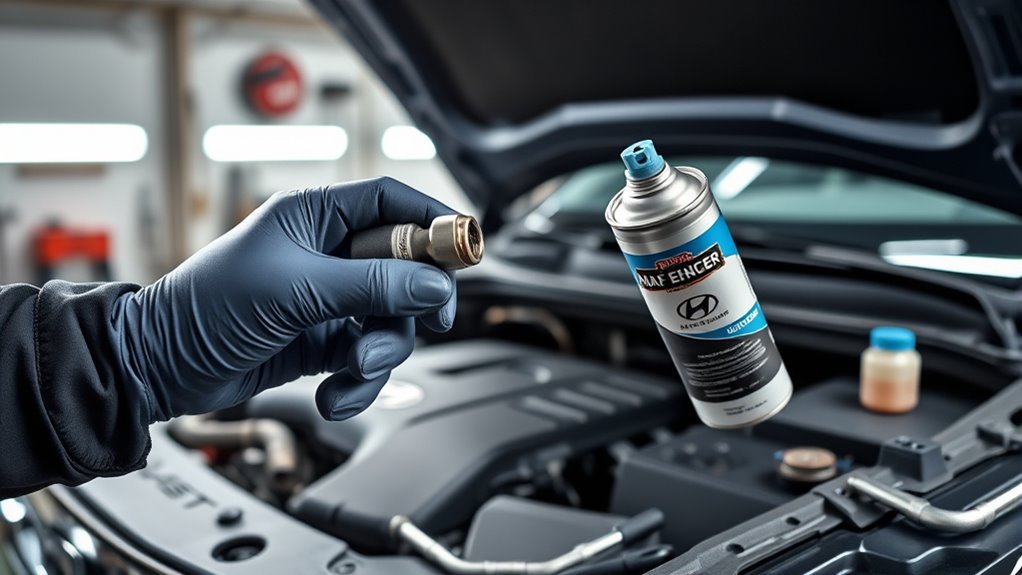
The MAF sensor deserves inspection because incorrect airflow data can cause lean fuel correction, but cleaning should follow inspection and scan-data checks rather than replace them. Never touch, scrape, or wipe the delicate sensing element.
Remove and Inspect the Sensor
Turn the ignition off before unplugging the MAF connector. Inspect the connector, terminals, wiring, sensor housing, air-cleaner assembly, and intake duct before removing anything unnecessarily.
- Look for dirt, oil contamination, cracks, corrosion, loose terminals, or damaged wiring.
- Check that the air duct is fully connected and sealed between the airflow sensor and throttle body.
- Inspect the sensor mounting area and seals for a path that could admit unmetered air.
If moving the wiring changes how the engine runs, investigate the connector and harness rather than assuming the sensing element itself has failed.
Clean With Approved MAF Cleaner
If the sensing area is contaminated, use only cleaner intended for mass-airflow sensors. Do not use carburetor cleaner, brake cleaner, compressed-air contact, a brush, or a cloth on the sensing element.
With the engine off and the sensor handled by its housing, spray the sensing area without touching it. Follow the cleaner manufacturer’s safety directions and allow the solvent to evaporate fully before reinstalling the sensor. CRC’s current MAF-cleaning instructions specifically warn against wiping or scraping the sensing element.
Test MAF Output With Service Data
Do not condemn the MAF because of one improvised voltage reading. The 2001 Sonata’s hot-film airflow system should be evaluated with the correct circuit information, scan data, and engine-specific specifications.
- Check for MAF-related trouble codes and wiring faults.
- Watch airflow data while engine speed rises smoothly and verify that the reading responds consistently.
- Check sensor power, ground, connector integrity, and signal behavior using the correct wiring information.
- After cleaning or repairing a fault, reinstall the intake securely and recheck fuel trims before considering replacement.
If the readings remain implausible after the intake and wiring have been verified, a known-good sensor or service-manual test can confirm whether replacement is justified.
Find and Fix Vacuum and Intake Leaks
An air leak downstream of the airflow sensor can create P0171 because the engine receives air the ECM did not account for. A smoke test is one of the most useful ways to find small leaks that are difficult to see.
Check the intake boot, PCV hoses, vacuum hoses, intake-manifold connections, injector sealing areas, and other openings connected to manifold vacuum. Introduce smoke with the engine off and follow the smoke-machine manufacturer’s pressure limits rather than applying uncontrolled shop-air pressure.
- Inspect large intake ducts and hose connections visually.
- Smoke-test the intake system and watch for smoke escaping from hoses, joints, seals, or gaskets.
- Repair each confirmed leak instead of sealing over damaged components temporarily.
- Repeat the smoke test and then recheck fuel trims.
An exhaust leak ahead of the front oxygen sensor can also affect oxygen readings, so inspect the exhaust manifold and upstream joints if the intake system proves tight.
Check Fuel Delivery: Pressure, Pump, Filter, and Injectors
If the intake is sealed and MAF data is reasonable, check whether the engine is receiving enough fuel. Low pressure, a weak pump, restriction, regulator trouble, or poor injector flow can all force the ECM to add fuel.
Warning: Fuel-system testing can release pressurized gasoline. Relieve residual pressure using the correct service procedure, work away from sparks and flames, wear eye protection, and use the proper gauge and adapters. If you are not equipped for fuel-system work, have a professional perform this test.
For the 2001 Sonata 2.4L, the published fuel-pressure specification is 255 kPa (37 psi) with the fuel-pressure regulator vacuum hose connected and 320–340 kPa (46–49 psi) with it disconnected. Do not apply those figures blindly to another engine configuration; use its matching service information.
- Measure pressure correctly: compare the gauge reading with the specification for your exact engine and test condition.
- Watch pressure under changing demand: a pressure drop when the engine needs more fuel can point toward the pump, filter, supply, or regulator.
- Inspect the regulator: fuel appearing inside a vacuum-operated regulator’s vacuum hose indicates a regulator problem.
- Check injector operation: compare injector electrical operation and fuel delivery rather than replacing the whole set because of P0171 alone.
Published same-generation 2.4L service data lists injector resistance at 13–16 ohms at 20°C (68°F). Confirm the specification for your exact 2001 engine before using resistance alone to condemn an injector; electrical resistance cannot prove that an injector has correct flow.
[Products Worth Considering]

This oxygen O2 sensor set is designed for select Toyota Camry and RAV4 models with 2.4L engines, providing upstream and downstream replacement coverage in one package. Built to OEM specifications for plug-and-play installation, it helps improve fuel efficiency, support accurate air-fuel monitoring, and restore reliable engine performance. The stainless steel and heat-resistant construction is made for long-lasting durability and stable operation.

AutoLine Pro HyperSmoke is a professional automotive smoke tester designed to quickly find EVAP, vacuum, intake, boost, exhaust, and other leak sources with thick visible smoke. It features adjustable pressure, built-in air compressor motor, instant warmup, and OEM approved smoke fluid for safe, accurate diagnostics across a wide range of vehicles and systems. The kit includes essential accessories and is backed by a full coverage warranty for dependable shop or garage use.

This silicone vacuum hose kit provides a versatile selection of tubing sizes and connector pieces for automotive, marine, and industrial routing tasks. Built for heat resistance and durability, it supports air and water applications in engine bays, custom intake setups, turbo piping, and cooling system projects. The included size variety makes it a practical choice for repairs, fabrication, and DIY maintenance work.
If Cleaning Fails: Test Before Replacing MAF, O2, or Fuel Parts
If MAF cleaning does not correct P0171, return to the evidence instead of moving down a parts-replacement list. Recheck fuel trims, intake sealing, MAF data, fuel pressure, injector operation, and the upstream oxygen-sensor signal.
An oxygen sensor can report a lean exhaust condition without being the cause of it. A genuine vacuum leak or weak fuel supply produces the same lean signal, so replacing the O2 sensor before testing the mixture can leave P0171 unchanged.
There is also a model-specific issue worth knowing about on the 2.5L V6. Hyundai bulletin 02-36-010 covered some 1999–2001 Sonata 2.5L vehicles produced through May 31, 2001 for front oxygen-sensor faults and ECM programming. The bulletin identifies codes including P0133, P0134, P1134, P0153, P0154, and P1154 and describes replacement/programming procedures.
If your V6 has P0171 plus those O2-related codes, review the Hyundai 2.5L O2 sensor and ECM bulletin before treating the oxygen sensor as an unrelated generic repair.
Replace a MAF sensor, oxygen sensor, fuel pump, regulator, or injector only when testing points to that component. After any repair, clear the code if appropriate, operate the engine through the conditions that originally set it, and verify that fuel trims have returned toward normal and P0171 does not return.
When to Call a Pro and How Identifix Can Help
Professional diagnosis makes sense when P0171 remains after basic intake, MAF, and fuel checks, or when the repair requires pressurized-fuel work, advanced electrical testing, waveform analysis, or ECM programming.
A technician can compare live data under load, perform a controlled smoke test, measure fuel pressure correctly, test injector balance, inspect O2 sensor behavior, and check the exhaust for leaks. These tests are usually more useful than replacing several suspected components in sequence.
Identifix Direct-Hit provides OEM service information, wiring diagrams, technical service bulletins, diagnostic information, and technician-confirmed repair records. That can be useful when basic testing produces conflicting results or the vehicle has several related codes.
- Give the shop all stored and pending codes, not just P0171.
- Ask what the fuel trims show at idle and higher engine speed.
- Ask whether intake leaks and fuel pressure were actually tested before authorizing a sensor or pump.
- For a 2.5L V6 with related oxygen-sensor codes, ask whether the applicable Hyundai bulletin or campaign history has been checked.
Key Takeaways
- P0171 describes excessive lean correction on Bank 1; it does not identify which component failed.
- Compare fuel trims at idle and higher RPM because the pattern can help separate an intake leak from airflow or fuel-delivery trouble.
- Never wipe or scrape the MAF sensing element; inspect the intake and wiring and use MAF-specific cleaner only when contamination is present.
- The verified 2.4L fuel-pressure specification is 37 psi with regulator vacuum connected and 46–49 psi disconnected.
- Certain 2.5L V6 cars have model-specific oxygen-sensor and ECM service information that should be checked when related O2 codes appear.
Frequently Asked Questions
Is the MAF sensor usually the cause of P0171 on a 2001 Hyundai Sonata?
No single component should be assumed to cause P0171. A contaminated or inaccurate MAF can contribute, but vacuum leaks, intake leaks, low fuel pressure, injector problems, exhaust leaks, wiring faults, and oxygen-sensor issues can produce the same code. Test the system before replacing the MAF.
What does Bank 1 mean on a 2001 Hyundai Sonata?
Bank 1 is the cylinder bank containing cylinder No. 1. A four-cylinder Sonata has only one cylinder bank. On the 2001 2.5L V6, Hyundai service information identifies Bank 1 as the dash-panel side and Bank 2 as the radiator side of the engine.
How much does it cost to fix code P0171?
A P0171 repair can cost roughly $100 to $1,000 depending on the actual fault, labor, and parts required. A small vacuum-hose repair or MAF cleaning can be relatively minor, while extensive diagnosis, a fuel pump, injectors, sensors, or multiple repairs can cost considerably more.
How long can you drive with a P0171 code?
There is no fixed number of safe days or miles for driving with P0171. If the engine runs smoothly, drive only as needed while arranging diagnosis. If it misfires badly, stalls, loses substantial power, overheats, or the check-engine light flashes, stop driving and address the underlying problem promptly.
Conclusion
A 2001 Hyundai Sonata P0171 should be diagnosed as a lean-condition problem, not as an automatic MAF or O2-sensor failure. Start with codes, freeze-frame data, fuel trims, intake leaks, and the MAF system; then verify fuel delivery and injector operation. If the evidence still conflicts, use engine-specific service information or professional testing before buying parts.
Sources
- 2001 Hyundai Sonata 2.4L MAF service information: MAF design, diagnostic checks, intake and wiring considerations.
- CRC Industries MAF cleaning guide: safe MAF cleaning procedure and warning not to wipe or scrape the sensing element.
- 2001 Hyundai Sonata 2.4L fuel-pressure specification: regulated fuel-pressure values with the vacuum hose connected and disconnected.
- Hyundai Sonata 2.4L injector specification: same-generation injector resistance reference.
- Hyundai TSB 02-36-010: 1999–2001 Sonata 2.5L front oxygen-sensor faults and ECM reprogramming information.
- Identifix Direct-Hit: OEM repair information, wiring diagrams, bulletins, diagnostic resources, and confirmed repair data.