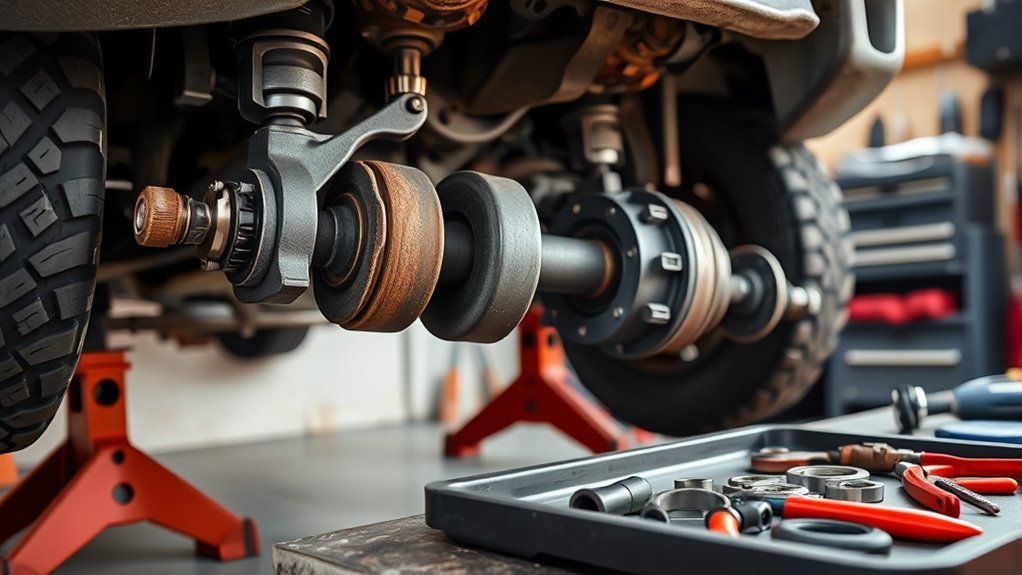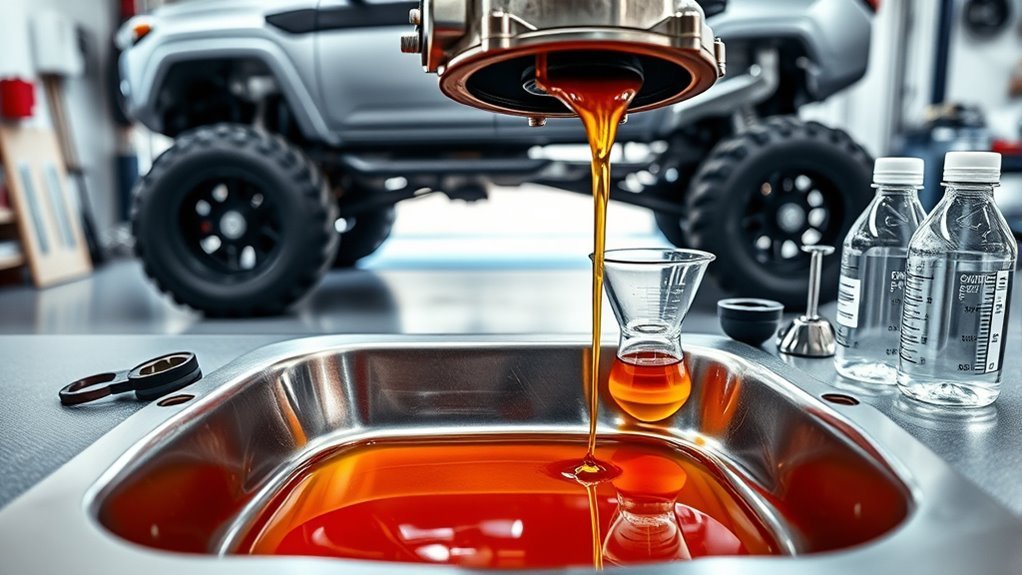
You’ll need about 11 quarts total for a 5th‑gen 4Runner automatic (converter included) and a pan drain removes roughly 4–5 quarts; DIY drain‑and‑fill yields closer to 3.7–5 quarts per service. Use Toyota ATF‑WS or a documented full‑synthetic WS‑equivalent, don’t mix fluids, and measure level at 104–113°F. Bring a 5mm Allen, new crush washer, thermometer and torque wrench. Follow 60k/30k mile intervals, and keep going for step‑by‑step procedures and cautions.
Quick Answer: 5th‑Gen 4Runner Transmission Capacities (Pan, Converter, Total)
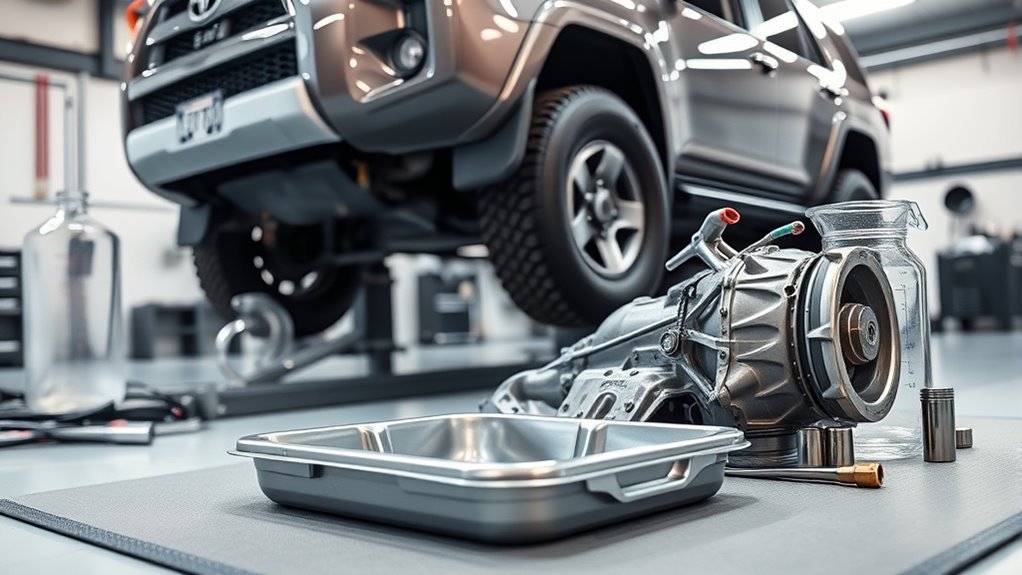
For a 5th‑generation Toyota 4Runner, the transmission holds about 11 quarts total (including the torque converter); a pan drain and fill typically removes roughly 5 quarts, so you’ll need to add the remainder to reach full capacity using Genuine Toyota ATF WS or an equivalent full‑synthetic ATF. You’ll measure level at 104–113°F for accuracy, since thermal expansion affects readings. A pan removal evacuates the accessible sump volume (~5 qt); the converter and torque‑tube retain the balance, so topping to ~11 qt restores system volume. Follow the service schedule—first change at 60,000 miles, then every 30,000 miles—to maintain hydraulic integrity and shift quality. When selecting replacement fluid, verify fluid compatibility with Toyota specifications; label cross‑references matter. Evaluate synthetic options for thermal stability and shear resistance to support liberation from frequent service constraints. Use a calibrated dipstick or scan tool where available, and document fill procedure and measured temperature to guarantee repeatable, precise results.
What Fluid to Use (Toyota WS vs. Full‑Synthetic Alternatives)
Although Toyota specifies ATF WS for the 5th‑Gen 4Runner’s automatic transmission because it’s formulated to meet specific friction, viscosity, and shear‑stability requirements, you can use a high‑quality full‑synthetic alternative (e.g., Amsoil ATF) only if it explicitly lists compatibility with Toyota WS specs. You should prioritize documented fluid compatibility to avoid altered clutch friction, shift quality loss, or premature wear. Full‑synthetic options often offer superior shear resistance, thermal stability, and oxidation control, translating to measurable performance differences under heavy towing, hot climates, or frequent off‑road use. Don’t mix fluids: combining older DAC or non‑WS fluids with WS‑compatible synthetics risks chemical incompatibility and degraded performance. For routine drain‑and‑fill service that replaces roughly half the system volume, stick to a fluid that matches Toyota’s friction and viscosity targets; for extended-life or extreme‑use goals, select a WS‑rated full‑synthetic with published test data. That approach keeps your transmission efficient, durable, and free to perform as you intend.
Tools & Parts Checklist: Plugs, Gaskets, Temp Gear, and Fluid Quantities
You’ll need the correct drain and check plug hardware—use a 5mm Allen socket and replace the crush washers (35178-30010) when servicing the pan. Verify fluid level with a transmission temp gauge or OBD‑II reader at 104–113°F, and plan on roughly 5 qt for a drain-and-fill while the total system holds just under 11 qt including the torque converter. Torque the pan and plugs to spec with a calibrated torque wrench and fit a new pan gasket (35168-60010).
[Products Worth Considering]

These genuine Toyota oil drain plug gaskets are designed to help maintain a reliable seal during oil changes, reducing the chance of leaks and supporting proper engine maintenance. With an OEM fit and trusted Toyota quality, they are a practical choice for routine service on compatible vehicles. The convenient quantity pack is ideal for keeping multiple maintenance intervals covered.

Castrol GTX Full Synthetic 5W-30 motor oil is designed to deliver maximum engine protection in severe driving conditions. It helps fight wear, control sludge, and resist viscosity breakdown while supporting longer intervals between oil changes. Formulated to meet or exceed key industry and vehicle manufacturer specifications, it offers dependable performance for modern engines.

Castrol EDGE 0W-20 advanced full synthetic motor oil is engineered for drivers seeking strong wear protection, excellent viscosity control, and thermal stability. It delivers superior performance in critical engine areas, including fuel economy, high-temperature protection, sludge control, and wear defense. Designed for extended oil-change intervals, it helps keep modern engines running smoothly under demanding conditions.
Drain & Check Plugs
Before you lower the pan, gather the 5mm Allen socket for both the drain and check plugs, the drain plug crush washer (PN 35178-30010), a replacement check plug gasket if needed, a thermometer or temp gear to verify 104–113°F, and at least 5 quarts of full synthetic ATF for a drain-and-fill (keep up to ~11 quarts available if you’ll refill the torque converter). You’ll use the same 5mm Allen for easy access to the drain plug and check plug; this simplifies tooling and reduces time. Replace the crush washer every service to prevent leaks. Verify temperature before using the check plug to get an accurate level. Keep extra fluid on hand if torque converter refill becomes necessary.
- Reassurance: you’re prepared.
- Control: you prevent leaks.
- Freedom: you finish on your terms.
Temperature Tools & Fluid
Now that you’ve got the drain and check plugs, crush washer, and thermometer ready, focus on the temperature tools and fluid quantities you’ll need to get an accurate level and a proper service. Use temperature monitoring to confirm fluid falls within 104°F–113°F before checking the level; OBD-II readers or a laser thermometer work reliably. For a drain-and-fill plan on a 1998 3.4 A340F, stock about 5 quarts of full-synthetic ATF; a complete flush requires up to 11.3 quarts (total capacity just under 11 quarts including torque converter). Keep a spare crush washer (PN 35178-30010) and transmission strainer (PN 35330-60050). Consider a T‑Tech machine for full-service flushes to guarantee pump-driven exchange and verify fluid compatibility with Toyota specs.
Drain & Fill: Step‑By‑Step Procedure With Temp‑Based Level Checks
While the pan drains, remove the refill plug so you won’t be left unable to top the gearbox, then measure the drained volume—typical single drain removes ~2 qts but the 1998 3.4 4Runner’s total capacity is just under 11 qts and usually needs multiple drain-and-fill cycles for a full fluid refresh. Drain, catch, and record volume; initially add about 5 qts, then cycle the transmission through gears. Heat the fluid to the target range and check level at the check plug: fluid should bleed out between 104°F and 113°F. Track drained volume to know how many iterations you need to approach full capacity. Adopt a clear maintenance frequency—roughly every 30,000 miles—to combat fluid degradation and extend freedom from failures.
- You’ll feel empowered restoring control when you measure and repeat methodically.
- You’ll gain confidence as level checks confirm correct fill at temp.
- You’ll be liberated from unexpected failures via disciplined maintenance.
How to Read Transmission Temperature: OBD Pins, Scan Tools, and IR Thermometer
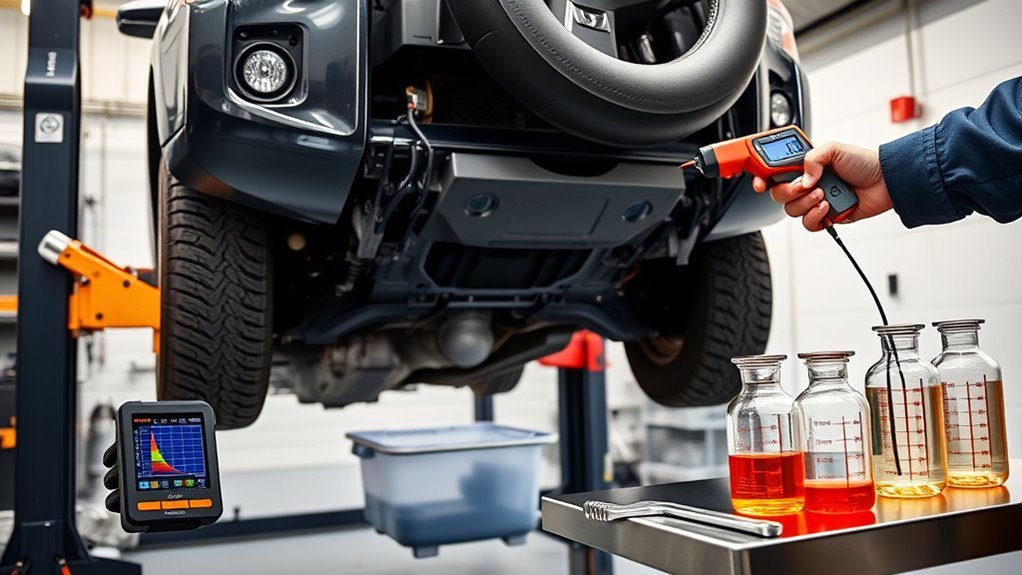
If you need an accurate transmission temperature for level checks, you can get it three ways: tie pins in Maintenance Mode, use an OBD-II scan tool, or verify with an IR thermometer. For Maintenance Mode, bridge OBD-II pins 4 and 13 with 16–20 gauge wire; the cluster will display transmission temperature for accurate temperature monitoring. Alternatively, fit a ScanGauge, UltraGauge or similar OBD-II reader and load the published programming codes to read realtime transmission temperature on your dash—this supports proactive transmission health checks. Use an infrared thermometer as a last resort: aim at the case near the pan to estimate fluid temp when electronic access isn’t possible. Remember fluid expands between 104°F and 113°F, so you must confirm the reading before removing the check plug. If the transmission is overheated, you risk fluid loss and reduced transmission health. Choose the method that gives reproducible, verifiable temperature monitoring for safe, liberated DIY maintenance.
[Products Worth Considering]

CHAPIN’s low-profile oil drain pan is designed to slide under low-clearance vehicles and equipment, making fluid changes easier in tight spaces. The large splash-free target area helps reduce mess while the molded carry handles support easier lifting, pouring, and storage. Built for draining oil, coolant, and other automotive fluids, it offers a practical high-capacity solution for routine maintenance.

This 12-pack oil filter and drain plug washer set is designed for a wide range of Toyota and Scion vehicles, helping support clean oil flow and dependable engine performance. It replaces several common OE part numbers and offers an easy-fit solution for routine maintenance. Built with corrosion-resistant materials and efficient filtration, it helps keep engine contaminants out and supports longer service life.

This color coded tire tread depth gauge helps you quickly check tire wear and monitor when replacement is needed. Calibrated in easy-to-read 32nds with clear red, yellow, and green ranges, it offers fast visual results for cars, trucks, motorcycles, and other passenger vehicles. The pocket clip makes it simple to keep on hand for routine maintenance and safety checks.
When to Drain‑And‑Fill vs. Full Flush: Pros, Cons, and Risks
When you need a quick, low-risk service, drain-and-fill replaces 1–2 quarts and preserves seal and gasket integrity while restoring some additive levels. If the fluid is dark or degraded a full flush replaces up to ~11 quarts but can dislodge sludge and clog passages, so you should only flush a well-maintained system or follow a technician’s inspection. Follow the 4Runner interval of first change at 60,000 miles and every 30,000 miles thereafter to minimize full-flush risks.
Drain‑And‑Fill Benefits
Choose drain‑and‑fill when you want a quick, lower‑risk fluid refresh: it replaces about 2–3 quarts, takes less time and equipment than a full flush, and — if done every ~30,000 miles — helps maintain fluid quality without the sludge‑dislodging risks associated with replacing the full 8–11‑quart capacity. You get improved fluid longevity and simple maintenance tips: monitor color and odor, change at intervals, and top to spec. Drain‑and‑fill reduces interruption risk in older 4Runners and is accessible for DIYers.
- Relief: you control maintenance without surrendering your vehicle to a shop.
- Confidence: conservative replacement protects passages.
- Freedom: minimal tools, minimal downtime — maintain independence.
Full Flush Risks
Although a full flush can restore most degraded fluid, it carries measurable risks—especially in transmissions with accumulated sludge that can dislodge and clog narrow passages. You should perform a thorough sludge assessment and flush preparation before committing. If fluid is dark or burnt-smelling, a full flush may be necessary to recover lubrication and cooling; otherwise, prefer drain-and-fill at regular intervals to refresh the system gradually.
| Action | Outcome |
|---|---|
| Drain-and-fill | Gradual renewal, lower risk |
| Full flush | Complete replacement, higher risk |
| Sludge assessment | Determines viability |
| Flush preparation | Protects passages |
Follow maintenance intervals (initial change ~60k mi, then ~30k mi) to minimize flushing hazards. Make evidence-based choices to liberate your drivetrain from avoidable failure.
Troubleshooting & Common Pitfalls: Underfill, Overfill, Sludge, and Check‑Plug Behavior
Because transmission fluid level and condition directly affect lubrication, cooling, and hydraulic control, you need to diagnose underfill, overfill, sludge, and check‑plug behavior promptly to avoid rapid wear or failure. Recognize underfill symptoms: overheating, poor lubrication, and hard or delayed shifts. Note overfill effects: foaming, erratic shifts, and accelerated wear. Prevent sludge by following sludge prevention practices: timely fluid changes and avoiding contamination. Understand check plug importance: at 104°F–113°F fluid should dribble when the check plug is removed; none or a trickle indicates underfill.
- You’ll feel urgency when underfill symptoms appear — act fast to protect gear integrity.
- You’ll resent the helplessness of overfill effects — correct level restores control.
- You’ll find liberation through routine checks — sludge prevention and proper check‑plug verification return authority to you.
Monitor temperatures, use proper fluid, and verify levels at specified temps. Diagnose precisely; intervene decisively.
Service Options & Maintenance Schedule: DIY, T‑Tech Flush, and Dealer Service
When you’re deciding between DIY, a T‑Tech exchange, or dealer service, match the method to how complete a fluid change you want and how much labor or cost you’ll accept. A DIY drain-and-fill removes roughly 3.75 quarts of the sub‑11‑quart 5th Gen 4Runner system; it’s economical and liberating but won’t fully renew fluid. Use full synthetic ATF and verify fluid compatibility to avoid warranty or performance issues. A T‑Tech machine uses the transmission pump to swap nearly all fluid, addressing sludge and debunking maintenance myths that a drain alone suffices. Schedule your first replacement at 60,000 miles, then perform drain-and-fills every 30,000 miles; consider periodic T‑Tech exchanges if you tow heavily. Dealer service costs about $174 for 6 quarts of Genuine Toyota ATF WS and guarantees OEM fluid and torque‑spec procedures. Choose based on desired completeness, budget, and your willingness to control service quality.
[Products Worth Considering]

This brake bleeder bottle is designed to make fluid bleeding easier for one-person use with a built-in check valve and magnetic mount. The flexible hose fits most bleeder valves and helps reduce the chance of air entering the system during service. With a practical fluid capacity and universal fit, it is a handy tool for brake maintenance and repair.

This flexible oil funnel is designed to make fluid changes cleaner and easier by guiding oil around obstacles like skid plates and crossmembers. Its shape-retaining core and silicone body can be molded for custom positioning, while the heat-resistant, leak-proof design helps prevent spills during draining and filter removal. Reusable and easy to clean, it works well for cars, trucks, motorcycles, and other hard-to-reach fluid fill or drain applications.

The GEARWRENCH Professional Bi-Directional Diagnostic Scan Tool brings OE-level diagnostics to your smart device for efficient troubleshooting and repair. It offers full bi-directional control, live actuation testing, live data mapping, freeze frame capture, and support for 23 reset and relearn functions to help technicians complete complex jobs with confidence. With software updates included, broad vehicle coverage, and a two-year warranty, it delivers powerful shop-ready capability without ongoing fees.
Frequently Asked Questions
How Much Transmission Fluid Does a 4runner Take?
A 1998 4Runner with a 3.4L A340F takes just under 11 quarts total; a drain/fill replaces ~2–3.75 quarts. You’ll use specified transmission fluid types and follow fluid change frequency of 60k, then every 30k miles.
How Much Transmission Fluid Does a 2001 4runner Take?
A 2001 4Runner holds about 11 quarts total (torque converter included); a drain-and-fill yields ~2–3.75 quarts. You’ll follow transmission maintenance tips and a 30,000-mile fluid change frequency to preserve freedom and reliability.
How Much Transmission Fluid Does a 2005 Toyota 4runner Take?
You’ll need about 11.3 quarts total for a 2005 Toyota 4Runner (drain/fill swaps replace ~4–5 quarts). For fluid change and maintenance tips, use Toyota ATF WS, check level warm, service every 30k miles.
Conclusion
You can do a proper 5th‑Gen 4Runner transmission service without a dealer: use Toyota WS or a high‑quality full‑synthetic ATF, gather plugs, gaskets, a temp gauge or OBD reader, and follow temp‑based fill procedures to avoid under/overfilling. If you worry about complexity, start with a drain‑and‑fill and practice reading temps — it’s low‑risk and reveals fluid condition. For long‑term care, schedule periodic drain‑and‑fills and reserve full flushes for shop use.