You’ll want trims with higher approach, breakover, and departure angles for technical trails; TRD Pro and Trailhunter give about a 33° approach and tuned suspension, TRD Off‑Road reaches ~30° with the air dam off, Limited can match that with larger tires, and avoid 2WD SR5 for serious obstacles. Removing the factory air dam and small lifts or nearly 33″ tires boost clearance, but check shocks, geometry, and legal/efficiency tradeoffs—keep going to get exact numbers and step‑by‑step options.
Quick Answer: Which 2025 4Runner Trims Are Best for Trails

Wondering which 2025 4Runner trim to take on technical trails? You’ll pick based on mission: pure capability or mixed comfort. The TRD Pro gives you the clearest edge—higher approach angle (about 3° more than TRD Off‑Road without air dams) and factory suspension tuned for aggressive obstacles. The Trailhunter advantages focus on calibrated off‑road electronics and component packaging that stretch usable Off Road capabilities without sacrificing reliability. The TRD Off‑Road is the baseline high‑clearance workhorse—nearly 33″ tires and lifted suspension let it hit roughly a ~30° approach angle without the air dam, ideal for steep entries. If you want liberation with some refinement, the Limited can match TRD Off‑Road ground clearance with tire adjustments, keeping Luxury features intact while boosting off‑road performance. Avoid the 2WD SR5 for serious trails; it’s the only trim that doesn’t meet high‑clearance criteria. Choose the trim that aligns with how far you’ll push terrain.
How Ramp Angles (Approach, Breakover, Departure) Affect Real‑World Off‑Roading
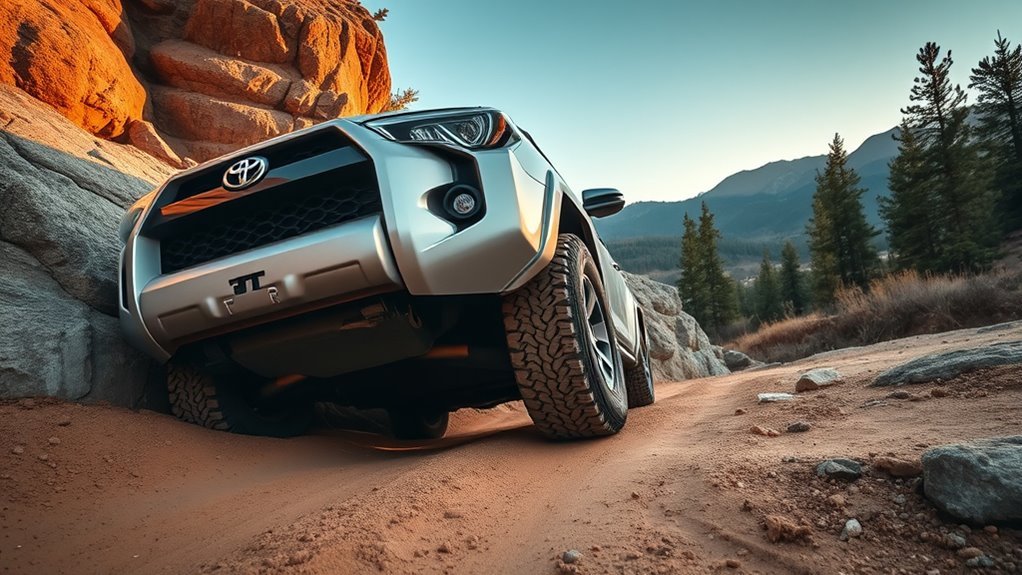
You picked a trim for a reason—now let’s look at how approach, breakover, and departure angles actually matter on the trail. You’ll use off road techniques to exploit these geometric limits: approach controls front bumper clearance on climbs, breakover prevents mid‑chassis grounding, and departure protects the rear on steep exits. Trim choices that raise clearance change what lines you can commit to.
- Approach angle: higher angle (up to 33° with TRD Off‑Road, better without an air dam) lets you climb steeper ramps without bumper strikes.
- Breakover angle: shorter wheelbase and higher clearance reduce belly contact, keeping momentum and preventing hangups.
- Departure angle: improved by rear lift or air dam removal, it preserves vehicle stability on descents.
You’ll pick lines where ramp angles match your skill and vehicle limits, maintain momentum, and use precise steering inputs. That combination frees you to explore tougher terrain with confidence and retained vehicle stability.
2025 4Runner: Measured Ramp Angles by Trim (SR5, TRD Off‑Road, TRD Pro, Trailhunter, Limited)
You’ll see actual measured approach angles for each 4Runner trim and how removing the air dam changes those numbers. Then we’ll compare breakover and ground clearance to show which trims handle center humps and ledges best. Finally, you’ll get practical guidance on using air dam removal and larger tires to improve real-world ramp performance.
Measured Approach Angles
Measured approach angles for the common 4Runner trims reveal how small configuration changes — like air dam removal or larger tires — translate into meaningful climbing performance differences. You’ll use angle comparisons and approach performance to choose the right trim for freer movement off-road. Measured values:
- SR5: ~22° with air dam, ~30° without.
- TRD Off‑Road: ~22° with air dam, 30° without.
- TRD Pro / Trailhunter: ~33° (TRD Pro) and comparable (Trailhunter) without air dam; superior steep-ascent capability.
The Limited achieves ~31° with larger tires and no air dam. You’ll prioritize trims with higher measured approach angles if you want fewer obstacles dictating your path. These numbers let you objectively trade aesthetics or factory bits for tangible gains in climbing capability and liberation on technical lines.
Breakover And Clearance
Having compared approach angles, it’s time to examine breakover and underbody clearance—the ramp angles that determine whether a 4Runner can straddle crests or clear mid‑trail obstacles without grounding. You’ll find trims with higher approach angles generally deliver better breakover performance because they pair steeper nose geometry with suspension and tire choices that lift the belly. TRD Pro and Trailhunter setups, with their enhanced approach numbers and tuned suspensions, give clear clearance benefits for technical traverses. TRD Off‑Road matches that capability without an air dam, while a modified SR5 or Limited—once you remove the dam and fit proper tires—can approach similar functional clearance. For liberation on remote lines, prioritize measured ramp angles, suspension travel, and tire diameter to maximize breakover performance and clearance benefits.
Effect Of Air Dam
Because the factory air dam sits low and trims the 4Runner’s nose profile, it noticeably reduces approach angle and limits off‑road clearance—removing it raises the TRD Off‑Road’s approach from about 22° to roughly 30° and lets the Limited reach near 31°. You’ll gain tangible air dam benefits and off road enhancements by deleting that low lip, exposing the true chassis clearance and improving obstacle entry. The TRD Pro already nets ~3° more than the Off‑Road without the dam, so pairing removal with its geometry liberates capability further. Evaluate tradeoffs—aerodynamics, splash protection, and legal considerations—before you cut or replace components. Practical steps:
- Measure baseline angles.
- Test clearance after removal.
- Fit a modular skid/air dam alternative.
Can You Improve Your Approach Angle? Air‑Dam and Suspension DIY Checks
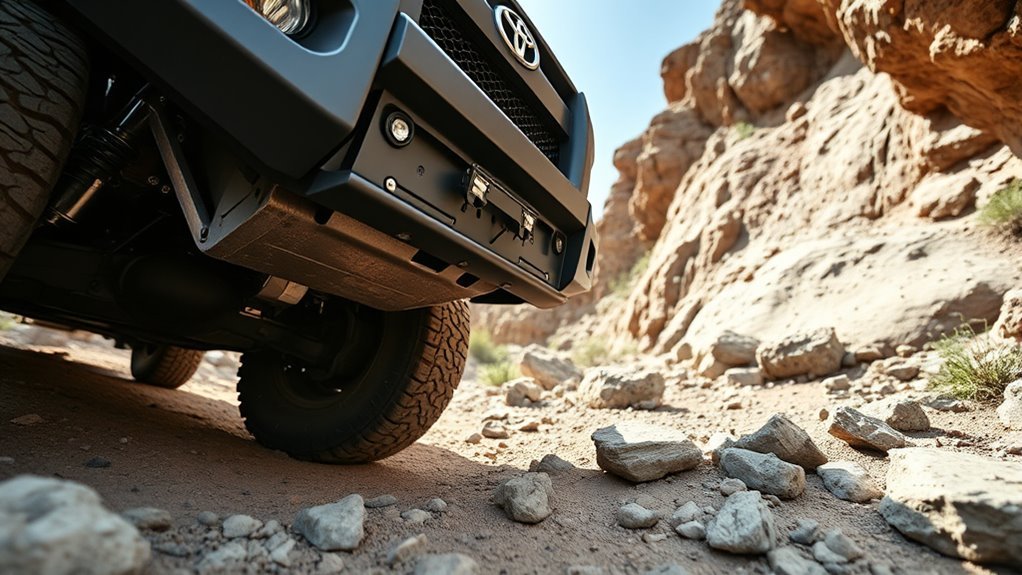
Want to improve your 4Runner’s approach angle? Start with objective checks: measure current clearance and note trim level. Air dam removal is the most immediate change—on a TRD Off‑Road it can raise approach from roughly 22° to about 30°, and the TRD Pro gains an extra ~3° once the dam’s off. Remove the dam if you want less snag risk and freer lines.
Next, inspect suspension components for sag, worn bushings, or compressed springs. Suspension upgrades will increase ride height and restore suspension travel, further improving approach. Verify stock tire capacity—TRD Off‑Road fits nearly 33″ tires stock, which adds clearance without heavy modification. DIY steps: document baseline angles, safely jack the vehicle, loosen fasteners, remove the air dam, and remeasure. If you pursue springs or mild lift components, confirm compatibility and torque specs. These targeted, reversible changes free your 4Runner for steeper terrain without overcomplicating the build.
Tires, Lifts, and Shocks That Add Clearance: Exact Sizes, Gains, and Safety Tradeoffs
You can gain meaningful clearance by choosing the right tire size and lift: nearly 33″ tires on a TRD Off-Road add significant ground clearance and, with the air dam removed, push approach angle toward 30°. Small lifts and upgraded shocks (OEM-to-1.1″ tire diameter increase or Old Man Emu/FOX setups) change both ride height and geometry, but they’ll alter steering, gearing, and warranty considerations. We’ll compare exact tire diameters, expected clearance gains, and the safety/performance tradeoffs for each lift and shock option.
Tire Sizes And Gains
When you swap to larger tires or fit a lift and upgraded shocks, expect measurable gains in ground clearance and approach angles—but know the exact payoffs vary by trim and setup. You’ll plan tire upgrades around trims: TRD Off-Road starts near 33″ and responds well; TRD Sport stock at 31.5″ may accept 33″ with mods; Limited gains about 0.55″ ground clearance from a 1.1″ larger diameter. TRD Pro (FOX) and Trailhunter (Old Man Emu) suspensions handle bigger tires better, preserving geometry and travel. Remove the TRD Off-Road air dam to push approach toward 30°. Balance gains with safety: steering, gearing, and brake load change. Prioritize measured swaps, verified fitment, and liberation through reliable, tested upgrades.
- Verify trim fitment
- Measure net clearance gains
- Confirm handling impacts
Lift Kits And Tradeoffs
Start by matching lift height, tire diameter, and shock choice to your 4Runner’s trim and intended terrain: a modest 1–1.5″ spacer lift paired with nearly 33″ tires on a TRD Off‑Road boosts ground clearance and approach angle with minimal steering or gearing changes, while a TRD Pro’s FOX shocks allow larger lifts and tires with better control and less compromise to suspension travel; removing the Off‑Road air dam can further increase approach from ~22° to ~30°, but every inch of lift raises center of gravity, alters steering geometry, and increases brake and driveline loads—so plan exact sizes, measure clearance gains, and validate handling before committing.
Choose lift kit benefits that match risk tolerance: small spacers preserve on‑road manners; bigger suspension upgrades improve articulation and damping but demand brakes, alignment, and driveshaft tuning.
Practical Checklist: Pick a Trim & Classify Trails (What Each Trim Can Handle)
Although trim choice hinges on intended terrain, pick the highest-approach and suspension package you can afford for serious high-clearance trails. Use trim comparisons and trail suitability to match capability to objective: TRD Pro and Trailhunter give the best approach and suspension, TRD Off-Road is stock-suited for high-clearance lines, Limited can match clearance with tire upgrades, and only 2WD SR5 falls short of high-clearance criteria.
Classify trails by required clearance, angle, and suspension travel. Then pick a trim that minimizes modifications while maximizing reliability and freedom.
- Assess: route features (approach angle, ledges, washouts) and pick TRD Pro/Trailhunter for extreme sections.
- Configure: TRD Off-Road handles most high-clearance trails stock; remove air dam to gain ~3° vs Off-Road on TRD Pro, and Off-Road reaches ~30° without air dam.
- Upgrade: Limited needs tires to match Off-Road clearance; avoid 2WD SR5 for demanding runs.
Follow this checklist to choose and liberate your off-road experience.
Frequently Asked Questions
What Is the Approach Angle of the Toyota 4runner 2026?
The 2026 4Runner’s approach angle runs about 33° with the air dam and up to 36° without it; you can boost off road capabilities further with suspension upgrades, freeing your trail access and reducing frontal obstruction.
What Is the Formula for Angle of Departure?
You calculate departure angle θ = arctan(h/d), where h is rear low-point height above ground and d is horizontal distance from rear tire contact to that point; this boosts off road performance and vehicle capabilities for liberated drivers.
What Is the Approach Angle and Departure Angle?
The approach angle is the maximum climb angle your front clears without scraping; the departure angle is the maximum descent angle your rear clears. They’re off road capabilities performance metrics that affect vehicle stability and terrain navigation for liberation.
What Is the Approach Angle of the 2025 4runner?
The 2025 4Runner’s approach angle varies by trim: expect about 22° with the TRD Off‑Road air dam, up to 30° without it, and around 33° for TRD Pro—boosting 4Runner performance and off road capabilities.
Conclusion
Pick the trim that matches your courage and toolbox: SR5 for weekend gravel, TRD Off‑Road for serious dirt, TRD Pro or Trailhunter when you mean business, Limited if you love comfort more than rocks. Know your approach, breakover and departure numbers, check air‑dams and shock travel, and add tires or a modest lift carefully—too much and you’ll trade stability for bragging rights. Choose wisely, prep smart, and conquer trails without theatrics.