The RAV4 Pre-Collision System uses a forward camera and radar fusion to detect vehicles, pedestrians, and cyclists, estimating time-to-collision from speed and distance; it gives visual and audible warnings, boosts braking force when you react, and can autonomously apply brakes if you don’t. Detection relies on shape, motion, and range algorithms but can be degraded by rain, glare, or sensor obstruction. It’s a driver aid, not a substitute for attention, and more details follow below.
What the RAV4 Pre-Collision System Does and Who Needs It
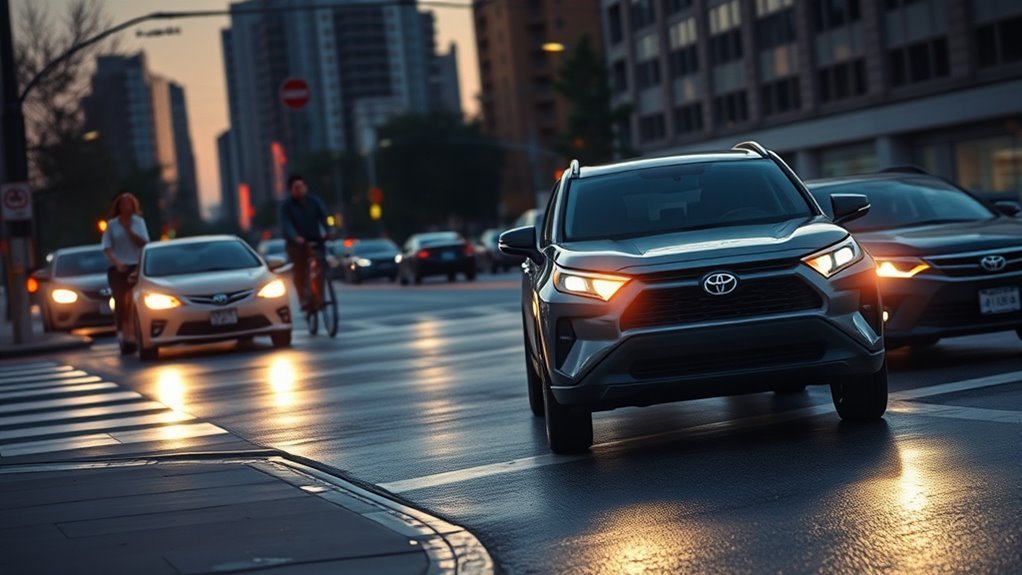
The RAV4 Pre-Collision System uses a forward-facing camera and radar to detect vehicles and pedestrians, estimate collision risk from relative speed and distance, and alert you with audible and visual warnings; if you don’t respond, it can automatically apply the brakes to reduce impact or avoid a crash. You get tangible pre collision benefits: reduced rear-end impact forces, fewer pedestrian injuries, and lower crash likelihood during routine commutes. As safety technology integrated into Toyota Safety Sense™, it’s standard or optional across RAV4 trims, so you can choose a model that aligns with your priorities for autonomy and protection. The system supplements—not replaces—your responsibility; you must stay attentive, maintain safe following distances, and intervene when prompted. If you value mobility without undue constraint, this feature expands your capacity to travel confidently while minimizing risk. Adopt it for daily commuter reliability, family transport, or anyone seeking practical, evidence-backed reductions in collision exposure.
How the RAV4 Pre-Collision System Detects Hazards
You’ll see how the RAV4 combines a forward camera and radar through sensor fusion to create a unified traffic picture that improves detection accuracy. The system uses computer vision and motion-based algorithms to classify vehicles, pedestrians, and bicyclists while continuously estimating distance and relative speed. Note that performance varies with weather, lighting, and reflective surfaces, which can reduce sensor range or cause misclassification.
Sensor Fusion Overview
Although sensors work independently, the RAV4’s Pre-Collision System fuses data from a forward-facing camera and millimeter-wave radar to detect vehicles, pedestrians, and other obstacles in the vehicle’s path. You rely on this sensor technology to provide complementary inputs: the camera supplies high-resolution visual cues while radar delivers reliable range and relative velocity, enabling accurate time-to-collision calculations. The fusion algorithm weighs each sensor’s confidence, compensating for degraded vision in poor weather or obscured lines of sight with radar returns. When computed collision likelihood exceeds thresholds, the system alerts you and can autonomously apply brakes if you don’t respond, a clear safety enhancement during critical moments. Be aware environmental factors and road irregularities can still reduce detection performance.
Object Recognition Methods
When detecting hazards, the RAV4’s Pre-Collision System fuses camera imagery and radar returns and then classifies objects by shape, motion, and range to determine threat level. You’ll see object detection algorithms parse visual frames for contours while radar supplies precise range and relative velocity. Shape recognition techniques distinguish vehicles, pedestrians, bicycles by comparing silhouette, limb motion, and aspect ratios against trained models. The fusion layer reconciles false positives: radar confirms moving returns, camera refines class labels. The system computes time-to-collision and issues alerts; if you don’t respond and the risk remains high, automatic braking engages. This pipeline gives you clearer agency on the road—transparent, data-driven recognition that prioritizes rapid, reliable intervention to protect liberated movement.
Environmental Limitations
If environmental factors obscure the RAV4’s forward sensors, the Pre-Collision System can miss or misclassify hazards. You’ll find that water, snow, or dust on the camera/radar reduces detection range and accuracy; regular sensor maintenance is essential to restore function. Uneven surfaces that tilt the vehicle alter radar/camera alignment, degrading performance. Tunnels, iron bridges, and highly reflective surfaces (guardrails, large trucks) can produce false returns or mask real targets. The system also has vertical detection limits, often failing on pedestrians shorter than 3.2 ft (1 m) or taller than 6.5 ft (2 m), and on objects off-center.
- Contamination: wipe sensors; check before driving in severe weather effects.
- Alignment: inspect after load or suspension changes.
- Environment: avoid relying solely on PCS in tunnels or near reflective structures.
How Collision Risk Is Calculated: Speed, Distance, Object Analysis
Because the Pre-Collision System fuses front-facing camera and radar data, it continuously calculates collision risk by combining your vehicle speed, the measured distance to detected objects, and an analysis of object shape, size, and motion; this lets the system estimate time-to-contact and likelihood of impact in real time. You get a quantitative risk estimate based on collision dynamics and sensor effectiveness: higher relative speed and shorter distance raise estimated impact probability, while object motion vectors and silhouette classification adjust confidence levels. The system weights radar range accuracy and camera classification to reduce false positives and prioritize threats—vehicles, pedestrians, cyclists—using probabilistic models.
| Parameter | Measurement Source | Impact on Risk |
|---|---|---|
| Relative speed | Radar + vehicle CAN | Increases time-to-contact urgency |
| Distance | Radar rangefinder | Primary decay factor for risk |
| Object profile | Camera classification | Modifies threat confidence |
You can rely on precise, evidence-based fusion to inform prompt, liberty-preserving driver responses.
System Actions: Warnings, Brake Assist, and Automatic Braking
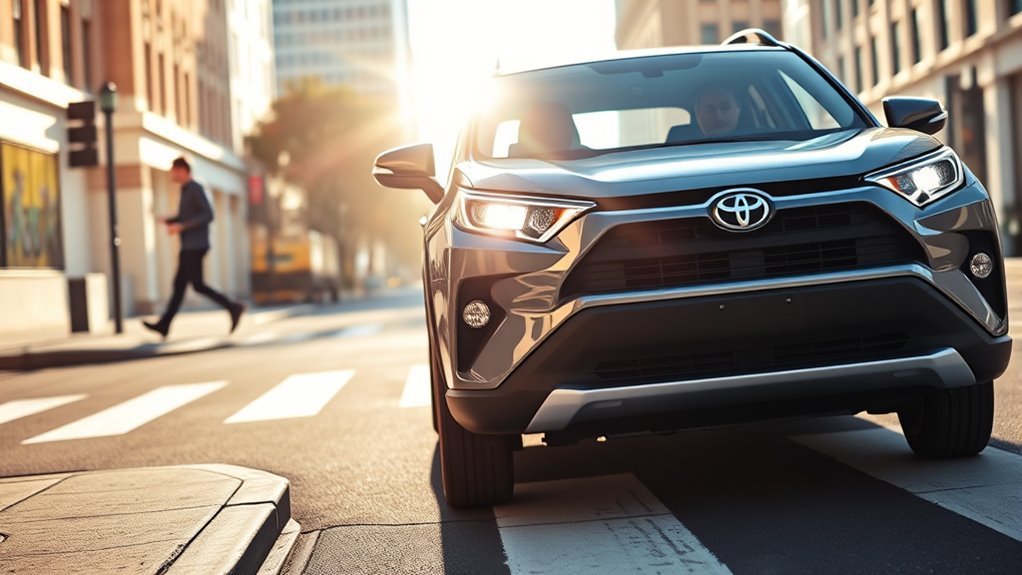
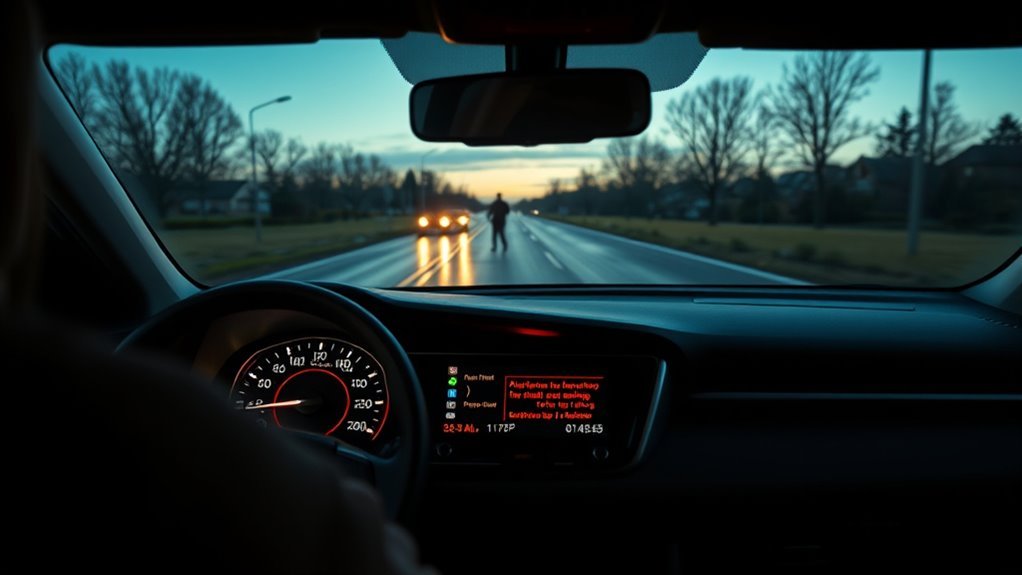
Although designed to stay unobtrusive, the RAV4’s Pre-Collision System actively intervenes through a tiered response: you get progressive alerts, assisted braking, then full automatic intervention when needed. A front-facing camera and radar monitor closing rates and object trajectories; the system’s sensitivity is adjustable so you control detection aggressiveness.
- Visual and audible warning signals: a dashboard alert plus buzzer prompt immediate driver action, minimizing reaction delay.
- Brake engagement assist: when collision probability rises, the system increases brake pressure to augment your input, tightening stopping performance without taking control.
- Automatic braking: if you don’t respond, the system autonomously applies brakes to mitigate or avoid impact, using measured deceleration based on sensor data.
This layered architecture preserves your agency while providing evidence-based, mechanical support—letting you choose responsiveness and rely on validated interventions when milliseconds matter.
RAV4 Pre-Collision: Pedestrian and Bicyclist Detection
When you drive the RAV4, its Pre-Collision Pedestrian and Bicyclist Detection combines a front camera, millimeter-wave radar, and laser to analyze an object’s shape, size, and motion and distinguish people and cyclists from vehicles. You get an evidence-based sensing suite that prioritizes pedestrian safety and cyclist awareness by classifying targets and estimating trajectories in real time. The system issues audible and visual alerts when it detects a likely collision with a pedestrian or bicyclist, prompting immediate driver intervention. If you don’t respond and a collision remains imminent, the Pre-Collision System can autonomously apply the brakes to reduce speed or avoid impact, providing measurable mitigation. Sensors fused across modalities improve detection confidence, supporting decisive automated braking thresholds. You should still maintain vigilance, since sensor performance varies with environmental factors like weather and visibility. This design respects your agency: it augments your control, layers protective automation, and reinforces liberated, responsible decision-making on shared roadways.
Limitations and Common Detection Failures to Watch For
If you rely on the Pre-Collision System, know it has measurable blind spots and failure modes that can leave you exposed in real-world conditions. You should understand specific limits so you can act, not depend. Weather impact and bright light can degrade camera and radar inputs, producing object misidentification or missed detections. Uneven terrain or a raised/lowered front end skews range calculations. Rapid pedestrian or vehicle maneuvers exceed prediction models. Electronic interference can also corrupt sensor data.
- Sensor occlusion: objects hidden behind luggage, multiple vehicles, or environmental clutter often aren’t resolved, increasing missed-hit risk.
- Dynamics mismatch: sudden lateral or vertical movements by targets or the RAV4 can break trajectory prediction, causing false negatives or late alerts.
- Environmental degradation: heavy rain, snow, strong radio fields, and direct glare reduce sensor fidelity, prompting object misidentification and detection gaps.
Treat the system as an aid; remain assertive and ready to intervene.
Settings & When to Disable the RAV4 Pre-Collision System
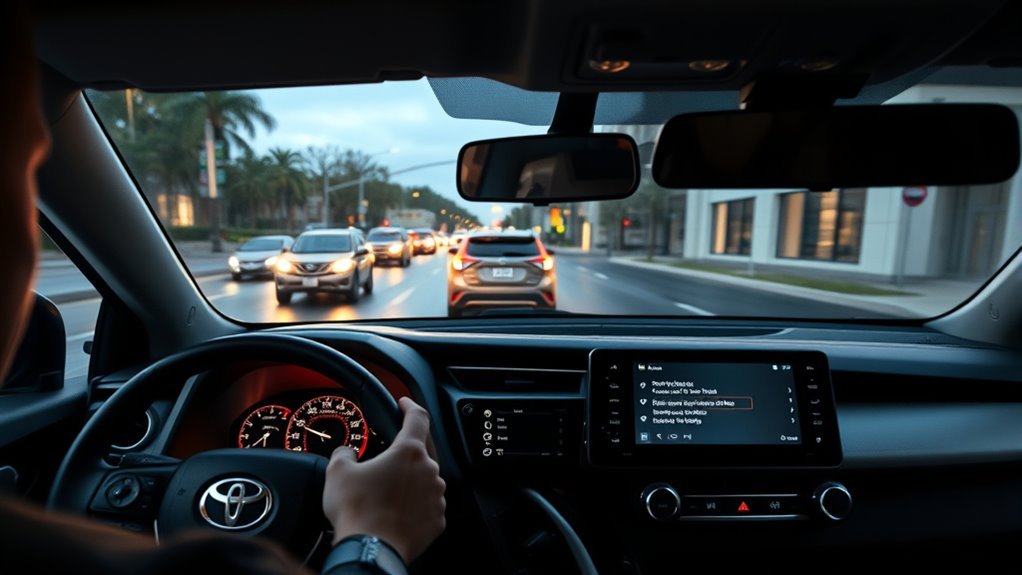
Knowing the system’s limits lets you decide when to change its behavior, and the RAV4 lets you enable or disable the Pre-Collision System via the vehicle settings menu to match real-world conditions. Use settings customization to tailor alerts, automatic braking sensitivity, and visual cues to your driving style and environment. You’ll access options through the instrument cluster or infotainment settings and confirm changes before you drive.
Disable the system under specific disabling conditions: heavy rain, snow, automatic car wash cycles, or when large cargo obstructs the front camera or radar. Also consider turning it off near toll booths or areas with many reflective surfaces that can create false detections. Keep Vehicle Stability Control active and perform regular maintenance—clean sensors and verify camera alignment—to reduce unnecessary disabling. When you disable the system, remember it removes automated intervention; you regain manual control but also bear full responsibility for collision avoidance.
Which RAV4 Trims Include the Pre-Collision System and TSS Integration
Anyone shopping for a RAV4 can expect the Pre-Collision System to be standard across the lineup, as Toyota includes it within the Toyota Safety Sense™ (TSS) suite on all trims—including LE, XLE, Limited, and hybrid variants—so you’ll get collision mitigation, pedestrian detection, lane departure alerts, and adaptive cruise control without opting up. You consequently gain consistent baseline protection regardless of chosen RAV4 trims, with TSS features integrated into sensor and camera sets calibrated for each model. The Hybrid models mirror this integration, preserving safety capability while freeing you from trade-offs between efficiency and protection.
- LE and XLE: standard Pre-Collision System + pedestrian detection; fundamental TSS features active.
- Limited: enhanced calibration, same TSS features; premium trim keeps identical collision suite.
- Hybrid variants: TSS features retained; Pre-Collision System standard across powertrains.
For precise availability or regional differences, consult your local dealer to confirm system spec and hardware revisions.
Driver Tips: Getting the Most From the Pre-Collision System
While the Pre-Collision System works continuously using radar and a forward camera, you should keep it enabled and verify system status regularly to maximize its effectiveness. You’ll rely on driver awareness as the primary defense; the system supplements, not replaces, your attention. Check instrument messages at startup and after vehicle service to confirm sensors are unobstructed and calibrated. Perform routine system maintenance: clean camera and radar areas, and inspect brakes and tires so automatic braking can operate within expected parameters. Adjust sensitivity through the settings menu to match traffic density and personal comfort, using higher sensitivity in urban environments and lower on open highways. Factor environmental limits—heavy rain, fog, glare, or slick surfaces degrade detection and braking performance—so increase following distances and reduce speed in those conditions. Treat alerts as actionable cues: brake or steer proactively rather than waiting for automatic intervention. These disciplined practices preserve your freedom to travel safely and guarantee the system augments, not replaces, your control.
Frequently Asked Questions
How Does the Toyota Pre-Collision System Work?
It detects obstacles with camera and radar, assesses collision risk, warns you audibly/visually, then brakes automatically if you don’t respond—safety technology that actively supports accident prevention while leaving you control and freedom to intervene.
What Triggers the Pre-Safe System?
Sensors detecting imminent impact via sensor technology and collision detection algorithms trigger the pre-safe system; it alerts you and readies brakes, increasing intervention if you don’t respond, minimizing harm through automated protective actions.
Does Toyota Pre-Collision Assist Stop the Car Before It Crashes?
Yes — it can stop the car in some situations. You’ll rely on collision detection and emergency braking that alert you then autonomously apply brakes, though effectiveness varies, so you shouldn’t fully relinquish control.
At What Speed Is Pre-Collision Assist Active?
You’ll find collision detection active roughly from 7 mph to 110 mph for vehicles, and below about 50 mph for pedestrians; you should note speed limitations mean it emphasizes alerts at higher speeds and won’t replace your vigilance.
Conclusion
You’ll get clearer safety from the RAV4 Pre-Collision System when you understand its limits and use it as a co-pilot, not a crutch. Rely on its radar/camera fusion for early warnings and automatic braking, but stay ready to steer or brake—especially around small, fast, or poorly lit targets. Keep sensors clean, adjust settings per conditions, and don’t disable the system unless you must; a stitch in time saves nine when milliseconds matter.