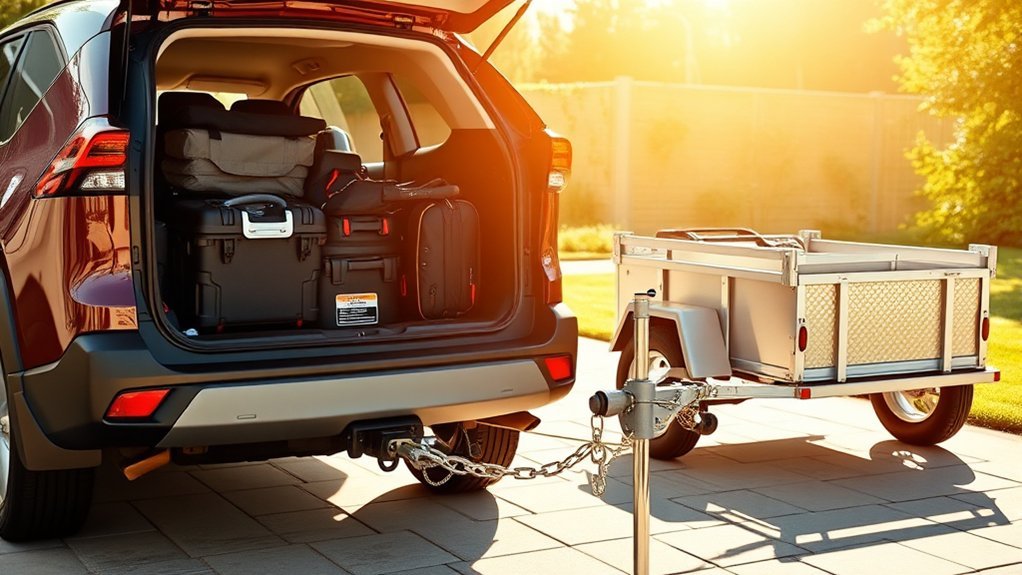
Your RAV4’s payload is what you can carry onboard—passengers, cargo, and accessories—while towing capacity is what you can pull behind. Hybrids top out near 1,750 lb tow with about 1,050 lb payload; gas models can tow roughly 3,500 lb but payload varies by trim. Always use curb weight, GVWR and GCWR from the door sticker to calculate limits, maintain tongue weight at 10–15% of trailer mass, and follow model-specific ratings to avoid overload—more specifics follow.
Quick Answer: What a RAV4 Can Carry and Tow
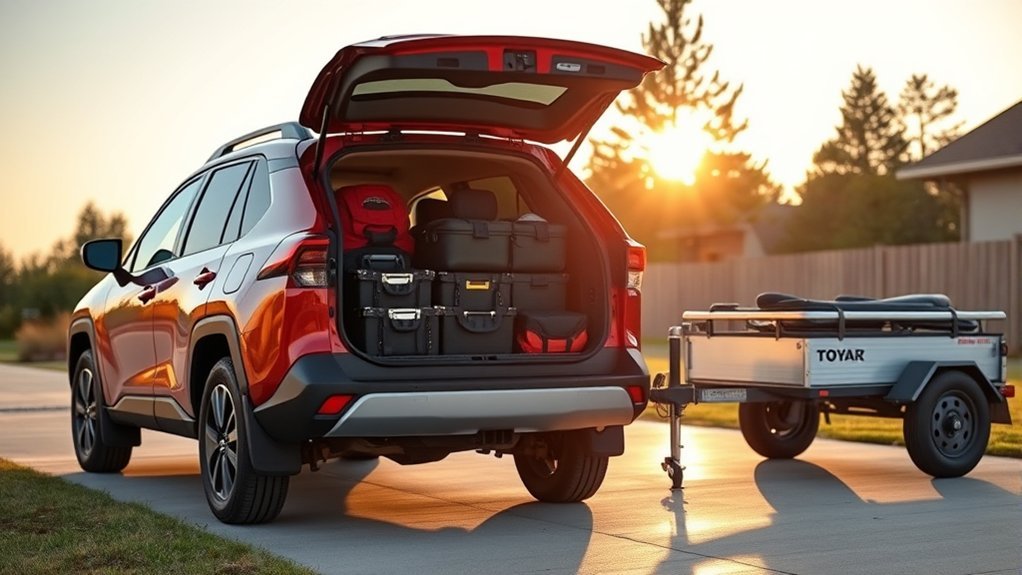
While the RAV4 Hybrid can tow up to 1,750 lb and carry a payload of about 1,050 lb, gas-only RAV4s raise towing capacity to 3,500 lb, so you should plan loads based on the specific model and equipment. You’ll assess payload distribution first: passengers and gear reduce available payload and consequently effective towing capacity. For the Hybrid, staying under that 1,050 lb payload preserves margins for trailer tongue weight and cargo; for gas models, you’ve more towing headroom but still must track payload to avoid overload. Maintain tongue weight at roughly 10–15% of trailer mass to guarantee towing stability; improper tongue weight shifts handling and can induce sway. You’ll choose trailers that match the Hybrid’s lower limit—micro campers and small utility trailers—or exploit the gas model’s higher rating when you need more. This comparative, technical approach lets you plan loads deliberately and claim operational freedom without compromising safety.
What “Payload” Means for Your RAV4 (What It Includes)
Because payload combines passengers, cargo, and any added accessories into a single allowable mass, you must count people and gear first when planning loads for a RAV4. The payload definition here is simple: the maximum interior and accessory weight the vehicle can carry without exceeding structural or safety limits. For a 2011 RAV4 Limited V6 that means roughly 375 kg (825 lbs) nominally, though door-sticker and GVWR-based figures can differ; trust official sources when discrepancies arise.
You’ll include occupants, luggage, roof racks, and aftermarket parts in your tally. Compare occupant mass plus personal effects against rated payload to find remaining cargo or tongue-weight allowance. Monitor weight distribution front-to-rear and side-to-side, since poor distribution degrades handling and safety. Regularly check loading against the limit and reposition items to optimize weight distribution. Staying within the payload prevents overstress of suspension, brakes, and chassis and preserves your freedom to travel without risking control or certification violations.
Read Your RAV4’s Curb Weight, GVWR, and GCWR
Start by checking the door jamb sticker to confirm your RAV4’s curb weight, since that baseline weight is used when calculating payload and towing margins. Compare the GVWR listed in your owner’s manual to the curb weight to determine the maximum additional load you can legally carry. For towing, verify the GCWR so the combined weight of vehicle, cargo, and trailer stays within safe limits.
Locate The Door Sticker
When you need exact weight figures for calculating payload and towing limits, check the door sticker on your RAV4; it lists curb weight, GVWR, and GCWR so you can make precise comparisons against load and trailer weights. Locate the door sticker location on the driver’s door jamb; that label is the authoritative weight rating source. You’ll read curb weight (empty vehicle), GVWR (max loaded vehicle), and GCWR (vehicle plus trailer limit). Use those numbers to calculate payload (GVWR minus curb) and towing margins (GCWR minus curb). Don’t substitute web specs—use the sticker for liberation through certainty.
| Label | Meaning | Use |
|---|---|---|
| Curb weight | Empty mass | Payload calc |
| GVWR | Max vehicle mass | Load limit |
| GCWR | Vehicle+trailer | Towing limit |
Find GVWR In Manual
How do you locate the GVWR, curb weight and GCWR in your RAV4’s manual and use them for precise payload and towing calculations? Use focused manual navigation: consult the index under “Weights,” “Capacities,” or “Vehicle Specifications.” The manual lists weight specifications including GVWR (maximum vehicle load), curb weight (vehicle empty), and GCWR (vehicle plus trailer limit). You’ll compare GVWR to curb weight plus planned payload to verify you stay within safe limits. This comparative, technical check prevents exceeding limits that impair safety or performance. By relying on the manual’s official figures you assert control—liberating you from guesswork—and can compute payload precisely. Record the specs, run the arithmetic, and adjust cargo or passengers accordingly.
Check GCWR For Towing
Having pulled the GVWR and curb weight from your manual, next confirm the Gross Combined Weight Rating (GCWR) to verify how much trailer mass you can safely add. The GCWR equals your vehicle’s curb weight plus its maximum towing capacity; for a RAV4 with up to 1,750 lbs towing, add that to curb weight to get the combined ceiling. Compare GCWR against the sum of curb weight, passengers, cargo and trailer tongue load to ascertain compliance. Prioritize towing safety by checking owner’s manual figures rather than estimates. Evaluate weight distribution between vehicle and trailer to prevent overloading the GVWR or exceeding GCWR. This comparative, technical check grants you freedom to tow responsibly while minimizing mechanical risk and preserving maneuverability.
Calculate Your RAV4’s Payload Capacity : Step by Step

Start by locating two key numbers on your RAV4: the curb weight and the Gross Vehicle Weight Rating (GVWR), which are listed in the owner’s manual or on the vehicle’s certification label. You’ll subtract curb weight from GVWR to determine payload capacity — a clear metric for payload optimization and sensible weight distribution decisions. Include passengers, cargo, and any aftermarket equipment in the total.
- Imagine a fully loaded weekend: passengers, gear, roof box.
- Picture a workday: tools, racks, and a full rear seat.
- Visualize freedom: a compact camper conversion and supplies.
Example: a 3,500 lb curb weight and 4,500 lb GVWR yield a 1,000 lb payload. You compare intended loads to that number and reallocate items to achieve balanced weight distribution; move heavy items low and near the axle. If you attach a trailer, count its tongue weight toward payload. Keep records and recheck after modifications to preserve performance, safety, and the liberating ability to carry what you need without exceeding limits.
Calculate Safe Towing Capacity and Tongue Weight : Step by Step
First, determine your Gross Combined Vehicle Weight by adding your RAV4’s curb weight, passengers, cargo, and the trailer’s loaded weight to guarantee you don’t exceed the vehicle’s rated limit. Next, calculate tongue weight as 10–15% of the trailer’s total weight and compare that value to your hitch and vehicle specifications. If tongue weight or GCVW approaches the limits, adjust loading or use a weight-distribution hitch to improve balance and stability.
Determine Gross Combined Weight
To determine Gross Combined Weight Rating (GCWR) for safe towing, add your RAV4’s curb weight to its manufacturer-specified maximum towing capacity and verify the sum doesn’t exceed the vehicle’s listed GCWR; this gives the absolute upper limit for vehicle-plus-trailer mass. You’ll then subtract actual passenger and cargo weight from that limit to find allowable trailer mass, ensuring towing safety and correct weight distribution. Compare values across trims and model years; don’t assume identical ratings.
- A loaded cabin with gear reduces trailer allowance.
- A heavier trailer shifts required stability margins.
- Manufacturer limits override informal estimates.
Use the owner’s manual values for GCWR, curb weight, and towing capacity. This method frees you to tow within certified limits while preserving control and legal compliance.
Calculate Tongue Weight
How do you determine the proper tongue weight for your trailer and RAV4 combination? You calculate safe towing capacity by subtracting your RAV4’s curb weight from its GCVWR, adding passenger and cargo weight, and factoring aftermarket components. Aim for tongue weight equal to 10–15% of total trailer weight to maintain stability. For a 1,500 lb trailer, that’s 150–225 lbs. You should measure tongue weight with a scale or tongue gauge and adjust load placement to optimize weight distribution between hitch and axle. Compare measured tongue weight against the allowable payload margin left after GCVWR calculations. Regular verification prevents swaying and overload. You’ll secure freedom on the road by enforcing precise tongue weight and balanced weight distribution.
Quick Examples: Loads and Trailers a RAV4 and RAV4 Hybrid Can Handle
Although the RAV4 and RAV4 Hybrid share compact SUV packaging, their towing and payload limits differ enough to guide trailer choices: you’ll match trailer mass to each model’s limits and payload allowance to avoid overloading passengers or gear. The 2016 RAV4 tops out at 1,500 lbs towing with roughly 1,000 lbs payload capacity; the Hybrid raises towing to 1,750 lbs, so it liberates you to tow slightly heavier trailers while keeping cabin load reasonable.
- A micro camper weighing 1,000–1,500 lbs fits the Hybrid’s envelope; keep 10–15% tongue weight in mind so the hatchback balance stays controlled.
- A lightweight utility trailer of 300–600 lbs is well within the standard RAV4’s capability for hauling tools, bikes, or small furniture.
- For mixed loads, allocate payload for passengers first, then trailer tongue weight, ensuring you don’t exceed gross vehicle weight ratings.
Compare numbers, prioritize safety margins, and choose trailers that free, not constrain, your mobility.
Safety Rules and Best Practices for Loading and Towing a RAV4
Start by confirming your RAV4’s specific limits—towing up to 1,750 lbs (for hybrid variants) and the vehicle’s listed payload—and plan loads so passenger weight, cargo, and trailer tongue load never exceed those ratings. You’ll apply towing safety principles: keep tongue weight at 10–15% of trailer mass, verify hitch and coupler engagement, and inspect lights and connections before departure. Compare scenarios: a lightly loaded trailer with correct tongue weight yields predictable handling; an overloaded or rear-heavy setup induces sway and braking degradation. Use loading techniques that centralize mass low and forward, distribute cargo evenly, and reserve payload margin for passengers and gear. Employ a weight-distribution hitch where applicable to restore balance and steering feel. Routinely recheck weights after loading and during stops. By adhering to these rules you’ll maximize control, reduce mechanical stress, and preserve freedom to travel confidently without compromising safety or vehicle integrity.
Hitch Ratings, Accessories, and Upgrades That Matter for RAV4 Towing
Because your RAV4’s published towing and payload limits are modest, selecting a hitch and accessories with matching rated capacities is essential to safe towing. You’ll compare hitch types (Class I vs II, fixed vs receiver) against your trim’s 1,500–1,750 lb capacity and select one whose towing and tongue weight ratings don’t exceed vehicle limits. A weight-distribution hitch can improve axle load balance and handling, but only if its rating aligns with the RAV4’s specs.
Match hitch and accessories to your RAV4’s modest towing and tongue-weight limits for safe, balanced towing.
Consider lightweight towing accessories and cargo carriers that keep you within payload allowances while freeing you to roam. Inspect connection points, coupler fit, and safety chains regularly; mismatched ratings or loose attachments compromise control.
- A compact receiver hitch sized to RAV4 limits, bolted to factory points
- A shallow cargo carrier keeping center of gravity low and payload legal
- A rated weight-distribution setup that corrects sag without overstressing the frame
Choose components that liberate capability without exceeding engineered constraints.
Pre-Trip Checklist: Verify Payload, Tongue Weight, and Towing Limits
A concise pre-trip check keeps your RAV4 within safe towing limits: verify the vehicle’s published towing capacity (up to 1,750 lb for the hybrid), confirm payload available after accounting for passengers and cargo (e.g., a 2011 RAV4 Limited V6 nets roughly 815 lb), and calculate tongue weight at 10–15% of trailer mass so a 1,750-lb trailer carries about 175–262 lb on the hitch. You should also check the owner’s manual for GCWR (7,640 lb) and verify combined vehicle, passengers, cargo, and trailer weight stays below it. Measure tongue weight with a scale or calibrated gauge; adjust cargo fore-aft placement to hit the 10–15% target for ideal weight distribution. If your trailer approaches the RAV4’s limit, fit a weight-distribution hitch to improve handling and reduce rear sag. These precise, comparative checks enhance towing safety and free you to tow confidently without compromising control or legal limits.
Frequently Asked Questions
What Is the Difference Between Payload and Towing Capacity?
Payload limits how much weight you can carry inside (payload limitations), while towing specs define how much you can pull behind (towing specifications). You’ll compare cargo versus trailer loads, ensuring you don’t exceed manufacturer limits.
Do You Subtract Hitch Weight From Payload?
Yes — you subtract hitch weight; 10–15% tongue weight (imagine 200 lbs) affects weight distribution, reduces cargo capacity, and counts toward capacity limits, so include towing accessories when comparing payload and towing options to stay liberated.
Can a Toyota RAV4 Tow 5000 Lbs?
No, you can’t tow 5,000 lbs with a RAV4. You’d violate RAV4 performance limits and endanger towing safety; compare instead to pickups rated for heavy loads, preserving your freedom to tow safely and responsibly.
Why Is Payload Less Than Towing Capacity?
Absurdly simple: payload’s limited because the vehicle must carry passengers, cargo and structural limits, while towing dynamics let trailers bear much weight; payload limitations stem from chassis, suspension and safety, whereas towing relies on trailer axles.
Conclusion
You now know the limits: payload tells you what you can carry, towing capacity tells you what you can pull. Check curb weight, GVWR and GCWR; calculate payload and tongue weight; compare factory towing ratings to hitch and accessory limits. Follow weight-distribution and braking rules, obey tongue-weight percentages, and verify tire pressures. Respect published limits, inspect connections, and adjust loads. Do the math, use the right gear, and drive within safe limits.