Your RAV4’s payload is the weight your SUV carries on itself—people, cargo, accessories, and trailer tongue weight. Towing capacity is the maximum loaded trailer weight it can pull. The two limits work together, so a trailer that is within the tow rating can still overload the vehicle if passengers, cargo, hitch weight, or accessories push the RAV4 over its payload, GVWR, GAWR, or GCWR limits.
Quick Answer
Payload is what your RAV4 carries; towing capacity is what it pulls. Recent RAV4 ratings vary by model: many gas models tow 1,500 lb, properly equipped Adventure grades can reach 3,500 lb, Hybrid models are commonly rated at 1,750 lb, and some 2026 Plug-in Hybrid grades list 3,500 lb. Always confirm your exact trim in the owner’s manual and door-jamb labels.
Key Takeaways
- Payload includes occupants, luggage, cargo, accessories, roof loads, and trailer tongue weight.
- Towing capacity is the maximum loaded trailer weight, not just the empty trailer weight.
- Toyota’s recent RAV4 manuals commonly specify a 9% to 11% tongue-weight target for conventional towing; use your manual’s value over a generic towing rule.
- Never rely on a single online number. Check your certification label, tire/loading label, owner’s manual, hitch rating, and actual scale weights.
At a Glance
| Time Required | 10–20 minutes, longer if you visit a public scale |
| Difficulty | Easy math, moderate attention to labels and ratings |
| Tools Needed | Owner’s manual, door-jamb labels, calculator, trailer/tongue scale or public platform scale |
| Cost | Free if using labels and manual; usually low cost for public scale weighing |
Quick Answer: What a RAV4 Can Carry and Tow
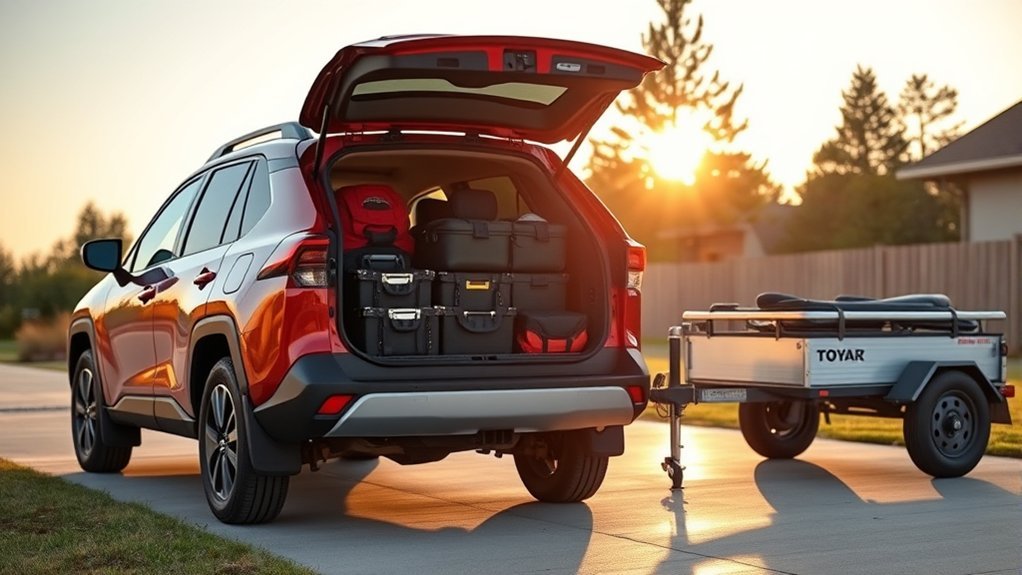
A Toyota RAV4 can carry only the load allowed by its vehicle capacity weight label, and it can tow only the trailer weight allowed for that exact model, trim, drivetrain, and equipment. For recent U.S. models, Toyota lists 1,500 lb without the towing package and 3,500 lb with the towing package for the 2025 gas RAV4. Toyota also states that the RAV4 Adventure grade with the Tow Prep Package can tow up to 3,500 lb.
For the RAV4 Hybrid, Toyota’s 2025 owner’s manual lists a Trailer Weight Rating of 1,750 lb and a Gross Combination Weight Rating of 6,670 lb. The 2026 RAV4 lineup changed because the standard RAV4 became hybrid-only, while Toyota’s 2026 RAV4 Plug-in Hybrid page lists 3,500 lb of towing capacity on Woodland, SE, and XSE Plug-in Hybrid grades.
Payload is the number many owners miss. Passengers, cargo, dealer accessories, roof-rack loads, and trailer tongue weight all reduce what remains. A trailer can be under the tow rating but still overload the RAV4 if the tongue weight plus people and gear exceed the vehicle’s load rating.
Warning: Do not tow from a bumper-mounted hitch or exceed the lowest-rated part of the system. The vehicle rating, trailer rating, receiver hitch, ball mount, hitch ball, safety chains, tires, and brakes all matter.
What “Payload” Means for Your RAV4: What It Includes
Payload is the total weight your RAV4 carries on the vehicle itself. Toyota owner’s manual language calls this the total load capacity or vehicle capacity weight, meaning the combined weight of occupants, cargo, and luggage. It is not the same as cargo-space volume, and it is not the same as towing capacity.
Count all of these against payload:
- Driver and passengers
- Luggage, tools, coolers, camping gear, pet crates, and cargo
- Dealer-installed or aftermarket accessories
- Roof racks, cargo boxes, bike racks, and the cargo placed on them
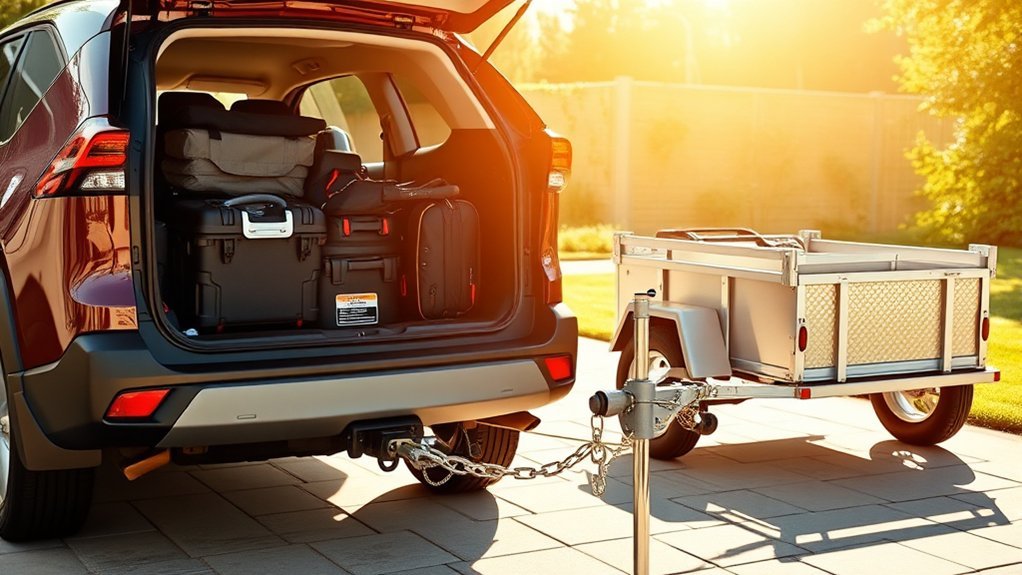
- Trailer tongue weight pressing down on the hitch
- Any hitch hardware or cargo carrier attached to the vehicle
Your exact payload is vehicle-specific. The safest first stop is the driver-side door-jamb tire and loading label, which states how much combined occupant and cargo weight the vehicle should carry. Then check the certification label and owner’s manual for GVWR and GAWR limits.
Note: Online payload charts are useful for planning, but the label on your actual RAV4 is more important because options, accessories, trim, and production configuration can change the available load.
Read Your RAV4’s Curb Weight, GVWR, GAWR, and GCWR
Before you load cargo or hook up a trailer, understand the four numbers that control the calculation: curb weight, GVWR, GAWR, and GCWR. Toyota’s manuals also use TWR, which means Trailer Weight Rating.
Locate the Door-Jamb Labels
Open the driver’s door and look for the certification label and the tire/loading information label. These labels usually show the vehicle’s GVWR, GAWR, tire information, and combined occupant/cargo load limit. Use those labels for your exact vehicle rather than assuming another RAV4 with the same model year has the same available payload.
| Label or Term | Meaning | Why It Matters |
|---|---|---|
| Vehicle capacity weight | People plus cargo allowed on the vehicle | Main payload planning number |
| GVWR | Maximum loaded vehicle weight | Do not exceed with passengers, cargo, accessories, and tongue weight |
| GAWR | Maximum weight allowed on each axle | Prevents overloading front or rear axle |
| GCWR | Maximum combined vehicle and trailer weight | Controls total tow setup weight |
| TWR | Maximum gross trailer weight | Controls loaded trailer limit |
Find Curb Weight and Towing Ratings in the Manual
The owner’s manual is the best place to confirm curb weight ranges, GCWR, TWR, unbraked trailer limits, required trailer brakes, and tongue-weight guidance. Search the manual for “vehicle load limits,” “trailer towing,” “GCWR,” “TWR,” “tongue weight,” and “dimensions and weights.”
Curb weight is the vehicle’s weight without your passengers and cargo. GVWR is the maximum allowed vehicle weight. In simple form, payload can be estimated as:
Payload capacity = GVWR − actual vehicle weight before loading.
Because actual vehicle weight changes with accessories, fuel, and equipment, Toyota notes that weighing the vehicle is the only way to be certain of exact curb weight. That matters most when you are close to the limit.
Check GCWR for Towing
GCWR is the maximum allowed weight of the loaded RAV4 and loaded trailer together. For example, Toyota lists a 6,670 lb GCWR for the 2025 RAV4 Hybrid and an 8,205 lb GCWR for 2025 gas RAV4 models equipped with the towing package. The important point is not just the headline tow rating; the total of vehicle, passengers, cargo, hitch weight, trailer, and trailer cargo must stay within the combined limit.
When in doubt, weigh the setup. A public platform scale can measure the loaded vehicle, loaded trailer, axle weights, and tongue weight so you are not guessing.
Calculate Your RAV4’s Payload Capacity: Step by Step
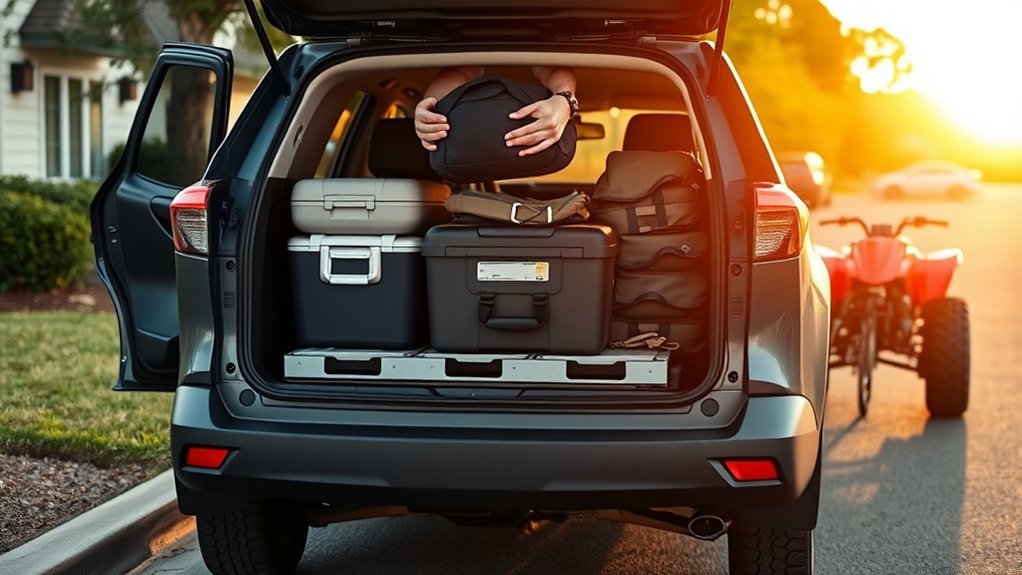
Use this calculation before a road trip, camping weekend, moving run, or trailer tow.
- Find the vehicle capacity weight on the tire/loading label inside the driver’s door opening.
- Add passenger weight, including the driver.
- Add cargo weight, including luggage, tools, coolers, strollers, pets, and loose items.
- Add accessories, such as roof racks, cargo boxes, hitch cargo carriers, bike racks, and aftermarket parts.
- Add trailer tongue weight if towing.
- Compare the total with the label and confirm the loaded vehicle does not exceed GVWR or GAWR.
Example: if your RAV4’s load label allows 1,000 lb and the vehicle carries 400 lb of people, 250 lb of cargo, 60 lb of accessories, and 180 lb of trailer tongue weight, the total payload used is 890 lb. That leaves 110 lb of margin before reaching the label limit.
Pro Tip: Load heavy cargo low and near the middle of the vehicle. This improves handling and helps avoid overloading the rear axle, especially when tongue weight is already pressing down behind the rear wheels.
Calculate Safe Towing Capacity and Tongue Weight: Step by Step
Safe towing is a two-part calculation: the trailer must be within the RAV4’s TWR, and the tongue weight must fit within the vehicle’s payload and axle limits.
Determine Gross Combined Weight
Start with the loaded weight of the RAV4, then add the loaded trailer weight. The total must be below GCWR. Include the weight of passengers, cargo, accessories, hitch equipment, and the trailer’s cargo—not just the empty trailer.
- A loaded cabin with people and gear reduces how much trailer weight you can safely handle.
- A trailer at the maximum rating leaves less margin for cargo and tongue weight.
- Manufacturer ratings override informal estimates, forum advice, or hitch advertising claims.
For the 2025 RAV4 Hybrid, Toyota lists a 1,750 lb TWR, 6,670 lb GCWR, and 1,000 lb unbraked trailer limit. For the 2025 gas RAV4, Toyota lists 1,500 lb TWR without the towing package and 3,500 lb with the towing package. If your model year differs, confirm the matching manual for your vehicle.
Calculate Tongue Weight
Tongue weight is the downward force the trailer coupler places on the hitch ball. Toyota’s recent RAV4 towing manuals specify that gross trailer weight should be distributed so the tongue weight is generally 9% to 11% of gross trailer weight. That differs slightly from the common general towing rule of 10% to 15%, so follow the Toyota owner’s manual for your exact RAV4.
Use this formula:
Tongue weight = loaded trailer weight × Toyota’s recommended tongue-weight percentage.
Example: for a 1,500 lb loaded trailer, a 9% to 11% tongue-weight target equals about 135 to 165 lb. That tongue weight counts against the RAV4’s payload, rear axle capacity, hitch rating, and gross vehicle weight.
Measure tongue weight with a tongue-weight scale, platform scale, or another safe weighing method. Do not estimate by eye. If the tongue is too light, the trailer may sway. If it is too heavy, the rear of the RAV4 can sag, steering can feel light, braking can suffer, and the rear axle or hitch can be overloaded.
RAV4 Towing Capacity by Model Type
RAV4 towing ratings are not one-size-fits-all. Use the chart below as a planning guide, then verify the exact number in your owner’s manual and door-jamb labels.
| RAV4 Type | Common Recent U.S. Rating | Important Notes |
|---|---|---|
| Gas RAV4 without towing package | Up to 1,500 lb | Applies to many recent non-hybrid models; confirm trim and year. |
| Gas RAV4 with towing package / Adventure grade Tow Prep | Up to 3,500 lb | Toyota lists 3,500 lb for properly equipped Adventure-grade models and 2025 gas models with towing package. |
| RAV4 Hybrid | Up to 1,750 lb | 2025 Hybrid manual lists 1,750 lb TWR and 6,670 lb GCWR. |
| RAV4 Plug-in Hybrid | Varies by year and grade | 2026 Plug-in Hybrid Woodland, SE, and XSE are listed by Toyota at 3,500 lb. |
[Products Worth Considering]

This custom-fit center console armrest cover is designed to refresh and protect the lid on compatible Toyota RAV4 models and trims. Made to follow the console curvature for a smooth, wrinkle-free look, it helps guard against scratches, spills, dirt, and everyday wear while improving the appearance of an aging armrest. Installation is simple and the cover is tailored for a snug, secure fit across supported RAV4, RAV4 Hybrid, and RAV4 Prime vehicles.

This custom-fit car phone holder is designed for Toyota RAV4 models with a 7/8-inch screen, providing a secure and convenient mounting solution without blocking vents or sightlines. It combines magnetic alignment with fast wireless charging to keep your phone powered while offering 360-degree rotation for optimal viewing in portrait or landscape mode. Built from durable ABS material and easy to install without tools, it supports safer hands-free navigation and calling on every drive.

This windshield sun shade is designed to fit Toyota RAV4 models from 2013 to 2018 and help keep the cabin cooler after long hours in the sun. Its triple-laminate construction and silver surface block most UV rays to help protect the dashboard, seats, and steering wheel from sun damage. The accordion-folding design makes it easy to set up, store, and carry with the included bag.
Quick Examples: Loads and Trailers a RAV4 and RAV4 Hybrid Can Handle
The safest trailer is not the heaviest one the brochure says you can pull. It is the one that stays within towing capacity, payload, tongue weight, axle ratings, tire ratings, brake requirements, and GCWR after it is fully loaded.
- Small utility trailer: A 300–600 lb empty utility trailer can work well for bikes, lawn equipment, light furniture, or dump runs, as long as the loaded weight and tongue weight stay within limits.
- Micro camper: A compact camper may fit a 1,500–1,750 lb rating only if its loaded weight, water, propane, battery, gear, and tongue weight are included.
- Small boat or personal watercraft: Add the trailer, fuel, battery, water, gear, and accessories—not just the hull weight.
- Higher-capacity gas or plug-in hybrid setup: Properly equipped 3,500 lb RAV4 variants have more trailer headroom, but payload and rear-axle limits still apply.
For mixed loads, allocate payload to passengers first, then cargo, then tongue weight. If the vehicle is full of people and camping gear, your practical trailer capacity may be lower than the headline tow rating.
[Products Worth Considering]

This custom-fit windshield sun shade is designed for Toyota Rav4 models from 2013 to 2018, helping block harsh sunlight and reduce heat buildup inside your vehicle. It protects the dashboard, seats, and interior surfaces from UV damage while adding privacy when parked. The foldable design makes it easy to install, remove, and store in seconds.

This custom-fit center console organizer tray adds practical storage to the Toyota RAV4 2026, helping keep small essentials neatly separated and easy to reach. Designed with precise 3D scanning for a snug fit, it creates extra usable space in the armrest area while reducing clutter and rattling. The durable insert installs easily without tools and includes a non-slip mat to help keep items in place.
Safety Rules and Best Practices for Loading and Towing a RAV4
Good towing starts before you drive. Confirm the trailer weight, tongue weight, hitch rating, tire pressure, lights, chains, brakes, and load balance before every trip.
- Keep the loaded trailer under the RAV4’s TWR.
- Keep the loaded vehicle under GVWR and each axle under GAWR.
- Keep the combined loaded vehicle and trailer under GCWR.
- Use Toyota’s tongue-weight guidance for your model year, often 9% to 11% in recent RAV4 manuals.
- Use trailer brakes when required by the manual or by law.
- Slow down, leave more stopping distance, and avoid sudden lane changes.
- Recheck straps, chains, coupler lock, lights, and tire temperatures during long trips.
Weight distribution matters. Load the trailer so it is stable, not rear-heavy. A rear-heavy trailer can sway, while too much forward weight can overload the hitch and rear axle. The right balance keeps steering, braking, and tracking predictable.
Hitch Ratings, Accessories, and Upgrades That Matter for RAV4 Towing
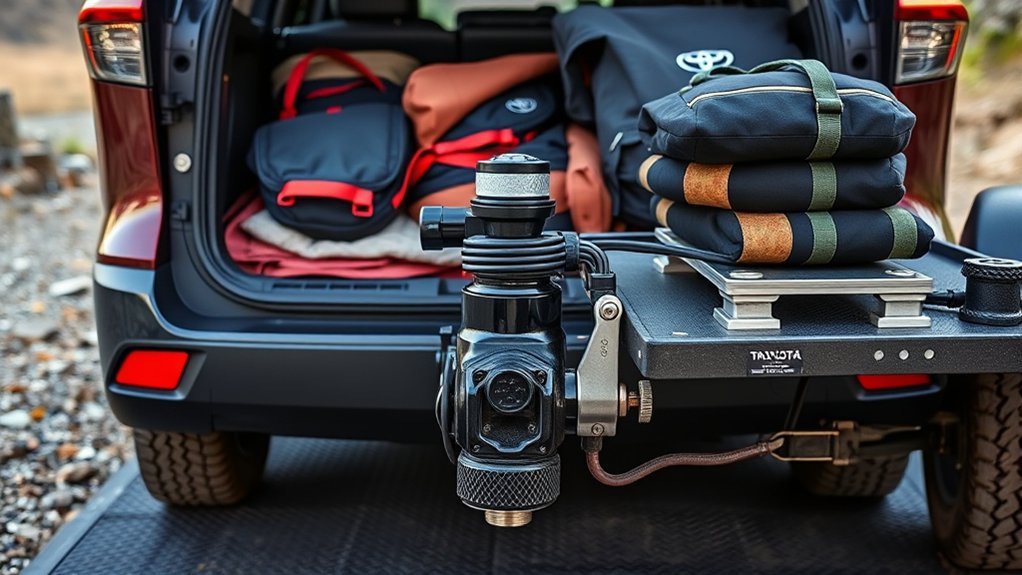
A hitch does not increase the RAV4’s factory towing capacity. It only provides a connection point, and the full towing setup is limited by the lowest-rated component.
Check the rating on each part:
- Vehicle tow rating and GCWR
- Receiver hitch gross trailer weight rating
- Receiver hitch tongue weight rating
- Ball mount and hitch ball rating
- Safety chain rating
- Trailer coupler and trailer GVWR
- Tire load ratings on the RAV4 and trailer
Toyota recommends using appropriate towing equipment installed correctly and used properly. Some manuals also recommend Toyota hitch/bracket components for the vehicle. If you are adding a receiver, wiring, brake controller, or sway control device, match the hardware to the exact RAV4 model and towing requirement.
Note: Weight-distribution hitches and sway-control devices must be compatible with the vehicle, hitch, and trailer. They can improve stability when appropriate, but they do not raise Toyota’s published ratings.
Pre-Trip Checklist: Verify Payload, Tongue Weight, and Towing Limits
Use this checklist before towing with any RAV4:
- Confirm your exact model year, trim, drivetrain, and towing package.
- Read the owner’s manual sections for vehicle load limits and trailer towing.
- Check the door-jamb tire/loading label for combined occupant and cargo capacity.
- Check GVWR and GAWR on the certification label.
- Confirm TWR, GCWR, and unbraked trailer limits in the owner’s manual.
- Weigh the loaded trailer, not just the empty trailer.
- Measure tongue weight and keep it within Toyota’s recommended range.
- Subtract tongue weight from available payload.
- Verify the hitch, ball mount, hitch ball, chains, and wiring are rated correctly.
- Check trailer lights, brakes, tire pressure, lug nuts, coupler latch, safety chains, and breakaway cable if equipped.
- Drive slower than normal and leave extra braking room.
Common Mistakes That Overload a RAV4
Most towing problems come from small assumptions that add up. Avoid these common mistakes:
- Using dry trailer weight only: Water, propane, batteries, food, tools, and camping gear can add hundreds of pounds.
- Ignoring tongue weight: Tongue weight is payload on the vehicle, not just trailer weight.
- Assuming every RAV4 tows 3,500 lb: Only specific properly equipped models reach that number.
- Trusting hitch capacity over vehicle capacity: A 3,500 lb hitch does not make a 1,500 lb-rated RAV4 tow 3,500 lb.
- Loading cargo high or far back: Poor load placement can reduce stability and steering control.
- Forgetting roof loads: Roof cargo adds weight high on the vehicle and counts against payload.
Frequently Asked Questions
What is the difference between payload and towing capacity?
Payload is the weight your RAV4 carries on the vehicle itself, including people, cargo, accessories, and trailer tongue weight. Towing capacity is the maximum loaded trailer weight the RAV4 can pull. You must stay within both limits at the same time.
Do you subtract hitch weight from payload?
Yes. Trailer tongue weight presses down on the RAV4’s hitch and counts against payload, GVWR, rear GAWR, and hitch tongue-weight rating. Hitch hardware and hitch-mounted cargo carriers also count as vehicle load.
Can a Toyota RAV4 tow 5,000 lb?
No. A RAV4 is not rated for a 5,000 lb trailer in normal U.S. specifications. Recent ratings commonly range from 1,500 lb to 3,500 lb depending on model and equipment. For a 5,000 lb trailer, choose a properly rated truck or SUV.
Why is payload sometimes less than towing capacity?
Payload is limited by the vehicle’s structure, suspension, tires, brakes, axles, and weight rating. A trailer carries much of its own weight on its axle, so the tow rating can be higher than the payload rating. The tongue weight still transfers part of the trailer load onto the RAV4.
What tongue weight should I use for a RAV4?
Follow the owner’s manual for your exact model year. Recent Toyota RAV4 manuals commonly specify that gross trailer weight should be distributed so tongue weight is 9% to 11% of gross trailer weight. Use that Toyota value over a generic towing rule.
Does a larger hitch increase RAV4 towing capacity?
No. A stronger hitch does not raise Toyota’s vehicle rating. Your safe limit is the lowest rating among the RAV4, hitch receiver, ball mount, hitch ball, trailer, tires, brakes, and other towing hardware.
Conclusion
Payload tells you what your RAV4 can carry, and towing capacity tells you what it can pull. The safe setup must satisfy both. Start with the door-jamb labels and owner’s manual, then calculate passengers, cargo, accessories, tongue weight, trailer weight, GVWR, GAWR, and GCWR. Do not rely on a single headline tow number. Weigh the loaded vehicle and trailer when you are close to the limit, use properly rated equipment, and drive with extra room for braking and maneuvering.
Sources
- Toyota Owners: 2025 RAV4 Trailer Towing — backs up gas RAV4 TWR, GCWR, tongue-weight guidance, and towing safety limits.
- Toyota Owners: 2025 RAV4 Hybrid Trailer Towing — backs up Hybrid TWR, GCWR, unbraked TWR, and tongue-weight guidance.
- Toyota Owners: 2025 RAV4 Cargo and Luggage — backs up cargo-load calculation and how trailer load reduces available vehicle load capacity.
- Toyota Support: RAV4 Adventure Grade Tow Rating — backs up the 3,500 lb Adventure grade Tow Prep Package rating and reminder to follow weight ratings.
- Toyota: 2026 RAV4 Plug-in Hybrid — backs up 3,500 lb towing capacity on 2026 Woodland, SE, and XSE Plug-in Hybrid grades.