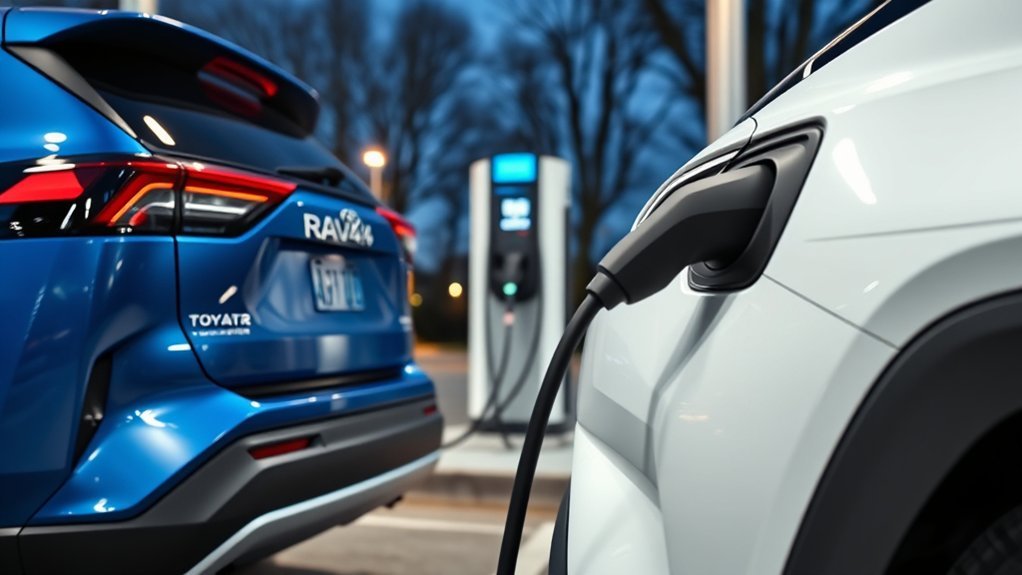
You’ll save fuel and get simpler ownership with the RAV4 Hybrid, which starts around $32,850, needs no plug-in charging, and returns about 39 MPG combined for reliable long trips. The RAV4 Plug‑In Hybrid (Prime) costs more—about $45,815—but gives roughly 42 miles of pure electric range, 302 hp and quicker acceleration if you can charge regularly. Compare cargo, towing, incentives and local charging to pick the right fit, and the details below explain how.
Which RAV4 Fits You? A Quick Hybrid vs PHEV Checklist
Wondering which RAV4 fits your routine? You want clarity, so here’s a concise checklist to free your daily drive. If fuel efficiency and long-range practicality matter, the RAV4 Hybrid starts at $32,850 and yields an EPA-estimated 39 MPG combined—ideal for long trips where charging’s scarce. Its self-charging via regenerative braking means you won’t depend on outlets. If you prioritize short trips, errands, and urban commuting with minimal gas use, the PHEV delivers 42 miles of electric-only range and sharper acceleration thanks to 302 hp—but it starts at $45,815. Cargo needs also influence choice: the Hybrid offers 37.6 cu.ft., the PHEV 33.5 cu.ft. Both have AWD, so traction’s equal; power and electric range differ. Choose the Hybrid for cost-conscious, low-maintenance freedom on long-haul routes; choose the PHEV to maximize electric miles and spirited performance in the city while accepting higher upfront cost and slightly less cargo space.
How the RAV4 Hybrid and PHEV Powertrains Work
Now that you’ve weighed range, cost and cargo, let’s look under the hood to see how each RAV4 makes power and when that matters for your drive. You’ll get a clear Powertrain Overview and an Efficiency Comparison so you can choose with intent. The Hybrid pairs a 2.5L four-cylinder with an electric motor for 219 hp, using regenerative braking to top the battery and seamlessly switching systems for long trips without stopping to charge. The PHEV keeps the same engine but adds a larger battery and electric output, delivering 302 hp and up to 42 miles of electric-only driving—useful if you charge regularly. Both have AWD for traction, but the PHEV gives quicker city acceleration.
Compare powertrains: Hybrid’s effortless 219 hp and nonstop range versus PHEV’s 302 hp and ~42 miles electric punch.
- Hybrid: 2.5L + motor, 219 hp, regen braking.
- PHEV: 2.5L + bigger battery, 302 hp, ~42-mile EV range.
- Charging: 120V or 240V for PHEV.
- Efficiency Comparison: Hybrid favors nonstop freedom; PHEV rewards charging discipline.
Real-World Range: City, Highway, and Combined for Both Models
When you compare city, highway, and combined range, the choice between the RAV4 Hybrid and PHEV comes down to daily driving patterns. The Hybrid delivers about 41 MPG in city driving and a 39 MPG combined EPA rating without needing charge stops, while the PHEV covers up to 42 miles purely on electricity and still manages roughly 38 MPG combined when running on gasoline. Assess whether your trips are short enough to stay mostly electric or long enough that the gas-only efficiency of the Hybrid serves you better.
City Driving Range
While both RAV4 Hybrid models handle city driving efficiently, they do so in different ways: you get city efficiency from the standard Hybrid and added electric benefits from the PHEV. You’ll appreciate clear trade-offs depending on your freedom to charge.
- RAV4 Hybrid: EPA-estimated 39 MPG combined, no charging needed, dependable urban range for errands.
- RAV4 PHEV (gas mode): 38 MPG combined, close to the Hybrid when battery’s depleted.
- RAV4 PHEV (electric): up to 42 miles of pure electric city driving, cutting fuel use for daily commutes.
- Local charging in Kirkland lets you recharge overnight, maximizing the PHEV’s electric benefits and smoothing stop-and-go traffic.
Choose the Hybrid for simple liberation; pick the PHEV to extend electric city freedom.
Highway & Combined
Having covered city performance and charging benefits, let’s look at highway and combined numbers to see how each model fares on longer trips. You’ll find the RAV4 Hybrid delivers reliable highway efficiency at an EPA-estimated 38 MPG and a combined performance of 39 MPG, so you can travel farther without hunting for chargers. The RAV4 PHEV, by contrast, posts a similar 38 MPG combined when running on gasoline but adds up to 42 miles of pure electric range—ideal if you want to liberate daily commutes from fuel costs. On long hauls beyond that electric window, the PHEV reverts to its gas efficiency, matching the Hybrid’s strengths. Choose based on how often you can exploit electric-only miles.
Charging in Kirkland and at Home: Practical Options and Time
One clear advantage for RAV4 PHEV owners in Kirkland is the growing public charging network, which makes topping up away from home straightforward and complements overnight charging options you can install. You’ll value the charging convenience and cost savings: public chargers extend your electric range during errands, while home charging minimizes fuel use for daily commutes.
Kirkland’s growing public charging network makes topping up easy, complementing overnight home charging for cost‑saving, low‑fuel daily driving
You can choose equipment and timing that match your liberated lifestyle and practical needs:
- Use a standard 120V outlet overnight for slow, maintenance charging and full battery readiness by morning.
- Install a 240V Level 2 charger for faster turnaround—useful if you need repeat electric trips in a day.
- Tap Kirkland’s expanding public chargers for midday top-ups, keeping trips largely emissions-free within the PHEV’s ~42-mile electric range.
- Rely on the self-charging RAV4 Hybrid if you prefer no-plug simplicity, trading pure-electric miles for continuous operation.
Make choices that free you from fuel dependency and lower long-term operating costs.
RAV4 Hybrid vs PHEV: Performance, Horsepower, and Towing
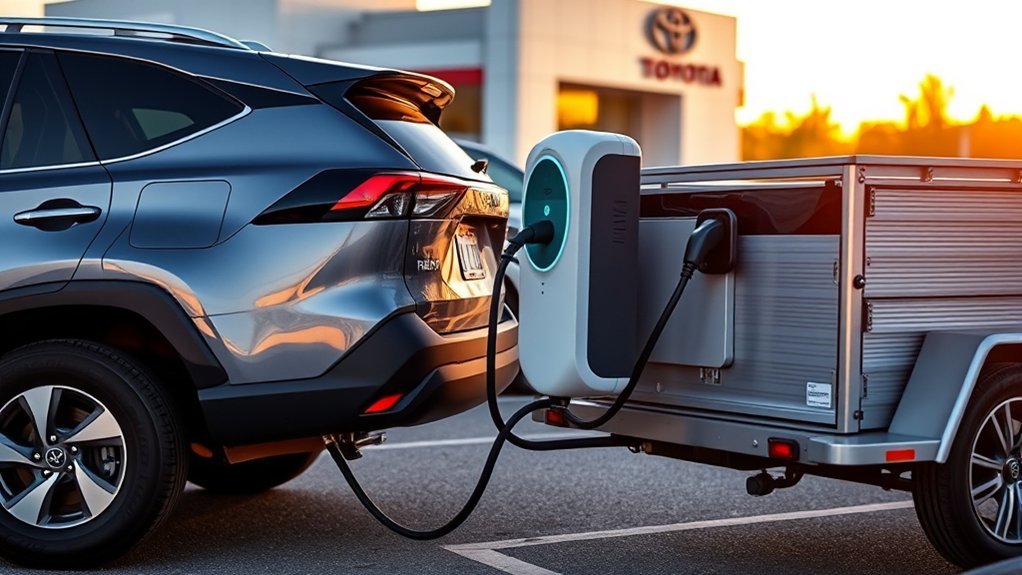
You’ll notice the PHEV’s 302 hp delivers noticeably quicker acceleration than the Hybrid’s 219 hp, so passing and merging feel more confident. You’ll also get a higher towing rating with the PHEV—2,500 lbs versus the Hybrid’s 1,750 lbs—making it the better choice if you plan to haul trailers or gear. Both AWD systems and selectable drive modes still give you stable, adaptable performance across conditions.
Horsepower And Acceleration
While both RAV4 hybrids prioritize efficiency, the plug-in hybrid clearly dominates on performance: its 302-horsepower system delivers noticeably quicker acceleration and stronger low-end punch than the Hybrid’s 219 horses.
You’ll feel the horsepower comparison immediately in traffic—more thrust off the line and surer overtakes. The PHEV’s electric assist gives tangible acceleration benefits, while the Hybrid stays efficient and steady. Both use AWD and multiple drive modes to lock in traction and tailor responses, so you won’t sacrifice control for power.
- PHEV: 302 hp, brisk launches, sharper throttle response
- Hybrid: 219 hp, smoother, efficiency-focused delivery
- Both: AWD and selectable modes for varied conditions
- PHEV: electric boost yields stronger low-end torque and responsiveness
Towing Capacity Differences
Because the PHEV pairs higher output with stronger low‑end torque, it also hauls more: the RAV4 Hybrid is rated for 1,750 lbs while the plug‑in climbs to 2,500 lbs, giving you greater flexibility for heavier trailers or gear. You’ll notice towing benefits immediately: the PHEV’s 302 hp and AWD deliver quicker acceleration under load, reducing strain and improving confidence when merging or climbing grades. Both AWD systems aid trailer stability, but the PHEV’s extra power and torque margin translate to safer, steadier control with heavier loads. Choose the Hybrid for lighter, economical hauling; choose the PHEV when you want liberated capability and practical towing range without upgrading to a larger vehicle.
| Model | Max Towing (lbs) |
|---|---|
| RAV4 Hybrid | 1,750 |
| RAV4 PHEV | 2,500 |
| Both | AWD trailer stability |
True Ownership Costs: MSRP, Fuel/Charging, Maintenance, Incentives
Although the RAV4 PHEV carries a substantial MSRP premium — $45,815 versus $32,850 for the Hybrid — its ownership math depends on how you drive, charge, and capitalize on incentives. For a clear ownership breakdown and cost analysis, weigh MSRP against everyday operating savings. You’ll get 39 MPG combined in the Hybrid for long trips; the PHEV posts 38 MPG combined but delivers about 42 miles of electric-only range. Maintenance tends to be lower for both thanks to simpler hybrid drivetrains and regenerative braking that extends brake life.
- Upfront: PHEV premium can be offset by federal/state rebates and incentives.
- Daily fuel: If you can charge at home or work, the PHEV cuts fuel expenses dramatically for commuting.
- Long trips: Hybrid’s superior MPG makes it cheaper on sustained highway travel.
- Maintenance: Both save you money over conventional engines with lower routine service needs.
Choose based on charging access, commute length, and how much freedom you want from fuel costs.
Cargo, Seating, Daily Usability, and Winter Driving in the PNW
Money and daily driving habits shape more than just ownership math — they also determine how the RAV4 fits into your everyday life. For cargo comparison, the self-charging RAV4 Hybrid gives you 37.6 cu.ft., versus 33.5 cu.ft. in the PHEV, so choose the Hybrid if hauling gear or freedom from tight packing matters. Both seat five comfortably and share interior tech, so seating won’t constrain your plans.
Consider usability factors: the PHEV’s up-to-42-mile electric range can cover most commutes, cutting fuel use if you can charge regularly; the Hybrid’s regenerative charging keeps you moving without plugs. In the Pacific Northwest’s wet, slippery winters both AWD systems deliver confident traction and stable handling, letting you drive with less anxiety. Weigh your pattern—if you prioritize electric-only urban trips, the PHEV liberates you from frequent gas stops; if cargo space and plug independence matter more, the Hybrid fits a freer, less constrained lifestyle.
Trim and Feature Comparison: Hybrid Trim Map vs PHEV Trims
When you map trims side‑by‑side, the RAV4 Hybrid gives you a broader palette—more trims including the off‑road–focused Woodland and a luxury‑leaning Limited—while the PHEV narrows choices to SE and the sportier, better‑appointed XSE. You get more Trim features in the Hybrid lineup to match different missions: rugged, efficient, or upscale. The PHEV concentrates performance and some Luxury options into two trims, with XSE adding a larger infotainment screen and richer appointments alongside 302 hp.
- Hybrid: Woodland adds Off road capability and rugged hardware; Limited brings Luxury options.
- PHEV: SE for basics; XSE for sportier feel and upgraded interior tech.
- Cargo space: Hybrid offers 37.6 cu.ft.; PHEV gives 33.5 cu.ft., a practical gap for freedom‑minded haulers.
- Infotainment: 8-inch standard; 10.5-inch available on upper trims for both models.
You’ll choose broader capability or concentrated performance and luxury.
Final Recommendations: Which RAV4 to Buy for Six Common Use Cases
If you’re weighing the RAV4 Hybrid and PHEV for specific needs, pick the PHEV for city commuters who can charge regularly and want up to 42 miles of electric range and near-zero fuel costs. For urban efficiency and short daily runs, the PHEV frees you from gas pain and shrinks operating costs if you charge at home or work. If you rarely access chargers, choose the Hybrid: its 39 MPG combined and self-charging regen deliver reliable range and lower upfront cost.
For long-distance travelers, the Hybrid wins—no charger dependence and consistent fuel economy. For mixed-use drivers who want both quick acceleration and towing, the PHEV’s 302 hp and 2,500-lb capacity give spirited performance. For off-roaders, the Hybrid Woodland trim prioritizes capability and durability—true adventure readiness. In every case, match your charging access, budget, and appetite for liberation from fossil fuel constraints to the model that fits your life.
Frequently Asked Questions
What’s the Difference Between the RAV4 Hybrid and the RAV4 Hybrid Plug-In?
The RAV4 Hybrid gives efficient, self-charging performance and more cargo space, while the RAV4 Plug-In delivers higher power and electric-only range. You’ll weigh RAV4 features, Charging options, and liberation through lower emissions and savings.
Should I Get a Plug-In Hybrid or Hybrid?
Choose the plug-in hybrid if you want electric range for daily trips and flexible charging options; pick the hybrid if you prefer lower cost, worry-free fuel efficiency and liberation from frequent charging while keeping strong AWD performance.
What Is the Downside of a Plug-In Hybrid?
Like a fax machine, you’ll face limits: PHEVs demand reliable charging infrastructure, cost more, add weight, and complicate maintenance; you’ll worry about battery lifespan and real-world range, so plan access and long-term costs.
How Many Miles per Gallon Does a Hybrid RAV4 Get Compared to the PHEV?
The Hybrid gets about 41 city, 38 highway, 39 combined MPG, while the PHEV logs roughly 38 MPG combined on gas; you’ll prioritize fuel efficiency or electric driving range depending on your liberated, pragmatic needs.
Conclusion
Choose the RAV4 that matches your routine: the hybrid for frugal, fuss-free fuel economy and familiar functionality; the plug‑in for punchy performance, pure‑electric pops, and shorter commutes. Weigh weekday wattage versus weekend towing, charging convenience versus cost, and climate concerns versus cargo needs. Prioritize practical performance, predictable pricing, and proven reliability. If you’re commuting, the PHEV’s electric edge excels; for eclectic errands and ease, the hybrid holds humble, hearty, hassle‑free appeal.