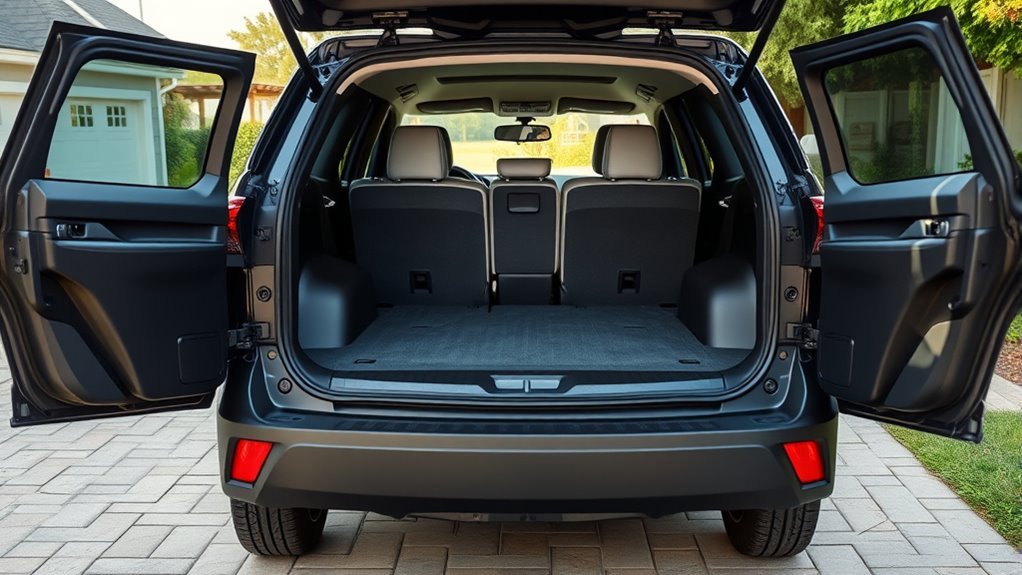
The RAV4’s rear aperture gives you about 45.5 in at the sill, narrowing to ~40.5 in at the top, with roughly 31 in vertical clearance from sill to trim and an effective span of ~41 in to the back seat; total depth to the seatbacks is ~74.5 in with seats up and ~112 in with seats folded. Measure your gear (L×W×H), note ±0.5–1 in tolerances, and use angling, pass‑throughs, or seat folds for long items—scroll on to get precise fit tactics.
RAV4 Cargo Opening Dimensions : Exact Width, Height, Threshold
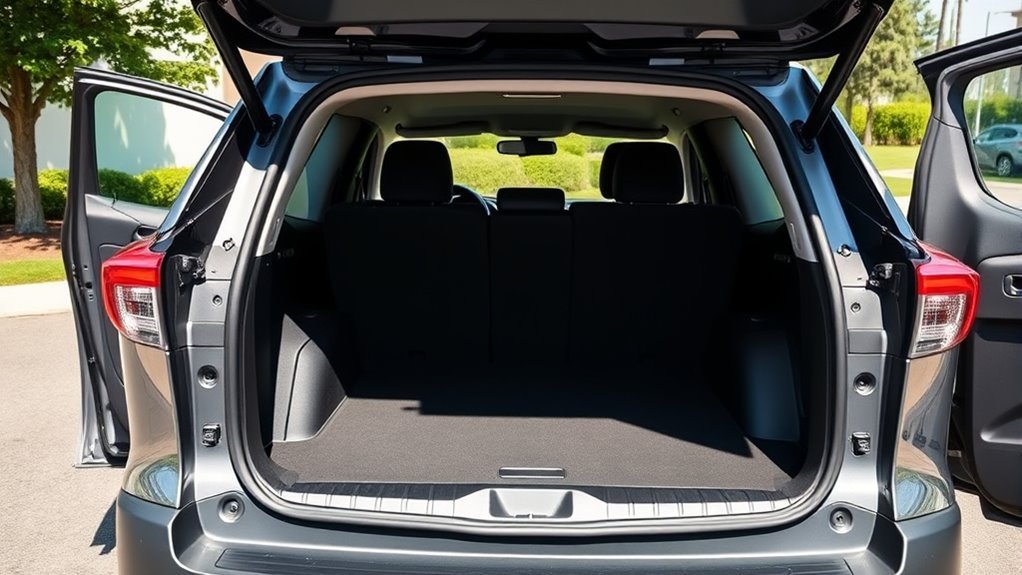
When loading gear, you’ll appreciate the RAV4’s practical cargo opening: the lower width measures about 45.5 in, the upper width about 40.5 in, and the vertical clearance from sill to top is roughly 31 in, yielding a usable aperture that accommodates most bulky items. You can exploit these precise dimensions for cargo space optimization by aligning long or wide items with the 45.5 in lower width while mindful of the 40.5 in upper constraint. The 31 in vertical clearance lets you orient taller loads upright or stagger them to maximize volume without forcing deformation. Note the 41 in span from back seat to door seal for effective placement when seats are up. The rear trunk opening height of 1,020 mm reduces lift effort for heavy items and informs your loading techniques: plan grips and leverage points, seat-to-door shifts, and threshold clearance. Execute deliberate, measured moves to free yourself from spatial constraints and load confidently.
How to Measure Your Gear for a Guaranteed Fit in the RAV4
Having the cargo opening dimensions on hand lets you measure gear to confirm a fit in the RAV4: use specific measurements to eliminate guesswork. Measure your gear dimensions (length, width, height) with a tape, noting max values and any protrusions. Compare widths to the driver’s door opening (25.5 in) for single-door loading and to the trunk bottom opening (45.5 in) for larger items. Check vertical clearance against the trunk opening height (31 in). For long items, measure total length against the seat-to-back span (74.5 in) with seats upright; if length exceeds that, plan diagonal placement or seat folding. Also confirm width from back seat to door seal (41 in) to determine best storage orientation inside the cabin. Record tolerances (±0.5–1 in) to allow for handles or cases. This disciplined measurement approach frees you to pack efficiently, guarantees a fit, and preserves space for additional gear.
What Those Dims Mean: Suitcases, Strollers, Golf Bags, Surfboards
Although compact at first glance, the RAV4’s measured openings give you clear, actionable limits: the trunk opening is about 1,100 mm wide and 1,020 mm high (roughly 45.5″ by 31″), the driver’s door clears ~25.5″, and the cabin width from back seat to door seal is ~41″. Those dimensions translate directly to what you can carry. Suitcase dimensions: standard checked luggage (up to ~28″ tall) fits upright or flat; you can load multiple suitcases across the 45.5″ width. Stroller compatibility: most single and many double strollers collapse to under the 31″ height and 41″ cabin width, so you’ll fit them without dismantling frames. Golf bag storage: full-length bags align with the 45.5″ opening; angled placement or seat fold gives clearance for clubs. Surfboard size: shortboards and many mid-lengths fit through the width, though longboards may require angled entry (covered in the next section). These limits let you plan gear choices and preserve mobility.
Loading Long Items: Angle, Seat Fold, and Pass‑Through Tips
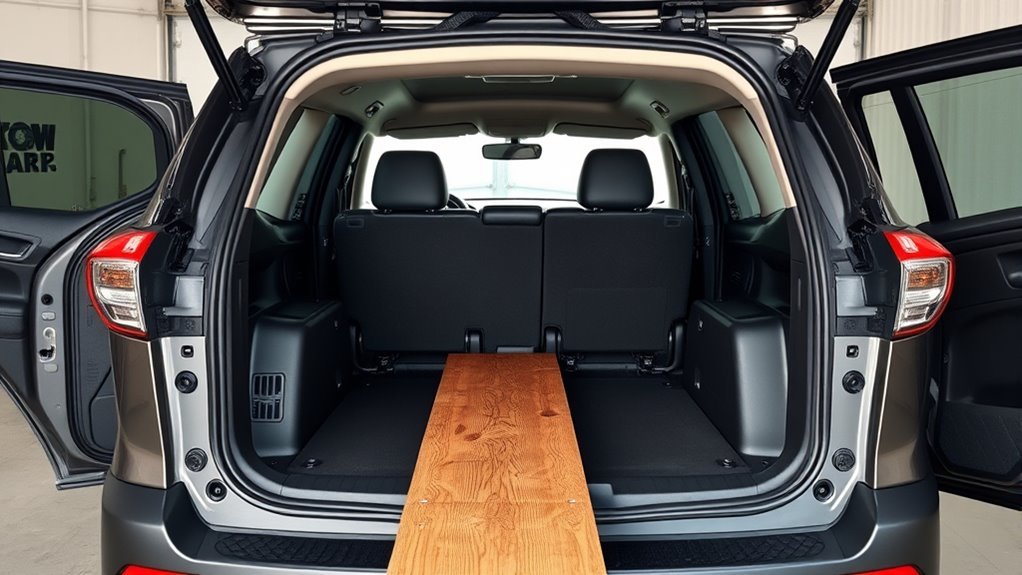
Those trunk and cabin measurements give you a predictable starting point for moving long items: by angling pieces through the 25.5″ driver’s door or folding rear seats you can extend usable length from about 74.5″ (seat up) to roughly 112″ to the rear screen. Use controlled angle techniques: rotate the item diagonally, lead with the thinnest edge, and pivot at the driver’s-door aperture to reduce required width. Measure before lifting; 25.5″ dictates entry orientation.
Prioritize seat adjustments to create a continuous load plane. Lower or fold the rear seats to reach the 112″ capacity, and fine-tune front-seat fore-aft and backrest angles to gain incremental length without compromising driver space. Use the pass-through for center-long items to maintain two passengers while transporting elongated loads.
Secure the item against movement with straps to the anchor points. These steps free you from guesswork, maximize usable length, and preserve cabin utility while keeping loading ergonomic and efficient.
Rear Threshold & Step‑In: Clearance Limits and Workarounds
Because the RAV4’s rear opening sits about 1,020 mm high with a bottom width near 45.5 in and an 85° door swing, you can load bulky items without contorting them through narrow gaps, but you must account for the 350 mm threshold width, 150 mm step‑in height, and 40 mm bumper overhang when planning clearance and approach angles. You’ll use threshold clearance data to set safe approach angles and avoid edge catches; measure the object’s base plus handling buffer against the 350 mm sill and 40 mm overhang. Adopt disciplined loading strategies to minimize lift and leverage.
With the RAV4’s 1,020 mm opening and 350 mm sill, plan angles, bridge the threshold, and limit lifting.
- Reduce lift by angling the load to clear the 150 mm step‑in height; slide where possible.
- Use a short ramp or board to bridge the 350 mm threshold for wheeled items and reduce torque on the bumper.
- Position helpers at the sill and inside cabin to control rotation and keep center of gravity low.
These tactics free you from reactionary moves and make each load predictable, efficient, and safe.
Roof Height, Racks, and When to Choose Roof Transport
When you add roof racks to a RAV4, plan for an increased overall height—from about 67.5 inches stock to roughly 70 inches with racks—which can affect garage clearance and low‑overhang routes; confirm a minimum 84‑inch garage clearance for safe access and factor the extra 2.5 inches into parking and drive‑through calculations. You’ll choose roof transport when interior volume or shape prevents secure carriage of long or bulky items. Roof rack benefits include expanded cargo capacity and freedom to carry boards, poles, or soft bags without compressing cabin space. Apply height considerations to route planning and loading technique; lean items to center, secure with rated straps, and note the top rear opening width (~40.5 in) and door opening height (~31 in) when transferring items. This preserves mobility and autonomy while minimizing damage risk. Use racks when bulk exceeds interior limits or when you prioritize passenger freedom over interior storage reconfiguration.
| Payload Type | Use Case |
|---|---|
| Long gear | Roof transport |
| Bulky loads | Interior or roof |
Parking & Positioning to Maximize the Rear Opening
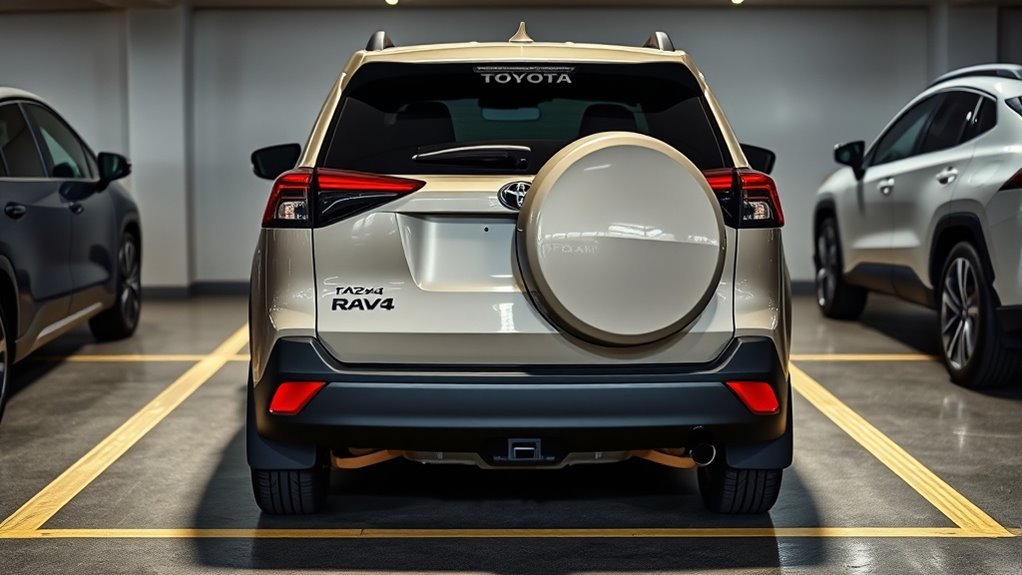
Park with at least 200 mm of clearance on the hinge side and rear to allow full use of the 1,020 mm trunk height and the door’s 85° swing, ensuring you can load through the roughly 45.5 in bottom width without obstruction. Positioning determines whether you exploit the RAV4’s cargo geometry or fight it; you’ll gain freedom by planning parking strategies and vehicle spacing in advance.
- Back-in when possible to align the hinge side away from traffic and tight barriers.
- Center the vehicle in the bay to preserve symmetrical clearance for full door articulation and unobstructed access to the 1,020 mm vertical plane.
- In garages, verify minimum 84 in ceiling clearance if you use roof racks; offset laterally to avoid door strikes.
You’ll act deliberately: measure available space, prioritize hinge-side clearance, and adjust angle to maintain the 85° swing. These technical steps free you from awkward loading, letting you move larger items through the 45.5 in opening with confidence.
Quick‑Fit Checklist: Measurements to Test Before You Buy
Start with four quick measurements you can check at the dealer or in the ad: driver’s door opening width (~25.5 in) for easy ingress/egress, rear trunk opening height (1,020 mm / ~40.2 in) and bottom cargo width (~45.5 in) for item clearance, and rear seat width (≈57 in max) for transporting wider loads. Use these as your baseline fitment factors. Apply systematic measurement methods: tape measure perpendicular to openings, record inside-to-inside dimensions, and note thresholds or trim that reduce clearances. Verify overall vehicle height against your garage (minimum 84 in recommended) to avoid roof interference when unladen. Inspect rear sill height and flatness for load transfer; measure with seats up and folded to capture usable depth. Prioritize exact numbers over approximations so you can plan cargo geometry and liberation of movement. Bring a template or box of your typical items to emulate real-world fitment and confirm that measured clearances match functional needs before you buy.
Troubleshooting Common Fit Problems and Simple Fixes
1 practical step you can take when a load won’t fit is to re-measure the critical clearances (driver’s door ~25.5 in, rear trunk opening ~1,020 mm/≈40.2 in, and the 31 in trunk passage) and compare them directly to your item’s maximum dimensions; this quickly tells you whether the problem is dimensional mismatch or a loading technique issue. After that, diagnose entry challenges and plan cargo adjustments: check the 41 in back-seat-to-seal width, confirm garage access height ≥84 in for safe maneuvering, and verify trunk opening alignment to avoid scraping.
- Rotate or tilt the item to reduce effective height and match the 31 in trunk passage.
- Remove or fold obstructing interior panels or headrests to gain millimeters where needed.
- Use padded sliders or protection to shift the item through the ~40.2 in rear opening without damage.
You act deliberately, measure precisely, and choose the minimal intervention that resolves the fit problem while preserving access and freedom.
Frequently Asked Questions
What Are the Dimensions of the Back of a Toyota RAV4?
The RAV4 back measures roughly 57 inches across seats (49.5 excluding handles), 41 inches from seatback to door seal, rear opening ~45.5″ bottom / ~40.5″ top width, and ~31″ height, enhancing RAV4 cargo accessibility.
What Are the Dimensions of the RAV4 Trunk?
Boldly between bounds: you’ll find trunk space roughly 31″ high, 45.5″ bottom width, 40.5″ top width, 41″ depth to seal; cargo capacity about 580 L (expandable to 1,690 L) — you’ll load freely.
What Are the Interior Dimensions of the Toyota RAV4?
You get interior space roughly: 41″ width back-seat access, 37″ interior height with seats leaned, 25.5″ driver door width, 1,020mm trunk height; seating capacity is five, optimizing liberated passenger comfort.
Conclusion
You’ve got the numbers and tactics—now test them. I once loaded a kayak that fit the RAV4’s 38.5‑inch cargo opening only after angling it like threading a key; that 2‑inch bevel made all the difference. Measure your gear, compare width, height, and threshold, then rehearse the angle and seat‑fold sequence. With precise measurements and one practice run, you’ll avoid surprises and make the RAV4’s rear opening work predictably every time.