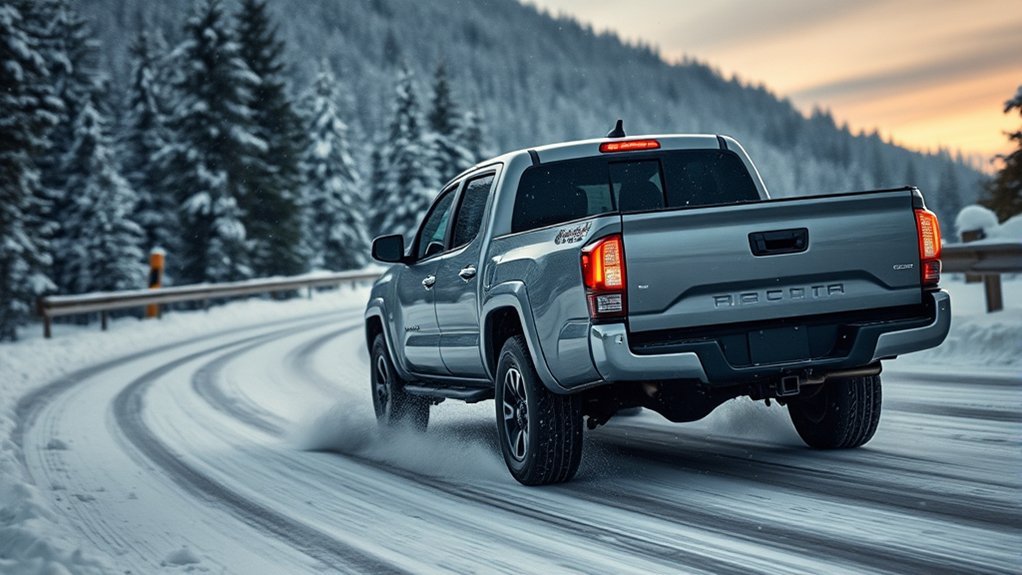
A Tacoma can be very capable in snow, but 4WD does not replace traction, judgment, or the owner’s manual. The safest setup starts with winter-rated tires, correct road pressure, secured weight over the rear axle, and the right drive mode for the surface. Use 4H for snowy roads, 4L only for slow technical sections, and save the rear locker for low-speed recovery situations.
Quick Answer
For a Tacoma in snow, run dedicated winter tires or at least 3PMSF-rated tires, keep road tire pressure at the door-jamb recommendation, add secured bed weight, carry recovery gear, and use 4H on slippery roads. Use 4L, Multi-Terrain Select, and the rear locker only for slow off-road snow or recovery.
Key Takeaways
- Tires matter more than 4WD. A true winter tire gives better cold-weather grip than most all-terrain tires.
- Use 4H for snowy or icy roads, 2H for dry pavement, and 4L only for slow, difficult terrain.
- Do not air down for normal winter roads. Use the tire pressure listed on the driver’s door placard unless you are off-road and prepared to re-inflate.
- Use the rear locker only at very low speed when traction is poor, then unlock it as soon as you are moving again.
- Carry traction boards, a shovel, straps, warm gear, water, and a jump starter before you need them.
At a Glance
| Time Required | 30–60 minutes to prep the truck before a winter trip |
| Difficulty | Beginner to moderate |
| Tools Needed | Tire gauge, air compressor, shovel, traction boards, recovery strap, D-rings, jump starter, gloves |
| Cost | Low for basic gear; higher if adding dedicated winter tires or chains |
Quick Tacoma Snow Checklist: Tires, Weight, and Gear
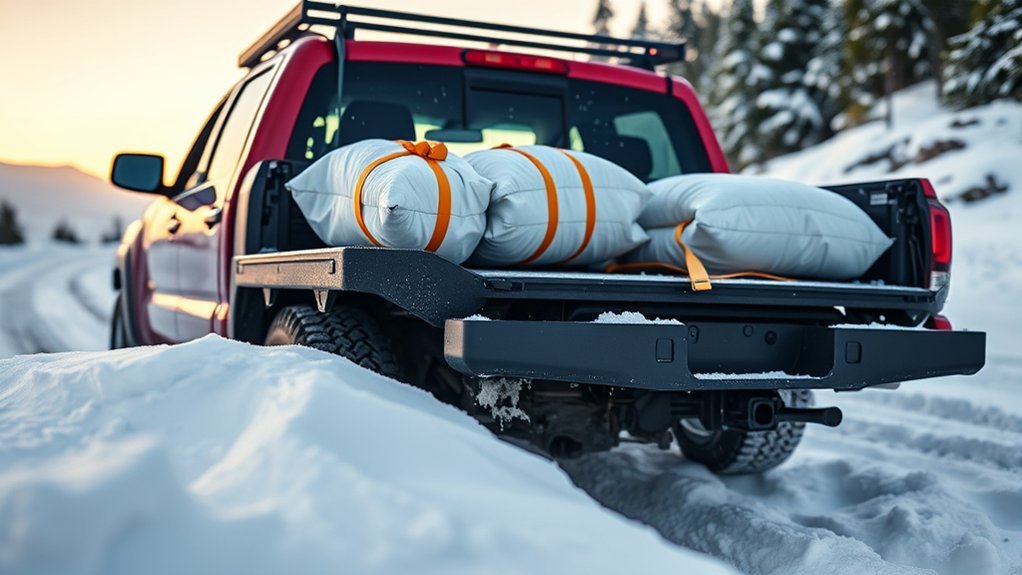
Start with the three things that make the biggest difference: winter traction, balanced weight, and recovery gear. A Tacoma with 4WD and poor tires can still slide, fishtail, or take too long to stop. A Tacoma with good winter tires, smooth inputs, and the right gear is far easier to control.
For regular winter driving, look for dedicated snow tires or tires with the three-peak mountain snowflake symbol. The 3PMSF mark means the tire meets a snow-traction test, but it does not automatically mean it performs like a dedicated winter tire on ice, braking, or cornering. If you drive in snow and ice often, true winter tires are the better choice.
Add weight only if it is secured. Around 150–250 pounds of sandbags, tube sand, or similar ballast over or slightly ahead of the rear axle can help the rear tires bite, especially on an empty bed. Do not let loose bags, tools, or traction boards slide around the bed; they can become hazards during a hard stop.
Warning: Added bed weight can reduce available payload and change braking distance. Keep the load low, centered, secured, and within your Tacoma’s payload rating.
Your winter kit should be reachable without unloading the whole truck. Pack traction boards, a compact snow shovel, recovery straps, rated D-rings or soft shackles, gloves, a headlamp, a portable jump starter, a tire gauge, an air compressor, warm clothing, water, and snacks. If you travel mountain passes, also carry tire chains or cables that match your tire size and local chain laws.
In 2023, NHTSA reported 320 fatal crashes and an estimated 22,293 injury crashes when snow or sleet was present. Winter prep is not just about getting unstuck — it is about preventing the situation in the first place.
[Products Worth Considering]

Upgrade your vehicle's interior with this universal console cover that combines comfort and organization. The high‑quality microfiber leather resists spills and scratches while the thick memory foam core provides ergonomic support, reducing elbow fatigue on long drives. Dual side pockets keep essentials within reach, and elastic straps with non‑slip dots ensure a secure, tool‑free installation for any sedan.

Stay warm and keep control with the KVAEY fluffy steering wheel cover. Its high‑density plush provides a soft, comfortable grip while the anti‑slip rubber liner ensures safety during winter drives. Easy to install and fits 15‑inch wheels on cars, trucks, and SUVs, adding a cozy, stylish touch to any interior.

These plush car seat belt cover pads provide a soft, friction‑reducing layer that eases shoulder pressure during long drives, making rides more comfortable for adults and kids. The cute purple flower pattern adds a stylish touch to any vehicle interior while the durable, wear‑resistant material ensures long‑term use. Easy Velcro straps secure the pads without tools, and the universal fit works with most seat belts.
Set Up Before You Drive: Tire Pressure and Modes
Before you roll into snow, set the truck up for the surface you are actually driving on. For normal roads, keep your tires at the cold pressure listed on the driver’s door placard. The NHTSA winter driving guidance notes that tire pressure drops as temperature falls, so check pressure when the tires are cold and adjust to the vehicle manufacturer’s recommendation.
Airing down can help in deep off-road snow because it increases the tire’s contact patch, but it is not a normal road-driving trick. If you are on a trail, beach, or private off-road route and you understand the risks, lower pressure gradually, drive slowly, avoid sharp steering, and re-inflate before returning to pavement. Very low pressures can debead a tire or damage it, especially with heavy loads or speed.
Note: Avoid fixed advice like “always run 14–15 psi.” That may work for some off-road setups, but it is too low for normal winter roads and may be wrong for your tire, wheel, load, and speed.
Use the transfer case deliberately. On Tacoma models with part-time 4WD, Toyota describes 2H as the normal mode for dry hard-surfaced roads. Use 4H when roads are snow-covered, icy, muddy, or otherwise slippery. Use 4L for slow-speed situations that need more control and torque, such as climbing a steep snowy trail, easing through deep ruts, or recovering from being stuck.
If your Tacoma has Multi-Terrain Select, choose the mode that matches the surface. Newer Tacoma manuals reference modes such as Sand, Mud, and Deep Snow, depending on model and trim. Use Deep Snow or the closest appropriate loose-surface mode for deep snow, not “Rock” as a one-size-fits-all answer. Toyota’s Multi-Terrain Select guidance notes that the system is meant to improve drivability on rough roads, but it does not cancel the need for careful driving.
[Products Worth Considering]

These silicone cup holder inserts provide a curved, anti‑shake design that securely grips water cups and bottles, preventing spills and rattling while driving. Made from...
Moving and Climbing: Momentum, Gears, and Traction
When you are pushing through snow or climbing a slippery grade, momentum matters — but too much throttle ruins it. The goal is steady motion, not wheelspin. Ease into the throttle, keep your steering smooth, and let the tires do the work.
| Principle | Best Action |
|---|---|
| Momentum | Keep a steady pace before the hill; avoid sudden acceleration |
| Gear choice | Use 4H for snowy roads and 4L for slow technical climbs |
| Throttle | Apply smooth power; back off if the tires spin |
| Tire pressure | Use door-placard pressure on roads; air down only for slow off-road snow |
| Drive mode | Use the appropriate snow, mud, sand, or loose-surface mode if equipped |
If the truck starts to dig down, stop before you bury the frame. Rocking the truck can work, but do it gently: shift between drive and reverse only after the wheels stop, use light throttle, and avoid spinning holes under the tires. Once the snow is packed under the chassis, recovery becomes much harder.
Pro Tip: If you are climbing a snowy trail, walk the line first when it is safe. Pick a path with the least off-camber angle, avoid hidden ice, and keep enough room to back down if traction disappears.
Turn, Corner, and Control Slides Safely
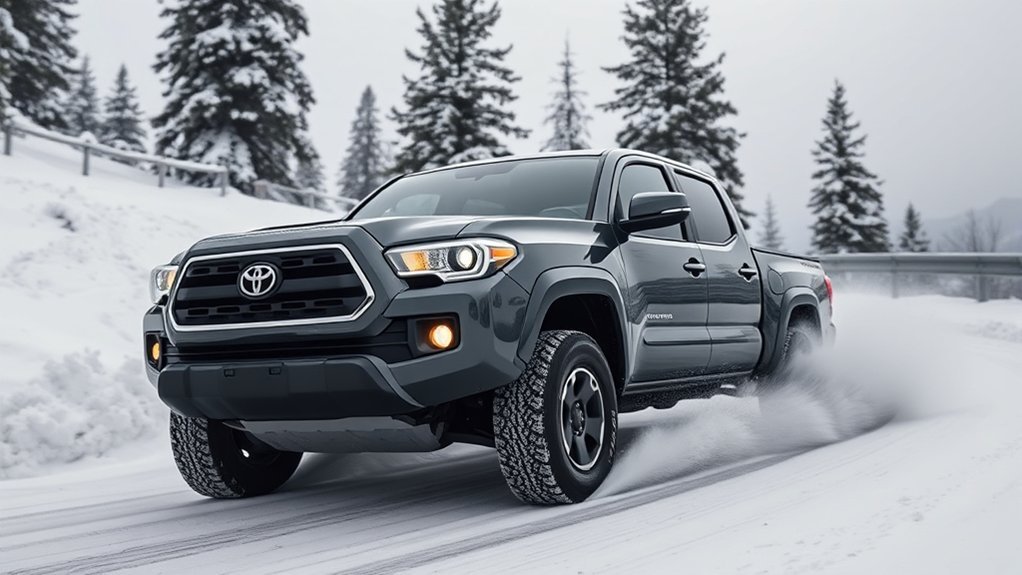
In snow, the best corner is the one you set up early. Slow down before the turn, keep your hands calm, and avoid steering and braking hard at the same time. Your tires only have so much grip; asking them to brake, turn, and accelerate aggressively all at once is how slides begin.
Steering Into the Slide
If the rear of the Tacoma steps out, look where you want the truck to go and steer gently in that direction. Do not snap the wheel back and forth. Sudden corrections can swing the truck the other way. Ease off the throttle, keep your inputs small, and let the tires regain grip.
If the front tires slide straight ahead, you are asking for more steering than the surface can provide. Reduce speed gently, unwind a little steering angle, and wait for the tires to bite again. Slamming the brakes or adding more steering usually makes the slide worse.
Controlled Throttle Steering
Throttle can help balance the truck, but it must be smooth. On slippery turns, use light, steady power instead of sudden bursts. A higher gear can reduce torque at the wheels and make the truck easier to manage. If the rear tires start spinning, ease off and let traction return.
- Brake before the turn: Slow down in a straight line before steering.
- Make one smooth steering input: Avoid jerky corrections that overload the front tires.
- Accelerate gently on exit: Wait until the truck is pointed straight enough to accept power.
Safe Cornering Lines
Use wider, deliberate lines when space and traffic allow. A wider line reduces the steering angle and helps the Tacoma track predictably. On a downhill turn, keep speed low before the corner and avoid heavy braking mid-turn. If equipped, downhill assist or Crawl Control may help on slow off-road descents, but it is not a substitute for choosing a safe speed.
Tacoma 4WD, Low Range, and Multi-Terrain Select Usage
Use 4WD as a traction tool, not a confidence trick. 4H is the mode most Tacoma drivers want for snowy or icy roads where extra traction is needed. 4L is for slow, difficult terrain where you need more torque and control. Do not use part-time 4WD on dry pavement, because driveline bind can occur.
If your Tacoma has a rear differential lock, use it sparingly. Toyota’s rear differential lock guidance warns that systems such as ABS, brake assist, VSC, downhill assist, and TRAC may not operate when the rear differential is locked. Toyota also warns not to lock it until the wheels have stopped spinning and not to drive over 5 mph with it locked.
Warning: Do not use the rear locker for normal snowy-road driving. It is for low-speed situations where a rear wheel is losing traction. Unlock it as soon as you are free or back on a surface with better grip.
Here is the simple way to think about Tacoma snow modes:
- 2H: Dry pavement and mostly clear roads.
- 4H: Snow-covered roads, icy patches, slush, gravel, and mixed low-traction surfaces.
- 4L: Slow off-road snow, steep climbs, ruts, deep drifts, or careful recovery.
- Multi-Terrain Select: Use the mode closest to the actual surface, such as Deep Snow, Mud, Sand, or loose terrain depending on your model.
- Rear locker: Use only when stuck or nearly stuck at very low speed, then unlock promptly.
Tire Chains and Winter Legal Requirements
Chains can make the difference on steep ice or mountain passes, but only if they fit and are legal for the road. Check your tire size, your owner’s manual, and local chain-control rules before you leave. Toyota’s winter driving tips for Tacoma say chain regulations vary by location and road type, and the manual instructs drivers to install chains on the rear tires and not on the front tires for the covered Tacoma configuration.
Practice installing chains at home with gloves on. Snowstorms are a bad place to learn. After installing, drive slowly, stop after a short distance to recheck tension, and remove the chains when you are back on bare pavement unless local rules say otherwise.
Recovery Gear and What to Do If Stuck
Keep recovery gear where you can reach it quickly. At minimum, carry traction boards, a shovel, a recovery strap, rated shackles, a bag of sand or non-clumping cat litter, a jump starter, warm gloves, a flashlight, water, and a basic first-aid kit. If you travel alone or off-road in winter, add a real air compressor, tire repair kit, blanket, extra layers, and a way to communicate if cell service fails.
Essential Recovery Tools
A good recovery kit gives you options before you call for help. Choose gear rated for the truck’s weight and know where your recovery points are before you are buried in snow. Do not attach a recovery strap to a hitch ball, bumper trim, suspension part, or anything not designed for recovery loads.
- Traction boards: Place them under the slipping tires after clearing snow from the path.
- Snow shovel: Dig around the tires, under the frame, and in the direction you want to travel.
- Recovery strap and rated shackles: Use only with proper recovery points and clear communication.
- Sand or litter: Add bite under the tires on packed snow or ice.
- Jump starter and warm gear: Cold weather is hard on batteries and people.
Step-by-Step Extraction
If your Tacoma gets stuck, slow down and work methodically. Spinning the tires usually digs deeper holes and polishes the snow into ice.
- Assess first: Check the slope, traffic, obstacles, and whether the truck is high-centered.
- Clear snow: Dig in front of and behind the tires, and clear packed snow under the frame if needed.
- Straighten the wheels: A straight tire path needs less traction than a turned tire path.
- Add traction: Place boards, sand, or litter under the tires that are slipping.
- Select the right mode: Use 4L for slow recovery. If equipped and appropriate, select the best Multi-Terrain Select mode.
- Use the locker only if needed: Stop wheelspin first, engage the rear locker at low speed, and unlock it once free.
- Apply gentle throttle: Let the tires climb onto the traction aid instead of launching over it.
- Call for help when needed: If the truck is unstable, near traffic, sliding sideways, or deeply buried, professional recovery is safer.
Note: If you are stopped or stranded in winter weather, NHTSA recommends staying with your vehicle, making it visible, and keeping the exhaust pipe clear of snow to reduce carbon monoxide risk.
Frequently Asked Questions
Should I drive in 2H or 4H in snow?
Use 4H when the road is snow-covered, icy, slushy, or consistently slippery. Use 2H on dry pavement or mostly clear roads to reduce wear, noise, and driveline stress. If you have part-time 4WD, do not use 4H on dry high-traction pavement.
What are the 3 P’s of winter driving?
The 3 P’s are preparation, patience, and practice. Prepare the truck with good tires and emergency gear, drive patiently with extra following distance, and practice braking and steering in a safe open area before you need those skills on the road.
When should I use Snow Mode or Multi-Terrain Select on a Toyota Tacoma?
Use Snow Mode, Deep Snow, or the closest loose-surface Multi-Terrain Select setting when the surface matches that mode and your Tacoma is equipped for it. Mode names vary by model year and trim, so follow the owner’s manual. Return to normal mode when you are back on regular pavement.
Should I air down my Tacoma tires in snow?
Not for normal winter roads. Use the cold tire pressure on the driver’s door placard. Airing down is only for slow off-road deep snow, and you should do it carefully, avoid speed and sharp turns, and re-inflate before returning to pavement.
Do I still need winter tires if my Tacoma has 4WD?
Yes, if you regularly drive in snow, ice, or freezing conditions. 4WD helps you move, but tires help you stop, steer, and recover grip. Dedicated winter tires usually outperform all-season and many all-terrain tires in cold winter conditions.
When should I use the rear locker in snow?
Use the rear locker only for low-speed recovery or slow off-road travel when one rear tire is spinning and you need both rear wheels to turn together. Do not use it for normal snowy-road driving, and unlock it as soon as you are moving again.
Conclusion
A Tacoma can handle winter well when you set it up like a truck, not a magic sled. Start with the right tires, correct road pressure, secured bed weight, and a real recovery kit. Use 4H for snowy roads, 4L for slow technical sections, and the rear locker only when the situation truly calls for it. Stay smooth, stay patient, and save the bragging for after you are safely home.
Sources
- NHTSA Winter Driving Tips — winter crash data, tire pressure guidance, emergency safety advice
- Toyota Tacoma Four-Wheel Drive System — 2H, 4H, and 4L usage guidance
- Toyota Tacoma Multi-Terrain Select — MTS function and mode behavior
- Toyota Tacoma Rear Differential Lock System — rear locker warnings and speed limits
- Toyota Tacoma Winter Driving Tips — tire chain and winter driving precautions
- Tire Rack 3PMSF Explanation — what the three-peak mountain snowflake tire symbol means and does not mean