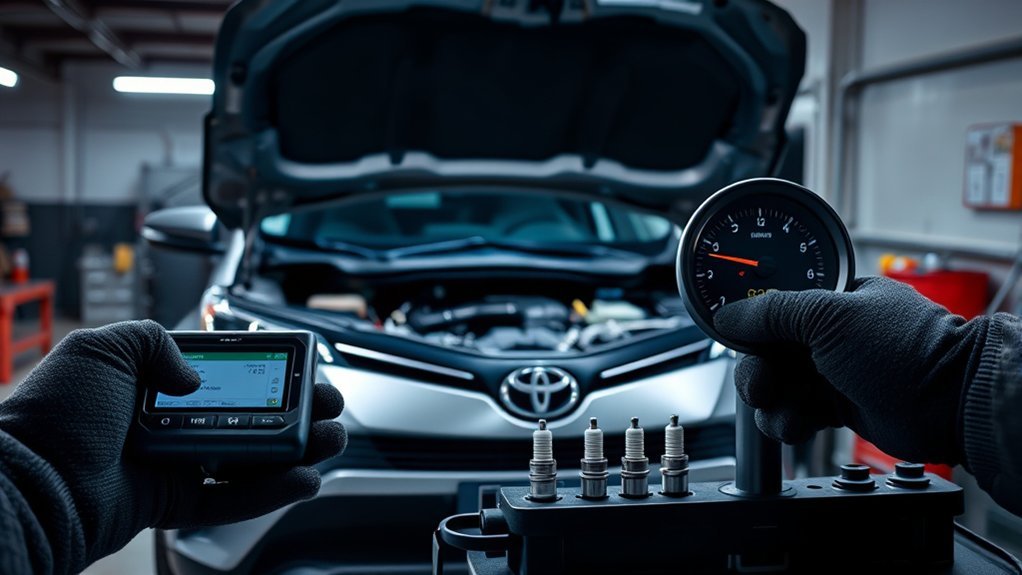
If your RAV4 is using excess fuel, start by measuring real MPG and ruling out simple causes: underinflated tires, clogged air filter, prolonged idling, heavy loads, or aggressive driving. Then scan for codes and check ignition (plugs/coils), O2 sensors, MAF, and fuel pressure for rich conditions. Inspect exhaust and catalytic converter, brake drag, and rear differential for mechanical resistance. Fixes range from tire and filter maintenance to sensor replacement or fuel system/service work—keep going for detailed diagnostics and costs.
Check Your RAV4’s Real MPG in 5 Steps

Start by measuring your real MPG manually: fill the tank, reset trip A and B, drive a known distance, then divide the miles traveled by the gallons added at the next fill-up to get an accurate baseline and to compare against the dashboard readout. Use that baseline to isolate variables: log fuel quality and note if you used different stations or grades. Record driving habits—cruise control, steady highway versus stop-and-go city—since 80% highway will raise MPG relative to urban cycles. Track engine load (cargo, towing, incline) because added load reduces efficiency predictably; quantify where possible. Note weather conditions, as cold air and headwinds lower real MPG and skew short-run comparisons. Compare successive resets of trip A and B against the baseline to detect trends. Integrate checks into your maintenance schedule so you correlate drops in MPG with service intervals; persistent fluctuations suggest mechanical faults rather than behavioral causes.
[Products Worth Considering]

These TPE door anti‑kick pads provide durable, water‑resistant protection for Toyota Tundra doors from 2022 to 2026. They fit precisely, are easy to install with...
Quick Fixes to Improve MPG Now (Tires, Pressure, Reset, Idle)
1 straightforward set of checks can yield noticeable MPG gains immediately: verify tire pressures at the manufacturer’s PSI, reset trip counters for accurate consumption tracking, minimize idle time, and replace a clogged air filter when needed. You’ll start with tire maintenance: measure pressures cold, correct to spec, and inspect tread for uneven wear that signals alignment or inflation issues increasing rolling resistance. Reset trip and fuel-economy counters after adjustments so you can quantify gains and spot deviations from expected MPG. Constrain idling habits by switching off the engine during prolonged stops; each minute idling burns fuel without movement and obscures true consumption metrics. Replace the air filter within 15,000–30,000 miles or sooner if visibly dirty; restricted airflow forces richer mixtures and higher fuel use. Combine these steps with smooth acceleration and deceleration to liberate yourself from avoidable consumption. Implement, measure, iterate — the data will confirm which quick fixes deliver real improvement.
Top Mechanical Causes of Poor RAV4 MPG and How to Spot Them
Check worn ignition components first — fouled plugs or failing coils will misfire, raise fuel use, and leave diagnostic trouble codes you can read with a scanner. Faulty oxygen sensors will skew the air–fuel trim and usually trigger a check-engine light; replacement runs about $200–$500 but restores correct fueling. Inspect the exhaust and drivetrain for restrictions or binding (clogged catalytic converter, seized bearings) that increase load and cut MPG.
Worn Ignition Components
Because worn ignition components disrupt combustion timing and quality, you’ll see measurable MPG losses and drivability issues on a RAV4. You must assess spark gap, ignition timing, and coil health: worn spark plugs and faulty coils cause incomplete combustion, misfires, rough idle, hard starts, and 1–2+ MPG loss. Monitor fuel trim and misfire counts; they reveal air-fuel imbalance tied to ignition faults. Replace spark plugs per interval (≈30,000 miles) and swap weak coils promptly to restore efficiency and liberated control of performance.
| Component | Symptom | Action |
|---|---|---|
| Spark plug | Fouled gap, weak spark | Inspect/replace at interval |
| Ignition coil | Misfires, power loss | Test resistance, replace |
| System data | Trim deviations | Diagnose via scan tool |
| Result | MPG loss | Restore timing/combustion |
Faulty Oxygen Sensors
When upstream O2 sensors fail to report accurate oxygen levels, your RAV4’s engine control unit will run a persistently rich or lean trim and waste fuel, noticeably cutting MPG. You should treat oxygen sensors as critical feedback devices: a failing upstream sensor skews air-fuel ratio, produces rust-colored spark plugs, and drops city and highway MPG. Monitor short- and long-term fuel trim values since a sensor can fail without triggering CEL. Assess sensor lifespan relative to mileage and operating conditions; replacement typically costs $200–$500, so timely action preserves liberation from recurring waste. Use targeted troubleshooting techniques: compare upstream vs downstream readings, watch for identical outputs that hint at sensor or catalytic issues, and verify alternating rich/lean cycles before replacing sensors.
Exhaust And Drivetrain
Although often overlooked, the exhaust and drivetrain are frequent mechanical sources of poor RAV4 MPG and deserve systematic inspection. You should check for exhaust leaks and restrictions: debris, damage, or a missing/malfunctioning catalytic converter can cause backpressure or a rich-running condition, forcing the engine to burn more fuel. Inspect upstream oxygen sensors—if faulty they’ll misread the air-fuel ratio and compound inefficiency. Listen for noise from the rear differential; unusual sounds can signal drivetrain issues that raise mechanical resistance and degrade fuel economy. Diagnose restrictors with backpressure gauges, scan for fault codes, and visually inspect piping and heat shields. Addressing these items restores combustion balance and driveline efficiency, lowering consumption and reclaiming control of your RAV4’s fuel use.
How to Test for a Rich Condition: O2, Fuel Trims, and Spark Checks
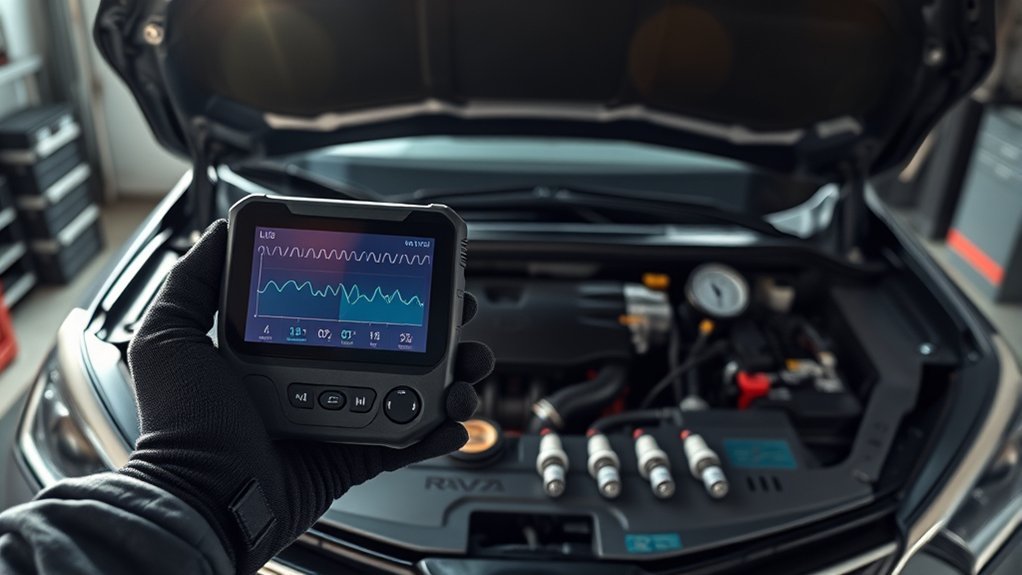
Start by watching the upstream O2 sensor: it should oscillate between rich and lean when the engine is healthy, while a stuck-rich reading indicates excess fuel. Then check fuel trims—long-term trims above +10% or persistent positive short-term trims confirm the ECU is adding fuel to compensate. Finally, inspect spark and ignition (spark plug fouling, weak spark) and verify intake airflow and fuel pressure to identify root causes of the rich condition.
O2 Sensor Behavior
If your RAV4 is consuming more fuel than expected, check the upstream O2 sensor voltage, fuel trim percentages, and spark plug condition to pinpoint a rich condition quickly. You’ll verify O2 sensor calibration by observing its voltage waveform: a steady high reading above 0.7V indicates excess fuel delivery or a failing sensor, while a healthy sensor toggles between ~0.1V and ~0.9V. Use live data to correlate fuel trim adjustment demands; trims should hover near 0%, with persistent positive corrections signalling enrichment. Inspect spark plugs for carbon fouling or blackening—these confirm incomplete combustion tied to richness. Regular scanning of O2 and trim values lets you act decisively, liberating you from wasted fuel and restoring efficient engine control.
Fuel Trim Readings
Building on O2 sensor waveform checks, you’ll use fuel trim readings to confirm whether the engine is running rich and to localize the cause. Use a scan tool to monitor upstream O2 voltage and both short-term (STFT) and long-term fuel trims (LTFT). A steady high O2 voltage plus negative STFT/LTFT indicates excess fuel versus available air. Fuel trim analysis quantifies the ECU’s corrective actions; values considerably below 0% show persistent over-fueling that hurts economy. Inspect spark plugs for fouling—dark, sooty deposits corroborate a rich mixture. Combine O2 feedback with trims to distinguish sensor, injector, vacuum, or fuel pressure faults. Apply targeted adjustment strategies: correct fueling sources, reset trims, then verify trims return toward zero for sustained liberation of performance and efficiency.
Spark And Ignition
When diagnosing a rich condition, focus on spark and ignition alongside O2 and fuel-trim data to separate true over-fueling from combustion or sensor-induced symptoms; you’ll correlate upstream O2 voltage swings (0.1–0.9V), STFT/LTFT trends, and plug appearance while confirming the MAF and ignition components are delivering correct inputs. Check the upstream O2 for consistent oscillation; a stuck high voltage or slow response suggests rich or sensor lag. Review LTFT >10% as evidence the ECU is adding fuel. Inspect plugs: sooty, wet deposits equal rich burn or misfire. Verify MAF accuracy with a scan tool. Test coils and spark plugs for spark efficiency and correct ignition timing; weak spark or timing errors cause unburned fuel, skewing O2 and trims. Replace faulty parts, then re-evaluate.
Check Exhaust & Emissions: CAT, Downstream O2, and Delete Signs
Although catalytic converter problems can be subtle, you should inspect the exhaust and emissions components early because CAT failure or tampering quickly degrades fuel economy and raises emissions. Check the catalytic converter for signs of removal, welding, or internal damage; a missing or modified CAT changes back pressure and can spike consumption. Watch for exhaust leaks at flanges, gaskets, or rusted sections—leaks upset the air-fuel mixture and sensor readings.
Monitor the downstream O2 sensor: if its waveform mirrors the upstream sensor, the CAT may be failing to attenuate oscillations. A P0420 code or persistent CEL often accompanies inefficiency and worsening MPG. Also consider restrictions or physical blockages that create excessive back pressure and reduce engine performance. Diagnose with live sensor data and smoke or pressure tests to locate leaks, deletions, or restrictions. You’ll restore efficiency by repairing leaks, replacing a compromised catalytic converter, or correcting tampering to reinstate proper emissions control and liberated, economical driving.
Check Tires, Brakes & Rear Differential for Drag and Noise
Because rolling resistance, brake drag, and driveline drag directly increase load on the engine, you should inspect tires, brakes, and the rear differential as a coordinated system when diagnosing poor fuel economy. Start with routine tire maintenance: check pressures against placard values and inspect tread for uneven wear. Underinflation raises rolling resistance; uneven wear signals alignment checks or suspension issues that steal efficiency. During brake inspection, look for seized calipers, collapsed hoses, or pad drag that cause continuous drag and heat build-up. Spin wheels with the vehicle lifted to feel resistance; compare sides for asymmetry. Listen closely for differential noise during low-speed turns and acceleration—groan, whining, or clunking often precede mechanical loss and higher parasitic drag. Perform visual and mechanical checks of differential seals, fluid level, and mounting for binding. Treat these systems collectively: addressing tire pressure, alignment checks, brake inspection, and early detection of differential noise reduces unjustified consumption and restores driving autonomy.
When to See a Mechanic: What Tests to Request and Expected Costs
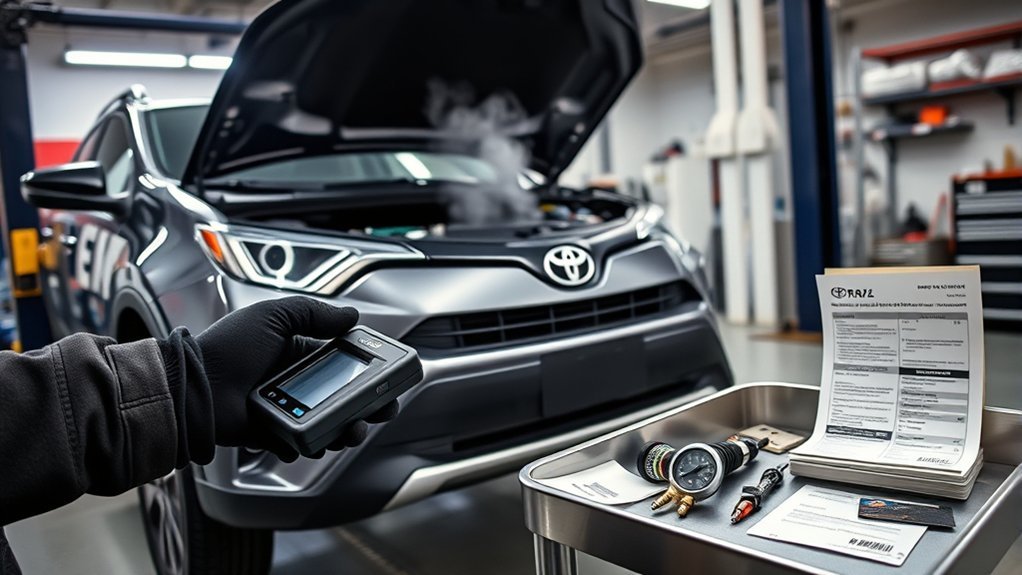
How should you proceed if your RAV4 is burning noticeably more fuel? You should see a mechanic promptly and request targeted diagnostic tests: an engine code scan ($100–$150) to pinpoint faults, plus a fuel pressure test ($50–$100) to evaluate pump or filter performance. Ask for oxygen sensor and mass airflow sensor inspections—failures cost $200–$500 to replace and degrade economy. Include an exhaust inspection for restrictions or removed catalytic converter (approx. $75–$150). Finish with tire pressure and alignment verification; basic maintenance runs $20–$50.
| Test/Check | Purpose | Typical Cost |
|---|---|---|
| Engine code scan | Identify ECU-stored faults | $100–$150 |
| Fuel pressure test | Verify pump/filter flow | $50–$100 |
| Sensors/exhaust/tires | Diagnose airflow, emissions, drag | $20–$500 |
Demand clarity from the shop, insist on documented results, and choose fixes that restore your RAV4’s efficiency and your freedom to drive without constraint.
Frequently Asked Questions
How to Fix Excessive Fuel Consumption?
You fix excessive fuel consumption by performing targeted fuel system maintenance: clean or replace filters, sensors, injectors, check tire pressure/alignment, and thermostat; follow practical maintenance tips so you regain control, efficiency, and liberation on the road.
What Is the Most Common Issue With the Toyota RAV4?
Most common issue: excessive fuel consumption. Like a leaking dam slowed town growth, faulty oxygen sensors and catalytic converter wear (engine problems) cut efficiency; you’ll follow maintenance tips, reclaim control, and liberate your driving economy.
Conclusion
You’ve gone from a smooth highway picture to a dashboard full of warning lights — that contrast tells the story. Don’t accept gradual decline: verify real MPG with a trip log, then apply quick fixes (tire pressure, reset, idle habits). If problems persist, run targeted diagnostics — fuel trims, O2 sensors, injectors, spark, exhaust backpressure, rear drag. Prioritize tests that isolate rich conditions; hand off to a mechanic when costs outweigh DIY time. Act promptly to restore efficiency.