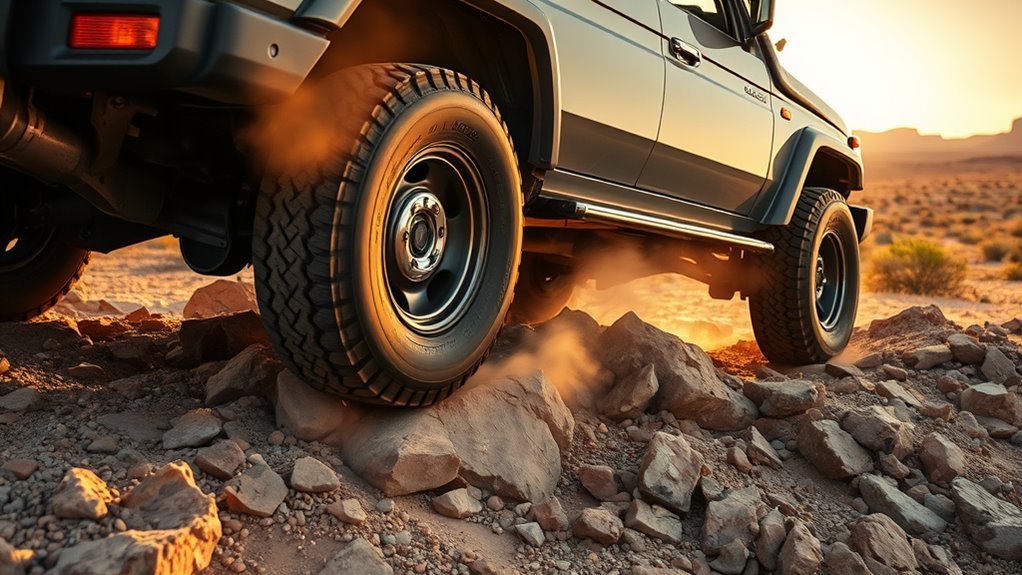
You’ll use A‑TRAC in your Land Cruiser to pulse brakes and redistribute torque at low speeds, giving predictable traction on mud, sand, snow and technical sections when the center diff is locked in 4LO. Shift into 4LO with center lock, keep rear locker off for modulation, and stay under about 7 mph with steady throttle around 1,200–2,200 RPM. It’s best for low‑speed traction recovery rather than extreme climbs, and more tactical guidance follows if you want to optimize use.
Quick: How to Use A‑TRAC-What It Does and When to Pick It
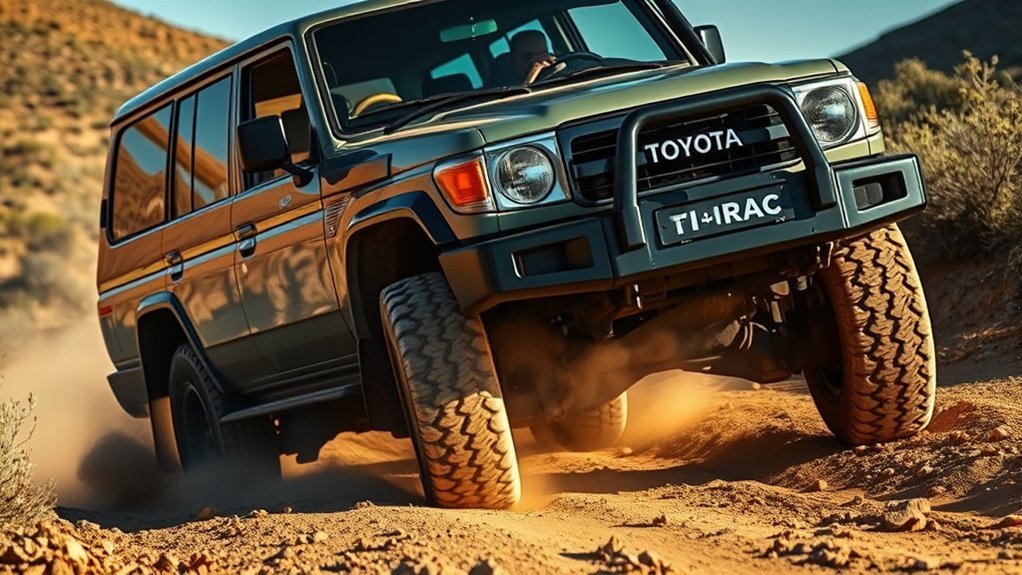
One key tool you’ll reach for on slippery trails is A‑TRAC, Toyota’s traction-control system that automatically redistributes torque to non‑slipping wheels when you’re in 4‑Hi, helping regain grip on mud or snow; you can also engage it manually in 4LO with the center differential locked and the transmission in manual “range 2” for more deliberate low‑speed work. You’ll use A TRAC benefits when traction loss threatens progress: it pulses braking to spinning wheels to send torque where it’s useful. In Off road scenarios you’ll prefer automatic 4‑Hi engagement for higher‑speed recoveries above about 5 mph, accepting modest momentum loss as brakes modulate. For deliberate extra grip, switch to 4LO/manual range 2; keep steady throttle—A‑TRAC is tuned for controlled inputs. Note its duty cycle: roughly 8–13 seconds of continuous operation before a cooldown and a flashing indicator. Evaluate each situation: choose automatic for brief slips, manual for sustained low‑speed extra traction and liberation from terrain that demands measured force.
Prepare Your Land Cruiser: Gears, 4LO Rules, and Speed Limits for A‑TRAC
Before engaging A-TRAC manually, make sure you shift into 4LO with the center differential locked, set the transmission to manual and select range 2, and confirm the rear diff-lock is off—this protects driveline components and lets the system modulate braking and engine output. Keep speeds under 7 mph and hold throttle between roughly 1,200–2,200 RPM to avoid overdriving the system or stalling; excessive or erratic throttle raises the risk of damage or getting stuck. Remember that A-TRAC can operate automatically in 4-Hi, but you should still manage gear choice and speed to maintain momentum and consistent tire engagement.
4LO Engagement Rules
When you’re preparing to engage A-TRAC in LO, put the transmission in 4LO with the center differential locked and switch the selector to manual mode set to “range 2”; do not engage the rear differential lock and keep speed under 7 mph for proper operation. Apply lo engagement strategies that prioritize controlled inputs and measured throttle to let all four tires contribute; A-TRAC’s lo engagement benefits include maintained momentum and reduced wheelspin in soft or technical terrain. Understand the system only monitors two wheels at once and shifts torque where slippage appears, so you’ll need to modulate steering and throttle for consistent grip. Watch the A-TRAC light—after 8–13 seconds of continuous use it may flash, signaling you must pause to cool the unit and avoid shutdown.
Gear Selection Tips
Now that you’ve got the basics of 4LO engagement down, gear selection becomes a tactical choice that directly affects A‑TRAC’s behavior and your vehicle control. You’ll choose gear engagement to match terrain adaptation needs: select 4LO with center diff locked and gear selector in range 2 to manually enable A‑TRAC without using the rear diff‑lock. In low range expect quicker, sometimes abrupt interventions; in high range expect smoother modulation. Keep speed conservative to let A‑TRAC work—under 7 mph generally, and under 5 mph in deep mud or sand. Avoid sudden throttle inputs that confuse the system.
- Use low range for maximum traction and sharper A‑TRAC response.
- Use high range for gradual control on slick surfaces.
- Match gear choice to terrain adaptation goals.
Speed Limits And Limits
Although A-TRAC delivers its best traction control in 4LO with the center diff locked and range 2 selected, you’ll need to respect strict speed and throttle limits to keep the system effective and prevent overheating. You should engage A-TRAC below 7 mph for manual activation, and keep pace under 5 mph during technical off-road moves; those speed thresholds let A-TRAC redistribute torque between two wheels at a time without thermal stress. Avoid heavy throttle—high input accelerates overheating and triggers a flashing A-TRAC light. Evaluate terrain, anticipate traction challenges, and modulate throttle to preserve system function and your freedom to press onward.
| Rule | Purpose |
|---|---|
| <5 mph | Ideal control |
| <7 mph | Activation ceiling |
| Light throttle | Prevent heat |
| Two-wheel limit | Torque management |
| Monitor light | System health |
How A‑TRAC Works and Which Trail Conditions Benefit Most
You’ll see A‑TRAC sense wheel slip and automatically redistribute torque to the wheels still gripping, so power keeps moving you forward in mud, sand, snow, or wet trails. It’s designed to work in 4‑Hi and shines at low speeds where steady throttle prevents excessive spin and lets the system modulate traction effectively. Be aware it’s less suited for high‑speed, steep climbs where its low‑speed bias and limited torque translation can reduce effectiveness.
How A‑TRAC Works
A-TRAC keeps your Land Cruiser moving by routing engine torque away from slipping wheels and applying brake pressure to those wheels so power is sent to the tires that still have grip. You’ll notice the system auto-engages when slippage is detected, redistributing torque in high and low ranges and modulating response by speed and terrain. It uses a timed cooldown (about 8–13 seconds) to prevent overheating. Assess A TRAC advantages and A TRAC limitations: it frees you from constant inputs but can struggle on steep, extreme off-camber climbs where lockers excel.
- You benefit from steady forward momentum in mud, sand, or snow.
- It clears tire lugs at low speeds for consistent bite.
- Expect reduced effectiveness on steep, uneven pitches.
Best Trail Conditions
When trails turn slick with mud, snow, or soft sand, you’ll see A‑TRAC shine by sending torque away from slipping wheels and applying brake pressure where it’s needed to keep momentum. You’ll find it most effective on varied trail surfaces and diverse terrain types — mud, snow, sand, and uneven rock fields — especially above 5 mph where automatic engagement prevents slip. At low speeds in 4‑Hi and 4‑Lo it modulates brake pressure to maintain control on steep climbs and descents, even when a tire lifts. Evaluate limitations: it can struggle on high‑speed steep climbs, where manual inputs or a rear locker may free you better. Use A‑TRAC to liberate forward motion; choose modes that match the trail to keep moving with confidence.
| Feeling | Function |
|---|---|
| Calm | Controlled torque |
| Bold | Momentum kept |
| Free | Traction regained |
| Safe | Slip reduced |
| Aware | Terrain read |
Step‑by‑Step: A‑TRAC Tactics for Mud, Sand, Snow, and Steep Climbs
Start by selecting the appropriate drive mode and engage the center differential lock before you approach the obstacle, since pre-engagement gives the system and drivetrain time to stabilize and prevents sudden traction shifts as conditions change. You’ll use A-TRAC’s automatic modulation differently depending on surface: for mud strategies stay in 4-Hi, keep throttle steady at 1,200–2,200 RPM to preserve momentum without excess wheel spin; for sand tips operate above 5 mph, avoid sudden throttle inputs so A-TRAC can clear lugs and distribute power; for snow tactics apply smooth throttle—A-TRAC will shift torque to gripped wheels to prevent abrupt braking; for climb techniques engage early and hold a consistent throttle, noting A-TRAC can limit performance if you accelerate too fast.
- Plan throttle and RPM ranges for each surface.
- Monitor system feedback to avoid overheating.
- Prioritize pre-engagement and steady inputs for control.
These steps free you to push terrain limits with measured confidence.
Combining A‑TRAC With Center Lock, Rear Locker, Crawl Control, and DAC
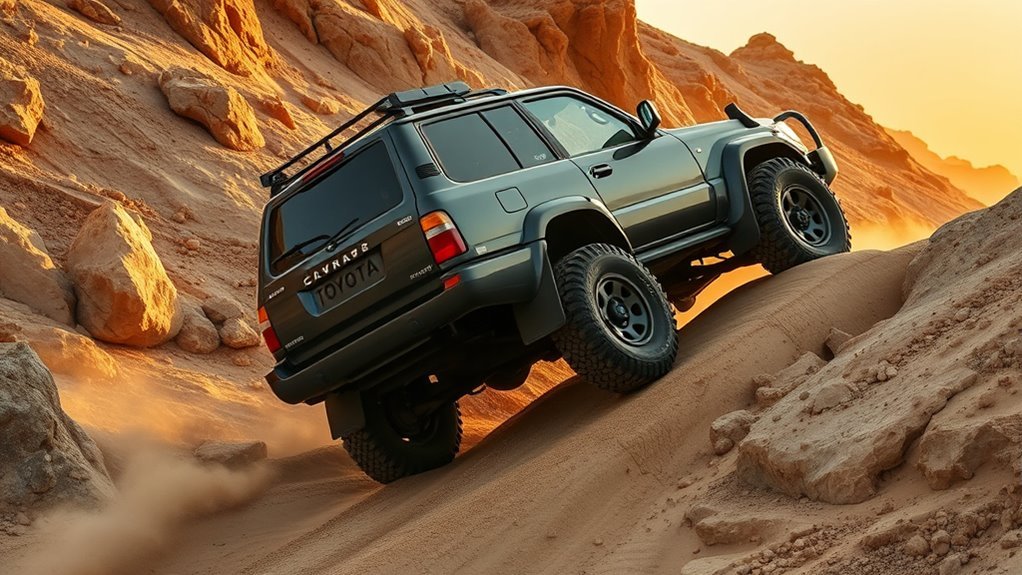
If you lock the center differential before tackling an obstacle and pair it with A‑TRAC you’ll get a more even torque split across the driveline, giving you predictable traction on flat or uphill sections while still allowing A‑TRAC’s wheel-by-wheel modulation to manage slipping wheels. You’ll find this synergy delivers A TRAC advantages: consistent power delivery, reduced wheelspin, and improved momentum through variable surfaces. Engage the rear locker when one axle needs brute force — combined control turns marginal traction into forward progress in deep mud or steep climbs. Use Crawl Control to hold a steady crawl speed while A‑TRAC meters torque to slipping wheels; it frees you to choose lines without constant throttle corrections. On descents, DAC maintains controlled speed and lets A‑TRAC redistribute torque away from unloaded wheels, enhancing stability. Be mindful of A TRAC limitations: it won’t replace mechanical traction in every scenario and can be overwhelmed if inputs or terrain exceed system thresholds. Apply systems selectively for maximum off‑road freedom.
Troubleshooting A‑TRAC: Symptoms, Cooldowns, and Avoiding Shutdowns
Although A‑TRAC is designed to intervene quickly to preserve traction, you’ll need to recognize its failure modes and give it proper cooldowns to avoid a shutdown. You’ll spot A TRAC overheating by a flashing A-TRAC light and clicking from the ABS unit; those are direct mechanical warnings that demand immediate moderation. Operate only with required conditions: 4LO, center diff locked, and manual gear selection. If the system shuts down, use smooth throttle to prevent wheelspin and further loss of control.
- Monitor for a flashing A-TRAC light and ABS clicking; these indicate imminent A TRAC overheating.
- Limit continuous A‑TRAC engagement to 8–13 seconds; sustain forward momentum and ease off the throttle to enact A TRAC cooldowns.
- If shutdown occurs, resume traction deliberately: gradual throttle, avoid sudden inputs, and re-engage only when temps normalize.
You’re liberating capability by respecting limits—diagnose, cool, and resume with precision to keep control and confidence.
Driving Techniques to Maximize A‑TRAC and Protect the Drivetrain
Drive deliberately to get the most from A‑TRAC while preserving the drivetrain: engage the system only in 4LO with the center differential locked and keep vehicle speed under about 7 mph, hold engine speed between roughly 1,200–2,200 RPM to minimize wheelspin, and approach obstacles at a slight angle (within a 35° arc) to maintain forward momentum without abrupt steering. You’ll combine traction techniques with disciplined throttle management to extract grip while protecting components. Use a steady, moderate throttle—avoid rapid inputs that heat clutch packs or trigger shutdown. Favor high range when conditions are slick but not extreme; it moderates torque transfer and reduces shock to CV joints and the front differential. Don’t let the front end bounce; that cyclic loading damages joints and predictably erodes traction. If you must stop, do so smoothly and reapply power progressively. Evaluate wheel slip visually and through pedal feel; back off when slip spikes. These habits free you to push capability without courting premature wear or system faults.
Frequently Asked Questions
Is the Land Cruiser Always in 4WD?
Yes—you’re always in full-time 4WD, though selectable 4WD modes and features like A-TRAC and center-lock adapt to driving conditions; you’ll evaluate traction needs and toggle systems for liberated, confident off-road control.
What Is the Trac off on a Land Cruiser?
You’ll find “Trac Off” disables traction control, liberating wheel spin like a thunderbolt, improving off road performance for mud, snow or rock crawling; evaluate risks, use cautiously, and re-enable on stable surfaces to preserve stability.
Conclusion
You’re now set to use A‑TRAC intelligently: engage it in low‑traction scenarios, keep speeds and gear choices within Toyota’s limits, and pair it with lockers or Crawl Control as conditions dictate. Remember that A‑TRAC can reduce wheel slip by up to 60% in measured tests, improving traction without driver intervention. Use conservative throttle, monitor system cooldowns, and avoid prolonged axle bind to protect the drivetrain—this preserves component life and keeps you moving on technical terrain.