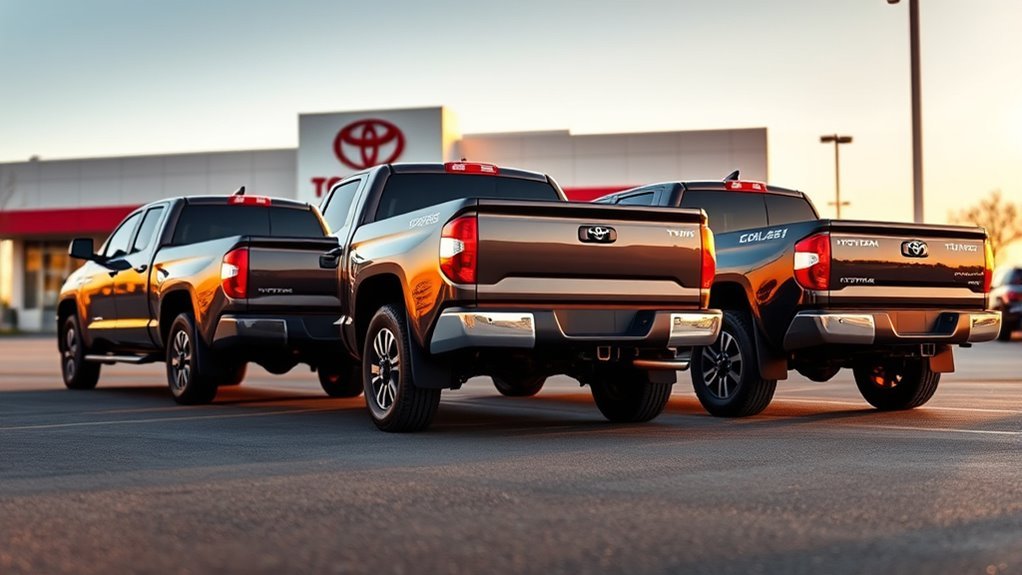
Pick the Tundra cab that matches how you work and ride: Regular Cab gives the longest beds (6.5 or 8.1 ft) and ~1,940 lb payload for heavy hauling; Double Cab balances 41.6 in rear legroom with 6.5 or 8.1 ft beds and up to 12,000 lb towing; CrewMax prioritizes passenger space (41.6 in rear legroom, ~138.7 cu ft interior) with 5.5 or 6.5 ft beds and ~10,340 lb max tow. Keep trim and hybrid availability in mind—more detail follows.
Quick Answer: Which Tundra Cab Should You Pick?
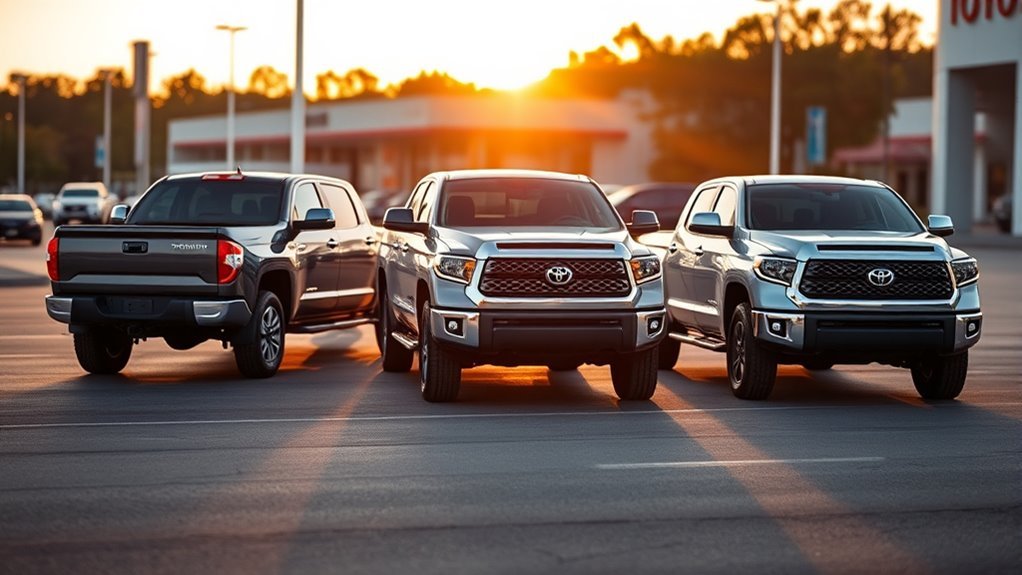
Wondering which Tundra cab fits your needs? You’ll base the decision on practical trade-offs: prioritize cargo length and a longer bed, pick the Double Cab (6.5- or 8.1-ft beds) to haul gear and still seat up to six; prioritize passenger space and liberated comfort, pick the CrewMax with 41.6 inches of rear legroom and a more generous rear cabin. Both share identical engine options and towing capacities, so performance isn’t a differentiator — that clarity simplifies cab comparisons to interior volume versus bed length. If you navigate tight urban streets or want easier maneuverability, the CrewMax’s shorter 5.5-ft bed reduces overhang without sacrificing power. Evaluate your routine: frequent long loads push you toward Double Cab; regular passenger transport pushes you toward CrewMax. Use tundra features as objective metrics—bed length, rear legroom, seating capacity—and make a choice that maximizes your mobility and autonomy without compromising capability.
Tundra Cab Options at a Glance (Regular, Double, CrewMax)
Three clear cab choices — Regular, Double Cab, and CrewMax — let you match the Tundra’s passenger and cargo geometry to your priorities. You’ll pick the Regular Cab when mission trumps comfort: a single seating row, simplified interior, and the longest bed option optimize payload and load management for work. The Double Cab balances crew transport and utility; it adds rear seating with four doors and accepts 6.5- or 8.1-foot beds, so you can carry people without surrendering significant cargo length. The CrewMax prioritizes rear-seat space—maximum legroom for family or crew—and pairs with 5.5- or 6.5-foot beds to preserve bed usability while freeing occupants. Across variants, Toyota preserves structural robustness, so safety and durability don’t trade off for your chosen layout. Use this CrewMax Comparison and Regular Cab overview to assert control over fitment, then match Tundra Bed Options to your work or freedom-oriented lifestyle with surgical precision.
Regular Cab: Bed Lengths, Payload, and Best Work Uses
When your workday demands maximum cargo real estate, the Tundra Regular Cab gives you two practical bed choices—6.5- and 8.1-foot—paired with a payload around 1,940 pounds and the 3.4L twin‑turbo V6’s 358 hp, so you can reliably haul heavy materials and tools without sacrificing performance. You get deliberate payload versatility: choose the 6.5-foot bed when you need balance between maneuverability and load, or the 8.1-foot bed when length is nonnegotiable. The Regular Cab’s minimalist cabin and lowered step-in profile improve cargo accessibility, speeding repetitive loading tasks and reducing friction on the jobsite. For contractors and construction pros who prize freedom from work compromises, this layout prioritizes utility—maximized bed area, straightforward tie-downs, and a powertrain tuned for consistent haulage. You’ll trade passenger count for uncompromised payload capacity and simple, purpose-built functionality, making the Regular Cab the clear choice when liberation from cabin clutter and focus on material movement matter most.
Double Cab: Rear Seat Space, Cargo Trade‑Offs, and Ideal Buyers
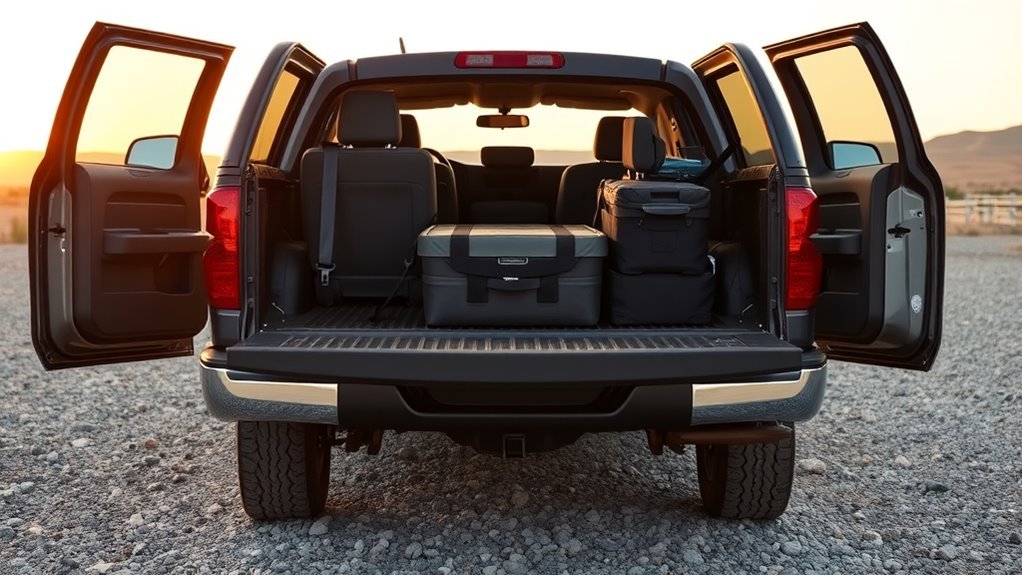
If you need adult-friendly rear seating without surrendering real bed length, the Tundra Double Cab delivers roughly 41.6 inches of rear legroom while still offering either a 6.5‑ or 8.1‑foot bed, giving you a clear trade‑off matrix between passenger comfort and cargo utility. You get genuine rear comfort for adults—seat space that doesn’t feel like an afterthought—while retaining serious bed options for work or play. Choose the 6.5-foot bed if you prioritize maneuverability; opt for the 8.1-foot bed when maximum load length matters. The Double Cab’s up-to-1,940-pound payload keeps it useful for tradespeople who need passengers and payload in one vehicle. For liberated buyers who reject compromises, this layout delivers functional duality: daily commuting with adult passengers and weekend or jobsite hauling. In short, the Double Cab is a precise solution for those who demand rear comfort and cargo versatility without converting the truck into a full-size crew carrier.
CrewMax: Interior Space, Family Comfort, and Long‑Trip Practicality
In the CrewMax you get 41.6 inches of rear legroom, so you’ll seat adults comfortably for extended drives without sacrificing shoulder or head clearance. The large rear doors and configurable bed lengths (5.5′ or 6.5′) let you balance passenger access with long-distance cargo needs. Add the 14-inch touchscreen and cabin storage, and you’ve got a practical package for family trips and organized, long-haul hauling.
Roomy Rear Seating
Space is the CrewMax’s strongest argument for family and long-trip practicality: with 41.6 inches of rear legroom and a total interior length of 233.6 inches, passengers get real stretch-out room and cargo flexibility. You’ll notice Rear Comfort immediately: rear headroom (36.9–38.5 in) prevents helmeting for taller occupants, while 62.4–65.0 inches of shoulder room keeps three abreast seating feasible without crowding. For Family Travel you get configurable amenities—optional leather and advanced multimedia—that reduce fatigue and maintain engagement. Analytically, the CrewMax shifts spatial constraints outward, turning typical truck cabin trade-offs into liberated utility: legroom, headroom, and shoulder breadth combine to prioritize occupant ergonomics and social space rather than just cargo-centric packaging.
Long‑Distance Storage
Because the CrewMax stretches interior volume to roughly 138.7 cu ft and gives you 41.6 inches of rear legroom, it turns the back seat into an active storage and comfort zone rather than just passenger space. You can reconfigure the rear folding seat to prioritize cargo management or recline it for restful family travel; both choices preserve utility. Cup holders and compartments let you stage essentials within reach, reducing stops and friction on long trips. The layout supports modular packing strategies, so gear, bags, and kid supplies coexist without compromise. You gain freedom to choose comfort or capacity instantly, optimizing for mission duration and passenger needs.
| Feature | Benefit |
|---|---|
| Folding seat | Expanded cargo floor |
| Recline | Enhanced comfort |
| Compartments | Organized essentials |
| Volume | Flexible staging |
How Cab Choice Changes Towing, Payload, and Bed Options
While your choice between the Double Cab and CrewMax may hinge on passenger needs, it also directly reshapes towing, payload, and bed options: you’ll weigh towing capacity against usable cargo length and interior space. The Double Cab is the workhorse—paired with the SR5 trim it achieves a max towing capacity of 12,000 pounds and offers 6.5‑ft or 8.1‑ft bed dimensions, so you keep long‑load capability without sacrificing towing grunt. The CrewMax prioritizes rear‑seat liberation—41.6 inches of legroom—while still towing respectably; Capstone models top out near 10,340 pounds. Payload capacity, importantly, stays consistent across both cabs with a 1,940‑pound maximum, so hauling heavy gear in the bed doesn’t penalize your cab choice. Choose Double Cab when maximum towing and bed length free you; choose CrewMax when cabin comfort and passenger freedom are nonnegotiable, accepting a shorter 5.5‑ft bed and slightly lower towing ceiling.
Which Trims Offer Which Cabs & Powertrains
Curious which trims line up with each cab and powertrain? You’ll find clear trim compatibility across the Tundra lineup: SR and SR5 let you choose Double Cab or CrewMax, giving you bed- and seat-layout freedom. Most higher trims—Limited, Platinum, 1794 Edition—are primarily CrewMax, prioritizing interior space. TRD Pro is CrewMax-only, engineered for off-road use with roomy rear seating. Capstone is the lone trim that won’t accept both cab types; it’s restricted in cab configuration compared with others.
Powertrain options are strategic: the hybrid powertrain is offered on Limited, Platinum, 1794 Edition, TRD Pro, and Capstone, so you can pair hybrid efficiency and torque with the trims that matter for capability or prestige. You’ll consequently match cab preference (Double Cab or CrewMax) against available trim compatibility and desired powertrain options to assemble a Tundra that balances liberated utility, on- or off-road intent, and drivetrain performance without unnecessary compromise.
Real‑World Decision Checklist: Pick the Right Cab for Your Budget and Use
Start by listing your priorities: bed length and payload, passenger space, towing needs, and budget constraints — then match them to the Double Cab or CrewMax. If you need work-ready payload (up to 1,940 lbs) and longer beds (6.5′ or 8.1′), the Double Cab is your pragmatic choice; it also enables the SR5 Double Cab’s top towing spec (12,000 lbs) when equipped. For passenger-first freedom, CrewMax’s generous rear legroom and comfort win, but accept the 5.5′ bed tradeoff.
Run a quick lifestyle evaluation: haul gear often? Lean Double Cab. Carry family or value in-cabin space? Choose CrewMax. Include cost considerations: longer beds and higher payloads can reduce options and affect trim pricing; CrewMax may cost more for equivalent equipment due to its interior focus. Prioritize the mission, balance towing and cargo mathematically, then select the cab that liberates your daily workflow without overpaying.
Frequently Asked Questions
What Are the Different Levels of Toyota Tundra?
You get SR, SR5, Limited, Platinum, 1794 Edition, TRD Pro, and Capstone. You’ll weigh Tundra powertrains and Tundra features—gas or hybrid, tech, luxury, and off-road tuning—to choose liberation through capability and comfort.
What Is the Difference Between a Toyota Tundra Crew Cab and Double Cab?
You’ll choose CrewMax for spacious rear seating and comfort, while Double Cab advantages prioritize longer bed utility and cargo flexibility; crew cab features emphasize passenger room, making the choice about freedom to carry people or payload.
Which Tundra Trim Is Most Luxurious?
The Capstone is the most luxurious trim; you’ll get top-tier luxury features and premium interior materials like semi-aniline leather and a 10-inch HUD, delivering refined comfort, advanced tech, and liberated driving confidence.
Conclusion
You’ve got clear tradeoffs: choose Regular for max bed and payload, Double if you need a balance of rear seats and cargo, CrewMax for passenger comfort and long trips. Match cab to how you work, tow and live—don’t buy blind. Factor trim and powertrain limits, then prioritize what you can’t live without. In short, pick the cab that fits your real use; it’ll repay you time and again, right down to the last mile.