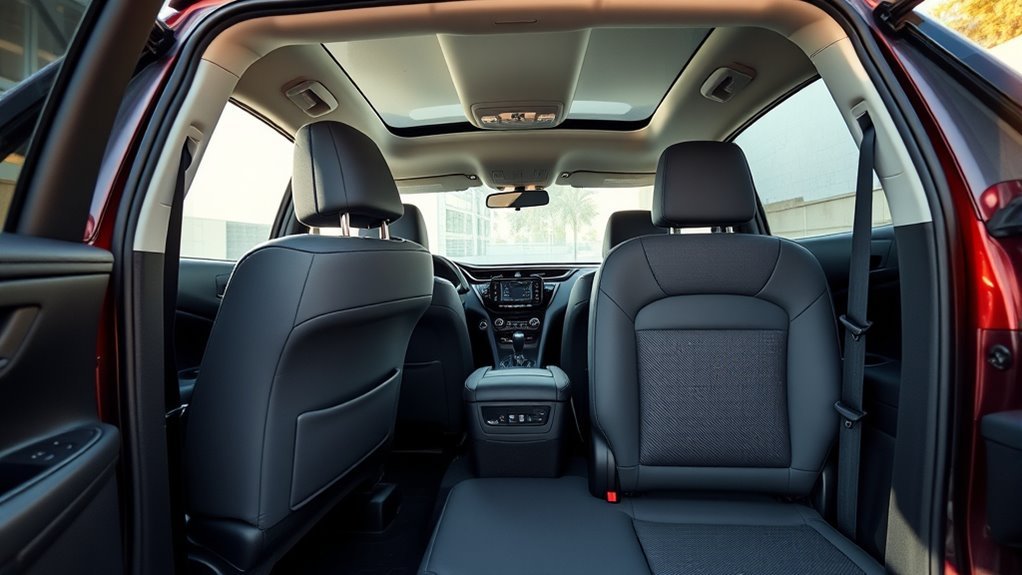
You’ll find the RAV4 gives roomy, ergonomic front and rear seating: 37.9 in. front headroom and 41.0 in. front legroom, plus 39.5 in. rear headroom and 37.8 in. rear legroom. Shoulder and hip dimensions support three adults across: front shoulders 57.8 in., rear shoulders 56.4 in.; front hips 54.3 in., rear hips 47.7 in. Cargo and split-fold seats preserve utility. Continue for trim, cargo and installation specifics.
RAV4 Interior Quick Specs (Headroom, Legroom, Cargo)
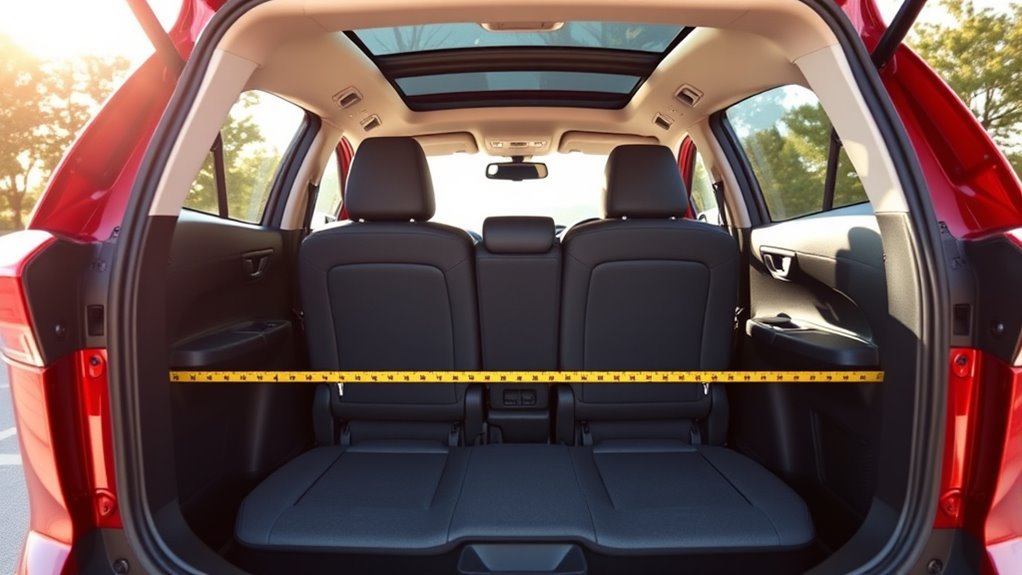
For a compact SUV designed around practical ergonomics, the RAV4 gives you 37.9 in. of front headroom and 41.0 in. of front legroom, while rear occupants get 39.5 in. of headroom and 37.8 in. of legroom. You’ll occupy a cabin with 98.9 cu ft of passenger volume that prioritizes movement and control—no wasted space, just usable room that frees you to travel long distances without constraint. The cargo bay behind the rear seats measures 37.8 cu ft, fitting daily gear, groceries, or modular storage crates. Fold the rear seats and you expand to 70.4 cu ft for larger loads, enabling tactical reconfiguration for trips or projects. Interior design centers on ergonomic sightlines, reachable controls, and configurable zones so you can adapt seating and cargo to intent. Storage solutions include deep door bins and a configurable cargo floor that you’ll leverage to organize equipment efficiently. The layout supports autonomy: you decide layout, load, and destination without compromise.
Front & Rear Dimensions: Headroom, Legroom, Shoulder, Hip
Having outlined overall passenger and cargo capacity, let’s examine the specific front and rear dimensional metrics that define occupant space. You’ll find the front row provides 37.9 inches of headroom, 41.0 inches of legroom, 57.8 inches of shoulder room and 54.3 inches of hip room. These measurements support upright posture, reduced contact stress, and predictable adjustability for diverse body sizes, translating into tangible seating comfort and clear dimension benefits during long drives.
In the rear, you get 39.5 inches of headroom, 37.8 inches of legroom, 56.4 inches of shoulder room and 47.7 inches of hip room, which lets three adults sit without lateral compression. The geometry balances torso clearance and pelvis support, minimizing fatigue and preserving freedom of movement. From an ergonomic standpoint, the combination of head, leg, shoulder and hip dimensions creates a liberated cabin layout that prioritizes human-centered spacing and functional accommodation across seating positions.
Passenger Volume & Seating: Comfort and Cargo Tradeoffs
Although the RAV4 prioritizes five-passenger comfort with a total passenger volume of 98.9 cu ft, it deliberately balances seating ergonomics against cargo needs: you get 41.0 in front legroom and 37.9 in front headroom for driver-centric control, while rear occupants have 37.8 in legroom and 39.5 in headroom for upright, liberated posture. This calibration delivers measurable passenger comfort without compromising cargo versatility; behind the rear seats you retain 37.8 cu ft of cargo, enabling daily utility while preserving seating ergonomics.
| Row/Seat | Legroom (in) | Headroom (in) |
|---|---|---|
| Front | 41.0 | 37.9 |
| Rear | 37.8 | 39.5 |
| Passenger Volume | 98.9 cu ft | — |
You’ll notice the design favors ergonomic support and modularity: seating layout keeps occupants centered and mobile, while fold-flat options (discussed later) expand cargo versatility when you need freedom to carry larger loads.
RAV4 Cargo Measurements: Seats Up vs. Folded
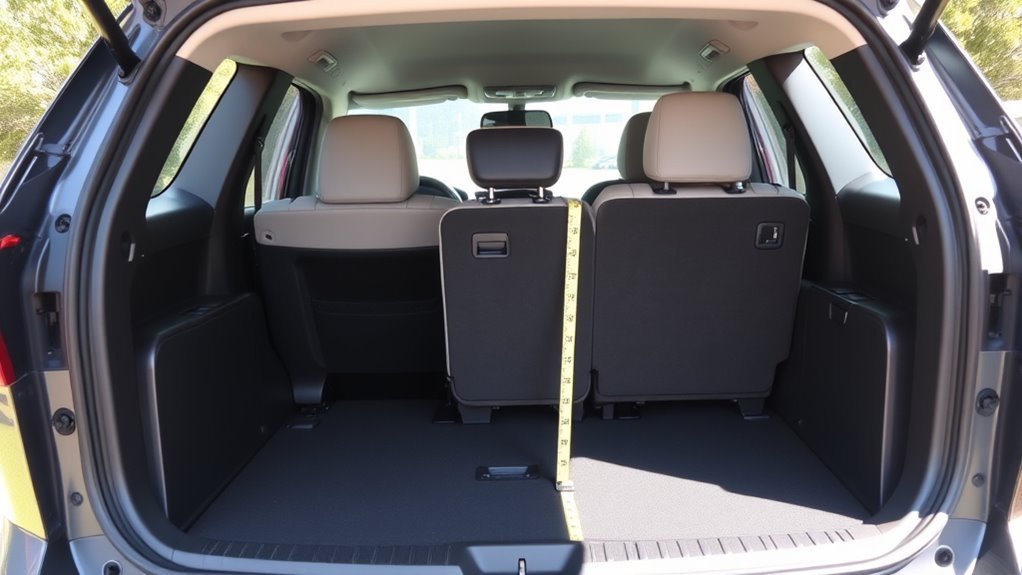
You’ll find 37.6 cu ft behind the rear seats and 69.8 cu ft with them folded, so plan loads based on those clear capacities. Use the 60/40 split-fold to combine passengers and long items efficiently. Note the ~34.5 in minimum cargo height and ~38.5 in width when arranging bulky or palletized gear.
Seats Up Cargo Volume
With 37.5 cubic feet of cargo space behind the rear seats, the RAV4 handles daily loads like groceries and gear without fuss; folding the 60/40 split seats expands usable volume to 69.8 cubic feet for larger items. You’ll rely on the seats-up configuration for routine tasks: upright seating preserves passenger capacity while giving you a predictable, flat cargo area with a low load floor that eases lifting. Use cargo organization to keep items stable—tie-down points secure loose loads and prevent shifting during transit. Loading tips: place heavy objects closest to the rear seatbacks, distribute weight evenly, and use smaller soft bags to conform to irregular gaps. The result is an ergonomic, liberated utility that minimizes effort and maximizes usable daily space.
Folded Seat Capacity
When you fold the RAV4’s 60/40 split rear seats down, cargo capacity increases from 37.6 cubic feet to 69.8 cubic feet, giving you a flat, low-load floor that simplifies loading heavier or bulkier items. You’ll use simple folding techniques to flip the seats and create a continuous load surface, preserving a passenger seat if needed. The low floor and tie-down points let you secure loads without improvisation, supporting efficient cargo organization and safe transit. This setup frees you to carry furniture, gear, or supplies with ergonomic ease and intentional control.
| Configuration | Capacity (cu ft) | Feature |
|---|---|---|
| Seats Up | 37.6 | Everyday cargo |
| Seats Folded | 69.8 | Flat, low-load floor |
Loading Dimensions & Tips
Although the RAV4’s cargo area measures 37.5 cu ft with the rear seats up and expands to 69.8 cu ft when folded, you’ll notice the low load floor and 60/40 split seats are the key ergonomic features that make loading and organizing items efficient. Use the seats-up configuration for daily freedom: groceries, bags, and gear sit low for easy access and balanced weight distribution. Fold one side of the 60/40 to carry longer items while retaining passenger capacity. When fully folded, the flat expanse accommodates bulky loads like furniture or bikes. Employ tie-down points and modular organizers for secure cargo organization. Adopt deliberate loading techniques—heavy items first, centered, and restrained—to maximize space, minimize movement, and preserve your autonomy on the road.
Trim Differences: Materials, Seats, and Comfort Features
Compare seating materials across trims to see how fabric, SofTex, and washable surfaces affect support, wear, and maintenance. Note comfort and tech differences—heated seats and steering, wireless charging, and audio/moonroof options—that change occupant ergonomics and usability. Use color and trim choices to match tactile preferences and interior contrast without compromising functionality.
Seating Materials Comparison
Because interior materials directly affect durability and comfort, you’ll want to match trim choice to your use case and ergonomic needs. Compare fabric vs. leather: LE’s fabric-trimmed seats prioritize breathability and low-maintenance wear for active lifestyles, while upgraded leather elements on SE add tactile refinement and targeted comfort features like heated front seats and a leather-wrapped steering wheel. XLE Premium’s SofTex delivers a durable, vegan-friendly surface with a balance of grip and cushion, suitable if you value easy care plus a premium feel. Woodland emphasizes practical easy-clean materials and a heated steering wheel for harsh conditions. Limited pairs upscale surfaces with acoustic and ambiance upgrades for long-haul comfort. Select trims offer custom blue or red-orange stitching to visually liberate your cabin.
Comfort & Tech Features
When you evaluate RAV4 trims for comfort and tech, focus on seat materials, climate controls, and integrated convenience systems that affect long-term ergonomics and usability. You’ll compare fabric LE seats and dual-zone climate to SE’s heated fronts and leather-wrapped wheel, XLE Premium’s SofTex, Digital Key, and wireless charging, Woodland’s easy-clean surfaces and heated wheel, and Limited’s moonroof plus nine-speaker JBL® audio. Prioritize interior aesthetics and tech integration that reduce fatigue and simplify tasks so you gain mobility and freedom.
| Trim | Key comfort & tech |
|---|---|
| LE | Fabric seats, dual-zone HVAC |
| SE | Heated fronts, leather wheel |
| XLE Premium | SofTex, Digital Key, wireless charge |
| Woodland | Easy-clean, heated wheel |
| Limited | Moonroof, JBL audio |
Real-World Fit: Child Seats, Three Adults, and Long Items
Although compact on paper, the RAV4 provides ergonomically efficient space: 37.8 inches of front and rear legroom and a 98.9 cu ft passenger volume let three adults sit without feeling cramped, while the 60/40 split-folding rear seat and 37.5 cu ft cargo area (expandable to 69.8 cu ft with seats folded) accommodate child seats and long items with minimal reconfiguration. You’ll find child seat installation straightforward thanks to accessible anchors and flat seat cushions; adult passenger comfort stays high for longer trips because legroom and passenger volume reduce positional strain. Use the flexible rear to prioritize cargo or seating without tools. Consider these real-world practices to maximize utility:
Although compact, the RAV4 offers roomy ergonomics and flexible 60/40 cargo space for family comfort and easy child-seat installation
- Place one child seat at the corner anchor, second inboard if needed.
- Fold the 40% section for longer items while keeping two passenger positions.
- Remove headrests or tilt rear seats to slide in bulky loads.
- Distribute weight low and centered to preserve handling and freedom.
The layout supports autonomy—seat and cargo decisions are yours to execute quickly.
RAV4 vs. CR‑V, Rogue, CX‑5: Dimension Comparison
If you prioritize usable dimensions over badges, the RAV4 presents a compact-but-efficient package: its 37.8 inches of rear legroom trails the CR‑V’s 40.4 inches, reducing rear-seat stretch for taller occupants, while its 37.6 cu ft cargo volume behind the seats is smaller than the Rogue’s 39.2 cu ft for daily hauling. You’ll find RAV4 advantages in front ergonomics: 57.8 inches of shoulder room exceeds the CX‑5’s 57.1 inches, giving you marginally wider positioning and easier ingress/egress. Rear headroom is competitive at 39.5 inches but doesn’t best the CX‑5’s 39.6 inches, so taller passengers may prefer the Mazda. At maximum capacity, 69.8 cu ft still lags the Rogue’s 74.1 cu ft when seats fold, highlighting a clear cargo trade-off. Weigh these RAV4 disadvantages against its overall packaging efficiency: if liberated mobility and balanced interior proportions matter more than absolute volume, the RAV4 remains a pragmatic choice.
Tips to Maximize Interior Space and Cargo Organization
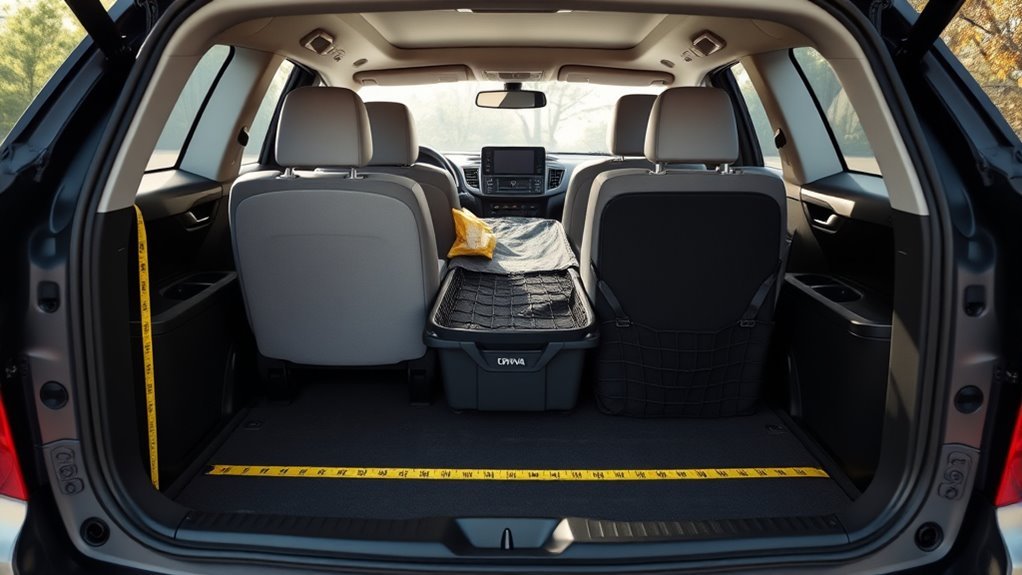
To maximize usable space and keep the cabin orderly, start by leveraging the RAV4’s 60/40 split-folding rear seats so you can carry long or bulky items without sacrificing every passenger seat. Use that flexibility to create flexible configurations that match tasks—fold one section for sports gear, fold both for large loads. Store frequently used items in the center console and door pockets to reduce cabin clutter and speed access. Secure cargo with tie-down points to prevent shifting and maintain vehicle stability.
- Fold 60/40 seats selectively to balance passenger needs and cargo length.
- Position heavy items low and forward in the cargo well for better balance.
- Use center console/door pockets for small essentials to preserve floor space.
- Attach straps to tie-downs to immobilize loose or irregularly shaped loads.
Adopt these ergonomic tactics to liberate space, streamline cargo organization, and sustain safety and comfort on every trip.
Frequently Asked Questions
What Are the Rav4’s Interior Dimensions?
Front row: 37.9″ headroom, 41″ legroom, 57.8″ shoulder, 54.3″ hip; rear: 39.5″ headroom, 37.8″ legroom, 56.4″ shoulder, 47.7″ hip; total passenger volume 98.9 cu ft, enhancing RAV4 cargo space and RAV4 interior features.
Conclusion
You’ll find the RAV4’s interior an efficient toolkit: ergonomic front seats and sensible rear space balance comfort and cargo like a Swiss army knife. Headroom and legroom stay generous up front, rear fit handles two adults comfortably or three in a pinch, while cargo volume shifts dramatically when you fold the seats. Trim choices tweak materials and support, but practical dimensions and smart storage make the RAV4 a compact workhorse that maximizes usable space.