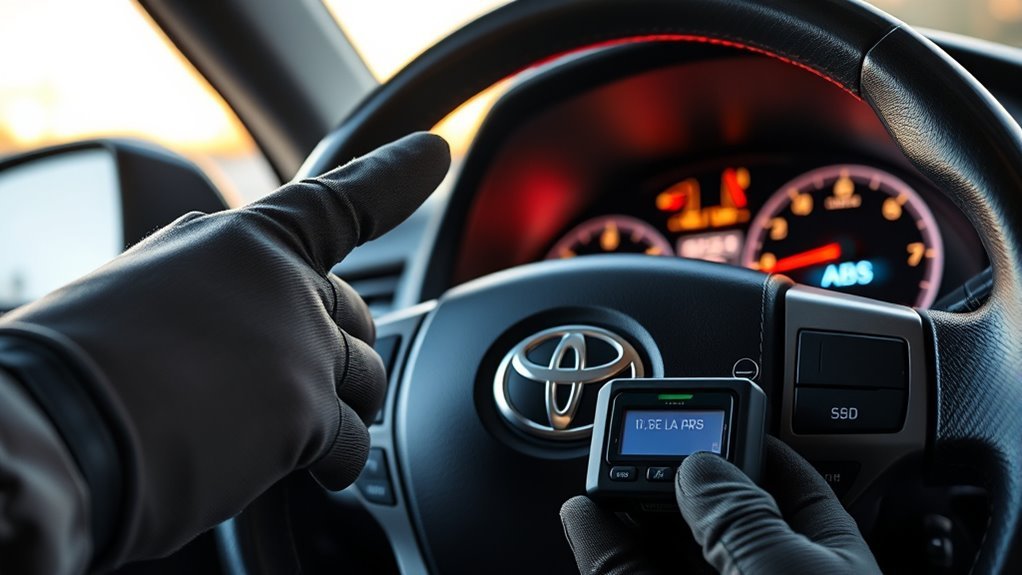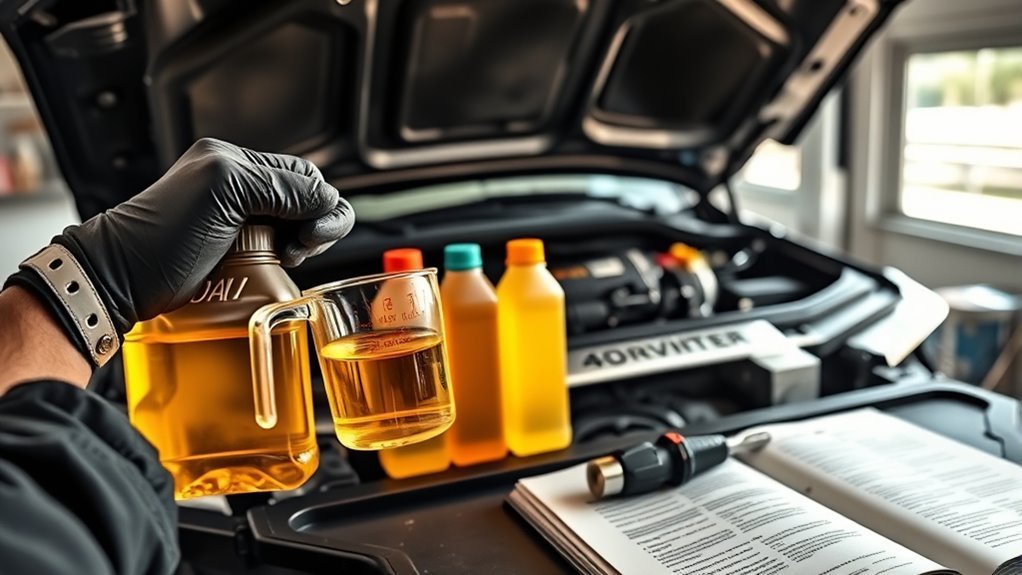
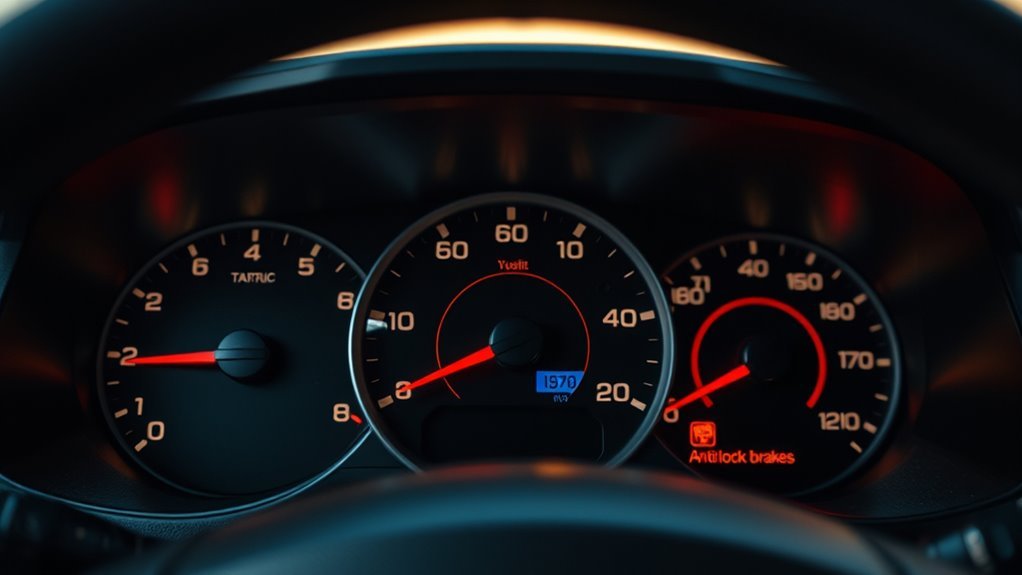
If your 4Runner shows VSC, TRAC, and ABS lights, don’t ignore them—you’ll lose stability and anti‑lock braking support. Start by checking brake fluid, tire pressure, and the stop‑light switch; perform a controlled battery reset and get ABS‑capable codes read (basic OBD2 won’t show traction/ABS faults). Common causes are wheel‑speed sensors, wiring, or calibration losses after battery work. Replace faulty parts or tow to a dealer for dealer‑level diagnostics to find the root cause and learn repair steps.
Quick Actions to Try Now for VSC/TRAC/ABS Lights

If one of the VSC, TRAC, or ABS lights comes on, start by checking the brake fluid level—low fluid commonly triggers these warnings—and verify the stop‑light switch is operating, since a faulty switch can falsely signal the ABS/VSC systems. You’ll confirm basic hydraulic integrity and eliminate a common electrical trigger quickly. Next, inspect wheel speed sensor wiring and connectors for damage or corrosion; worn sensors produce erratic inputs that engage the systems. Perform a controlled battery reset to clear transient faults, but don’t rely on it if lights return. If you’ve addressed fluid, stop switch, and visible sensor issues yet warnings persist, avoid solo improvisation: seek a qualified technician to prevent compromised braking performance. Maintain the braking system proactively—fluid condition, sensor cleanliness, and connector security—to reduce recurrence. These steps let you act decisively and reclaim control without needless dependency on dealerships for initial triage.
Read Codes: OBD2 vs ABS/Traction Scans (Free Scan Options)
You can read generic engine codes with any OBD2 scanner, but those readers often won’t access ABS or traction-control modules. For ABS/TRAC faults you’ll need a scanner that explicitly supports ABS codes—or you can use free scans at parts stores that offer ABS-capable tools. If you want full, dealer-level data, plan on a more advanced diagnostic tool tailored to your 4Runner.
OBD2 Scanner Limitations
Because many basic OBD2 scanners only read engine (powertrain) codes, you’ll often miss ABS and traction-control fault data unless the tool explicitly supports those modules. You need diagnostic tools that state ABS/traction support; scanner accuracy varies by protocol and model year. Free scans at parts stores usually cover generic OBD2 only, so they won’t liberate you from mystery ABS faults. For reliable troubleshooting, use a thorough scanner with ABS capability or seek pro service to prevent misdiagnosis and costly repairs.
| Tool type | ABS support | Notes |
|---|---|---|
| Basic OBD2 dongle | No | Engine-only DTCs |
| Mid-level reader | Sometimes | Limited ABS codes |
| Professional scanner | Yes | Full ABS/traction access |
Reading ABS Codes
One clear step when a 4Runner’s ABS or traction light comes on is to check for ABS-specific diagnostic trouble codes (DTCs), since standard OBD2 scanners often won’t see them and can miss sensor or ABS module faults. You’ll want a scanner that explicitly reads ABS/traction modules; OBD2 tools may show unrelated engine codes but not the wheel speed sensor or pump errors that trigger the ABS light. Many auto parts stores provide free ABS scans, so use that free resource to begin ABS troubleshooting. If codes remain unclear or intermittent, seek advanced diagnostic tools at a dealer or specialist for deeper module data and live sensor monitoring. Confirm your diagnostic tools support ABS protocols to avoid misdiagnosis.
How These Systems Work (Short Primer)
When stability, traction, or anti-lock braking intervene, your 4Runner uses sensor data and targeted braking or engine control to keep the vehicle controllable; you get coordinated intervention from VSC functionality, TRAC mechanics, and ABS modulation to preserve direction and momentum. You’ll rely on wheel speed, steering angle, and yaw rate sensors to tell the system when to act. VSC trims engine torque and applies differential braking to counter lateral motion. TRAC cuts power and brakes slipping wheels during acceleration. ABS pulses hydraulic pressure to prevent lock-up during heavy stops. If a fault appears, a warning light prompts inspection—don’t ignore it.
When VSC, TRAC, or ABS intervene, targeted braking and engine control keep your 4Runner steady—don’t ignore warning lights.
- You’ll feel selective braking when VSC corrects oversteer or understeer.
- You’ll notice reduced engine power when TRAC limits wheel spin.
- You’ll retain steering control under hard braking via ABS pulses.
- You’ll see lights when sensors or actuators report faults.
- You’ll need timely maintenance to keep systems reliable and liberating.
Quick Checks: Stop Light Switch, Brake Fluid, Tires
If a dashboard lights up, start with three quick checks you can do yourself: the stop light switch, brake fluid level, and tire pressure. You’ll first inspect the stop light switch at the pedal—faulty switches can trigger VSC, TRAC, and ABS warnings and cause intermittent illumination; replace promptly if contacts fail. Next confirm brake fluid is at the correct mark; low brake fluid turns on the red brake warning light, can also bring on the amber ABS and VSC/TRAC indicators and a buzzer, and risks brake failure—top with spec-correct fluid and inspect for leaks. Finally measure tire pressure; underinflation alters traction sensing and can activate stability warnings. These steps empower you to act immediately and safely, reducing dependence on towing or service delays.
| Check point | Symptom if bad | Immediate action |
|---|---|---|
| Stop light switch | Intermittent warnings | Inspect/replace switch |
| Brake fluid | Red brake light, ABS/VSC, buzzer | Top/inspect for leaks |
| Tires | Traction warnings | Inflate to spec |
Common Causes and How to Interpret the Codes
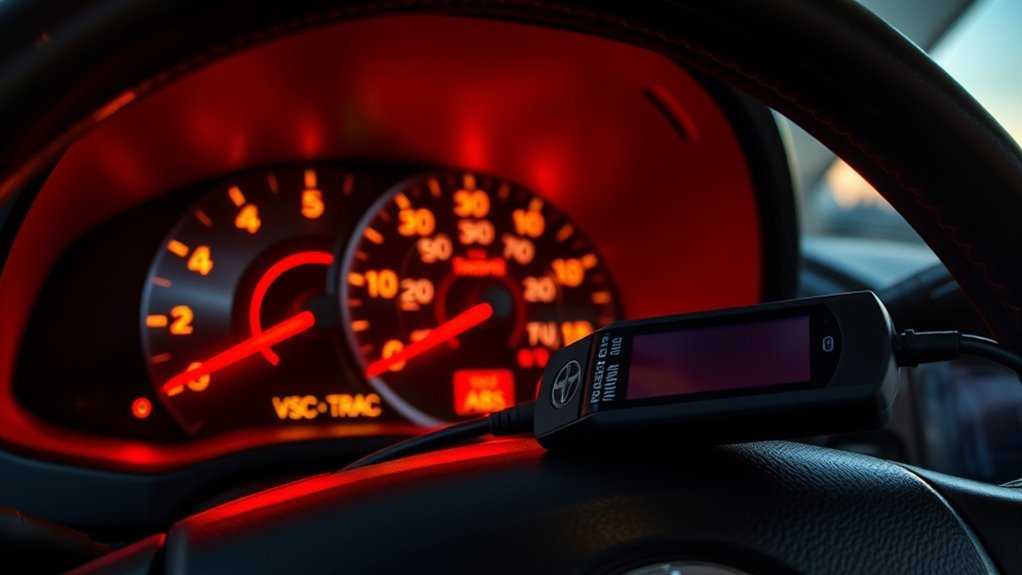
Because multiple systems share sensors and inputs, a single fault can light VSC, TRAC, and ABS simultaneously, so you’ll need targeted diagnostics rather than guessing. Scan for DTCs with proper ABS-capable equipment; generic readers can miss wheel-speed or ABS-specific codes. Interpret codes against the ECU map: wheel-speed faults point to faulty sensors, stop‑light switch errors indicate brake input communication loss, and calibration codes suggest lost zero point after battery work or mods.
A single fault can trigger VSC/TRAC/ABS together—scan with ABS-capable tools and fix the root cause, not symptoms.
- P0300-style vs ABS-specific: use specialized scanner to distinguish.
- Low brake fluid triggers ABS light and can cascade to VSC/TRAC—inspect for leaks.
- Faulty sensors (wheel-speed) commonly fail off-road; compare signals between wheels.
- Stop-light switch faults disrupt brake logic; check connector integrity before replacement.
- Calibration codes mean you’ll need zero-point recalibration rather than parts swaps.
Follow code logic: fix the root cause, not the symptom, to reclaim control and safety without needless parts changes.
Step‑by‑Step Repairs & DIY Calibrations You Can Try
Start with basic, verifiable steps you can perform yourself: park the 4Runner on level ground, verify brake fluid level and condition, inspect visible brake lines and wheel sensors for damage, and use an ABS-capable OBD2 scanner to read and record all stored codes before clearing anything. Then follow targeted repairs: replace a faulty stop‑light switch, repair leaks, or swap a damaged sensor. For an ECU reset, try a battery disconnect for several minutes to clear temporary faults, then reconnect and recheck codes.
Apply manufacturer calibration techniques when codes indicate lost zero‑point or steering angle discrepancies; follow exact steering angles and ignition sequences. After repairs, confirm with the scanner and perform system checks by driving at low speed.
| Task | Tool | Outcome |
|---|---|---|
| Read ABS codes | ABS OBD2 scanner | Diagnostic data |
| Reset ECU | Battery disconnect | Clears temp codes |
| Recalibrate SAS | Steering inputs | Restores zero point |
Document each step to preserve autonomy and guarantee repeatable, reliable results.
When to Stop Driving and What the Dealer Will Diagnose
If the VSC, TRAC, or ABS light comes on and you notice unusual brake feel, noises, or loss of stability, stop driving immediately and park safely. Continuing to drive can worsen system faults and risk control loss, so you’ll want a dealer to read the stored trouble codes quickly. The dealer will inspect sensors, switch inputs, brake fluid level and related wiring to pinpoint the fault and recommend repairs.
Immediate Stop Conditions
When the ABS light comes on along with VSC and TRAC, you should stop driving immediately, as this combination often signals a compromised brake system and disabled traction control that can leave you unstable in slippery conditions. You’ll prioritize brake safety and heed warning signals: a buzzing ABS alarm or fading brake feel means stop now. Don’t risk continued travel; stability aids may be off and braking performance can be unpredictable.
- Pull over safely, park, and shut the engine to assess.
- Check brake fluid level if you can access it safely.
- Listen for buzzing or abnormal noises indicating a leak.
- Avoid driving in wet or slick conditions until fixed.
- Arrange tow or dealer service; do not ignore these warning signals.
Dealers use OBD ABS code readers to confirm faults—get it inspected.
Dealer Diagnostic Steps
After you pull over and shut the engine as described above, have the vehicle towed or driven directly to a dealer for a targeted diagnostic check; don’t keep driving with VSC, TRAC, or ABS illuminated. You’ll want dealer expertise because factory diagnostic tools read ABS/traction control codes that generic scanners miss. The dealer will scan system modules, log trouble codes, and inspect brake fluid level, stop light switch operation, and wheel speed sensors for faults or wiring damage. If multiple warning lights are on without CEL illumination, they’ll prioritize traction and ABS fault trees instead of engine diagnostics. You should insist on a documented code printout and recommended repair scope. Prompt dealer inspection prevents escalation, preserves your freedom to drive safely, and guarantees repairs follow manufacturer specifications.
Frequently Asked Questions
What Does It Mean When the ABS and VSC Light Come On?
It means your brake system has detected faults; warning indicators for ABS and VSC signal reduced anti‑lock and stability control functionality. You’ll want diagnostics immediately, since safety systems may be compromised and need repair.
Why Is My ABS Brake Light and Traction Control Light on Toyota?
Your ABS brake light and traction control light are on because the brake system detected faults—like a bad stop light switch, low fluid, lost calibration, or wheel sensor failure—so warning indicators tell you to run diagnostics and regain control.
What Does It Mean if My Traction Control and ABS Lights Are On?
It likely means a traction control issue and ABS malfunction causes are present; you should assume system faults (sensors, stop light switch, low fluid) and scan for codes, then repair to restore safe, liberated driving.
Conclusion
If your 4Runner lights up VSC, TRAC and ABS, act quickly: read codes, check stop‑light switch, fluid and tires, then follow targeted repairs or calibrations. Many of these warnings trace to sensors, wiring, or the stop-light switch, so you can often fix them without major parts. You’ll save time by using an OBD2 + ABS scanner, but stop driving if braking feels compromised. Let a dealer diagnose complex modulators or hydraulic faults.