Last updated: September 14, 2026. This guide was updated to clarify R-134a versus R-1234yf compatibility, remove universal pressure targets, add current U.S. refrigerant-handling guidance, and separate a limited DIY top-off from a complete professional evacuation and recharge.
A Toyota 4Runner AC recharge should begin with one check: read the air-conditioning label under the hood and confirm the exact refrigerant type and specified charge before connecting any equipment. Do not assume every 4Runner uses R-134a. Earlier 4Runner systems commonly use R-134a, while Toyota service information for the redesigned 2025 4Runner specifies R-1234yf. Never mix refrigerants, oils, fittings, or service equipment between the two systems. If the system is empty, has a significant leak, or shows abnormal pressures or compressor behavior, stop adding refrigerant and have the system diagnosed, recovered, evacuated, and recharged to specification.
Quick Diagnosis & Should-I-DIY Checklist
Weak cooling does not automatically mean your 4Runner needs refrigerant. A refrigerant leak, restricted cabin airflow, condenser airflow problem, blend-door fault, electrical problem, or compressor issue can produce similar symptoms. If you need broader diagnosis before touching the refrigerant circuit, see the 4Runner AC not-cold troubleshooting guide.
| What you find | Best next step |
|---|---|
| Refrigerant type or charge amount is unknown | Read the under-hood A/C label before buying refrigerant or connecting equipment. |
| Cooling is slightly weak but the system still operates | Check airflow, vent temperature, condenser condition, visible leakage, and system pressures before assuming it is low. |
| System is completely empty or pressure is extremely low | Do not simply refill it. A substantial leak may be present; professional leak diagnosis and evacuation are appropriate. |
| Refrigerant repeatedly becomes low | Locate and repair the leak instead of repeatedly topping off the system. |
| Pressure readings are abnormal or compressor operation is erratic | Stop charging and diagnose the system rather than adding more refrigerant. |
| Correct refrigerant is confirmed and the system is only slightly low | A careful owner-level top-off may be possible if the refrigerant product and vehicle instructions permit it. |
Start with simple checks. Set the A/C to its coldest setting and verify that airflow from the vents is strong. Inspect the cabin air filter if airflow is weak. Look through the grille at the condenser for heavy debris or obvious damage. Check accessible refrigerant lines, fittings, the compressor area, and service ports for oily residue or visible dye that may indicate leakage.
A hissing sound by itself does not prove the system is low. Likewise, a compressor that does not engage can have electrical, pressure-control, or mechanical causes. Use symptoms as clues, not as proof that refrigerant must be added.
[Products Worth Considering]

The OEMTOOLS coolant vacuum refill kit helps quickly refill a vehicle’s cooling system while removing trapped air that can lead to overheating and engine damage. It also performs vacuum leak tests to help confirm system integrity and reduce the chance of repeat repairs. With multiple bushings, adapters, and a tapered cone seal, it is designed for flexible use on many radiator and coolant bottle necks.

AutoLine Pro HyperSmoke is a professional automotive smoke tester designed to quickly find EVAP, vacuum, intake, boost, exhaust, and other leak sources with thick visible smoke. It features adjustable pressure, built-in air compressor motor, instant warmup, and OEM approved smoke fluid for safe, accurate diagnostics across a wide range of vehicles and systems. The kit includes essential accessories and is backed by a full coverage warranty for dependable shop or garage use.

This all-in-one radiator pressure tester and vacuum refill kit helps diagnose cooling system leaks, measure temperature, and refill coolant efficiently. It includes a wide range of adapters for broad vehicle compatibility, plus a pressure tester, vacuum refiller, thermometer, and storage case for organized use. Designed for DIY mechanics and professionals, it simplifies coolant service while reducing guesswork and unnecessary repairs.
Check Refrigerant, Tools, PPE & Legal Requirements
Read the vehicle’s A/C label first. It identifies the refrigerant intended for that vehicle and normally gives the specified charge. R-134a and R-1234yf use different servicing requirements and should never be mixed. R-1234yf is mildly flammable and requires compatible equipment and fittings.
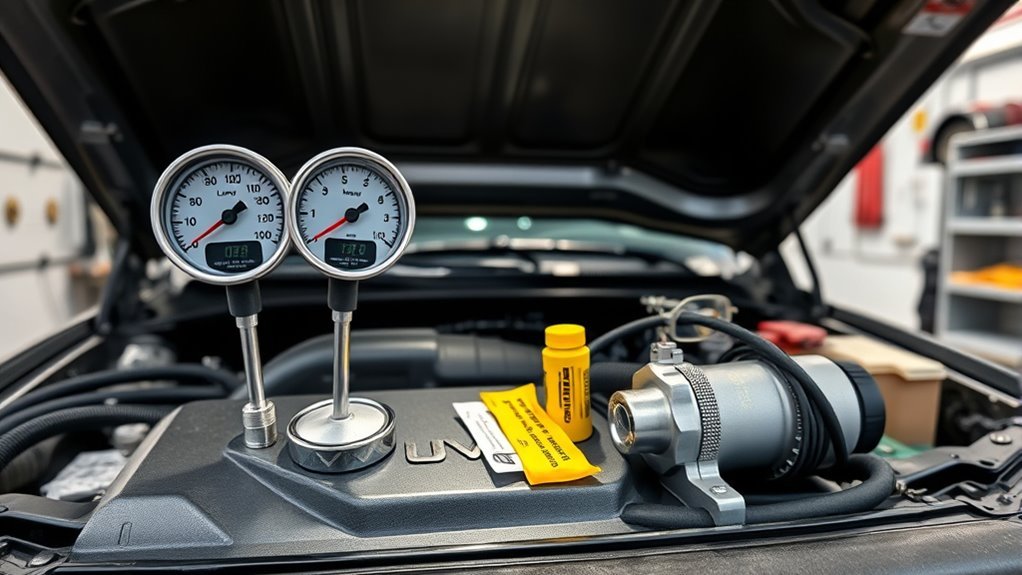
For basic diagnosis, useful equipment includes safety goggles, suitable gloves, a vent-temperature thermometer, and refrigerant-compatible pressure gauges or service equipment. A complete evacuation and recharge requires additional recovery, vacuum, leak-testing, and charging equipment and should not be treated as the same job as adding a small amount of refrigerant to a functioning system.
Wear eye and hand protection whenever connecting or disconnecting refrigerant equipment. Escaping liquid refrigerant can cause cold burns or eye injury. Work in a well-ventilated area and keep ignition sources away from systems using R-1234yf.
For U.S. owners, the EPA prohibits intentionally venting refrigerant during motor-vehicle A/C servicing. Small cans of qualifying MVAC refrigerant containing two pounds or less and fitted with required self-sealing valves can be sold for DIY vehicle use without technician certification. Anyone servicing a motor-vehicle A/C system for compensation must meet the applicable EPA Section 609 certification requirements.
Do not release refrigerant to lower a gauge reading. If refrigerant must be removed, it should be recovered with suitable equipment.
How Do You Check a 4Runner AC for Refrigerant Leaks?
A refrigerant system is closed, so repeatedly losing charge indicates leakage. EPA guidance notes that topping off may temporarily restore cooling but does not permanently repair a leak. Repairing or replacing the leaking component provides the longer-lasting solution.
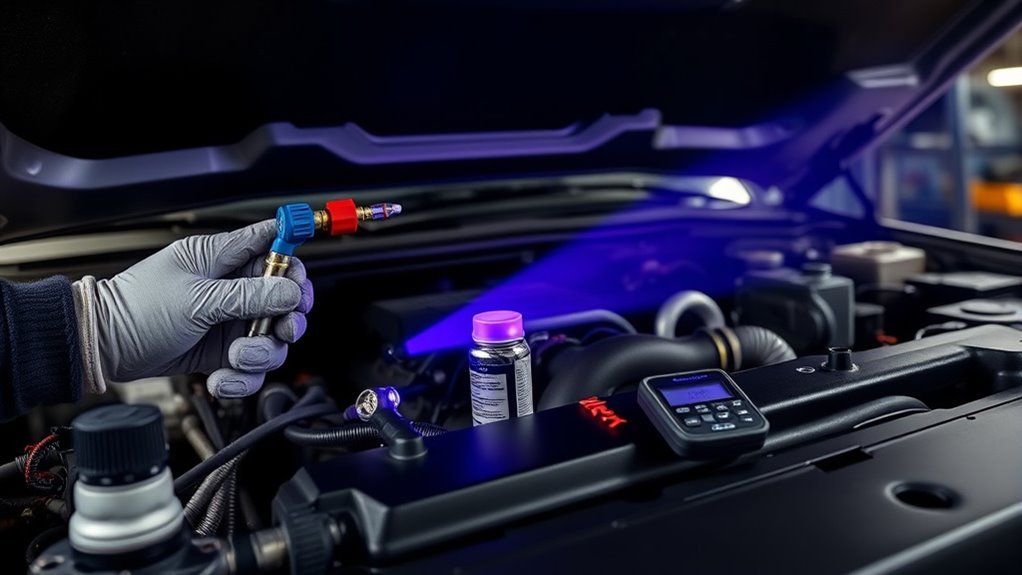
Begin with a visual inspection. Look for oily residue around hose crimps, fittings, the compressor, condenser, and service ports. If approved fluorescent dye is already present, inspect suspected areas with the correct UV light. Do not automatically add extra dye to every system; use only a refrigerant-compatible product and follow its instructions.
A mild soap solution can help reveal some accessible leaks at fittings or service connections when sufficient pressure is present, but it will not reliably expose every slow or hidden leak. An electronic detector compatible with the vehicle’s refrigerant can locate smaller leaks around joints, components, and accessible evaporator areas.
Dry-nitrogen pressure testing, evacuation, refrigerant recovery, and diagnosis of a system that has lost its entire charge are better treated as professional procedures. They require regulated service equipment, careful pressure control, and knowledge of the specific system.
If a leak is confirmed, repair it before repeatedly adding refrigerant. Recharging a leaking system may restore cooling temporarily while allowing the same problem to return.
How to Recharge a Toyota 4Runner AC Safely
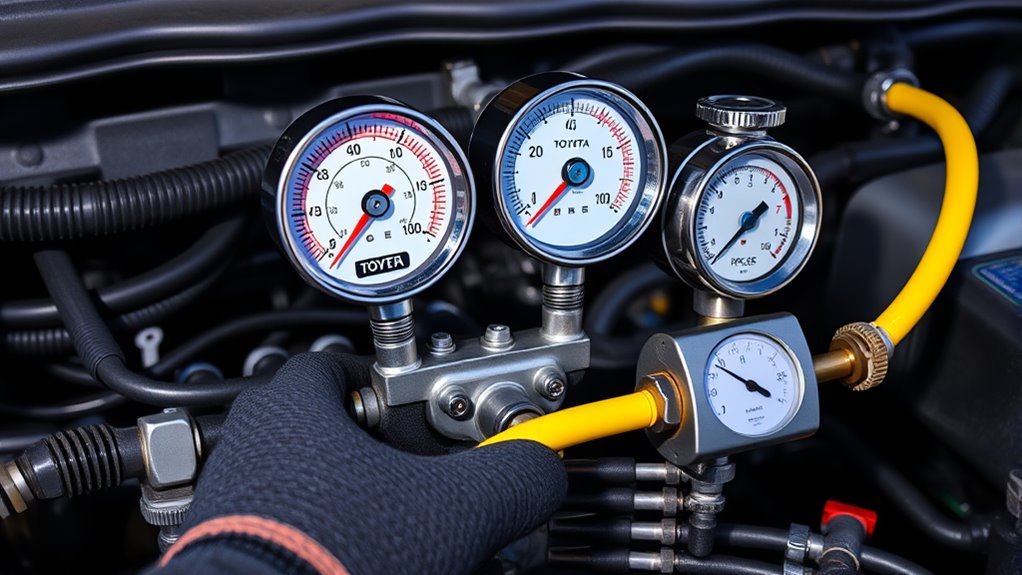
There are two very different jobs commonly called an “AC recharge”: adding a limited amount of refrigerant to a functioning but slightly low system, and performing a complete recovery, evacuation, leak check, and measured recharge. Do not treat them as interchangeable.
[Products Worth Considering]

This AC valve core removal and installer set is designed for efficient servicing of automotive and HVAC refrigerant systems. It includes high- and low-pressure quick connectors with ball valves to help reduce refrigerant leakage during valve core replacement. Built with durable brass, stainless steel, and aluminum components, it offers reliable grip, easy operation, and broad compatibility for air conditioning maintenance and repair.

This dial type tire tread depth gauge helps you quickly check tread wear on motorcycles, cars, trucks, and buses with easy-to-read 1/32-inch increments. Its colorful zone markings make it simple to assess tire condition for safer driving in different weather, while the durable zinc cast body and legible dial provide dependable everyday use.

This Yuirote universal car motor diagnostic tool helps drivers quickly detect engine fault codes and identify system issues for routine inspections and maintenance. It also supports electronic parking brake reset and emergency release functions, making it useful for handling EPB-related problems without a repair shop visit. Its compact, ergonomic design and broad vehicle compatibility make it a practical choice for car owners and DIY repair enthusiasts.
1. Confirm the Refrigerant Type
Read the under-hood A/C label before connecting anything. Toyota service information for older 4Runner applications includes R-134a systems, while the redesigned 2025 4Runner uses R-1234yf. The label on your specific vehicle is the controlling reference.
Do not put R-134a into a system labeled R-1234yf or vice versa. Do not defeat unique service fittings or substitute an unapproved hydrocarbon refrigerant.
2. Check Whether a Recharge Is Actually Appropriate
If the system is completely empty, has recently been opened for component replacement, rapidly loses refrigerant, or has obvious physical damage, a simple top-off is not appropriate. The leak should be diagnosed and repaired, and the system should then be evacuated and charged with the specified refrigerant amount.
If cooling is only moderately weak and testing indicates the system is slightly low, follow the vehicle service information and the instructions supplied with the correct refrigerant equipment.
3. Understand Static and Running Pressure
Static pressure is checked with the compressor off and the refrigerant pressures allowed to equalize. Running pressure is measured while the system operates under defined conditions. They are not the same measurement.
Do not use one universal high-side or low-side pressure number as the charging target for every 4Runner. Pressure changes with ambient temperature, refrigerant type, condenser airflow, compressor operation, engine speed, humidity, and system design. Gauge readings are primarily diagnostic information.
4. Use the Low Side for an Approved Owner-Level Top-Off
For a compatible DIY topping-off product, identify the low-pressure service port according to the vehicle and product instructions. Never attach a simple charging can to the high-pressure service port.
Connect the equipment exactly as its manufacturer specifies. Keep the refrigerant container oriented as directed by that product. Purge or prepare the hose only as instructed and avoid unnecessary refrigerant release.
Add refrigerant gradually rather than trying to force a full can into the system. Allow the system to stabilize between additions and monitor its behavior. Stop if pressures become abnormal, the compressor behaves erratically, the high side rises excessively, cooling does not improve, or you are no longer certain how much refrigerant is present.
5. Prefer the Specified Charge by Weight for a Full Recharge
The most accurate complete recharge starts after the remaining refrigerant has been properly recovered and the system has been evacuated and checked for integrity. The correct refrigerant is then charged according to the amount specified by Toyota for that exact vehicle.
This is why a universal instruction such as “charge until the high side reaches 190–230 psi” is not appropriate. A correct refrigerant mass and normal system operation matter more than chasing one pressure number.
6. Verify Cooling After Service
After charging, verify that vent temperature improves, airflow remains strong, compressor operation is normal, and there are no obvious signs of leakage. A vent thermometer provides a useful before-and-after comparison, but the expected outlet temperature depends on ambient conditions, humidity, airflow, and operating mode.
If the system becomes warm again shortly after charging, do not continue adding refrigerant. Find the leak or underlying fault.
Troubleshooting, Costs, Maintenance Tips & When to Call a Pro
Call a professional when the system is empty, the refrigerant type is uncertain, a substantial leak is present, recovery is required, pressure readings do not make sense, the compressor makes abnormal noise, or cooling remains poor despite an apparently correct refrigerant charge.
Also stop DIY work if the system has been contaminated with the wrong refrigerant or another substance. The EPA warns against using unapproved hydrocarbon products marketed as replacements for R-134a or R-1234yf in vehicle systems.
Professional service normally includes more than simply adding a can. A technician can recover the existing refrigerant, determine how much was removed, inspect for leaks, evacuate air and moisture, verify system integrity, and recharge the exact specified amount.
As of August 2026, RepairPal estimates an average Toyota 4Runner AC recharge at about $269–$351. Actual cost can change with model year, refrigerant type, location, labor rate, leak diagnosis, and any failed components.
For maintenance, keep the condenser free of heavy debris, maintain the cabin air filter, and investigate a noticeable loss of cooling instead of routinely adding refrigerant. Do not replace the receiver/drier on an arbitrary schedule; replace it when the applicable repair procedure, contamination condition, or system-opening procedure calls for it.
Frequently Asked Questions
What Refrigerant Does a Toyota 4Runner Use?
The correct refrigerant depends on the model year and A/C system. Earlier 4Runner systems commonly use R-134a, while Toyota service information for the redesigned 2025 4Runner specifies R-1234yf. Always use the refrigerant listed on your specific vehicle’s under-hood A/C label.
Can I Recharge My Toyota 4Runner AC Myself?
A limited DIY top-off may be reasonable when the correct refrigerant is confirmed, the system is still operating, and testing indicates it is only slightly low. If the system is empty, has a substantial leak, needs refrigerant removed, or has abnormal pressures, use professional recovery, leak-testing, evacuation, and charging equipment.
What Pressure Should a Toyota 4Runner AC Have?
There is no single correct pressure for every Toyota 4Runner. Low- and high-side pressures change with refrigerant type, ambient temperature, humidity, condenser airflow, compressor operation, engine speed, and model year. Use Toyota service specifications and the under-hood charge label instead of charging to one universal pressure number.
Do Car AC Leak Sealers Work?
Leak sealer may temporarily slow certain small leaks, but it is not a substitute for locating and repairing the failed component. Some sealers can also complicate later servicing or contaminate recovery equipment. For a durable repair, locate the leak, replace or reseal the failed part, evacuate the system when required, and recharge it with the specified refrigerant.
Conclusion
The safest way to recharge a Toyota 4Runner AC is to identify the exact refrigerant first, diagnose why cooling has weakened, and use the vehicle’s specified charge rather than a universal pressure target. A small top-off may be possible on a functioning system that is only slightly low, but an empty system, recurring refrigerant loss, abnormal pressures, or compressor problems call for leak diagnosis and proper recovery and evacuation equipment.
Do not mix R-134a and R-1234yf, do not intentionally vent refrigerant, and do not keep adding refrigerant to compensate for an unrepaired leak. Correct refrigerant identification and a measured repair are safer for both the AC system and the person servicing it.
[Products Worth Considering]

This wheel alignment tool makes it easy to check and adjust toe-in and toe-out at home for better handling, stability, and more even tire wear. Designed for one-person use, it includes tape-measure slots for simple setup and accurate measurements without extra help. Its stainless steel construction and broad vehicle compatibility make it a practical addition to any DIY garage.

This cabin and engine air filter kit is designed for a wide range of compatible Toyota, Scion, and Pontiac models, helping improve airflow and keep your HVAC and engine systems cleaner. The activated carbon cabin filter helps reduce odors and trapped debris, while the engine air filter supports efficient performance with extended service life. It is easy to install and offers a convenient replacement solution for routine vehicle maintenance.

This coolant thermostat is a direct replacement designed for a wide range of Toyota, Lexus, and Scion vehicles. It helps maintain proper engine temperature, supports reliable cooling system performance, and installs easily without special tools or programming. Built to meet OEM standards, it offers durable, stable operation and dependable fitment for compatible models.