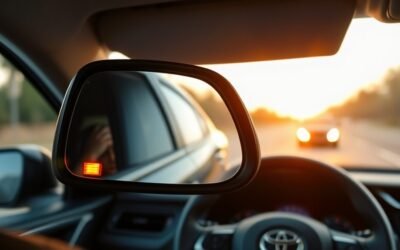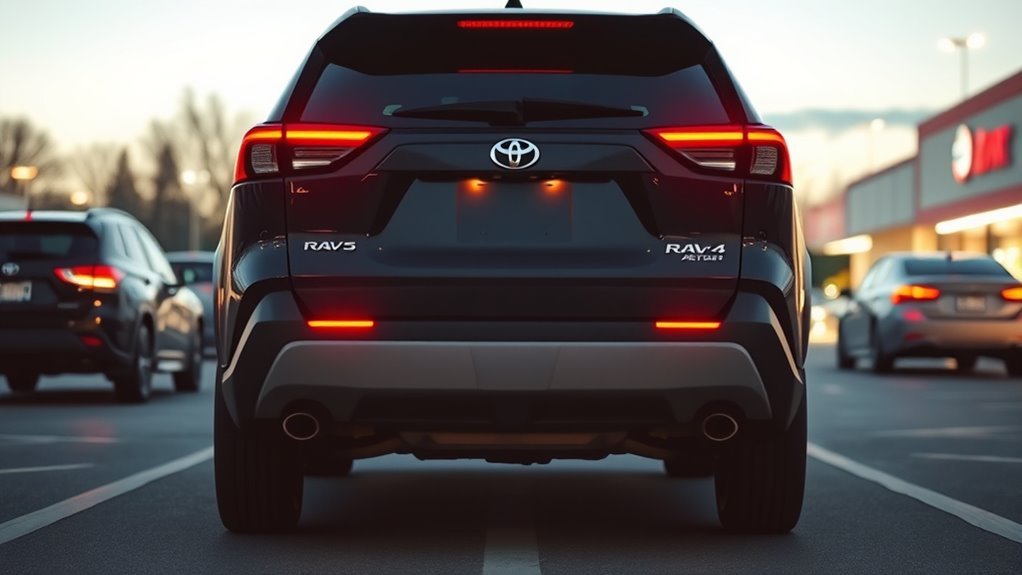
Your RAV4’s Rear Cross‑Traffic Alert uses rear‑mounted radar to scan lateral zones and detect approaching vehicles moving about 5–18 mph while you’re reversing, then warns you with beeps, mirror flashes and console messages. It filters stationary clutter by velocity and trajectory gating, but performance drops with angled parking, obstructions, very slow or fast targets, and small objects. You can toggle RCTA with the BSM button and should still perform manual checks; continue for troubleshooting and maintenance tips.
What RAV4 RCTA Is and Why It Matters
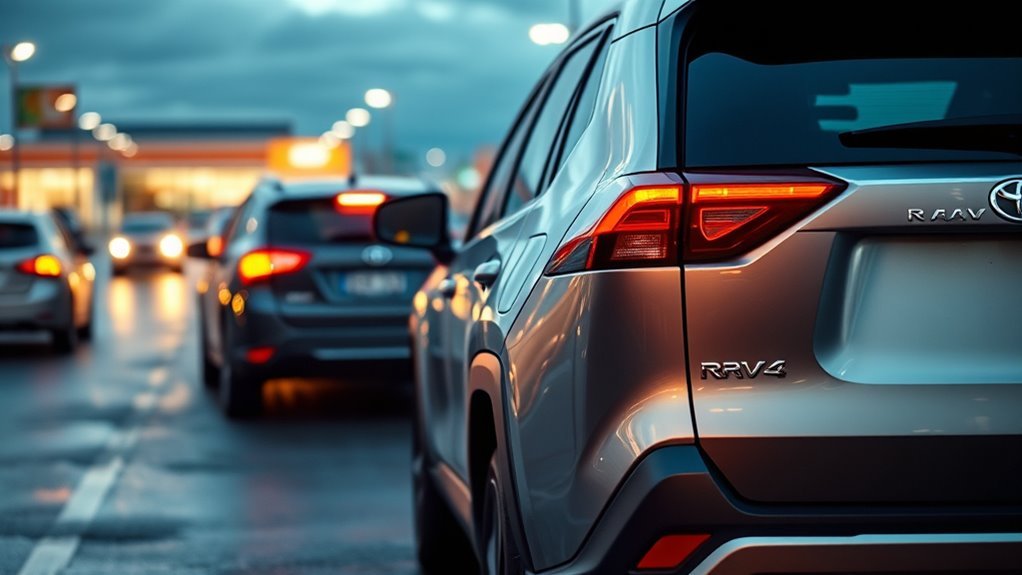
The Rear Cross Traffic Alert (RCTA) on the RAV4 warns you to approaching vehicles while you’re reversing, using rear-mounted radar sensors to reduce collision risk in crowded or low-visibility situations. You rely on this safety features suite to extend awareness beyond mirrors and cameras, supporting accident prevention during low-speed maneuvers. The system activates automatically in reverse, scanning lateral zones where 20% of collisions occur, and it targets approaching vehicles moving roughly 5–18 mph. Alerts are concise and distinct: auditory beeps, console messages, and flashing side mirror lights, so you can make liberated, decisive responses without hesitation. Functionally, RCTA complements your visual inputs, reducing cognitive load and shortening reaction time when space is tight. You’ll appreciate the predictable, technical behavior—automatic engagement, specific speed thresholds, and multimodal alerts—because it lets you operate with autonomy and reduced risk. This precise integration of electronics and user feedback enhances both individual freedom and collective safety.
How RAV4 RCTA Detects Cross Traffic
When you shift into reverse, rear-mounted radar modules in the RAV4 scan lateral zones on both sides of the bumper to detect approaching vehicles; they continuously emit and receive high-frequency radio pulses, calculate target range and closure rate, and trigger alerts when an object’s trajectory and speed match thresholds. You rely on detection technology that focuses on defined monitoring corridors extending rearward and outward, optimized for parking-lot geometries and constrained sightlines. Radar sensors track objects moving between roughly 5 and 18 mph and operate while you reverse at up to 5 mph, filtering stationary clutter and false returns through velocity and trajectory gating. When the system computes a probable cross-traffic threat, it generates layered cues—audible beeps, console messages, and mirror flashes—so you can act decisively. The design prioritizes timely, unambiguous warning delivery, enabling you to reclaim control in crowded, low-visibility spaces without overreliance on subjective judgment.
When to Use RCTA: Best Cases and Manual Checks
Why use RCTA here and now? You engage RCTA when reversing in environments where lateral threats are frequent and sightlines are constrained. Prioritize parking lot safety in busy lots: RCTA detects cross traffic you can’t see until the last moment, reducing collision risk as you back from stalls. Use it on residential streets with frequent cross traffic to augment your situational control; it catches approaching vehicles hidden by parked cars or hedges.
When exiting driveways, RCTA supports driveway awareness by alerting to vehicles entering the travel path from either side. Always perform manual checks—look over both shoulders and scan mirrors—because the system supplements, not replaces, your perception. Reverse slowly; RCTA is calibrated for targets moving roughly 5–18 mph, so reduced speed increases detection and reaction time. Rely on RCTA as a liberation tool that extends your sensory reach while you maintain deliberate, manual verification of the scene.
RCTA Limits: Angled Parking, Obstructions, and Speed
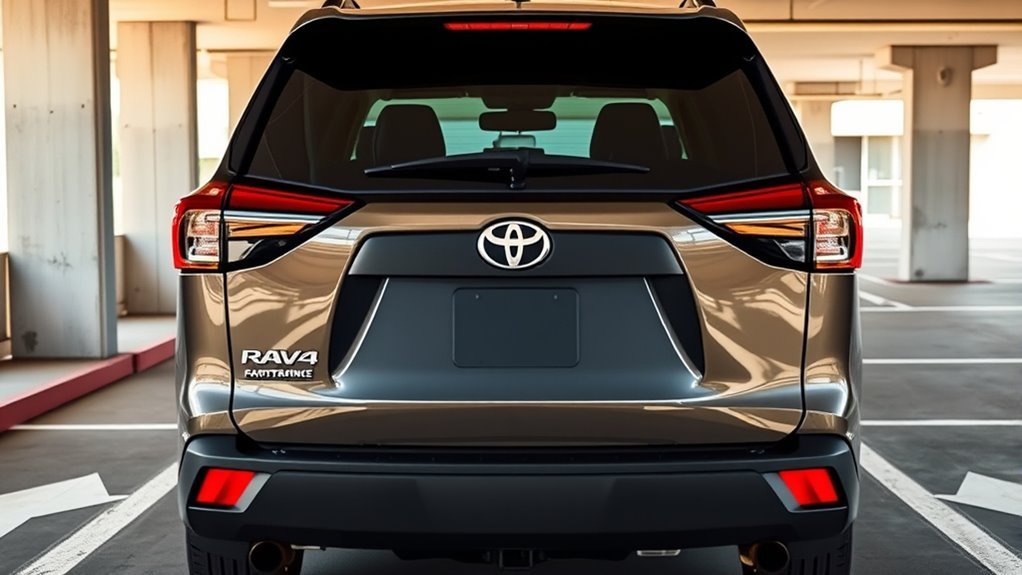
Although RCTA greatly aids rearward awareness, it has clear operational limits you need to account for: angled parking challenges, obstruction impacts, and speed constraints all reduce reliability. You should expect degraded detection in angled parking because sensors and radar beams are oriented for perpendicular bays; vehicles can pass outside the sensor footprint and remain undetected. Obstruction impacts are direct: walls, adjacent vehicles, or cargo that block sensor line-of-sight will prevent alerts. You must also respect the system’s speed envelope—RCTA detects approaching vehicles effectively between about 5 and 18 mph while your vehicle is reversing slowly (optimal below 5 mph). Faster cross traffic can escape detection; smaller objects like carts or bicycles may not trigger sensors at all. For liberation from false certainty, combine RCTA with deliberate manual checks: shoulder checks, mirrors, and slow, controlled backing. Treat RCTA as a supplemental tool, not as a substitute for your situational awareness and conservative backing decisions.
Turn RCTA or BSM On/Off in a RAV4
Locate the BSM button (usually left of the steering wheel) to toggle both Blind Spot Monitor and Rear Cross-Traffic Alert; press it once to enable—indicator lights will illuminate—and press again to disable, noting that turning off BSM also disables RCTA. You’ll perform simple system activation with a single, deliberate press; the dashboard indicators confirm status so you won’t guess. Make it routine to check activation at each start to preserve your autonomy and reduce reliance on memory.
The control is binary and deterministic: enabled equals both BSM and RCTA active; disabled equals both inactive. This pairing simplifies operation and aligns with Toyota’s integrated safety features logic. Use the button when you need liberation from constant visual scanning; disable only when specific conditions demand it. The behavior is consistent across normal driving modes and requires no menu navigation, offering immediate control over these safety features for clear, confident decision-making.
Troubleshooting, Maintenance, and Toyota Service Recommendations
Now that you know how to enable or disable BSM and RCTA with the BSM button, you should routinely inspect and maintain the rear sensors to keep RCTA reliable. You’ll perform simple maintenance checks: clear dirt, remove ice, and verify the system is activated in settings. If alerts act inconsistently, don’t guess—seek diagnostics for sensor calibration at a Toyota service center. Consult the owner’s manual for intervals and procedures. For persistent faults, use Toyota customer support; they’ll access vehicle history and recommend targeted service or parts replacement. You’re reclaiming control: regular checks and prompt professional calibration liberate you from uncertainty and risk.
| What to do | Why it matters |
|---|---|
| Clean sensors | Prevent false negatives/positives |
| Confirm activation | Verify system is allowed to operate |
| Run maintenance checks | Detect failures early |
| Professional calibration | Restore accuracy and confidence |
Frequently Asked Questions
What Is the Cross Traffic Alert on the Toyota RAV4?
The cross traffic alert warns you of approaching side vehicles while reversing, using RAV4 sensors and integrated safety features to detect and notify you via audio, visual, and console alerts so you can act and stay empowered.
Why Does My Car Say Check Rear Cross Traffic Safety System?
Your car says that because rear sensors need cleaning, sensor calibration, or there’s a fault triggering warning indicators; you should inspect sensors, clear obstructions, reset system if possible, and seek technician diagnostics to restore safe, autonomous reversing freedom.
What Does the Rear Cross Traffic Alert Do?
It warns you of cross-traffic when reversing, using radar to alert with sounds and lights. Like a watchdog that saved my friend in a crowded lot, it’s a driving assistance safety feature that frees cautious choices.
Conclusion
You now know what RCTA monitors and how it senses approaching vehicles, yet the system isn’t infallible. Picture yourself reversing from a crowded lot: sensors sweep, alerts ping, but a low scooter or sudden bend can slip through. Use RCTA as a precise aide—engage it, double-check blind spots, and know its limits. Keep sensors clean, update software, and consult Toyota when warnings persist so the next alert won’t be your only warning.