You should measure tongue weight before every tow to guarantee stability and safety. Park the Tundra and trailer level, attach the coupler, then use a tongue-weight scale under the jack or weigh axles on CAT scales and calculate hitch load as 10–15% of trailer GVW. Remember hitch weight counts toward payload, so confirm door-sticker limits and adjust cargo or use a weight-distribution hitch, airbags, or ballast as needed — keep going for step-by-step setup and fixes.
What Is Tongue Weight and Why It Matters for a Tundra
Tongue weight is the downward force at the trailer hitch that your Tundra carries, and getting it right is critical for stable, predictable towing. You need to grasp tongue weight importance because it directly affects steering, braking, and resistance to trailer sway. Measured at the coupling point, tongue weight is a small fraction of gross trailer weight but dictates dynamic balance; too little and the trailer will yaw, too much and you’ll overload the rear axle and impair front-wheel steering.
You’ll measure tongue weight to maximize your Tundra’s towing capacity—typically between about 10,000 and 12,000 lbs depending on model—and to guarantee that the percentage of load on the hitch keeps the truck responsive. Regular monitoring and correct loading techniques prevent hazardous handling and protect both vehicle and cargo. Treat tongue weight as a control parameter: adjust cargo position until you achieve the balance that delivers reliable towing safety and the freedom to tow with confidence.
Recommended Tongue Weight for Tundra (10–15%) : Examples
When you load a trailer for your Tundra, aim for tongue weight equal to 10–15% of the gross trailer weight to keep steering, braking, and stability predictable. For example, an 8,000 lb trailer requires an ideal range of 800–1,200 lbs at the hitch. You’ll measure tongue weight with a calibrated scale or tongue-weight gauge, then shift cargo forward or aft to hit the target.
Maintaining that percentage reduces trailer sway, improves steering response, and lowers the chance of brake imbalance—clear safety implications for you and others on the road. Don’t overshoot: excess tongue weight stresses the truck’s rear suspension, increases tire wear, and degrades handling. Check tongue weight whenever you add or remove gear so your setup stays efficient and controllable.
You’re aiming for liberation from uncertainty: consistent measurement and adjustment give you predictable towing performance and confidence to travel farther, safer, and with less mechanical compromise.
Check Your Tundra’s Payload and Hitch Limits First
Before you measure tongue weight, check the yellow payload sticker on the driver’s door to confirm your Tundra’s payload limit (about 1,240 lbs for a 2016 CrewMax). Remember that hitch weight counts toward that payload, so subtract the hitch/tongue weight from the sticker value when calculating available capacity for passengers and cargo. Stay under the payload limit to avoid instability and safety risks.
Verify Payload Sticker
1 simple check can prevent a dangerous overload: open the driver’s door and read the yellow payload sticker to confirm your 2016 Tundra Crewmax’s listed capacity of 1,240 lbs. You’ll use this figure as the hard limit for occupants plus cargo; sticker verification is your baseline metric. Treat it like an uncompromising spec in your freedom-to-move toolbox.
Check the sticker every time load plans change, and compare totals before hitching to avoid instability. This keeps you compliant and empowers decisions rather than guesswork. Remember that payload capacity already includes hitch weight, so account for all contributors when you calculate totals.
- A clear yellow sticker inside the doorframe, legible and authoritative
- Passengers, gear, and tongue pressure adding up on paper
- A single number defining safe freedom to tow
Account For Hitch Weight
Now that you’ve verified the payload sticker, account for the hitch weight as part of that limit: your Tundra’s 1,240 lb payload includes tongue/load on the hitch, so any hitch weight directly subtracts from the capacity available for passengers and cargo. You’ll perform a payload calculation that treats hitch weight as fixed load. Subtract the measured tongue weight from 1,240 lb to determine remaining capacity. If your hitch weight is 1,215 lb, only 25 lb remains — unacceptable for most trips. Exceeding the payload limit compromises handling and safety, so respect limits to stay free on the road. Use the yellow sticker as the authoritative reference, document your measurements, and recheck whenever you change trailers, hitches, or onboard load.
Set Up Your Tundra & Trailer for Accurate Weighing
Start by parking your Tundra on a truly level surface and detaching the trailer so you can measure axle loads separately and compute tongue weight accurately. You’ll verify trailer leveling and establish baseline axle weights before reconnecting. Use a CAT Scale to weigh front and rear axles independently—record both readings with and without the trailer attached so you can derive the tongue load mathematically. Keep passenger and cargo loads constant; don’t exceed the Tundra’s payload limit (≈1,240 lbs for a 2016 model).
Park on level ground, detach the trailer, and use CAT Scales to measure axle loads and compute tongue weight.
Position the trailer jack and tongue-weight scale precisely under the coupler when you later need a direct reading; that placement gives the most repeatable result. Check suspension sag and ride height to confirm consistent weight distribution across tests. Use consistent steps and note ambient variables (fuel level, tire pressure).
- A leveled trailer on level ground, jack down, coupler centered.
- Tundra parked, parking brake set, tires cold and aired to spec.
- CAT Scale procedure: front then rear, with meticulous logging.
Measure Tongue Weight With a Tongue‑Weight Scale
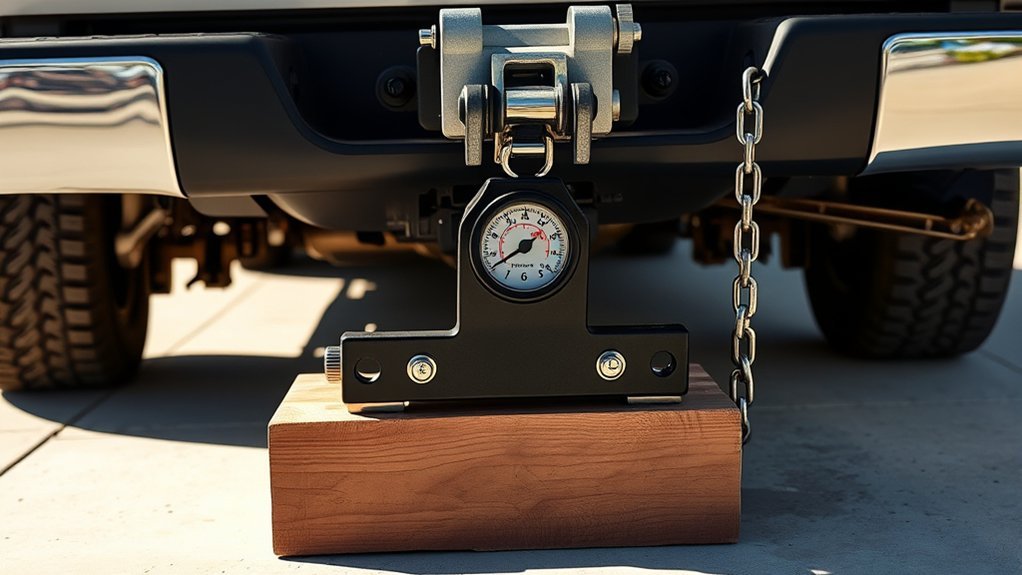
Place the tongue-weight scale solidly under the trailer jack and lower the jack straight down until the scale bears the full coupling load. Make sure the trailer is level, then read and record the tongue weight shown—compare it to the target 10–15% of gross trailer weight. If the number’s outside that range, adjust load distribution and recheck until the reading is within spec.
Proper Scale Placement
- You’ll position the tongue‑weight scale for reliable scale calibration and measurement accuracy. Place the scale directly under the trailer jack so the downward force at the coupling point transfers straight to the sensor.
- Visualize a rigid scale centered beneath the jack, trailer level, feet planted on solid ground.
- Imagine using a sturdy pipe as a lever if direct placement’s impossible, keeping alignment true.
- Picture the trailer perfectly level so readings reflect real weight, not tilt-induced error.
Lower the jack until the trailer’s weight fully rests on the scale; don’t partially support it. Confirm the trailer is level before and during lowering. Target tongue weight sits at 10–15% of gross trailer weight for stable towing. This precise setup frees you from guesswork and unsafe loads.
Reading And Recording
Lift the trailer jack until the tongue‑weight scale’s display stabilizes, then read the value shown—this is the downward force at the coupling point and should be compared to 10–15% of your gross trailer weight. Verify the reading by watching the display for at least 3–5 seconds to ascertain measurement accuracy; any fluctuation means reposition and repeat. Record the value immediately using concise recording techniques: note date, trailer load, ballast position, and measured tongue weight. Store entries in a simple logbook or digital spreadsheet for trend analysis and accountability. Regular checks prevent overload and restore control, letting you tow with confidence. Accurate, repeatable readings free you from guesswork and increase safety on every trip.
Measure Tongue Weight Using a Bathroom Scale (Step‑by‑Step)
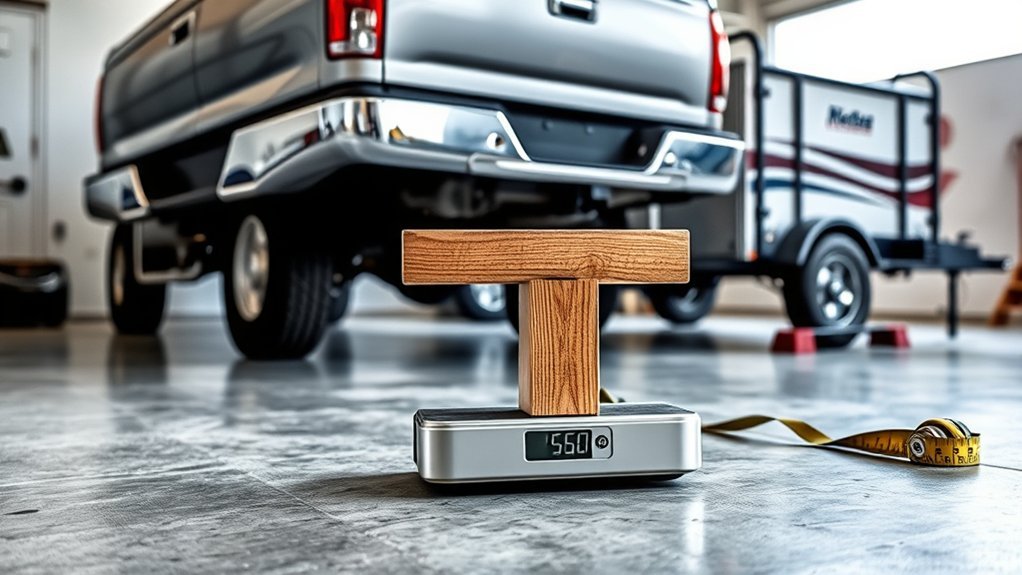
Start by setting the bathroom scale on a flat, level surface and lay a sturdy board or pipe under the trailer tongue to create a solid transfer point for the load. You’ll use simple measuring techniques to get a reliable tongue weight reading. If the tongue weight is under 300 pounds, set the tongue directly on the scale and note the value. For heavier tongues, build a lever: position the board over a pipe so the tongue rests on the board above the fulcrum and the scale sits under the board at the short end. Read the scale, then multiply that reading by three to calculate the actual tongue weight for larger trailers. Record results and compare to the 10–15% guideline of gross trailer weight to confirm safe balance. Work deliberately, free yourself from guesswork, and repeat measurements until they’re consistent.
Set a scale on level ground, use a board-and-pipe lever for heavy tongues, multiply readings, and confirm 10–15% balance.
- Scale on flat concrete, board spanning pipe fulcrum
- Short lever arm on scale, long arm under tongue
- Clear markings, repeatable setup for liberation
Calculate Tongue Weight With Vehicle/CAT Scales
Often you’ll get the most accurate tongue-weight reading by using vehicle or CAT scales: weigh your Toyota Tundra alone, then weigh it again with the trailer attached while keeping the trailer wheels off the scale; the difference between the two measurements is the tongue weight. Use a certified CAT Scale when possible for superior scale accuracy—drive the truck onto the platform, record gross vehicle weight, then reconnect the trailer and repeat with trailer tongue on the truck and trailer wheels off the scale. The subtraction yields tongue weight, which should sit near 10–15% of gross trailer weight for proper balance. For deeper insight, weigh front and rear axles to see how the trailer shifts load across the Tundra; this helps you maintain payload limits and optimize handling. Regular checks empower you to tow confidently; accurate measurements reduce risk of sway, axle overload, and compromised towing safety. Act deliberately, verify readings, and free yourself from guesswork.
If Tongue Weight Is Too High or Too Low : What to Do
If your tongue weight falls outside the ideal range, you’ll need to correct the load or change the hitch setup. Reduce or redistribute cargo—move heavy items forward to lower a high tongue weight or rearward and add forward ballast to raise a low tongue weight—and recheck with a scale. If adjustments aren’t enough, change your hitch, add a weight-distribution hitch, or alter suspension settings to achieve stable, safe towing.
Reduce Or Redistribute Load
Check your tongue weight against the recommended 10–15% of the trailer’s gross weight and, when it’s outside that range, rebalance the load: move heavy items forward to raise tongue weight or toward the rear to lower it, remove unnecessary gear to reduce overall hitch load, and use ballast at the trailer’s tongue if you need added forward weight to prevent sway. You’ll apply load balancing and deliberate cargo placement: for a 1,215 lb hitch weight, confirm trailer gross sits between 8,100–12,150 lbs to validate percentages. Measure with a scale or CAT Scale after adjustments. Move or remove items systematically until stability returns. Aim for predictable handling so you’re free to travel without uncertainty.
- Heavy toolboxes secured near the axle
- Fuel and water forward of midpoint
- Loose gear removed or lashed tight
Adjust Hitch Or Suspension
Start by evaluating whether the tongue weight falls within the safe 10–15% range; when it doesn’t, you’ll need to adjust the hitch or suspension to restore balance and handling. If tongue weight’s high, redistribute trailer cargo rearward or remove excess to hit 10–15%. If it’s low, move items forward or add ballast at the trailer nose. Consider hitch adjustments: install a weight-distribution hitch to spread load and improve steering. For persistent overload or sag, pursue suspension upgrades like Firestone airbags to restore ride height and control. Monitor changes with a CAT Scale or tongue weight scale after each modification. Make deliberate, liberating choices: measure, modify, and confirm stability rather than guessing.
| Issue | Action | Result |
|---|---|---|
| High TW | Move cargo back | Lower hitch load |
| Low TW | Add forward weight | Increase stability |
| Excess load | WD hitch | Better handling |
| Sagging rear | Airbag upgrade | Restored height |
| Verify | Reweigh | Safe towing |
Fixes: Redistribute Load, Use a Weight‑Distribution Hitch, or Add Airbags
Balance your trailer and truck to restore safe towing: redistribute cargo so 10–15% of gross trailer weight sits on the tongue, fit a weight‑distribution hitch to transfer load and level the rig, or install airbags to support heavy tongue loads and maintain ride height. You’ll practice load balancing to reclaim control and enhance towing safety: shift batteries, water, or heavy gear forward or aft until a tongue‑weight scale reads within spec. Fit a properly rated weight‑distribution hitch to move leverage from the rear axle to the front, improving steering response and reducing sag. If tongue weight still overwhelms the Tundra, add airbags to the rear suspension to carry extra load and preserve ride height without compromising cargo placement. Measure tongue weight after each change and adjust until handling, braking, and level stance are satisfactory. These fixes free you to tow confidently while protecting tires, brakes, and suspension—small technical steps that deliver practical liberation on the road.
- heavy gear moved to front bunk, trailer nose eased
- hitch spring bars lifting truck frame level
- airbags inflating to raise rear end
Pre‑Trip Checklist and Routine Checks for Long Towing Trips
After you’ve adjusted cargo, hitch setup, or airbags and confirmed tongue weight, run through a focused pre‑trip checklist to keep that setup working over long hauls. Start by confirming your Toyota Tundra’s payload capacity—about 1,940 lbs for 2022+ models—and guarantee gross trailer weight plus payload stays within limits. Inspect the hitch, coupler, and safety chains for wear or deformation; replace any suspect hardware. Check tire pressure on truck and trailer to manufacturers’ specs; underinflation undermines control and efficiency. Verify trailer brake lights and turn signals operate reliably; test with a helper or a trailer tester. Confirm tongue weight sits at 10–15% of gross trailer weight; adjust load or use a weight‑distribution hitch or airbags if needed. Pack towing essentials: lug wrench, spare tire, basic tool kit, and extra fluid. Perform these safety checks at regular intervals during the trip—every couple hundred miles and after significant road or weather changes—to maintain stability and preserve your freedom on the road.
Frequently Asked Questions
What Is the Tongue Weight on a Toyota Tundra?
Tongue weight varies by setup, but you’ll aim for 10–15% of your trailer’s gross weight to guarantee trailer safety; check your towing capacity and adjust cargo so your Tundra carries the correct downward force.
How Do I Know What My Tongue Weight Is?
You measure your tongue weight with a tongue scale, bathroom scale setup, or vehicle scale comparison; guarantee trailer safety and stay within towing capacity limits, and you’ll liberate control over balance, stability, and confident towing performance.
What Should the Tongue Weight Be on a 7000 Lb Trailer?
You should target 700–1,050 lbs (10–15% of 7,000 lbs) for tongue weight to maintain trailer stability. Adjust weight distribution and cargo placement so you’re free from sway and won’t overload your tow vehicle’s limits.
What Is the Tongue Weight of a 10000 Lb Trailer?
Balanced yet firm, you should set the tongue weight at 1,000–1,500 lbs for a 10,000 lb trailer. You’ll enhance trailer stability and weight distribution, keeping handling predictable while protecting payload and braking performance.
Conclusion
Always confirm your Tundra’s payload and hitch limits, then measure tongue weight before every trip. I once overloaded one side of a camper and felt the steering pull so sharply it was like a magnet on the road—after adjusting load to hit the 10–15% range, stability returned. Use a tongue scale or vehicle scale, redistribute gear, or add a weight‑distribution hitch/airbags if needed. Check straps, lights, and tire pressures before you roll.