To add engine oil to a Toyota Camry, park on level ground, shut the engine off, wait several minutes, check the dipstick, and pour the correct oil through the filler opening in small amounts. Recheck after each addition and stop before the level passes the full mark. For the 2019 non-hybrid Camry, the A25A-FKS 2.5L engine uses SAE 0W-16 and the 2GR-FKS 3.5L V6 uses SAE 0W-20. Other model years and the Camry Hybrid can differ, so confirm the oil grade in the owner’s manual for your exact vehicle.
Last updated: July 15, 2026
Quick Answer
Park your Toyota Camry on level ground, turn the engine off, wait several minutes, and check the dipstick. If the level is low, remove the oil filler cap and add the owner’s-manual-specified oil about 1/4 quart at a time. Recheck after each addition and stop when the level is within the marked range, never above the full mark.
Key Takeaways
- For a 2019 non-hybrid Camry, use SAE 0W-16 for the A25A-FKS 2.5L engine and SAE 0W-20 for the 2GR-FKS 3.5L V6.
- Do not pour in a full quart automatically. Start with about 1/4 quart, wait briefly, then recheck the dipstick.
- The oil level should sit between the low and full marks, not above the full mark.
- Check your oil level about once a month and before long trips, especially if your Camry has high mileage.
At a Glance
| Time Required | 5–10 minutes |
| Difficulty | Beginner |
| Tools Needed | Correct engine oil, clean funnel, paper towel or lint-free rag, gloves |
| Cost | Usually the cost of one quart of matching engine oil; price varies by brand and location |
Warning: A red oil pressure warning light is not the same as a slightly low dipstick reading. Stop safely and shut the engine off. Check the level, but do not keep driving just because you added oil. If the light stays on, the dipstick was not low, or the engine knocks or ticks, arrange professional service or towing.
Low Oil Level vs. Low Oil Pressure
| What You See | What It Means | What to Do |
|---|---|---|
| Dipstick below the low mark | The engine oil level is low | Add the correct oil in small amounts, recheck, and look for the cause if it drops again |
| Red oil pressure light | The lubrication system may not be building safe pressure | Stop the engine, check the level, and seek service if the light remains on |
How Do You Check the Oil Level in a Toyota Camry?

For an accurate reading, park your Toyota Camry on a level surface, turn the engine off, and wait several minutes for oil to drain back into the pan. Keep your hands away from hot engine and exhaust parts if you have just driven the car.
- Open the hood and locate the engine oil dipstick. It is usually near the front or side of the engine and has a pull handle.
- Pull the dipstick out and wipe it clean with a paper towel or lint-free rag.
- Reinsert the dipstick all the way, then pull it out again.
- Read the oil level. The oil should be between the low and full marks, dots, or crosshatched area on the dipstick.
- If the level is at or below the low mark, add oil before driving farther.
If the dipstick is dry, the oil looks milky, or the level drops again soon after topping off, your Camry may have a leak, oil consumption issue, or coolant contamination. In that case, have it inspected instead of repeatedly adding oil.
[Products Worth Considering]

This long-neck automotive funnel makes pouring oil, gas, and lubricants cleaner and easier from different angles. Its wide neck and raised sides help reduce spills, dirt entry, and leaks, while the flexible, reusable plastic design stands up to regular use. Sized for convenient handling, it’s a practical tool for routine vehicle maintenance across cars, trucks, and SUVs.

This spill-proof radiator coolant filling funnel kit helps you refill cooling systems cleanly while reducing trapped air pockets that can affect heater and engine performance. It includes a 5-inch extension bar and 45-degree elbow for easier access under shrouds or at awkward angles. Color-matched caps for dedicated adapters make setup simpler and more organized.

Castrol GTX Full Synthetic 5W-30 motor oil is designed to deliver maximum engine protection in severe driving conditions. It helps fight wear, control sludge, and resist viscosity breakdown while supporting longer intervals between oil changes. Formulated to meet or exceed key industry and vehicle manufacturer specifications, it offers dependable performance for modern engines.
Which Engine Oil Should You Add to a Toyota Camry?
Use the viscosity and oil quality listed for your exact Camry engine in the owner’s manual. The 2019 examples below cover the A25A-FKS 2.5L non-hybrid engine and the 2GR-FKS 3.5L V6. Do not apply these capacities to a different model year, engine, or hybrid powertrain.
You can identify the engine through the owner’s manual, under-hood emissions label, service records, or a Toyota dealer using your VIN. Toyota provides official manuals through the Toyota Manuals and Warranties portal.
| 2019 Camry Non-Hybrid Engine | Recommended Oil | Oil Capacity for Oil Change | Important Note |
|---|---|---|---|
| 2.5L 4-cylinder A25A-FKS | SAE 0W-16, API SN/RC multigrade or equivalent | 4.8 qt. with filter; 4.4 qt. without filter | If SAE 0W-16 is unavailable, SAE 0W-20 may be used temporarily, but it should be replaced with SAE 0W-16 at the next oil change. |
| 3.5L V6 2GR-FKS | SAE 0W-20, ILSAC GF-5 multigrade or equivalent | 5.7 qt. with filter; 5.6 qt. without filter | If SAE 0W-20 is unavailable, SAE 5W-20 may be used temporarily, but it should be replaced with SAE 0W-20 at the next oil change. |
Note: This table does not cover the 2019 Camry Hybrid. It also lists full oil-change capacities, not the amount needed for a top-off. If the dipstick is only slightly low, you may need far less than one quart.
When shopping for oil, match the viscosity first, then check the bottle for the performance category required by your manual. The American Petroleum Institute engine oil program explains the certification marks used on licensed motor-oil containers.
[Products Worth Considering]

Castrol EDGE 0W-20 advanced full synthetic motor oil is engineered for drivers seeking strong wear protection, excellent viscosity control, and thermal stability. It delivers superior performance in critical engine areas, including fuel economy, high-temperature protection, sludge control, and wear defense. Designed for extended oil-change intervals, it helps keep modern engines running smoothly under demanding conditions.

These adjustable oil filter pliers are designed to help remove engine filters, conduit, and fittings with better reach and control in tight spaces. The bent head design improves access, while soft nonslip grips add leverage and comfort during use. Built with high carbon steel and a Permalock fastener, they offer dependable strength and long-lasting performance.

Advanced protection against the four main causes of engine breakdown: wear friction heat and deposits
How Do You Add Engine Oil to a Toyota Camry?
Adding engine oil to your Toyota Camry is a top-off task, not a full oil change. The goal is to bring the level back into the safe dipstick range without overfilling.
- Park safely. Stop on level ground, shift to Park, set the parking brake, and turn the engine off.
- Let the oil settle. Wait several minutes so the oil drains back into the oil pan and the dipstick reading is more accurate.
- Check the dipstick. Pull it out, wipe it clean, reinsert it fully, then pull it out again to read the level.
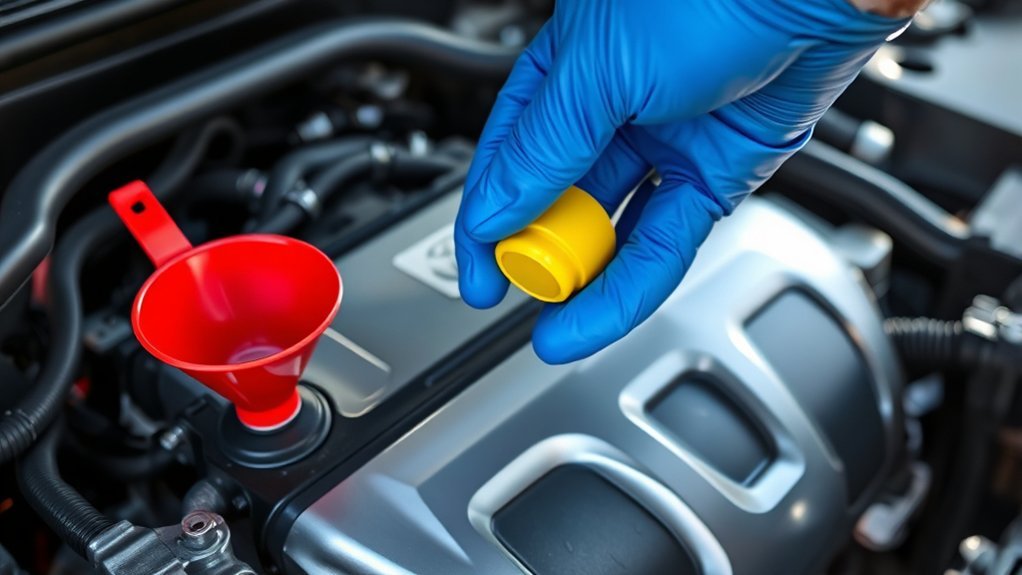
- Open the oil filler cap. The cap is on top of the engine and usually has an oil-can symbol or oil wording on it.
- Use a clean funnel. This keeps oil off the engine and helps prevent dirt from entering the filler opening.
- Add oil slowly. Start with about 1/4 quart of the correct oil, then pause. A slightly low reading may need less.
- Recheck the level. Wait a minute, wipe and reinsert the dipstick, then read it again.
- Stop at the safe range. The oil should be between the low and full marks. Do not fill above the full mark.
- Secure the cap. Reinstall the oil filler cap tightly, wipe up spills, close the hood, and check for warning lights after restarting.
Pro Tip: Keep a small maintenance note in your phone with the date, mileage, oil brand, viscosity, and how much oil you added. If the same Camry keeps needing oil, that record helps a mechanic diagnose leaks or oil consumption.
[Products Worth Considering]

Free Hands - This funnel can be fixed where it should be, freeing your hands.

Fitment – Shonee Threaded oil funnel perfect fit fort Toyota, Lexus, and Scion vehicles with threaded oil filler caps (does not fit Prius or engines with half-turn tab style oil filler caps)
What Mistakes Should You Avoid When Adding Oil?
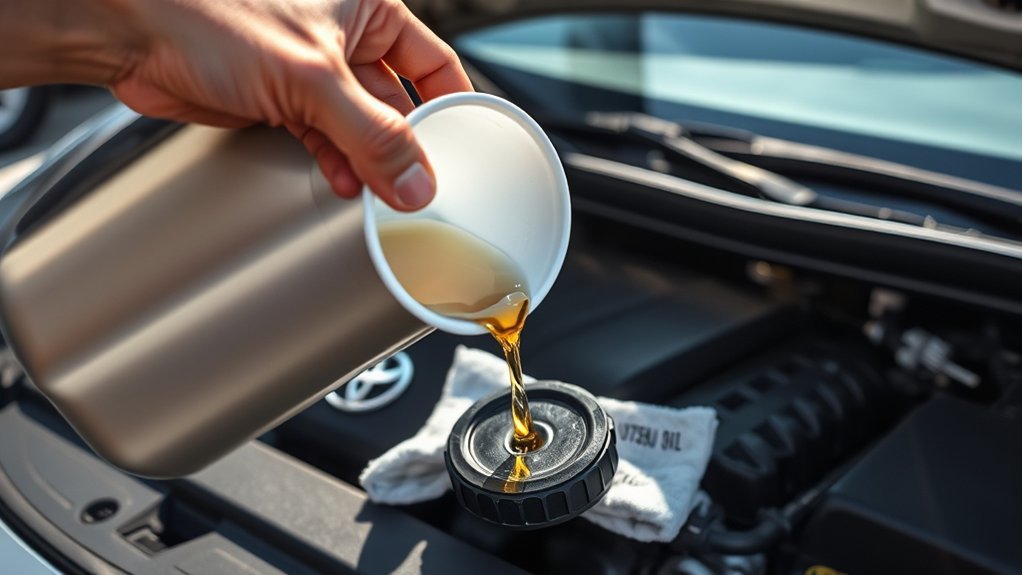
When you’re adding oil to your Toyota Camry, small mistakes can cause messy spills or expensive engine problems. Avoid these common oil-adding errors:
- Using the wrong oil type: Match the viscosity and performance category for your exact Camry engine. For the 2019 non-hybrid engines covered here, that means SAE 0W-16 for the A25A-FKS 2.5L or SAE 0W-20 for the 2GR-FKS V6.
- Overfilling the engine: Too much oil can foam, increase pressure, cause leaks, and reduce lubrication quality.
- Adding a full quart without checking: Add a small amount first, then recheck the dipstick.
- Checking on a slope: A tilted driveway can make the dipstick reading look higher or lower than it really is.
- Leaving the oil cap loose: A loose cap can cause oil mist, engine smells, warning lights, or a mess under the hood.
- Ignoring leaks: Oil spots under the car, a burning-oil smell, or repeated low readings mean the vehicle needs inspection.
Toyota’s official 2019 Camry maintenance guide tells owners to check the engine-oil level once a month and warns that neglect can lead to oil starvation or oil gelling.
When Should You Check Your Camry’s Oil Level?
Check your Toyota Camry’s oil level once a month, before long trips, after an oil change, and whenever you notice an oil smell, ticking noise, spots under the vehicle, or a warning light. Toyota’s 2019 maintenance guide specifically recommends the monthly check and includes routine fluid-level inspections in its service schedule.
| When to Check | Why It Matters | Recommended Action |
|---|---|---|
| Once a month | Catches low oil before it becomes engine damage | Check the dipstick and top off only if needed |
| Before a long trip | Long highway drives can expose existing low-oil issues | Check level, inspect for leaks, and carry the correct oil |
| After an oil change | Confirms the shop or DIY fill level is correct | Wait several minutes, then verify the level is in range |
| If a warning light appears | Low oil pressure can damage the engine quickly | Stop safely, shut off the engine, check level, and seek service if needed |
Why Does Your Camry Keep Needing Oil?
A one-time top-off may be normal between services, especially on older or high-mileage vehicles. However, if your Camry repeatedly drops below the low mark, do not ignore it.
- Look under the car: Fresh oil spots may point to a drain plug, filter, oil pan, gasket, or seal leak.
- Check for burning smells: Oil dripping onto hot engine parts can create a sharp burnt-oil odor.
- Watch the exhaust: Blue smoke can indicate oil burning inside the engine.
- Review recent service: A loose filter, loose cap, wrong oil, or underfill after an oil change can cause problems.
- Get it inspected: Repeated low oil can damage the engine, even if topping off temporarily quiets symptoms.
Frequently Asked Questions
How much oil should I add to a Toyota Camry?
Add only enough oil to bring the dipstick into its marked safe range. Start with about 1/4 quart, wait briefly, then wipe, reinsert, and read the dipstick again. Do not use the full oil-change capacity as a top-off amount, and never fill above the full mark.
Can I drive with the red oil pressure light on?
No. Stop in a safe place and shut the engine off. Check the dipstick, but do not assume adding oil has solved the problem. If the light remains on, the oil level was normal, or the engine makes abnormal noise, arrange service or towing.
How often should I change my engine oil?
For a 2019 Toyota Camry using the specified oil under normal driving conditions, Toyota lists engine oil and filter replacement at 10,000 miles or 12 months. Under listed special operating conditions, including dusty roads, towing or heavy loading, repeated short trips below freezing, and extensive idling or low-speed use, the schedule calls for replacement at 5,000 miles or 6 months. Follow the guide for your exact model and use.
Can I mix different oil brands?
You can usually mix oil brands for a top-off if the viscosity and oil specification match what your Camry requires. For example, do not choose a random thicker oil just because it is available. Match the owner’s manual first, and use API-licensed oil when possible.
What happens if I overfill the oil?
Overfilling can cause the crankshaft to whip air into the oil, creating foam that does not lubricate well. It can also increase pressure and contribute to leaks or engine performance problems. If the dipstick reads above the full mark, have the extra oil drained to the correct level.
Is synthetic oil better than conventional oil?
For many modern Camry engines, the required viscosity is commonly sold as synthetic oil. The most important rule is to use oil that matches Toyota’s required viscosity and quality specification for your engine. Do not choose oil based only on the word “synthetic” if the viscosity or certification is wrong.
Can I use 0W-20 instead of 0W-16 in a 2019 Camry?
For the 2019 Camry A25A-FKS 2.5L non-hybrid engine, SAE 0W-16 is recommended. Toyota allows SAE 0W-20 only if SAE 0W-16 is unavailable, and it should be replaced with SAE 0W-16 at the next oil change. The 2GR-FKS 3.5L V6 uses SAE 0W-20.
How do I dispose of old oil properly?
Do not pour used oil into the trash, ground, storm drain, or household drain. Store used oil in a clean, leak-proof container and take it to a used-oil recycling center, auto parts store, repair shop, or local waste collection site that accepts it. The U.S. Environmental Protection Agency recommends recycling used motor oil and oil filters through approved collection options.
Conclusion
To top off your Toyota Camry safely, verify the oil specification, check the dipstick on level ground, add about 1/4 quart at a time, and stop within the marked range. Reinstall the cap before starting the engine. If the level drops again, the oil looks milky, or the red oil pressure light remains on, stop treating it as a routine top-off and arrange an inspection.
Sources
- Toyota 2019 Camry Owner’s Manual — oil grade, viscosity, capacity, and engine-oil checking guidance.
- Toyota 2019 Camry Warranty & Maintenance Guide — monthly oil-level checks and scheduled maintenance intervals.
- Toyota Manuals and Warranties — official Toyota manual access for 2019 Camry owners.
- American Petroleum Institute Engine Oil Program — API oil certification marks and engine-oil quality guidance.
- U.S. EPA: Managing, Reusing, and Recycling Used Oil — proper used-oil and oil-filter recycling guidance.