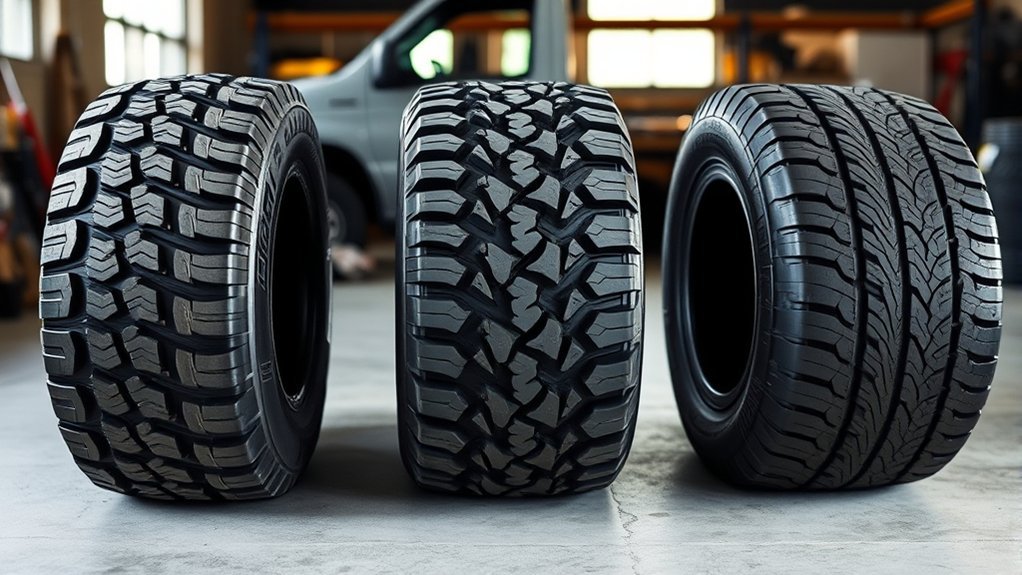
You need tires that match how and where you drive, so pick smartly: All‑Terrain (AT) gives quiet, durable performance for daily streets and light trails with 60,000+ mile life; Mud‑Terrain (MT) delivers aggressive bite and protection for extreme off‑road but wears faster (~35,000 miles) and is louder; Highway tires maximize comfort, fuel economy, and low noise for pavement. Match load rating and sidewall strength to your vehicle, check winter certification, and keep a rotation plan—keep going to get detailed fit, maintenance, and cost comparisons.
Quick Pick: Choose AT, MT, or Highway in 30 Seconds
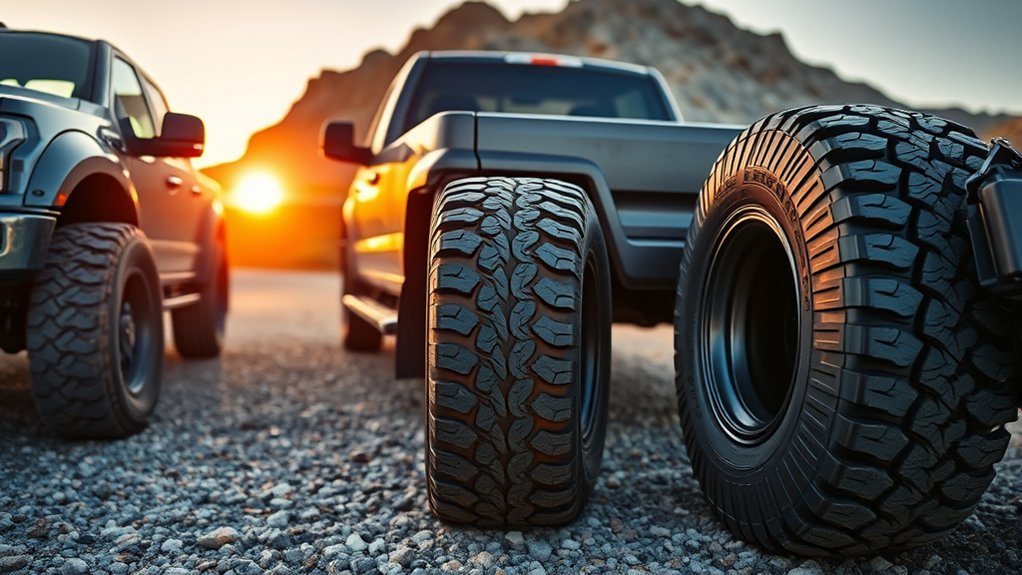
Need a fast answer? You’ll pick smartly by matching tire performance to your primary driving conditions. If you want versatility—daily streets plus light trails—choose All-Terrain (AT); it lasts over 60,000 miles and balances grip, comfort, and durability. If you crave conquest in extreme off-road environments, choose Mud-Terrain (MT); its aggressive tread dominates mud and rock but typically wears faster, around 35,000 miles with regular driving. If your freedom is urban efficiency and smooth rides, choose highway tires; they optimize fuel economy and comfort on pavement but sacrifice off-road capability. Prefer a middle ground? Rugged Terrain (RT) blends off-road aptitude and on-road comfort, with 40,000–50,000 miles life. Decide in 30 seconds: identify your dominant driving conditions, prioritize the performance attribute you value most (longevity, extreme traction, or comfort), then select the tire class that aligns. You’ll gain mobility, resilience, and the autonomy to go where you mean to go.
AT vs MT vs Highway Tires: Side‑by‑Side Specs
You just picked the tire class that fits your driving priorities; now compare the specs side‑by‑side to confirm that choice. Check tread patterns: AT tires use a compact, versatile design for mixed surfaces, MT tires employ aggressive, large lugs to bite into mud and rock, and Highway tires favor smooth ribs for highway rolling efficiency. That pattern choice dictates off road performance and everyday comfort.
Consider longevity and noise: AT and Highway tires commonly exceed 60,000 miles with proper care, while MT tires wear faster—around 35,000 miles—because of their aggressive tread, and they’re noticeably louder. Usage intent matters: choose AT for daily driving with trail capability, MT for extreme off‑road demands, and Highway for mainly paved travel.
Finally, match load capability and expected conditions. You’ll free yourself to roam further when the specs align with your route: quieter, longer‑lasting Highway freedom; balanced AT versatility; or uncompromising MT traction where liberation means going beyond limits.
Load Ratings & Sidewalls: What Your Build Needs
Choosing the right load rating and sidewall construction is critical for any build, because those specs determine how much weight your tires can safely carry and how well they’ll resist punctures and flex under stress. You need to match load ratings (C, D, E) to your vehicle: C for lighter rigs, D for heavier use, E for extreme durability. Stiffer sidewalls increase sidewall stiffness, boosting stability, handling and towing capability while resisting off‑road impacts. That reinforcement raises tire durability and has a measurable performance impact on ride firmness and control. Verify ratings against vehicle specs to prevent blowouts, uneven wear, and handling problems.
| Rating | Use case |
|---|---|
| C | Light trucks, daily drivers |
| D | Towing, heavier loads |
| E | Commercial, extreme loads |
Choose reinforced MTs for rock and debris; they protect your freedom to explore without sacrificing safety or long‑term performance.
Expected Lifespan, Noise & Maintenance Schedule
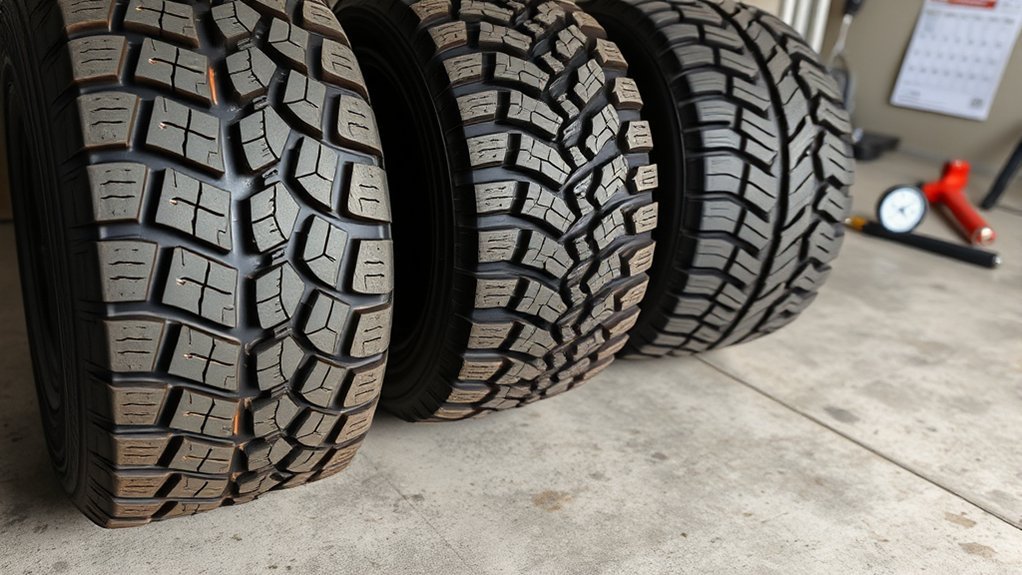
Expect realistic lifespans: all-terrain tires often exceed 60,000 miles while mud-terrain averages around 35,000 due to aggressive tread. You’ll also hear big differences—mud-terrain is the loudest, all-terrain strikes a balance, and highway tires stay quiet for daily driving. Follow a strict maintenance plan—check pressures monthly (especially for load E tires), rotate every 5,000–6,000 miles, and replace tires at 4/32″ tread (2/32″ is unsafe).
Expected Tire Lifespan
Frequently, your tire choice will dictate how long the tread lasts and how much noise you’ll tolerate on the road. You’ll weigh tread design for off road performance against driving comfort and weather conditions; AT tires last over 60,000 miles for balanced daily use, MT tires average ~35,000 miles due to aggressive lugs, and RT tires sit around 40–50,000 miles as a compromise. You should monitor pressure monthly and rotate every 5,000–6,000 miles to extend life and retain traction.
| Tire Type | Expected Miles |
|---|---|
| All-Terrain (AT) | 60,000+ |
| Mud-Terrain (MT) | ~35,000 |
| Rugged Terrain (RT) | 40,000–50,000 |
Choose boldly: maintain proactively to free your journeys from premature wear.
Noise Levels Comparison
How loud will your ride be once you swap tires? You’ll notice tread patterns dictate cabin sound: mud-terrain’s aggressive, high-void design produces the loudest roar, trading quiet for off-road grip. All-terrain’s compact tread patterns offer a balanced compromise—quieter on highways and longer lasting, often exceeding 60,000 miles versus roughly 35,000 for MT. Choose based on how much noise you’ll tolerate; if liberation means open trails, accept higher decibels. If freedom equals smooth, contemplative highway miles, favor AT for superior noise reduction and longevity. Technically, reducing void ratio and optimizing block spacing lowers aerodynamic excitation and structure-borne vibration. That engineering trade-off is yours to own: prioritize performance and grit, or opt for stealthy comfort and extended service life.
Maintenance And Rotation Schedule
When you want tires that last and stay quiet, a disciplined maintenance and rotation schedule is essential. You’ll extend life: all-terrain units typically exceed 60,000 miles while aggressive mud-terrain wear faster, near 35,000 miles. Rotate every 5,000–6,000 miles to prevent uneven wear and push tires toward their rated lifespan. Check tire pressure regularly—especially on load range E—to maintain contact patch, reduce heat, and avoid premature failure. Monitor tread depth: replace at 4/32″ for safety, and never let it fall to 2/32″ where hydroplaning risk spikes. Mud-terrain noise is inherent, so maintain pressures and alignment to minimize it. Commit to this regimen and you’ll reclaim control—longer service, safer traction, and quieter, more liberated driving.
Which Tire for You: Commute, Mixed Trails, Extreme Off‑Road?
Which tire fits your routine best depends on where you drive most: stick with All‑Terrain if your days are mostly pavement punctuated by occasional gravel or dirt, pick Rugged Terrain if you split time between highway commuting and regular mixed trails (it balances traction, comfort, and 40–50k mile life), and choose Mud‑Terrain only if you spend serious time in deep mud, rock gardens, or steep, loose slopes where aggressive lugs and sidewall protection trump noise and faster wear (around 35k miles).
You want tire performance matched to driving conditions. AT gives long life (60k+ miles), quiet highway manners, and sufficient off-road bite for liberated daily use. RT balances capability and comfort for mixed-usage rebels, with 40–50k miles and better wet/winter handling. MT is for extreme adventurers; expect louder roads and ~35k miles. Maintain pressure and rotate every 5–6k miles to maximize any choice.
| Use Case | Strength | Typical Life |
|---|---|---|
| Commute/Light Trail | Comfort, longevity | 60k+ mi |
| Mixed Trails | Versatility, wet grip | 40–50k mi |
| Extreme Off‑Road | Traction, protection | ~35k mi |
Buying Checklist: Size, Load Range, Winter Rating, Noise, Cost Trade‑Offs
Start by matching tire size and load range to your vehicle’s specifications and typical use—incorrect sizing or an underspecified load rating compromises handling, braking, and safety. You’ll pick Load E for heavy towing or frequent payloads and Load C for lighter duty; verify factory specs and adjust only with informed changes to gearing, clearance, and suspension. Check winter rating: if you face snow or ice, choose tires bearing the three-peak mountain snowflake for certified traction.
Balance noise and mission: MTs deliver superior bite off-road but generate cabin noise; ATs are quieter for daily freedom. Evaluate cost trade-offs by comparing initial price to expected miles—ATs often exceed 60,000 miles, MTs nearer 35,000—so calculate cost per mile. Don’t neglect tire maintenance and seasonal considerations: rotate, align, and swap to winters/ summers as needed to extend life and preserve capability. Make choices that liberate your driving without compromising safety or economy.
Frequently Asked Questions
Are Mud-Terrain Tires Good on a Highway?
No — you’ll sacrifice highway performance with mud-terrain tires; their aggressive tread design boosts off-road grip but raises noise, vibration, and wear, so choose them only if you prioritize rugged freedom over smooth, efficient pavement cruising.
Are All-Terrain Tires Good for Freeway Driving?
Want reliable freedom on the road? You’re right to choose all-terrain; they offer all terrain benefits and strong freeway performance, lasting long, reducing noise, handling snow, and freeing you with confident, well-maintained, versatile traction.
Should I Get Mud-Terrain or All-Terrain?
Choose all-terrain if you crave daily comfort and all terrain durability; pick mud-terrain if you demand extreme traction and mud terrain benefits for rugged freedom. You’ll balance noise, lifespan, and off-road capability to liberate driving.
Conclusion
Quickly choose: all‑terrain balances grip and gas‑mileage for mixed use, mud‑terrain maximizes muddle‑splitting traction at the expense of noise and wear, and highway tires prioritize comfort and life for pavement. Consider load rating and sidewall strength for your build, expect differing lifespans and service schedules, and weigh winter ratings and cost. Pick the proper profile to protect performance and preserve peace of mind — pick prudently, prioritize purpose, and prepare properly.