Your Toyota 4Runner’s Electronic Stability Control system is Toyota’s Vehicle Stability Control (VSC). It helps the SUV stay on the path you intend by comparing steering input, wheel speed, yaw movement, throttle position, and braking data. When the system detects oversteer, understeer, or wheel slip, it can apply brake force to individual wheels and reduce engine torque to help the vehicle regain stability.
Quick Answer
The 4Runner’s ESC system is called VSC. A flashing slip indicator usually means VSC/TRAC is actively helping. A VSC OFF light means the system is disabled. A steady warning or “Check VSC” message can mean a fault in a wheel-speed sensor, steering-angle sensor, brake/ABS circuit, wiring, tire setup, or related control module.
Key Takeaways
- Toyota commonly calls ESC Vehicle Stability Control (VSC); it works with TRAC, ABS, Brake Assist, and, on some models, A-TRAC and Trailer Sway Control.
- A flashing slip indicator is usually normal system activation. A steady warning light or repeated message should be diagnosed.
- For U.S.-market 4Runners, Toyota brochures show VSC/TRAC on 2003 and newer models, but always verify a used vehicle by VIN, build sheet, or owner’s manual.
- Tires, brake condition, wheel-speed sensors, steering-angle calibration, and ABS/VSC codes are the first things to check.
- Do not turn VSC/TRAC off unless conditions require it, such as freeing the vehicle from deep snow, mud, or sand.
At a Glance
| Time Required | 5–15 minutes for basic checks; 30–60 minutes for a proper ABS/VSC code scan. |
| Difficulty | Easy for tire and visual checks; moderate to professional for ABS/VSC diagnostics and calibration. |
| Tools Needed | Tire-pressure gauge, flashlight, tread-depth gauge, and a scan tool that can read ABS/VSC/chassis codes. |
| Cost | Free for basic inspection; usually diagnostic-labor cost for code reading; repairs vary from minor sensor/wiring work to higher-cost ABS components. |
What Is Electronic Stability Control, and Why It Matters for 4Runner Owners

Electronic Stability Control (ESC) is the general safety-system name. Toyota usually calls its version Vehicle Stability Control (VSC). The goal is simple: help the 4Runner follow the direction you are steering when tire grip changes suddenly.
Under U.S. safety rules, ESC systems must be able to apply brake torque individually to all four wheels, monitor steering input, estimate yaw or side-slip behavior, limit oversteer and understeer, and reduce engine torque when needed. You can read the federal ESC definition in 49 CFR § 571.126, FMVSS No. 126.
On a 4Runner, VSC matters because the vehicle is tall, body-on-frame, and often used in rain, snow, gravel, mud, and towing situations. VSC cannot overcome physics, bad tires, excessive speed, or poor steering inputs, but it can help correct a developing skid before it becomes harder to control.
NHTSA’s 2025 evaluation estimated that ESC-equipped vehicles had a 47.7% relative risk reduction for first-event single-vehicle rollover crashes compared with similar vehicles without ESC.
Warning: VSC is a driver aid, not a guarantee. Slow down for rain, snow, gravel, curves, towing, and worn pavement. If the brake warning light is on, the pedal feels abnormal, brake fluid is low, or braking power is reduced, stop driving as soon as it is safe and have the vehicle inspected.
VSC vs. ESC, TRAC, A-TRAC and Trailer Sway Control
Toyota owners often see several related terms. They are connected, but they are not identical.
| ESC | Generic term for Electronic Stability Control. |
| VSC | Toyota’s Vehicle Stability Control name for ESC-type stability control. |
| TRAC | Traction control. It reduces wheelspin during acceleration and works closely with VSC and ABS. |
| A-TRAC | Active Traction Control on certain 4WD models. It can brake a spinning wheel to help send torque to wheels with grip. |
| Trailer Sway Control | A VSC-related function on equipped models that can help reduce trailer sway by brake and torque intervention. |
In normal driving, keep these systems on. Toyota’s current 4Runner owner information warns that when TRAC/VSC/Trailer Sway Control systems are off, the driver should be especially careful and drive at a speed appropriate to the road conditions. It also notes that the slip indicator flashes when the system is activated. See Toyota’s 2025 4Runner Hybrid driving assist systems manual page for current wording.
Which 4Runner Years and Trims Include ESC/VSC
For U.S.-market 4Runners, Toyota documentation shows VSC/TRAC earlier than many owners realize. The safest wording is: most U.S. 2003 and newer 4Runners were listed with Toyota VSC/TRAC, but a buyer should still verify any individual used vehicle by VIN, window sticker, build sheet, and owner’s manual.
| Model years | What to know |
| 1996–2002 | Third-generation 4Runners should not be assumed to have modern ESC/VSC. Verify equipment by VIN and owner’s manual. |
| 2003–2009 | Toyota’s U.S. 2003 4Runner brochure lists Vehicle Skid Control (VSC) + TRAC as standard across SR5, Sport Edition, and Limited. Toyota’s U.S. 2009 4Runner brochure also lists VSC + Traction Control. |
| 2010–present | Toyota’s 2010 4Runner brochure lists the Star Safety System with VSC, TRAC, ABS, Electronic Brake-force Distribution, and Brake Assist. Later U.S. 4Runners are also covered by modern ESC requirements. |
| U.S. regulatory note | FMVSS No. 126 mandated ESC for covered light vehicles manufactured on or after September 1, 2011. That rule is broader than the 4Runner itself. |
Note: Toyota brochures and owner manuals are market-specific. Imported vehicles, salvage-title vehicles, swapped clusters, modified braking systems, or incorrectly repaired ABS/VSC systems can differ from the original equipment list.
ESC/VSC Warning Light on a 4Runner: What It Means
A VSC-related light does not always mean the same thing. Start by identifying exactly which light or message you see.
| Light or message | Likely meaning | What to do |
| Flashing slip indicator | VSC/TRAC is actively intervening because the tires are near their grip limit. | Ease off the throttle, steer smoothly, and reduce speed. |
| VSC OFF or TRAC OFF | The system was turned off manually, or a drive mode has changed system behavior. | Turn it back on when you no longer need extra wheelspin. |
| Steady VSC/check message | Possible fault in VSC, ABS, sensor, wiring, steering-angle calibration, or related control system. | Check tires and scan ABS/VSC codes. Avoid aggressive driving until repaired. |
| ABS or brake warning with VSC | The stability system may be disabled because the brake/ABS system has a fault. | Treat this as more serious. Inspect brake fluid, pedal feel, and braking ability immediately. |
A steady light after startup should not be ignored. The 4Runner may still drive, but stability assistance may be reduced or unavailable. Drive gently, avoid sudden steering or braking, and diagnose the fault before towing, off-roading, or driving in poor weather.
Quick Diagnostics: What to Check First When ESC/VSC Warns or Fails
Use a simple order: confirm the warning, check the tires and brakes, then scan the right control systems. Do not replace sensors blindly before reading codes.
Check the Warning Light
- Note the behavior: flashing, steady, VSC OFF, TRAC OFF, ABS, brake, or a message in the display.
- Think about the context: Did it happen in rain, snow, loose gravel, after a battery disconnect, after tire work, after an alignment, or after off-road use?
- Restart once: If the light clears and stays off, it may have been temporary. If it returns, continue diagnostics.
- Do not erase codes too soon: Record stored, pending, and history codes before clearing anything.
Inspect Tires and Wheels
VSC depends on accurate wheel-speed data and predictable tire grip. A mismatched tire can confuse the system because one wheel rotates at a different speed than the others.
| Item inspected | What to look for |
| Tire pressure | Set all tires to the door-jamb specification when cold. |
| Tread depth | Check for uneven wear, cupping, one tire much newer than the others, or tires of different sizes. |
| Wheels | Look for bent wheels, damaged tone rings, heavy mud, ice buildup, or impact damage near sensors. |
| Wheel-speed sensor wiring | Inspect visible harnesses and connectors for broken clips, corrosion, rubbed insulation, or unplugged connectors. |
Scan for Trouble Codes
A basic emissions-only OBD-II scanner may not be enough. Many VSC problems are stored in the ABS, brake, chassis, or skid-control system, not just the engine computer.
- Use a scan tool that can read ABS/VSC/chassis codes for your 4Runner year.
- Record all codes and freeze-frame data before clearing anything.
- Check for common causes: wheel-speed sensor faults, steering-angle sensor zero-point issues, yaw-rate sensor faults, brake switch faults, CAN communication faults, and ABS actuator/module faults.
- If the codes return after clearing, perform the diagnostic test for that exact code instead of guessing.
- After steering, alignment, lift, collision, sensor, or ABS work, confirm whether zero-point calibration or initialization is required.
Pro Tip: If the VSC light appeared right after new tires, a lift, alignment, battery replacement, brake repair, or off-road impact, tell the technician. That history can shorten the diagnostic path.
How 4Runner ESC/VSC Works: Sensors, ABS, Yaw and Throttle Control
VSC works by comparing what you ask the vehicle to do with what the vehicle is actually doing. The main inputs include wheel-speed sensors, steering-angle data, yaw-rate data, throttle position, brake pressure, and system status from the ABS/brake control unit.
Sensor Inputs and Data
- Wheel-speed sensors: Tell the system how fast each wheel is rotating.
- Steering-angle sensor: Shows where you are steering and how quickly you are turning the wheel.
- Yaw-rate sensor: Measures how quickly the vehicle is rotating around its vertical axis.
- Brake and throttle data: Help the system decide whether to reduce torque or apply targeted braking.
- Tire condition: Not a direct electronic sensor input in the same way, but tire size, pressure, and grip strongly affect what the system sees.
Brake and Throttle Control
If the 4Runner begins to understeer or oversteer, VSC can command brake pressure at one or more wheels to create a correcting yaw moment. It can also request reduced engine torque. ABS helps prevent wheel lockup during braking, while TRAC helps manage wheelspin during acceleration.
For example, on a slick curve, if the front of the 4Runner pushes wide, VSC may brake a specific wheel and reduce engine torque to help the vehicle rotate back toward the intended path. If the rear begins to step out, the system can apply different targeted braking to reduce the yaw movement.
When 4Runner ESC/VSC Activates: Common Scenarios and Limits
VSC commonly activates when the 4Runner’s path no longer matches the steering input. You may feel brake pulses, hear pump noise, see the slip indicator flash, or feel a momentary reduction in power.
- Wet or icy turns: VSC may intervene when the tires begin to slide.
- Sudden lane changes: The system can help stabilize the vehicle if yaw builds quickly.
- Gravel or washboard roads: Wheel-speed differences can trigger TRAC or VSC intervention.
- Towing: Trailer Sway Control on equipped models can work through the VSC system.
- Off-road cross-axle situations: A-TRAC or brake-based traction control may brake a spinning wheel to help move torque to a wheel with grip.
The limits matter. VSC cannot make worn tires grip, cannot shorten every stopping distance, cannot prevent every rollover, and cannot make excessive speed safe. It also may behave differently when 4WD modes, low range, rear differential lock, Crawl Control, or Multi-Terrain Select are in use.
Safely Testing ESC/VSC on Your 4Runner
You do not need to force a skid to know whether VSC is working. The safer goal is to understand warning lights and system feel at low speed in a legal, open area.
Warning: Never test VSC on public roads, near traffic, near pedestrians, or beside curbs, poles, ditches, parked vehicles, or buildings. Do not intentionally provoke a high-speed skid.
Low-Speed Slalom Familiarization
- Choose a large, flat, empty, legal lot with permission to be there.
- Check tire pressure, remove loose cargo, and wear seatbelts.
- Place cones or soft markers with plenty of space.
- Drive a gentle low-speed slalom and use smooth steering inputs.
- If the slip indicator flashes, reduce speed and note the feel of the system.
This is not a performance test. It is only a way to learn how the vehicle communicates traction loss.
Wet-Surface Braking and ABS Feel
A straight-line stop on a wet surface mainly demonstrates ABS and brake control, not full VSC yaw correction. If you practice this, do it only in a safe, empty, legal area at low speed. Keep the steering wheel straight, brake firmly, and leave far more room than you think you need.
Normal ABS operation can include pedal pulsation and pump noise. If the vehicle pulls hard to one side, the brake pedal sinks, the brake warning light appears, or the ABS/VSC lights stay on afterward, stop testing and inspect the vehicle.
Typical Repairs, Maintenance Checklist and Estimated Costs
Start with maintenance basics before assuming the VSC computer has failed. Many warning lights come from ordinary tire, brake, sensor, wiring, or calibration problems.
| Item | Why it affects VSC | Typical budget range |
| Tire pressure / tire matching | Incorrect pressure or mismatched tires can change wheel-speed readings and available grip. | Free to low cost, unless tires need replacement. |
| Wheel-speed sensor or wiring | A bad signal can disable ABS, TRAC, and VSC functions. | Often a few hundred dollars, depending on year, parts, corrosion, and labor. |
| Steering-angle or yaw sensor calibration | The system needs a correct zero point to understand driver intent and vehicle motion. | Usually diagnostic/calibration labor; more if a sensor is replaced. |
| Brake switch, brake fluid, pads, rotors | VSC depends on brake-system status and the ability to apply controlled brake pressure. | Low to moderate for switches/service; higher for full brake work. |
| ABS actuator/module | A major brake-control fault can disable ABS/TRAC/VSC operation. | Potentially high. Confirm diagnosis before replacing. |
Repair-cost estimators such as RepairPal’s 4Runner wheel-speed sensor estimate and RepairPal’s 4Runner ABS control module estimate can help with budgeting, but local labor rates, corrosion, model year, OEM vs. aftermarket parts, and related repairs can change the actual price.
How ESC/VSC Interacts With Toyota’s TRAC, Off-Road Modes and Mods

The 4Runner’s stability and traction systems change behavior depending on the model, drivetrain, transfer-case mode, off-road setting, and equipment. On some current 4Runner models, Toyota says Multi-Terrain Select can automatically turn VSC off in SAND, MUD, or DEEP SNOW modes. See Toyota’s 2025 4Runner Multi-Terrain Select manual page.
This behavior makes sense off-road because some surfaces require wheelspin to keep moving. Deep sand, mud, and snow can punish a system that cuts power too aggressively. Still, VSC should be restored for normal road driving.
When to Turn VSC or TRAC Off
Only turn off VSC/TRAC when the situation calls for it, such as:
- Rocking the vehicle out of mud or snow.
- Maintaining momentum in deep sand.
- Using specific off-road modes that change traction behavior.
- Following the owner’s manual procedure for a selected terrain mode.
Turn the systems back on before normal pavement driving. If the VSC OFF light stays on when you did not request it, treat it as a possible fault.
Modifications That Can Affect VSC
Lift kits, larger tires, mismatched spare tires, steering changes, alignment changes, differential changes, and damaged wheel-speed sensor wiring can all affect system behavior. After modifications, confirm the alignment is correct, tire sizes match, sensor wiring has enough slack, and steering-angle/yaw calibrations are correct for your model year.
Note: If VSC warnings started after a lift or larger tires, do not assume the light is harmless. The system may be seeing steering, yaw, or wheel-speed data that no longer matches expected values.
Practical Driving Tips: Using ESC/VSC While Towing, on Wet Roads and Off-Road
While Towing
Before towing, check tire pressure on the 4Runner and trailer, confirm trailer tongue weight and load balance, verify hitch security, and make sure trailer brakes work if equipped. VSC and Trailer Sway Control can help, but they cannot fix an overloaded trailer, improper tongue weight, excessive speed, or worn tires.
- Drive slower than normal.
- Leave more following distance.
- Avoid sudden steering corrections.
- If sway begins, ease off the accelerator and steer straight. Do not make abrupt inputs.
On Wet or Icy Roads
Keep VSC/TRAC on. Use smooth throttle, smooth steering, and early braking. If the slip indicator flashes, the system is telling you the tires are near their grip limit. Slow down before the next curve or stop.
Off-Road
Off-road, the correct setting depends on terrain. In loose sand, mud, or deep snow, controlled wheelspin may be useful. On rocky climbs or uneven trails, A-TRAC, Crawl Control, rear differential lock, or Multi-Terrain Select may be more useful than normal road-mode VSC behavior. Follow the owner’s manual for your exact year and trim.
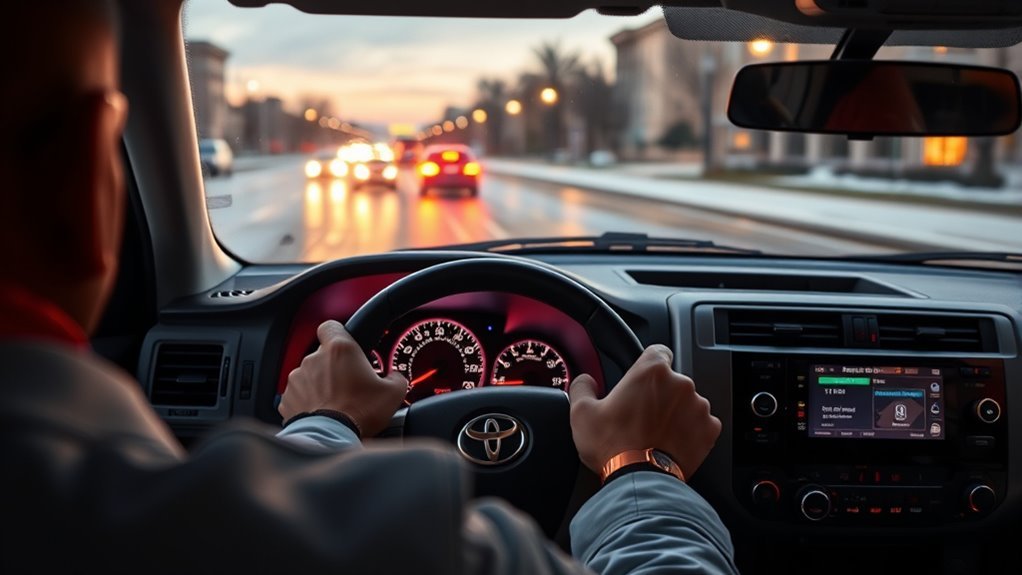
If the Light Comes On While Driving
- Stay calm and keep steering inputs smooth.
- Reduce speed gradually.
- Avoid hard acceleration, hard braking, and sudden lane changes.
- Find a safe place to stop and check tire pressure, visible damage, and warning messages.
- If ABS or brake warning lights are also on, treat it as a brake-system issue and get help promptly.
Frequently Asked Questions
Can I drive with the VSC light on?
You may be able to drive carefully if the 4Runner brakes and steers normally, but VSC/TRAC assistance may be reduced or unavailable. Avoid towing, off-roading, high speeds, rain, snow, and sudden maneuvers until the cause is diagnosed. If the brake warning light, ABS light, low brake fluid, or abnormal pedal feel is present, stop driving as soon as it is safe.
Should I keep VSC and TRAC on?
Yes. Keep VSC and TRAC on for normal pavement driving, rain, snow, highway use, and towing. Turn them off only when the owner’s manual or terrain conditions call for it, such as freeing the vehicle from deep mud, sand, or snow. Turn them back on when normal driving resumes.
What does it mean when the slip indicator flashes?
A flashing slip indicator usually means VSC, TRAC, ABS, or a related brake-control function is actively working because the tires are slipping or the vehicle is near its stability limit. Ease off the throttle, steer smoothly, and slow down.
Can low tire pressure trigger a VSC or TRAC warning?
Low tire pressure, mismatched tire sizes, uneven tread depth, and damaged wheels can contribute to stability-control warnings or unwanted intervention. Check tire pressure and tire condition before replacing electronic parts.
Will a regular OBD-II scanner read VSC codes?
Some basic OBD-II scanners read only engine and emissions codes. For VSC problems, use a scanner that can access ABS, brake, chassis, and skid-control systems for your 4Runner year.
Conclusion
Think of VSC as a stability assistant that works quietly until the 4Runner starts to slide, yaw, or lose traction. It uses sensors, ABS brake control, and torque reduction to help keep the vehicle on the path you intended. The system is valuable, but it depends on good tires, working brakes, accurate sensors, correct calibration, and safe driving decisions.
If the slip indicator flashes briefly, slow down and drive smoothly. If VSC, TRAC, ABS, or brake warnings stay on, diagnose the cause instead of ignoring the light. Start with tires and visible wiring, then read ABS/VSC codes with the right scanner. When the system is maintained and used correctly, it adds a meaningful layer of control on pavement, in bad weather, while towing, and on the trail.
Sources
- 49 CFR § 571.126, FMVSS No. 126 — federal ESC definition, equipment requirements, and malfunction telltale requirements.
- NHTSA, Evaluation of Electronic Stability Control: FMVSS No. 126, an Update — 2025 ESC effectiveness and rollover-crash risk reduction data.
- IIHS-HLDI, Life-saving benefits of ESC continue to accrue — ESC fatal-crash risk reduction discussion.
- Toyota 2025 4Runner Hybrid Driving Assist Systems — TRAC/VSC/Trailer Sway Control warnings and slip-indicator behavior.
- Toyota 2025 4Runner Hybrid Multi-Terrain Select — off-road mode behavior, including VSC OFF behavior in certain terrain modes.
- Toyota 2003 4Runner brochure and Toyota 2010 4Runner brochure — VSC/TRAC and Star Safety System availability references for U.S.-market vehicles.