What’s in This Article
- Is White Smoke From a Camry Urgent?
- Steam vs. Real White Smoke: How to Tell
- Most Common Camry Causes: Head Gasket, Cracked Head, Coolant in Cylinders
- Less Common Causes: Valve Seals, PCV, Intake, and EGR Issues
- Quick DIY Checks at Home (Coolant, Oil, Plugs, Radiator Cap)
- When to Stop Driving and Call a Mechanic
- What a Shop Will Run: Pressure Test, Compression/Leakdown, Dye, Borescope
- Repair Options and Typical Costs (Gasket, Head Work, Valve Seals, Engine Swap)
- Repair, Rebuild, or Replace? Questions to Ask Your Mechanic and Warranty Tips
- Frequently Asked Questions
- Conclusion
Steady white smoke from your Toyota Camry can turn into an expensive engine problem fast. Thick smoke after warm-up often points to coolant entering a cylinder through a failed head gasket, cracked cylinder head, or cracked block. This guide helps you tell normal cold-start steam from a real fault, check safe clues at home, and choose the right shop test or repair.
Quick Answer
If your Camry blows thick white smoke after the engine warms up, treat it as a possible coolant-in-cylinder problem. Check coolant level, oil condition, spark plug tips, and engine temperature first. Then ask a shop for a cooling-system pressure test, compression test, leak-down test, and combustion leak test before you approve major repairs.
Key Takeaways
- Brief white vapor on a cold start often means normal condensation.
- Thick white smoke after warm-up often means coolant has entered a combustion chamber.
- Low coolant, milky oil, overheating, and sweet-smelling exhaust need fast attention.
- Compression, leak-down, block, and pressure tests help confirm the real fault.
- A written diagnosis protects you from paying for the wrong repair.
Is White Smoke From a Camry Urgent?
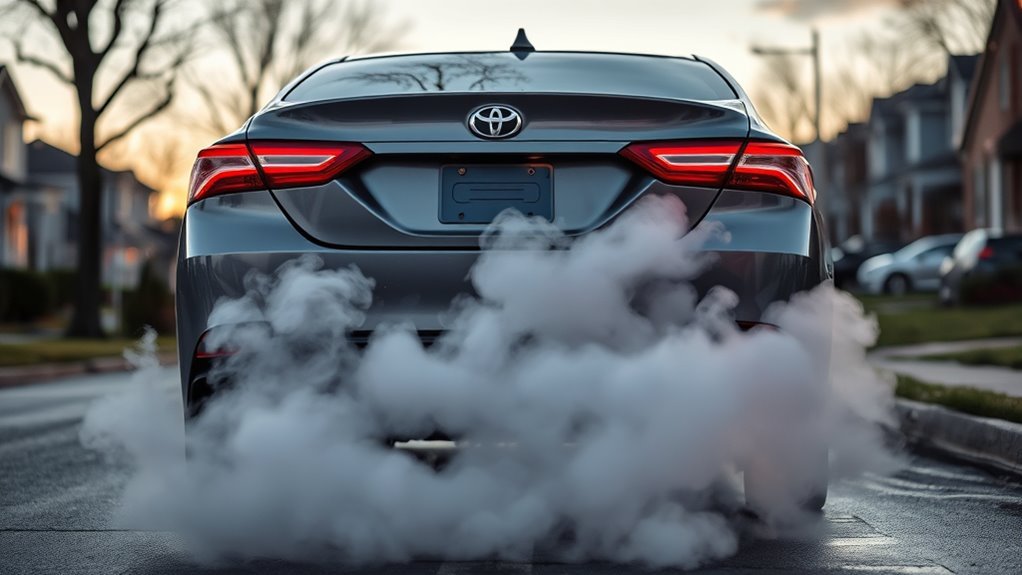
Persistent white smoke from your Camry deserves fast attention. According to major roadside-assistance guidance, continuous white exhaust smoke can point to coolant or water entering the combustion chamber through engine damage.
Start with the simple clues. Check the coolant level after the engine cools, look for milky or foamy oil, and watch the temperature gauge. Falling coolant, overheating, misfires, or thick smoke after warm-up all raise the risk.
Do not assume the problem will clear on its own. Continued driving can overheat the engine, warp metal parts, and turn a gasket repair into a larger engine repair.
Warning: Stop driving if your Camry overheats, loses coolant quickly, misfires badly, or produces thick white smoke after warm-up.
Steam vs. Real White Smoke: How to Tell
Cold-start steam and real white smoke can look similar for a few seconds. The difference comes from duration, odor, thickness, and coolant loss.
Normal steam usually clears as the exhaust warms. Thick white smoke that stays after warm-up, returns under throttle, or smells sweet needs diagnosis because coolant may have entered a cylinder.
Cold Start Steam
White vapor at startup often comes from condensation inside the exhaust. Cool, damp weather makes it more visible, and it should fade soon after the engine warms.
- Duration: It fades within a short time.
- Odor: It has little or no sweet coolant smell.
- Appearance: It looks light, wispy, and thin.
- Coolant level: It does not make the coolant level drop.
Persistent White Smoke
Thick white smoke after warm-up needs a different response. It often points to coolant entering the combustion chamber through a failed gasket, cracked head, or cracked block.
Watch for a sweet smell, rough idle, low coolant, overheating, or one spark plug that looks unusually clean or crusted. Ask for a compression test, leak-down test, and combustion leak test to confirm the fault before major work begins.
Most Common Camry Causes: Head Gasket, Cracked Head, Coolant in Cylinders
When steady white smoke continues after warm-up, focus first on internal coolant leaks. A failed head gasket, cracked cylinder head, or cracked block can let coolant reach the combustion chamber.
Check the repair history and engine type too. Toyota Technical Service Bulletin T-SB-0015-11 covers damaged cylinder head bolt threads on 2002-2006 four-cylinder Camrys with the 2AZ-FE engine.
Head Gasket Failure
A head gasket seals the space between the engine block and cylinder head. When it fails, coolant can enter a cylinder and burn as thick white exhaust smoke.
- Check: Look for low coolant, overheating, and a sweet exhaust smell.
- Inspect: Look for milky oil on the dipstick or under the oil cap.
- Test: Ask for compression, leak-down, and combustion leak tests.
- Confirm: Get written findings before you approve head gasket work.
Do not rely on one clue alone. A shop should match the symptoms with test results before it removes the cylinder head.
Cracked Cylinder Head
A cracked cylinder head can also let coolant enter a combustion chamber. You may notice steady white smoke, unexplained coolant loss, rough running, or overheating.
Prior overheating, low coolant, or cooling-system failure can damage the head. A good shop may use a pressure test, leak-down test, borescope inspection, and machine-shop checks to confirm cracks or warpage.
Cracked-head repairs can cost more than gasket-only work because they may require machining, pressure testing, valve work, or head replacement.
Less Common Causes: Valve Seals, PCV, Intake, and EGR Issues
Not every smoke problem means coolant has entered the engine. Some faults create white-gray or blue-gray smoke that drivers mistake for coolant smoke.
- Valve stem seals: Worn seals can let oil enter the cylinders, often causing smoke at startup or after idling.
- PCV system: A stuck positive crankcase ventilation (PCV) valve can pull oil vapor into the intake and cause oil smoke.
- Intake manifold gasket: Some intake leaks can affect coolant or air flow, depending on engine design.
- EGR system: Exhaust gas recirculation (EGR) faults can cause rough running, but they rarely explain thick white coolant smoke by themselves.
Use smoke color, odor, coolant level, and test results together. That approach helps you avoid replacing a head gasket when another system caused the symptom.
Quick DIY Checks at Home (Coolant, Oil, Plugs, Radiator Cap)
Start with simple checks before you approve a large repair bill. Only inspect the cooling system after the engine cools fully.
Check the coolant reservoir first. Low coolant, rapid loss, or oily coolant points toward a leak or internal contamination. Watch the temperature gauge during a short, safe drive only if the car runs smoothly and does not overheat.
Pull the oil dipstick and inspect the oil. Milky or foamy oil strongly suggests contamination, but it does not prove a head gasket failure by itself.
Inspect the spark plug tips if you can remove them safely. A plug that looks unusually clean, wet, or crusted may point to the cylinder that has coolant intrusion.
Warning: Never open a radiator cap while the engine is hot because pressurized coolant can burn you.
Check the radiator cap only when the engine has cooled. A weak cap can let pressure escape, lower the boiling point, and hide the real cooling-system problem.
When to Stop Driving and Call a Mechanic
Stop driving if the temperature gauge rises, the coolant level drops quickly, or the engine starts to misfire. Those signs can turn a repairable gasket leak into major engine damage.
Call a mechanic or arrange a tow if the smoke stays thick after warm-up. You should also stop if the heater stops blowing warm air, the dashboard shows a warning light, or the engine smells hot.
Brief cold-start vapor usually lets you monitor the car, but steady smoke needs testing. A written diagnosis gives you control before you spend money.
What a Shop Will Run: Pressure Test, Compression/Leakdown, Dye, Borescope
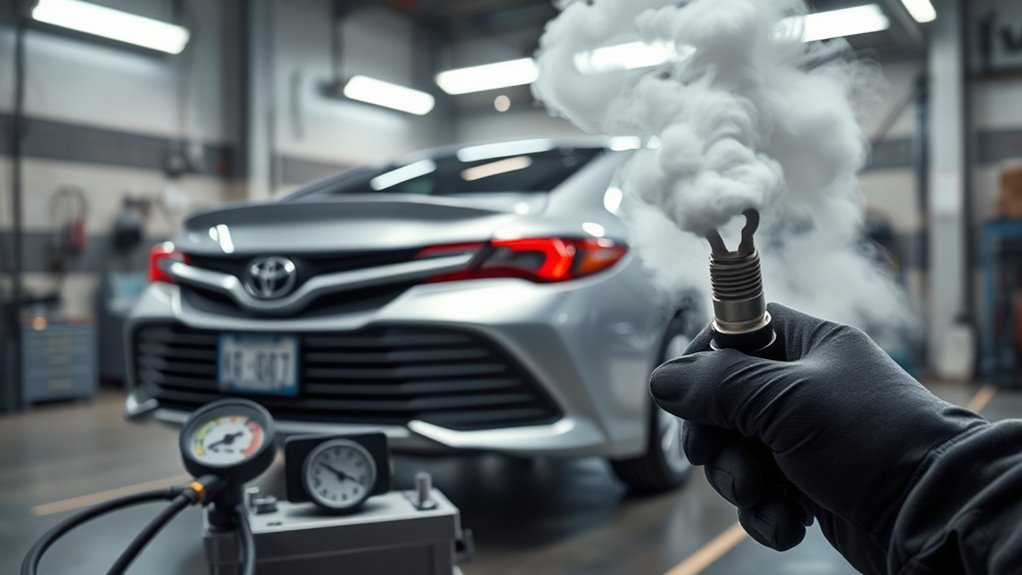
A good shop should test before it guesses. Ask the technician to explain which test points to which failure.
- Cooling-system pressure test: The shop pressurizes the cooling system and looks for pressure loss or leaks.
- Compression test: The shop measures each cylinder’s ability to build pressure during cranking.
- Leak-down test: The shop sends compressed air into a cylinder and checks where air escapes.
- Combustion leak test: The shop checks for combustion gases in the cooling system.
- Dye and borescope checks: The shop uses dye or a small camera to trace coolant paths and inspect cylinders.
Ask for written readings, photos, and the technician’s conclusion. Those records help you compare estimates and avoid repeat repairs.
Repair Options and Typical Costs (Gasket, Head Work, Valve Seals, Engine Swap)
Repair cost depends on the engine, damage level, labor rate, and parts quality. Use the table below as a planning guide, then ask local shops for written estimates.
| Repair route | When it fits | Cost context |
|---|---|---|
| Head gasket replacement | Tests confirm gasket failure, and the head and block can still seal. | RepairPal lists Toyota Camry head gasket replacement at about $2,688-$3,618 before taxes, fees, location changes, and related repairs. |
| Cylinder head replacement | Tests show a cracked or badly warped cylinder head. | RepairPal lists Toyota Camry cylinder head replacement at about $4,040-$5,123 before taxes, fees, and related repairs. |
| PCV valve replacement | The smoke looks oil-related, and crankcase ventilation tests show a fault. | RepairPal lists Toyota Camry PCV valve replacement at about $291-$422 before taxes, fees, and related repairs. |
| Intake manifold gasket replacement | Tests point to an intake gasket leak instead of a head gasket leak. | RepairPal lists Toyota Camry intake manifold gasket replacement at about $459-$616 before taxes, fees, and related repairs. |
| Valve stem seal work | The smoke looks blue-gray, and tests do not show coolant intrusion. | Costs vary widely because labor changes by engine design and whether the shop removes the cylinder head. |
| Engine replacement | The block has damage, the car has repeat failures, or repair cost exceeds the car’s value. | Remanufactured Camry long-block parts often start around $2,700-$3,000 before labor, core fees, fluids, and related parts. |
Note: Online cost estimators help you plan, but your final price depends on location, engine type, shop rate, and damage found during teardown.
If the test results show only a gasket leak, a head gasket repair may make sense. If the head has cracks or warpage, head replacement or machining can add major cost.
If the block has damage, compare engine replacement against the car’s value. Do not approve teardown work until you know how the shop handles surprise damage and warranty coverage.
Repair, Rebuild, or Replace? Questions to Ask Your Mechanic and Warranty Tips
Your best choice depends on the test results, the car’s value, and your plans for the vehicle. A low-mileage Camry in good shape may justify a larger repair more than a high-mileage car with several other problems.
- Ask which test proves the root cause.
- Request separate estimates for gasket repair, head work, and engine replacement.
- Ask what parts, fluids, machining, and labor the estimate includes.
- Confirm the parts and labor warranty in writing.
- Ask what happens if the shop finds block damage after teardown.
Do not choose the cheapest estimate by price alone. Choose the shop that gives clear test results, clear warranty terms, and a repair plan that matches the actual failure.
Frequently Asked Questions
How Much Does It Cost to Fix White Smoke From Exhaust?
Cost depends on the cause. A PCV or intake repair can cost far less than a head gasket, cracked head, or engine replacement.
RepairPal lists Toyota Camry head gasket replacement at about $2,688-$3,618 and cylinder head replacement at about $4,040-$5,123 before taxes, fees, location changes, and related repairs.
Can I Drive My Camry If It Has White Smoke?
You can monitor brief cold-start vapor if it clears quickly and the coolant level stays stable. Do not keep driving with thick white smoke after warm-up, overheating, low coolant, or rough running.
Does White Smoke Always Mean a Blown Head Gasket?
No. Cold condensation, oil smoke from valve seals, PCV faults, intake leaks, or fuel-related problems can also create visible exhaust smoke.
A blown head gasket becomes more likely when thick white smoke comes with coolant loss, overheating, milky oil, or combustion gases in the cooling system.
Why Does White Smoke Go Away After Startup?
White vapor that disappears after startup often comes from water condensation inside the exhaust. Cool and damp weather makes this normal vapor more visible.
If the smoke returns after warm-up or under acceleration, treat it as a possible engine fault.
What Test Confirms Coolant Is Entering a Cylinder?
No single visual clue confirms the problem every time. A shop may combine a cooling-system pressure test, compression test, leak-down test, combustion leak test, and borescope inspection.
Ask for the results in writing before you approve head gasket or engine work.
Safety Disclaimer: This article gives general car care information only. It does not replace inspection from a qualified mechanic. Stop driving and get professional help if your Camry overheats, loses coolant quickly, misfires, or shows steady white smoke after warm-up.
Conclusion
Steady white smoke after warm-up means you should treat your Camry like it has a coolant-intrusion problem until tests prove otherwise. Start with coolant, oil, spark plug, and temperature checks, then ask a shop for pressure, compression, leak-down, and block-test results.
Compare repair estimates against the car’s value before you approve major work. A clear diagnosis helps you avoid repeat repairs and keeps your Camry safer and more reliable.
References
- White car exhaust smoke: what does it mean and how to fix it – The AA, 2024
- Why is white smoke coming from my car exhaust? – RAC, 2025
- Toyota Camry Head Gasket Replacement Cost – RepairPal
- Toyota Camry Cylinder Head Replacement Cost Estimate – RepairPal
- Toyota Camry Intake Manifold Gasket Replacement Cost – RepairPal
- Toyota Camry PCV Valve Replacement Cost – RepairPal
- Toyota Technical Service Bulletin T-SB-0015-11: Cylinder Head Bolt Threads Damaged (2AZ-FE) – Toyota Motor Sales USA, 2011
- How to do a leak-down test – Mobil