Last updated: September 16, 2026. Reviewed against current Toyota, U.S. EPA, federal emissions-warranty, and California Air Resources Board guidance.
The Toyota Camry’s federal emissions warranty can cover qualifying emissions repairs, but there are three different numbers to understand. Federal law generally requires 2 years or 24,000 miles of emissions defect and performance coverage. Toyota extends some emissions-defect protection through its 3-year/36,000-mile Basic Warranty, and specified major emissions components can receive 8 years or 80,000 miles of coverage. Your Camry’s model year, in-service date, mileage, failed component, emissions certification, and state rules determine which coverage applies.
Quick Answer
The Toyota Camry federal emissions warranty generally provides 2 years or 24,000 miles of federal emissions coverage. Toyota’s Basic Warranty extends certain emissions-defect coverage to 3 years or 36,000 miles. Federal law provides 8-year/80,000-mile protection for specified major components including the catalytic converter, electronic emissions-control ECU or computer, and onboard emissions diagnostic device or computer. Always confirm the exact component in your model-year Toyota Warranty & Maintenance Guide.
Key Takeaways
- Federal emissions coverage generally starts from the vehicle’s original in-service date, not the date you notice a problem or buy the Camry used.
- The EPA identifies the catalytic converter, electronic emissions-control ECU or computer, and onboard emissions diagnostic device or computer as the three specified major components subject to federal 8-year/80,000-mile coverage.
- Toyota’s model-year warranty parts list may mark additional specific components “8/80,” so use the booklet for the final part-by-part determination.
- A failed EPA-approved emissions test can trigger the Emission Performance Warranty when the other federal claim conditions are met.
- Coverage can be denied when the failure was caused by misuse, lack of required maintenance, improper repairs, or a non-equivalent replacement part rather than a covered defect.
- California-certified Camrys may have separate California emissions coverage, so check the warranty guide for your exact model year and emissions certification.
Coverage at a Glance
| Federal Emission Defect Warranty | Generally 2 years/24,000 miles; Toyota’s Basic Warranty provides 3 years/36,000 miles for covered defects |
| Federal Emission Performance Warranty | Generally 2 years/24,000 miles when an EPA-approved emissions-test failure meets the claim conditions |
| Specified Major Components | 8 years/80,000 miles for qualifying components |
| California Emissions Coverage | Different terms can apply, including 3 years/50,000 miles and 7 years/70,000 miles for qualifying California-covered vehicles and parts |
What Does the Federal Emissions Warranty Cover on a Toyota Camry?
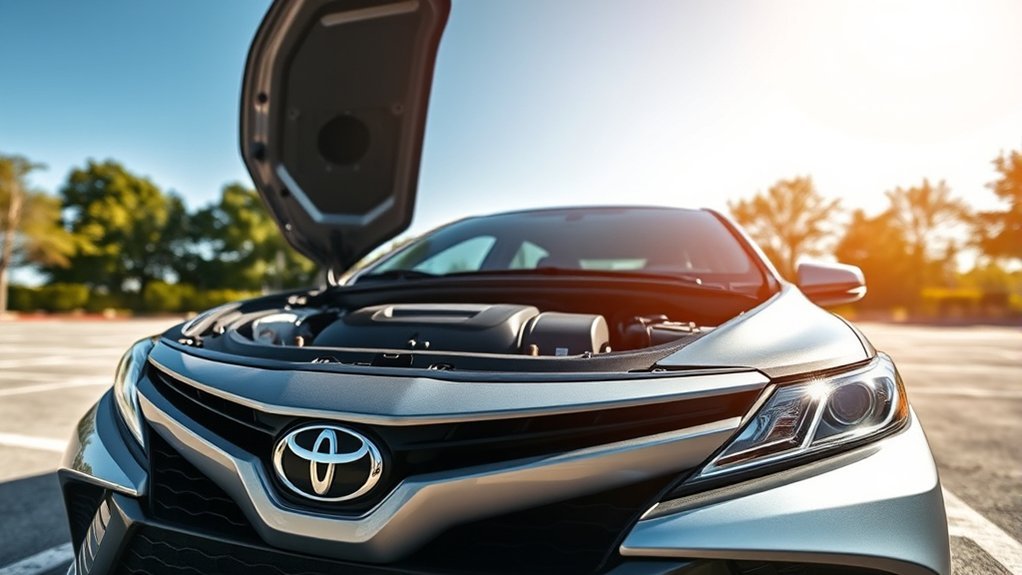
The federal emissions warranty is a legally required warranty designed to ensure that your Toyota Camry meets federal emissions requirements. Federal law provides two related protections: an Emission Defect Warranty for covered components that fail because of a defect, and an Emission Performance Warranty for qualifying failures of an EPA-approved emissions inspection.
For most light-duty vehicles, the federal minimum is 2 years or 24,000 miles. Toyota’s Camry Warranty & Maintenance Guide states that its Basic Warranty provides 3 years or 36,000 miles of defect coverage even though the federal minimum is shorter. Specified major emissions components receive longer protection of 8 years or 80,000 miles, whichever comes first.
The U.S. EPA identifies three federally specified major emissions-control components for this longer term: the catalytic converter, the electronic emissions-control unit or computer, and the onboard emissions diagnostic device or computer. Toyota’s model-year warranty parts list may also mark specific associated components “8/80,” so the booklet for your exact Camry remains the final vehicle-specific reference.
You can confirm your exact model-year coverage through the Toyota Owners manuals and warranties page or the warranty booklet that came with your vehicle.
Note: Warranty time and mileage are counted from the Camry’s in-service date, which is generally when the vehicle was first delivered to the original buyer or first placed into service. Buying the Camry used does not restart the warranty clock.
Toyota Camry Federal Emissions Warranty Coverage Periods
Not every emissions-related part receives the same coverage. Separate the general federal warranty, Toyota’s Basic Warranty overlap, the Emission Performance Warranty, and the longer 8/80 protection for specified components.
| Warranty Area | Typical Coverage | What It Means |
|---|---|---|
| Federal Emission Defect Warranty | 2 years or 24,000 miles | Federal minimum for emissions-related parts that fail because of a covered defect in materials or workmanship. |
| Toyota Basic Warranty overlap | 3 years or 36,000 miles | Toyota provides longer defect coverage than the 2/24 federal minimum for qualifying defects under its Basic Warranty. |
| Federal Emission Performance Warranty | 2 years or 24,000 miles | Applies when the vehicle fails an EPA-approved emissions test and the other performance-warranty conditions are met. |
| Specified major emissions components | 8 years or 80,000 miles | Federal extended coverage applies to the catalytic converter, electronic emissions-control ECU/computer, and onboard emissions diagnostic device/computer; Toyota’s parts list identifies the exact 8/80 items for the model year. |
Federal emissions rules establish the 2-year/24,000-mile and 8-year/80,000-mile framework for qualifying light-duty vehicles. The U.S. EPA emissions-warranty guidance explains the two federal warranties and the three specified major emissions-control components. Toyota’s own Camry Warranty & Maintenance Guide explains how the coverage applies to Toyota’s listed parts.
Is My Camry Still Covered Under the Emissions Warranty?
Use four checks before authorizing a paid emissions repair. First, determine the Camry’s in-service date and current mileage. Second, identify whether you have a normal defect claim or a qualifying failed-emissions-test claim. Third, get the exact name of the failed component and see whether Toyota marks it for 8/80 coverage. Fourth, check whether a California emissions warranty applies to your vehicle.
- Check age and mileage together. Warranty coverage ends when either the time limit or mileage limit is reached.
- Identify the type of claim. A defective emissions component and a failed inspection can fall under different warranty provisions.
- Identify the exact failed part. “Emissions system problem” is not specific enough to determine whether 2/24, Toyota 3/36, 8/80, or another warranty applies.
- Check the vehicle’s emissions certification and state coverage. California-certified vehicles can have additional warranty protection.
Pro Tip: Before approving a catalytic-converter, ECU, OBD, oxygen-sensor, or other emissions repair, ask for the failed component by name and compare it with the emissions warranty parts list in your Toyota booklet.
[Products Worth Considering]

This oxygen O2 sensor set is designed for select Toyota Camry and RAV4 models with 2.4L engines, providing upstream and downstream replacement coverage in one package. Built to OEM specifications for plug-and-play installation, it helps improve fuel efficiency, support accurate air-fuel monitoring, and restore reliable engine performance. The stainless steel and heat-resistant construction is made for long-lasting durability and stable operation.

The ANCEL AD310 is a compact, easy-to-use OBD II code reader designed to help drivers quickly identify check engine light causes, read and clear fault codes, and review key vehicle data. It supports major OBD2 protocols and works with many 1996-and-newer cars, light trucks, SUVs, and other OBD2 vehicles. Built for fast diagnostics at home or on the go, it runs directly from the vehicle and provides clear results on a large screen.

This A-Premium cartridge engine oil filter is designed for a wide range of Toyota and Lexus vehicles, helping support cleaner oil flow and dependable engine protection. With high filtration efficiency and included O-rings, it offers a practical replacement solution for routine maintenance. Built for extended service intervals, it is suitable for conventional or synthetic oil applications.
Which Toyota Camry Emissions Components Are Covered?
The Toyota Camry’s federal emissions warranty can cover parts that control, monitor, or reduce emissions. The exact parts list varies by model year, and not every listed emissions component receives the same warranty duration.
Common covered systems can include:
- Air/fuel metering components, including listed electronic fuel-injection and engine-control components.
- Catalyst system parts, including the catalytic converter and other catalyst-system components listed in the warranty guide.
- Evaporative emissions parts, such as the charcoal canister, fuel filler cap, and listed fuel-system components.
- Ignition and PCV system parts, including listed ignition components, PCV valves, caps, hoses, clamps, and fittings.
- Onboard diagnostic-related parts, including listed diagnostic and malfunction-indicator components.
- Hybrid emissions-related components when the applicable Camry warranty guide lists them under federal or California emissions coverage.
Do not assume every emissions-related component receives 8-year/80,000-mile coverage. Federal law specifies three major component categories for 8/80 protection, while Toyota’s model-year parts list identifies the exact components it marks “8/80.”
[Products Worth Considering]

This silicone key fob cover is designed to fit select Toyota Camry and Corolla Crown 4-button key fobs, helping protect them from scratches, wear, and everyday pocket damage. Made from food-grade silicone, it offers a soft, comfortable feel while keeping all buttons accessible and the signal unaffected. The fluorescent white buttons also make it easier to identify controls at night, and the set includes two covers with matching key chains.

Walker 36454 is a spring bolt kit designed to help secure exhaust components and maintain a tight, leak-resistant connection. It is made for ball and socket joint applications and uses durable materials for long-lasting performance. This hardware is a practical choice for exhaust repairs and compatible replacement needs on select vehicles.

This engine oil filler cap is a direct replacement designed for a wide range of Toyota, Lexus, and Scion vehicles. It helps restore a secure seal, supports reliable engine operation, and is made for easy installation with compatible factory fitment. Multiple part numbers are referenced to help ensure the correct match before ordering.
What Does the 8-Year/80,000-Mile Emissions Warranty Cover?
For most Toyota Camry owners, the key numbers are 2 years/24,000 miles for general federal emissions coverage, 3 years/36,000 miles for qualifying defects covered by Toyota’s Basic Warranty, and 8 years/80,000 miles for specified major emissions components and other components Toyota explicitly marks 8/80 in its applicable parts list.
The EPA identifies the catalytic converter, electronic emissions-control ECU or computer, and onboard emissions diagnostic device or computer as the three specified major federal components. An oxygen sensor or air/fuel-ratio sensor is therefore not automatically entitled to federal 8/80 coverage simply because it is an emissions part. Check Toyota’s model-year parts list and any other applicable Toyota or state warranty before paying for the repair.
If your Camry is inside the applicable 8-year/80,000-mile window and the failed component qualifies, contact an authorized Toyota dealership before authorizing paid work elsewhere. EPA guidance says owners seeking manufacturer-paid federal emissions warranty repairs should give an authorized manufacturer facility the opportunity to diagnose and repair the condition.
[Products Worth Considering]

This key fob shell is a replacement case and button pad designed to refresh worn or damaged Toyota remote housings. It fits select Camry, Corolla, RAV4, and Highlander models and installs without programming when you transfer your existing electronics and battery. It is a simple way to restore the look and function of your keyless entry remote.

NGK Iridium IX spark plugs are designed to deliver a stable spark, reliable ignition, and long-lasting performance for compatible Toyota Camry 2.5L engines. The fine-wire iridium center electrode helps improve durability and efficient combustion, making these plugs a smart replacement choice for maintaining smooth engine operation. Sold in a convenient four-pack, they are built for consistent performance and dependable fitment.

This replacement gas cap is designed for a wide range of Toyota and Lexus vehicles, offering a direct-fit solution for worn, cracked, or failing fuel caps. Built from durable materials and tested for reliability, it helps restore a secure seal and supports dependable everyday driving. It is a practical replacement part for owners looking for an easy installation and broad vehicle compatibility.
Federal vs. California Emissions Warranty
Some Toyota Camry vehicles are also covered by a California Emission Control Warranty. This generally depends on the vehicle’s emissions certification and the requirements that apply where the vehicle is sold, registered, or operated. Use the warranty guide for the exact model year rather than assuming every Camry in a CARB state has identical coverage.
Current California Air Resources Board guidance lists 3 years or 50,000 miles for general California emissions defects and performance coverage and 7 years or 70,000 miles for specified high-cost emissions-related parts. The exact high-cost parts are identified in the applicable owner or warranty documentation.
CARB also lists enhanced 15-year/150,000-mile emissions coverage for vehicles certified to specified PZEV and TZEV standards, but its current guidance identifies those standards for 2001–2017 PZEV and 2018–2025 TZEV vehicles. Do not assume that enhanced term automatically applies to a 2026 Camry; check the vehicle’s emissions certification and its model-year warranty guide.
The California Air Resources Board publishes current emissions-warranty period guidance and specifically advises owners to use their vehicle documentation for exact coverage.
When Does the Emission Performance Warranty Apply?

A performance-warranty claim is different from a normal defect claim. The federal Emission Performance Warranty can apply when your Camry fails an EPA-approved emissions test, the vehicle remains within the applicable warranty limit, the government requires the emissions problem to be corrected, and the other federal claim conditions are met.
A check-engine light by itself does not automatically create a performance-warranty claim. The dealership still has to identify the cause and determine which warranty, if any, covers the failed component. If the failure was caused by misuse, improper maintenance, or another excluded cause rather than a covered defect, warranty coverage can be denied.
How Long Does the Emission Performance Warranty Last?
Federal emissions performance coverage is generally 2 years or 24,000 miles. Qualifying specified major emissions components can receive 8 years or 80,000 miles. Toyota’s separate Basic Warranty can also provide 3 years or 36,000 miles of coverage for qualifying emissions-related defects, although that Basic Warranty is distinct from the federal Emission Performance Warranty.
Do You Need Maintenance Records for an Emissions Warranty Claim?
You are responsible for performing the required maintenance in your Owner’s Manual and Warranty & Maintenance Guide. Toyota states that it will not deny a warranty claim solely because you do not have maintenance records. However, a failure caused by lack of maintenance or improper repairs is not covered.
Keep maintenance records when possible because they make a disputed claim easier to document. Use the correct fuel, fluids, and service procedures for your model year, and retain receipts for maintenance and emissions-related repairs.
What Can Cause Emissions Warranty Coverage to Be Denied?
Coverage can be affected when the emissions failure was caused by misuse, lack of required maintenance, improper repair, tampering, or replacement parts that are not equivalent in quality or design. Toyota also states that routine maintenance and paid repairs do not have to be performed at a Toyota dealership, but damage caused by improper maintenance or repair is not covered.
Warning: Do not remove, bypass, or defeat emissions-control equipment to avoid a repair. Tampering can create legal and inspection problems and can affect warranty eligibility when the modification causes the failure.
Does Independent Maintenance Void a Toyota Emissions Warranty?
No. Toyota’s warranty guidance says paid maintenance and repairs may be performed by you or by an automotive service provider you choose. Toyota also says it will not deny a warranty claim solely because you used a non-Toyota service provider or lack maintenance receipts.
However, warranty coverage does not extend to a failure caused by improper maintenance or repair. Good documentation therefore helps establish what work was performed and makes it easier to separate a covered defect from maintenance-related damage.
Useful maintenance habits include:
- Following Toyota’s mileage- and time-based maintenance schedule.
- Using the correct engine oil, fuel, filters, fluids, and service specifications for the model year.
- Keeping receipts from Toyota dealers, independent shops, or do-it-yourself maintenance when available.
- Diagnosing emissions warning lights rather than repeatedly clearing diagnostic trouble codes.
- Using replacement parts that are suitable and equivalent in quality and function for the application.
You do not have to use a Toyota dealership for routine maintenance. If you want Toyota to pay for a repair under the federal emissions warranty, however, EPA guidance says you should present the vehicle to a manufacturer-authorized facility so the manufacturer has an opportunity to diagnose and repair it.
How Do You File a Toyota Camry Emissions Warranty Claim?
If your Toyota Camry has an emissions problem, check coverage before authorizing an expensive repair. The key facts are the vehicle’s in-service date, current mileage, exact failed component, emissions certification, and whether the claim involves a normal defect or a failed approved emissions test.
- Check your warranty booklet. Find the Federal Emission Control Warranty section and compare your mileage, in-service date, and failed part with the listed coverage.
- Collect your records. Bring your VIN, current mileage, maintenance receipts if available, diagnostic trouble codes, repair estimates, and any emissions-test report.
- Contact an authorized Toyota dealership. Explain that you want the issue reviewed under the federal emissions warranty or, if applicable, the California emissions warranty.
- Present the emissions test report if the vehicle failed. Toyota instructs owners making an Emission Performance Warranty claim to bring a copy of the EPA-approved test report and maintenance records if available.
- Ask for a written explanation if coverage is denied. Identify the failed component, the stated reason for denial, and the warranty provision or exclusion being applied.
Toyota’s Camry warranty guidance states that a qualifying emissions performance claim is to be repaired within 30 days unless a shorter period is required by law or a permitted delay applies.
What Should You Do If Your Camry Fails an Emissions Test?
If your Toyota Camry fails an emissions test, keep the report and check warranty coverage before authorizing paid repairs. A qualifying failure can fall under the Emission Performance Warranty when the vehicle is inside the applicable time and mileage limits and the federal claim conditions are satisfied.
Use this checklist:
- Keep the failed test report. Toyota may need it to process an Emission Performance Warranty claim.
- Check the mileage and in-service date. Compare both with the applicable 2/24, Toyota 3/36, or 8/80 coverage.
- Identify the failed component. Ask for the exact diagnosis rather than relying only on a trouble code.
- Check the warranty parts list. Determine whether Toyota marks that component 8/80 or covers it under another applicable warranty.
- Schedule diagnosis with Toyota before paying elsewhere. Give an authorized Toyota dealership the opportunity to review a potentially covered condition.
- Keep the paperwork. Save the test report, diagnostic printout, dealer repair order, invoices, and any written coverage decision.
Federal Emissions Warranty vs. Other Toyota Warranty Coverage
The federal emissions warranty is separate from Toyota’s Basic, powertrain, hybrid-system, hybrid-battery, corrosion, and optional service-contract coverage. A repair that falls outside one warranty can sometimes qualify under another Toyota warranty, depending on the failed component, cause, vehicle age, and mileage.
For that reason, do not stop after checking only the 2-year/24,000-mile federal period. Toyota specifically states that its Basic Warranty provides 3-year/36,000-mile protection for qualifying defects, and some components can have longer protection under other applicable warranty provisions.
Note: Ask the dealership which warranty category was checked before accepting a paid repair. The same component may need to be reviewed under federal emissions, California emissions, Basic, powertrain, or hybrid coverage depending on the vehicle.
Frequently Asked Questions

What is covered under a Toyota Camry emissions warranty?
Covered parts can include components in the air/fuel metering, catalyst, evaporative-control, ignition, PCV, onboard-diagnostic, and other emissions systems listed in Toyota’s model-year warranty guide. Coverage periods differ by component, so being an emissions-related part does not automatically mean it receives 8-year/80,000-mile coverage.
How many miles is the federal emissions warranty good for?
General federal emissions coverage is usually 2 years or 24,000 miles. Toyota’s Basic Warranty provides 3 years or 36,000 miles for qualifying defects, while specified major emissions components can receive 8 years or 80,000 miles.
Does the catalytic converter have an 8-year/80,000-mile warranty?
Yes. The catalytic converter is one of the three specified major emissions-control components the EPA identifies for federal 8-year/80,000-mile coverage, subject to the warranty conditions and applicable time and mileage limits.
Is a Toyota Camry oxygen sensor covered for 8 years or 80,000 miles?
Not automatically under the federal 8/80 rule. EPA identifies the catalytic converter, electronic emissions-control ECU or computer, and onboard emissions diagnostic device or computer as the three specified major federal components. Check Toyota’s parts list and other applicable warranties for the exact oxygen or air/fuel-ratio sensor on your model year.
Does the federal emissions warranty apply to a used Toyota Camry?
Yes. EPA guidance states that the federal emissions warranties apply to used vehicles as well. Buying the Camry used does not restart the coverage period; the original warranty time and mileage limits still apply.
Do I need maintenance records to use the emissions warranty?
You should keep and bring maintenance records when available, but Toyota states that a warranty claim will not be denied solely because you do not have records. A failure caused by lack of required maintenance or improper repairs can still be excluded.
How do I use a federal emissions warranty after a failed emissions test?
Keep the failed EPA-approved emissions-test report and take your Camry to an authorized Toyota dealership with your VIN, mileage, and available maintenance records. Ask the dealer to review the failure under the Emission Performance Warranty before authorizing paid repairs.
Does California emissions warranty coverage change the rules?
It can. Current CARB guidance lists 3-year/50,000-mile emissions defects and performance coverage and 7-year/70,000-mile protection for specified high-cost parts on qualifying California-covered vehicles. Enhanced PZEV/TZEV terms have separate certification and model-year requirements, so check the warranty guide for your exact Camry.
Conclusion
The Toyota Camry’s federal emissions warranty is easiest to understand as three main coverage levels: the 2-year/24,000-mile federal minimum, Toyota’s 3-year/36,000-mile Basic Warranty overlap for qualifying defects, and 8-year/80,000-mile protection for specified major emissions components and other parts Toyota explicitly marks 8/80.
Before paying for a catalytic converter, ECU, OBD, oxygen-sensor, or other emissions repair, identify the exact failed component, check the Camry’s in-service date and mileage, review the model-year Warranty & Maintenance Guide, and give an authorized Toyota dealership the opportunity to review a potentially covered repair. California-certified vehicles should also be checked for separate state emissions warranty coverage.
Sources
- Toyota 2025 Camry Warranty & Maintenance Guide — federal emissions warranty periods, Toyota Basic Warranty overlap, 8/80 parts list, maintenance responsibilities, and claim procedures.
- Toyota Owners Manuals and Warranties — Toyota’s model-year Camry warranty and owner-document resource.
- U.S. EPA Transportation Emissions Warranty FAQ — federal Emission Performance and Design and Defect warranties, used-vehicle applicability, claim conditions, and specified 8/80 components.
- 40 CFR § 85.2103 — federal emissions warranty requirements.
- California Air Resources Board Emissions Warranty Periods — current California emissions-warranty periods and PZEV/TZEV guidance.