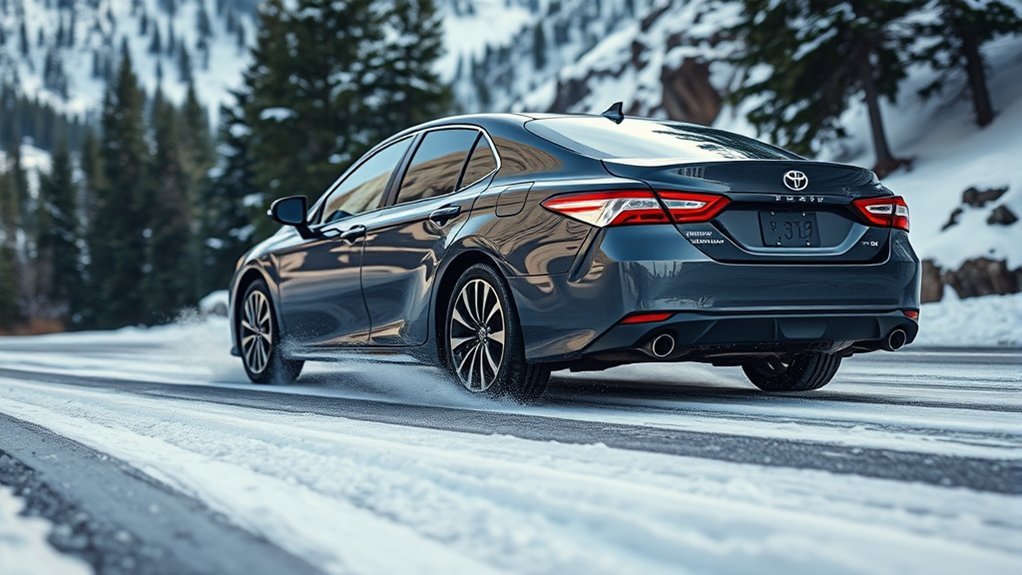
The Toyota Camry AWD gives you noticeably better traction than FWD on snow and mud by routing torque rearward via a mechanical drive linkage and quick traction-control braking pulses. Tests show it maintains forward motion in low-traction starts and diagonal slips, but limited ground clearance and sporty trims reduce deep-snow capability. Use winter tires, correct pressure, and balanced loading for best results. Keep going and you’ll find detailed test notes, limits, and practical tips to improve winter performance.
Quick Verdict : Camry AWD in Snow and Mud
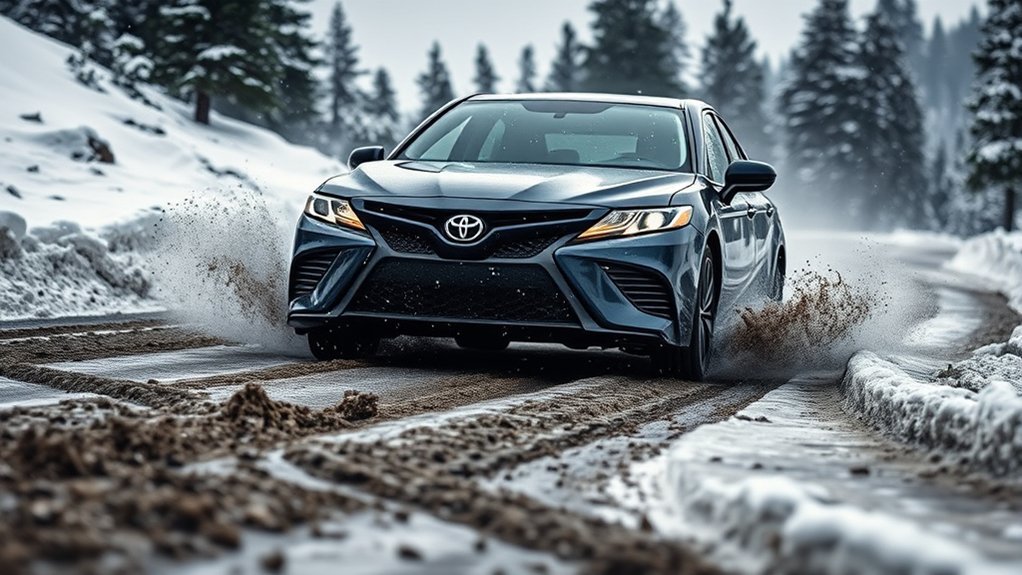
One clear takeaway: the Camry AWD gives you noticeably better traction in snow and mud than its FWD counterpart. You’ll feel the difference because the AWD system shifts torque rearward when needed, improving snow performance and mud handling during low-traction starts. TFL Slip Tests showed the Camry can move where FWD variants struggle, confirming the traction control and instant torque from the 2.5‑liter engine boost responsiveness in slippery conditions. You should still prioritize tires and maintenance: winter tires and correct pressure matter more than drivetrain alone. Also consider trim and ground clearance—sporty lowers can compromise capability in deep snow, so choose a standard trim if you want reliable winter mobility. Finally, weight distribution affects grip, so avoid unnecessary loads that disrupt balance. Taken together, the Camry AWD gives you pragmatic, evidence-based gains in traction, but you’ll get the most liberation from it by pairing the system with proper tires and upkeep.
How Camry AWD Works (Non-Hybrid 2.5L Mechanical System)
You’ll see that the Camry’s non-hybrid 2.5L uses a purely mechanical rear drive linkage to send torque to the rear wheels without electric assist. The system works with the traction-control software to shift power front-to-rear immediately when wheel slip is detected, improving control in diagonal and three-wheel slip scenarios. Keep in mind that lower-ground-clearance sporty trims may limit how well that mechanical setup performs in severe snow or deep ruts.
Mechanical Rear Drive Linkage
Because the Camry’s AWD uses a mechanical rear drive linkage, the 2.5L non-hybrid sends engine torque to the rear axle without electric assist, giving you predictable traction on slippery surfaces. You benefit from mechanical advantages: the direct drivetrain path reduces lag and preserves all wheel efficiency when conditions demand grip. The engine’s torque engages the rear wheels through a robust coupling and driveshaft arrangement, improving acceleration response in snow or mud. Test data and field reports show consistent power distribution across varied traction scenarios, underlining reliability. You should maintain the linkage—inspecting joints, seals, and fluid—to retain peak performance. This mechanical system frees you from complexity while delivering straightforward, durable traction control in adverse weather.
Traction Control Behavior
When traction drops, the Camry’s mechanical AWD and traction-control system work together to route torque where it’s most effective, engaging the rear axle through the drive linkage and modulating wheel slip via brake intervention and engine torque reduction. You’ll feel the system act in low-grip road conditions: sensors detect slip, the brakes pulse to slow a spinning wheel, and the engine trims torque while the linkage sends power rearward. Tests show this prevents stalls and sustains momentum in snow, mud, and diagonal slip scenarios. Maintain tires and service to keep freedom on slippery routes. Key takeaways:
- Traction control limits wheel spin quickly.
- Mechanical linkage supplies rear torque without electric assist.
- Instant torque aids responsiveness despite modest horsepower.
TFL Slip-Test Results: What the Tests Actually Showed
You’ll see in the roller front-wheel test that the Camry’s traction control engaged and the car moved despite the front wheels spinning on rollers. The diagonal slip outcome showed the AWD mechanically shifted torque to the planted wheel, preserving forward motion when one side lost grip. Taken together, the power distribution response confirms effective torque transfer for typical snowy scenarios, though limited ground clearance can constrain real-world performance in deep snow.
Roller Front-Wheel Test
The roller front-wheel test puts the Camry AWD’s front wheels on spinning rollers while the rear wheels grip solid pavement, simulating a common slippery scenario and showing how the system reacts under asymmetric traction. You see clear roller test advantages: the traction control intervenes, the mechanical linkage shifts torque rearward, and the car still moves under control, proving capability for everyday adverse weather. You should also note roller test limitations: it isolates front-slip conditions and doesn’t replicate all real-world angles or surface variance. Results remain evidence-based and liberating: they confirm a functional AWD that hands you predictable control when roads betray you. Key takeaways:
- Traction control engaged successfully.
- Torque moved rearward effectively.
- Test scope was limited.
Diagonal Slip Outcome
Although conditions were deliberately unbalanced, the diagonal slip test clearly showed the Camry AWD keeping forward momentum: traction control engaged, the mechanical linkage routed torque to the rear wheels, and the car continued moving despite one axle losing grip. You see that in simulated snowy streets the system restored usable snow traction quickly, engaging rear-drive assistance when the front lost adhesion. You can count on AWD performance to prevent stall and maintain steady progress where two-wheel drive would struggle. The evidence shows the traction control algorithms plus mechanical coupling delivered measurable forward movement and stability without electronic overcompensation. For drivers seeking freedom from winter constraints, the Camry’s AWD gives tangible liberation—predictable, repeatable control and improved mobility in marginal conditions.
Power Distribution Response
Because traction control and the mechanical rear-drive coupling kicked in quickly during TFL’s slip tests, you can see how the Camry’s AWD routes torque to where it’s needed and sustains forward motion on snow and mud. You learn that traction management isn’t theoretical here — it’s mechanical, immediate, and tailored to maintain momentum when the front wheels lose grip. The rear linkage provides consistent engagement, improving driving dynamics in diagonal and front-slip scenarios. Tests showed limits in extreme conditions, but overall power distribution supported stability.
- Front-slip: rear wheels held traction, vehicle advanced.
- Diagonal-slip: AWD adapted torque split for balance.
- Mechanical coupling: predictable rear engagement, reliable response.
Which Wheel-Slip Scenarios Camry AWD Handles Best
In diagonal-slip and front-wheel-on-rollers scenarios, you’ll see the Camry AWD engage traction control and its mechanical rear linkage to redistribute torque and keep the car moving through simulated snow or slush. You’ll notice this system addresses common winter challenges by shifting drive to the rear wheels when the front ones lose bite, a clear traction enhancements benefit proven in diagonal-slip tests. During TFL’s front-on-rollers assessment the car achieved forward motion where a front-drive model might stall. The mechanical linkage and instant torque from the 2.5‑liter engine combine to restore propulsion quickly, helping you maintain momentum on packed snow, slushy streets, or muddy patches. That responsiveness means fewer stalled attempts and more predictable exits from low-traction spots. You can thus rely on Camry AWD for everyday winter avoidance of minor slide situations and mixed-surface confidence, while still choosing options and driving technique suited to liberated, capable winter mobility.
What Camry AWD Can’t Do: Clearance, Trims, and Severe-Winter Risks
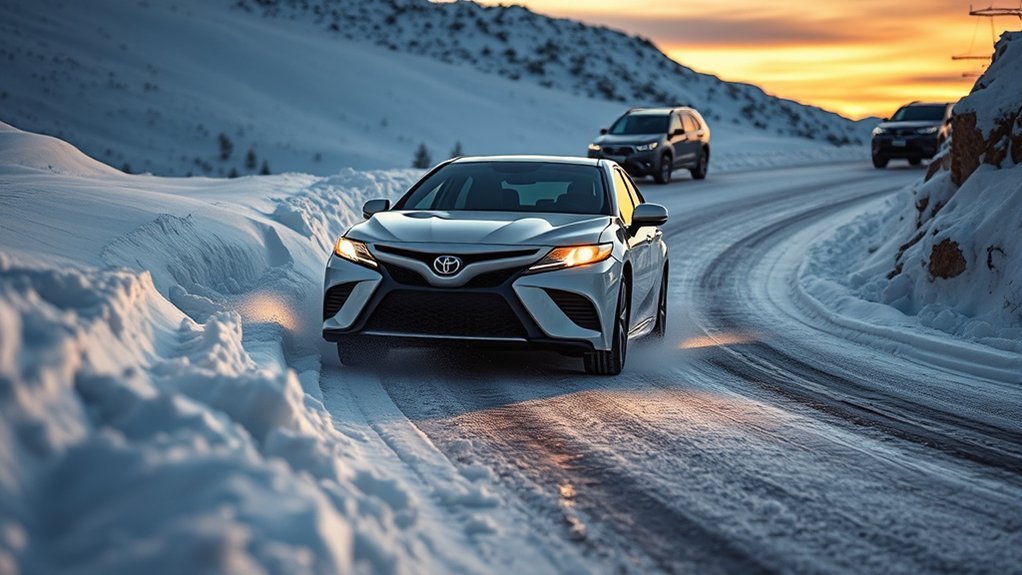
While Camry’s AWD helps in moderate slick spots, it can’t overcome low ground clearance or the limits of a mechanical torque-split system in severe winter conditions. You should know the system aids traction, but ground clearance remains limited; deep snow can stall progress or trap the vehicle. Sporty trims lower ride height for handling, so they worsen winter performance compared with standard trims. The mechanical AWD sends torque rearward when slip is detected, yet it won’t match the instant, zonal torque control of some electric/hybrid systems in extreme ice and deep-snow scenarios.
- Expect reduced capability in deep snow due to limited ground clearance and lower-trim compromises.
- Sport-oriented Camrys sacrifice ride height; they’re less suited for harsh winter roads.
- Mechanical torque-split AWD improves traction, but can’t prevent rear-wheel slip in very severe conditions.
You’re empowered to choose freedom on winter roads, but respect these physical and mechanical limits to avoid getting stuck or risking safety.
Tires, Weight Distribution, and Maintenance to Improve Traction
You can boost a Camry AWD’s on-road grip more effectively through tires, weight distribution, and routine maintenance than by relying on the drivetrain alone. Choose tire types suited to conditions: quality all-season tires improve year-round grip, while dedicated winter tires deliver markedly better traction in snow and ice. Keep tire pressure within spec and rotate tires regularly to prevent uneven wear that undermines traction and AWD effectiveness.
Mind load balance: distribute cargo and passengers to preserve even weight over the axles so all tires maintain contact and the AWD system can allocate torque predictably. Neglecting load balance can create understeer, oversteer, or traction loss.
Maintain suspension and alignment to guarantee consistent tire contact patches; worn components or misalignment reduce grip even with good tires. Treat these measures as liberation tools: they restore control, reduce dependence on electronics, and let the AWD system perform as designed in slippery conditions.
Driving Tips for Camry AWD in Snow and Mud
Because traction control will actively route power to the rear wheels when sensors detect slip, engage it before you hit snow or mud to help the Camry AWD maintain grip and stability. Use a deliberate driving strategy: keep steady speed, avoid sudden acceleration or braking, and leverage the AWD’s mechanical linkage for better low-traction acceleration. Check tire quality and pressure as part of winter preparation; proper tires greatly affect stopping distance and lateral grip. Remember limited ground clearance—skip sporty trims in deep drifts.
- Start slow and smooth: gradual inputs reduce wheel spin and let the system redistribute torque effectively.
- Monitor escape options: choose lines with firmer surfaces and avoid ruts or deep slush that exceed ground clearance.
- Inspect tires often: maintain correct pressure and tread to maximize traction and reduce rollback risk.
These tactics free you to travel more confidently in winter conditions while respecting the Camry AWD’s capabilities and limits.
Should You Choose Camry AWD : or an SUV/Added Winter Gear?
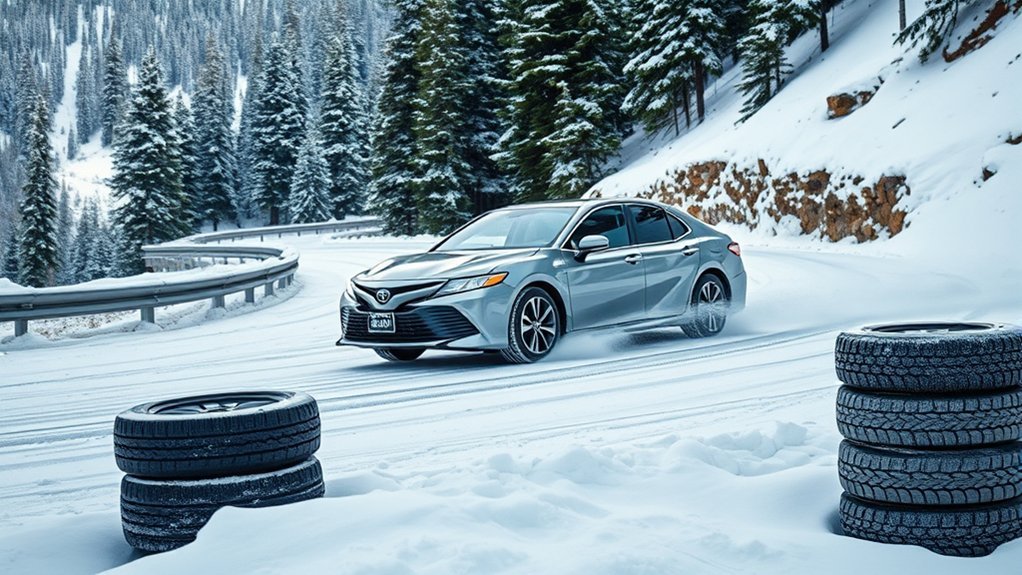
Having covered how to handle snow and mud in a Camry AWD, it’s time to weigh whether that sedan or an SUV (or simply added winter gear) better fits your needs. You’ll get real Camry AWD benefits: a mechanical linkage that shifts power rearward when needed and a proven 2.5‑liter AWD setup that outperforms FWD in slippery tests. That translates to confident traction on packed snow and wet roads.
Yet ground clearance is limited, so in severe winter or deep snow an SUV alternatives offer clearer advantages: higher ride height, greater cargo and towing capacity, and more off‑road capability. If your winters are extreme but you prefer a sedan, add winter tires — they markedly improve grip and safety and narrow the performance gap. Decide by matching typical conditions to use: daily commuting and fuel efficiency favor Camry AWD benefits; frequent deep‑snow travel or cargo needs push you toward SUV alternatives or a purpose‑built winter vehicle.
Frequently Asked Questions
Is AWD Good for Slippery Roads?
Yes — you’ll get better traction in slippery weather conditions because AWD works with traction control to distribute power to all wheels, improving stability; you’ll still need good tires, maintenance, and cautious driving for full safety.
Is the Toyota Camrys AWD System Good to Drive on Snow?
Yes — you’ll find the Camry’s AWD offers solid snow performance and improved handling dynamics in light snow, thanks to torque distribution and traction control; just mind ground clearance, tire condition, and weight for ideal freedom on slippery roads.
Conclusion
Quick verdict: Camry AWD gives you noticeable traction gains on packed snow and muddy roads compared with FWD, but it’s no substitute for ground clearance or a true winter-ready vehicle. As tests show, it helps when individual wheels slip, yet it won’t overcome deep snow, ice, or mismatched tires. Keep tires, weight distribution, and maintenance sharp. Remember, “an ounce of prevention is worth a pound of cure”: choose AWD plus winter tires for safer, more confident driving.