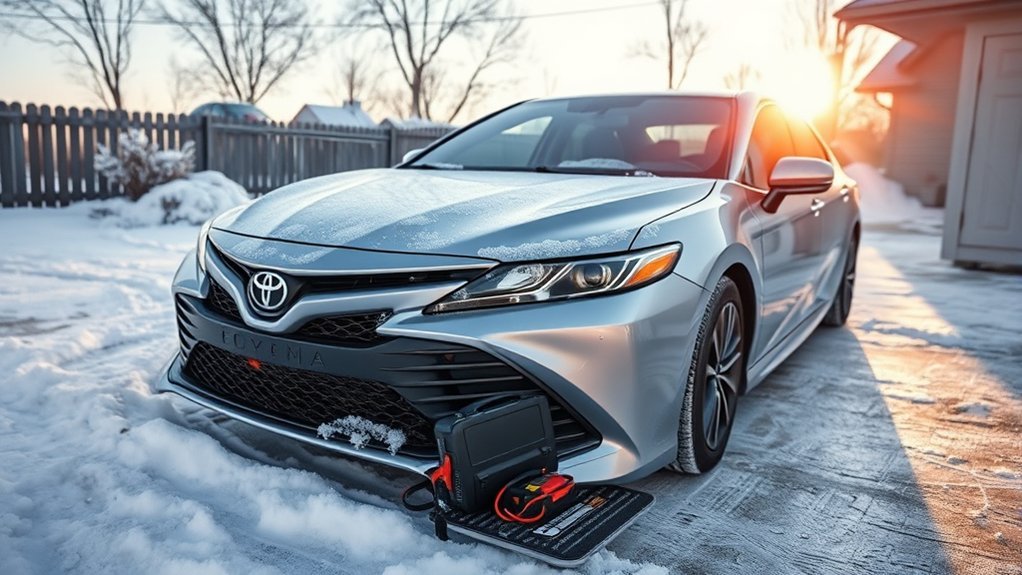
A Toyota Camry that will not start on a freezing morning usually has one of a few causes: a weak 12-volt battery, a Smart Key/fob issue, thick or incorrect fluids, poor fuel quality, or an electrical fault that cold weather makes worse. For a 2025 Toyota Camry Hybrid, the diagnosis is slightly different from older gas-only Camrys because the 12-volt battery must wake up the hybrid system before the car can show the READY indicator.
Quick Answer
To prevent most Toyota Camry cold-start failures, test the 12-volt battery before winter, keep terminals clean, use the engine oil specified in your owner’s manual, use fresh winter-grade gasoline, and avoid long idle warm-ups. For a 2025 Camry Hybrid, Toyota specifies SAE 0W-8 oil and a Toyota-specific jump-start procedure.
Key Takeaways
- Cold weather weakens the 12-volt battery and can expose a battery that seemed fine in mild weather.
- For a 2025 Toyota Camry Hybrid, use Toyota’s specified SAE 0W-8 oil; do not guess based on older Camry oil grades.
- If the Smart Key battery is weak, hold the key fob near the START button while pressing the brake.
- Avoid long warm-up idling. Start the car, clear visibility, then drive gently until it reaches normal temperature.
- Use Toyota’s hybrid jump-start instructions and never touch orange high-voltage hybrid cables.
At a Glance
| Time Required | 10–30 minutes for basic checks |
| Difficulty | Easy for voltage and fluid checks; moderate for jump-starting |
| Tools Needed | Digital multimeter, gloves, terminal brush, flashlight, owner’s manual, tire gauge, and a compatible jump pack if needed |
| Cost | $0–$30 for basic checks; about $150–$300+ if the 12-volt battery needs replacement |
What Causes Cold-Weather Starting Problems in a Toyota Camry
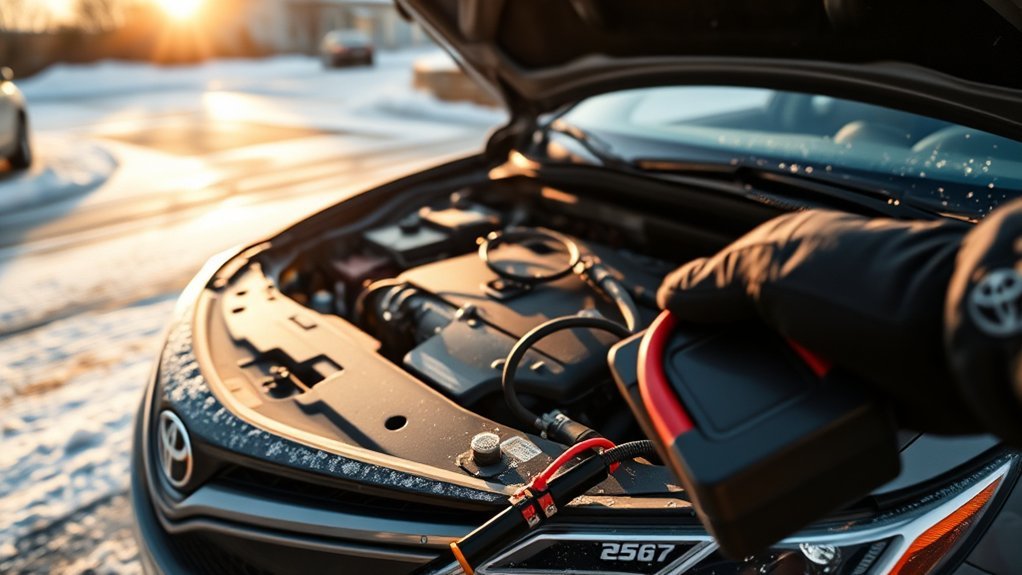
Cold weather makes every weak point in a Camry’s starting system show up faster. A battery loses output as temperature drops, oil flows more slowly, rubber seals stiffen, and electronic sensors or key-fob batteries may respond more slowly than usual. On older gas Camrys, the driver may notice slow cranking. On a 2025 Camry Hybrid, the more common symptom may be that the car will not wake up fully or will not display READY.
The most common cold-start causes are:
- Weak 12-volt battery: Cold reduces battery strength and raises the power needed to start or initialize the vehicle.
- Loose or corroded battery terminals: Even a good battery can act weak if current cannot flow cleanly.
- Weak Smart Key battery: The car may not detect the key, especially when the fob battery is already low.
- Wrong or old engine oil: Oil that is too thick for the vehicle can slow lubrication during cold starts.
- Fuel-quality or moisture problems: Bad fuel, water contamination, or a nearly empty tank can make cold starting harder.
- Starter, relay, or charging-system faults: Cold can expose parts that are already near failure.
Note: The U.S. 2025 Toyota Camry is hybrid-only. If you own an older gas-only Camry, the same battery and fluid principles apply, but your oil grade and starting-system details may be different. Always verify the model year in your owner’s manual.
How to Tell If Your Camry’s Battery Is the Culprit
Start with the 12-volt battery because it is the most common winter failure point and one of the easiest items to test. A battery can show enough voltage to light the dash but still fail a load test when the vehicle needs real current.
Battery Voltage Check
With the vehicle off, place a digital multimeter’s red probe on the positive battery terminal and the black probe on the negative terminal or a proper ground point. A healthy, fully charged 12-volt battery often reads around 12.6 volts at rest. A reading around 12.4 volts suggests the battery is partly discharged, and a reading near or below 12.2 volts deserves charging and further testing.
Voltage alone is not the final answer. Cold-start reliability depends on battery capacity under load. If the battery is more than three years old, has a low resting voltage, or drops sharply while starting, have it load-tested by a shop or parts store.
Cold Cranking Performance
Cold cranking performance is the battery’s ability to deliver power when temperatures are low. In cold weather, a weak battery may show these signs:
- Slow crank on older gas Camrys.
- Clicking sounds or dim lights when trying to start.
- No dash lights or flickering displays.
- On a hybrid Camry, failure to enter READY mode.
- Repeated “key not detected” or low-power warnings when the fob is not the real problem.
A battery that starts your Camry in October can still fail in January. Cold temperatures reduce available battery power while the vehicle demands more from the 12-volt system.
Quick Troubleshooting Steps for Push-Button Start Camrys
If your Camry has push-button start, do these checks before assuming the starter or hybrid system has failed:
- Confirm the shifter is in Park. The vehicle may not start if it does not recognize Park.
- Press the brake pedal firmly. Push-button systems require the brake interlock.
- Move the Smart Key closer to the START button. If the fob battery is weak, Toyota says you can hold the Smart Key next to the START button and press it while depressing the brake.
- Look for READY, not just engine noise. On a 2025 Camry Hybrid, the gasoline engine may not run immediately. READY means the vehicle is on and able to drive.
- Check the 12-volt battery. If the dash is dead, flickering, or full of warning messages, test the 12-volt battery before chasing more complex faults.
Pro Tip: Keep a spare key-fob battery at home. A weak fob battery can look like a major starting problem, but it is often a quick fix.
Safe Jump-Starting for a Camry Hybrid
If the 12-volt battery is discharged, a Camry Hybrid may need a jump-start before the hybrid system can initialize. Use the jump-start procedure in the Toyota owner’s manual for your exact model year. For the 2025 Camry Hybrid, Toyota describes using the under-hood exclusive jump-start terminal rather than guessing at connection points.
Warning: Never touch, probe, disconnect, or jump-start from orange high-voltage hybrid cables or components. Use only the approved 12-volt jump-start points and follow the owner’s manual. If you are unsure, call roadside assistance or a Toyota technician.
After a successful jump-start, do not assume the battery is fixed. A jump only gets the vehicle running. Have the 12-volt battery and charging system tested, especially if the battery is older than three years or the car needed more than one jump in the same winter.
Engine Oil and Fluids That Improve Cold Starts
The right oil matters because cold oil flows more slowly. However, the safest rule is not “use the thickest winter oil” or “switch to 5W-30.” The correct rule is: use the oil viscosity and specification listed in your owner’s manual for your exact Camry year and engine.
For the U.S. 2025 Toyota Camry Hybrid, Toyota lists JASO GLV-1 SAE 0W-8 as the recommended oil. Toyota says SAE 0W-16 may be used if 0W-8 is not available, but it should be replaced with 0W-8 at the next oil change.
Also check these winter fluids:
- Coolant: Use the coolant type specified by Toyota and keep the mixture strong enough for your climate.
- Windshield washer fluid: Use winter-rated washer fluid so the reservoir and spray nozzles do not freeze.
- Brake fluid: If the brake pedal feels abnormal, have the brake system inspected; do not ignore brake warnings.
- Transmission/eCVT fluid: Follow Toyota’s maintenance schedule and avoid universal fluids unless they meet the required specification.
Fuel System Problems and Preventing Fuel-Line Freeze
Fuel problems are less common than battery problems, but they can still cause rough starts in freezing weather. The best prevention is simple: use fresh gasoline from a busy station, keep the tank from running near empty, and follow Toyota’s fuel requirements.
For the 2025 Toyota Camry Hybrid, Toyota specifies unleaded gasoline with an octane rating of 87 or higher and gasoline that meets ASTM D4814 in the U.S. Premium fuel is not required unless your specific manual says otherwise.
Fuel-line de-icer can help when water contamination is suspected, but do not pour random additives into the tank as routine maintenance. Use only products compatible with gasoline engines and your owner’s manual, and follow the product dose exactly.
Note: Keeping the tank at least half full during deep cold reduces air space in the tank and can help limit condensation, especially if the car sits outside for long periods.
Using Block Heaters and Engine Warmers: Do You Need One?
A block heater or engine warmer can help if your Camry regularly sits outside in severe cold. It warms the engine or coolant area before startup, which can improve oil flow and reduce cold-start stress. This is most useful in climates where temperatures regularly fall well below freezing.
Before buying one, confirm fitment for your exact model year and powertrain. A heater that fits an older gas Camry may not be the correct part for a 2025 Camry Hybrid. Use a weather-rated outdoor extension cord, keep the plug dry, and consider a timer so the heater runs only long enough to pre-warm the engine.
Maintenance Checklist to Prevent Winter Start Failures
Preventing a no-start is easier than dealing with one in a frozen parking lot. Use this checklist before the first hard freeze:
- Test the 12-volt battery voltage and schedule a load test if the battery is older than three years.
- Clean corrosion from battery terminals and tighten loose clamps.
- Replace a weak Smart Key battery.
- Use the correct Toyota-specified engine oil for your model year.
- Check coolant level and freeze protection.
- Fill the washer reservoir with winter-rated washer fluid.
- Keep the fuel tank at least half full during severe cold.
- Check tire pressure because pressure drops as temperatures fall.
- Keep a winter emergency kit in the trunk: gloves, blanket, flashlight, phone charger, small shovel, and a compatible jump pack.
Battery Health Checks
Battery checks should include more than “it started yesterday.” Look at age, voltage, terminals, and load-test results. If the battery is near the end of its life, replace it before deep winter instead of waiting for a failure.
- Voltage: Check resting voltage after the car has been off for a while.
- Terminals: Clean corrosion and make sure clamps do not rotate by hand.
- Hold-down: A loose battery can suffer vibration damage.
- Load test: Have a shop test capacity under load, especially before winter travel.
Proper Fluid Selection
Proper fluid selection means using the exact specification Toyota calls for, not simply choosing a lower number on the bottle. Modern Camry engines, especially hybrids with frequent engine stop-start cycles, are built around specific oil viscosity and certification requirements. Keep oil fresh, verify the coolant mixture, and do not ignore fluid warning lights.
Practical Tips for Driving and Storing Your Camry in Freezing Temps
When possible, park in a garage, carport, or wind-protected area. If you must park outside, point the front of the car away from direct wind, lift wipers away from the glass before an ice storm if safe to do so, and keep the fuel tank from running low.
Do not warm the car by idling for 10 or 15 minutes just to protect the engine. FuelEconomy.gov says most manufacturers recommend driving gently after about 30 seconds, because the engine warms faster under light driving than by sitting still. Idle only long enough to stabilize the vehicle and clear the windows so you can drive safely.
Pro Tip: If your commute is mostly short trips in winter, use a battery maintainer during long parked periods. Short cold trips may not give the 12-volt battery enough time to recover.
When to Call a Technician or Schedule Winter Service in Rockville, MD
If your Camry fails to start more than once, needs repeated jump-starts, or shows warning lights after it enters READY mode, schedule service instead of guessing. In Rockville, MD, winter temperatures can swing above and below freezing, which is hard on batteries, tires, wipers, and electrical connections.
Call a technician if you notice:
- The 12-volt battery fails a load test.
- The car will not enter READY mode even with a known-good key.
- The vehicle starts only after a jump, then fails again later.
- You hear repeated clicking or see flickering dash lights.
- Warning lights remain after the vehicle starts.
- You smell fuel, see coolant leaks, or notice damaged battery cables.
A winter service visit should include a 12-volt battery test, charging-system check, terminal inspection, coolant freeze-protection test, tire-pressure check, wiper/washer inspection, and confirmation that the correct oil is being used.
Frequently Asked Questions
How do I make sure my Toyota Camry starts in cold weather?
Test the 12-volt battery before winter, clean and tighten the battery terminals, use the owner’s-manual oil specification, keep the fuel tank at least half full in severe cold, replace a weak Smart Key battery, and park in a garage or sheltered spot when possible.
What are the 5 P’s for cold-weather Camry care?
A practical 5 P’s checklist is: Prepare the battery, Pick the correct fluids, Park smart, Prevent fuel and visibility problems, and Plug in a block heater or battery maintainer when your climate and vehicle setup justify it.
Should I start my Camry and let it run in extreme cold?
Let it run only briefly. Modern vehicles usually do not need a long idle warm-up. Start the car, clear snow and ice from the windows, wait long enough for stable operation, then drive gently until the vehicle reaches normal temperature.
What oil should I use in a 2025 Toyota Camry Hybrid for winter?
For the U.S. 2025 Toyota Camry Hybrid, Toyota lists SAE 0W-8 as the recommended oil. If SAE 0W-8 is unavailable, Toyota says SAE 0W-16 may be used temporarily, but it should be replaced with SAE 0W-8 at the next oil change.
Why does my Camry Hybrid not make engine noise after I press START?
That can be normal. A Camry Hybrid may be ready to drive before the gasoline engine turns on. Look for the READY indicator. If READY does not appear, check the brake pedal, shifter position, Smart Key detection, and 12-volt battery condition.
Conclusion
Most Toyota Camry cold-start problems are preventable. Start with the 12-volt battery, verify the Smart Key is working, use the correct Toyota-specified oil, keep fuel and washer fluid winter-ready, and avoid long idle warm-ups. If your Camry needs repeated jumps or will not enter READY mode, schedule service before the next hard freeze leaves you stranded.
Sources
- Toyota Owners — 2025 Camry Hybrid maintenance data — backs up SAE 0W-8 oil specification and temporary 0W-16 guidance.
- Toyota Owners — 2025 Camry Hybrid fuel information — backs up 87-octane unleaded gasoline and ASTM D4814 fuel guidance.
- Toyota Support — starting with a dead Smart Key battery — backs up holding the Smart Key near the START button.
- Toyota Owners — 12-volt battery discharged procedure — backs up Toyota-specific hybrid jump-start cautions.
- FuelEconomy.gov — fuel economy in cold weather — backs up minimizing warm-up idling and driving gently after about 30 seconds.
- AAA — cold weather and car battery strength — backs up how low temperatures reduce battery output.