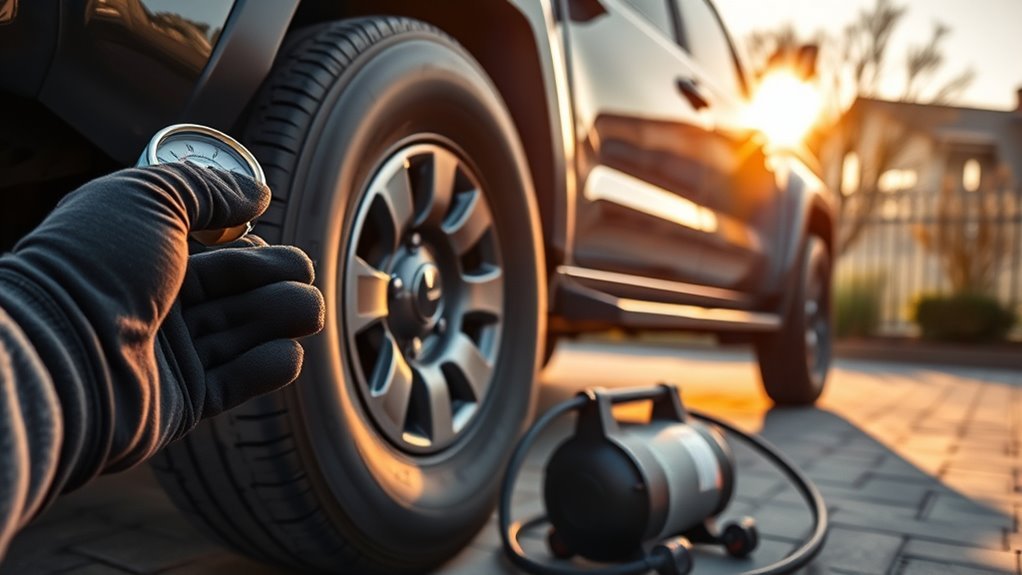
You should check your Toyota Tacoma’s tire pressure at least monthly, before long trips, and whenever temperatures shift, keeping tires within the owner’s recommended 32–36 PSI. Inspect visually for cuts, bulges, and uneven tread, use a calibrated digital gauge when tires are cold, add air in short bursts and recheck, and top up low tires until TPMS clears. Learn how to pick the right tools, adjust pressure safely, and spot damage to stay safe and save fuel.
How to Check Toyota Tacoma Tire Pressure in 6 Steps
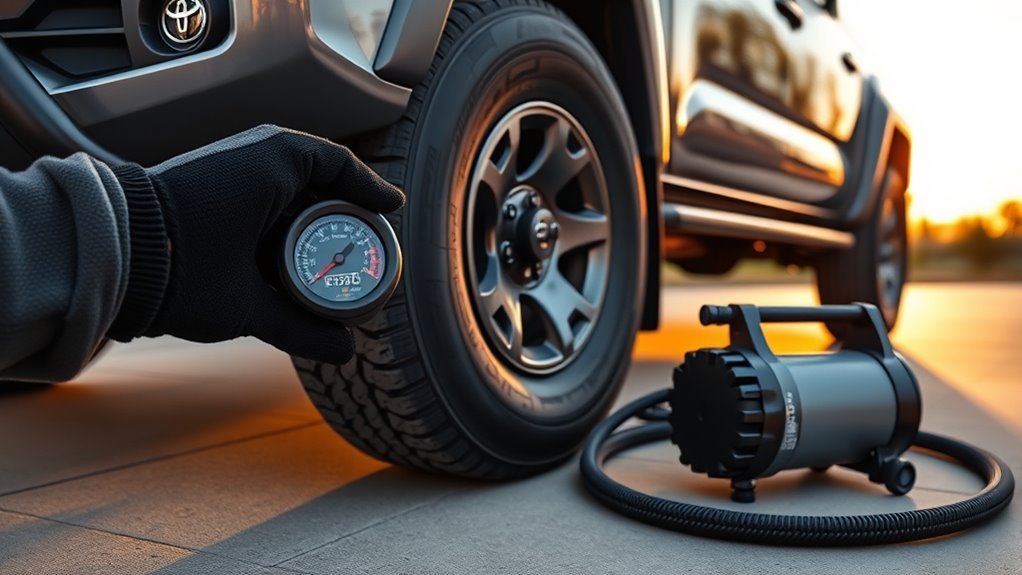
Start by gathering a tire pressure gauge and, if possible, an air compressor; you’ll check all four tires when they’re cold to get accurate readings. You begin with a quick visual inspection for cuts, bulges, or uneven tread wear—note anything that suggests rotation or replacement. Remove the valve cap, press the gauge firmly, and read the PSI; record each tire. Compare readings to the owner’s manual recommended range, remembering that you shouldn’t rely on blanket numbers here. If the TPMS light is on, prioritize immediate pressure monitoring and top up with the compressor until the gauge matches the manual’s guidance. Reinstall valve caps and reset TPMS if needed. Repeat this process monthly and before major trips, especially during temperature shifts that affect psi. These tire maintenance tips keep your Tacoma responsive, safer, and freer on the road—empowering you to control performance rather than letting neglect dictate it.
Find the Correct PSI for Your Tacoma
Now that you know how to check your Tacoma’s tires, the next step is confirming the right PSI for safe, efficient driving. You’ll aim for the manufacturer’s range—typically 32–36 PSI—so consult your owner’s manual or the sticker on the driver’s door jamb for the exact number. This tire pressure importance isn’t just bureaucracy: correct PSI prevents uneven wear, improves fuel economy, and supports peak driving performance.
Use a reliable gauge and check cold tires for accurate readings. Keep a portable compressor to restore pressure quickly when you find a low tire. TPMS will warn you of significant drops, but don’t rely on it as your only check.
- Verify the exact PSI from your Tacoma’s manual or door sticker.
- Check each tire with a quality gauge while tires are cold.
- Use TPMS alerts as a backup, not the sole method.
- Carry a compressor for on-the-spot adjustments.
Best Time and How Often to Check Tire Pressure
Routine checks keep your Tacoma safe and efficient, so check tire pressure at least once a month and any time temperatures swing or before a long trip. You’ll get the truest reading when tires are cold—measure in the morning before you drive. That’s when PSI reflects baseline pressure, letting you act decisively.
Understand tire pressure importance: proper PSI prevents flats, improves fuel economy, and keeps handling predictable. For most Tacomas, target 32–36 PSI; confirm your model’s spec in the owner’s manual. During seasonal shifts, increase monitoring frequency — check weekly when temperatures change rapidly or you’re preparing for extended travel.
Make checks routine and intentional. If you find pressure about 3 PSI low, correct it promptly; small drops already cost fuel and safety. By owning this simple habit, you free yourself from avoidable breakdowns and inefficiency. Consistent monitoring frequency turns maintenance from chore into control.
Which Gauge, Compressor, or TPMS App to Use
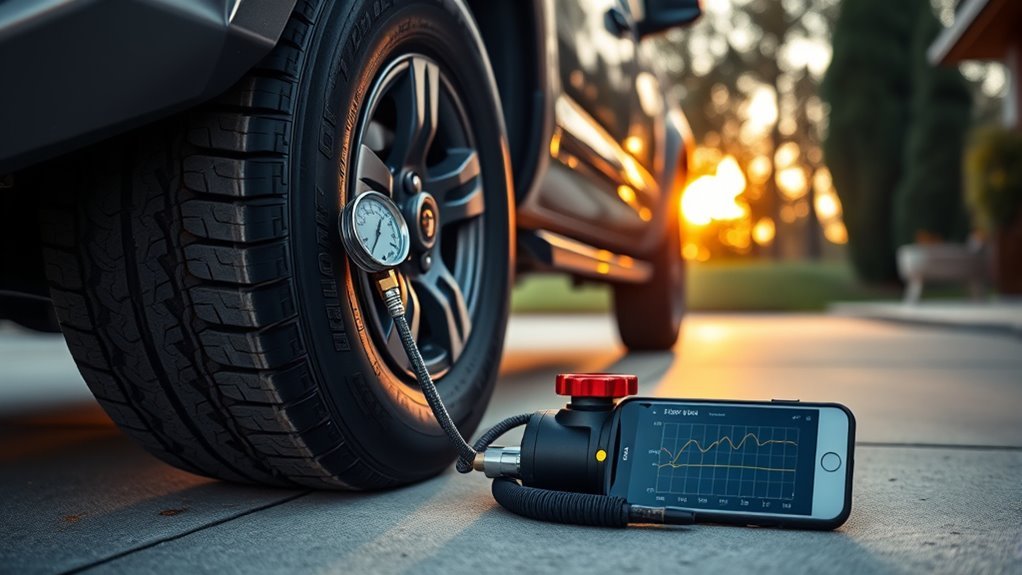
For quick, precise PSI readings you’ll want a digital tire gauge rather than an analog one. Keep a portable air compressor at home so you can top tires to the manufacturer’s recommended 32–36 PSI without a trip to the gas station. If you prefer continuous monitoring, install a TPMS app that links to your sensors and have a shop check it if the warning light stays on.
Digital Versus Analog Gauges
When choosing between digital and analog tire gauges (or adding a portable compressor or TPMS app), pick the tool that matches how precise, portable, and fail-safe you need it to be: You’ll favor digital accuracy if you want repeatable, 0.1 PSI readings for fine tuning and monitoring. Choose analog durability when you need a rugged, battery-free tool that survives rough use. Match the gauge’s range to your Tacoma’s 32–36 PSI target and avoid tools that max out below your needs. You’re aiming for freedom from surprises, so pick what keeps you rolling without dependency.
- Digital: precise readings, good for systematic checks
- Analog: tough, no batteries, simple
- Range: guarantee 0–60+ PSI coverage
- Alerts: use TPMS for continuous monitoring
Portable Compressors And Apps
Because keeping your Tacoma at the right pressure means both accurate measurement and on-the-spot correction, choose a setup that combines a calibrated digital gauge or rugged analogue with a portable compressor and, if you want continuous alerts, a TPMS app that pairs with your truck; this lets you verify readings to 0.1–1 PSI, inflate or bleed air immediately, and get real-time warnings of pressure drift so you won’t drive on underinflated tires. You’ll want a compressor with auto-shutoff, thermal protection, and a reliable duty cycle—those compressor features prevent damage during repeated use. Pick a calibrated digital gauge to avoid the PSI errors that cost fuel. For apps, weigh app comparisons on connectivity, alert thresholds, and battery drain. Follow your door-sticker PSI range (32–36 PSI).
How to Read a Tire Pressure Gauge Correctly
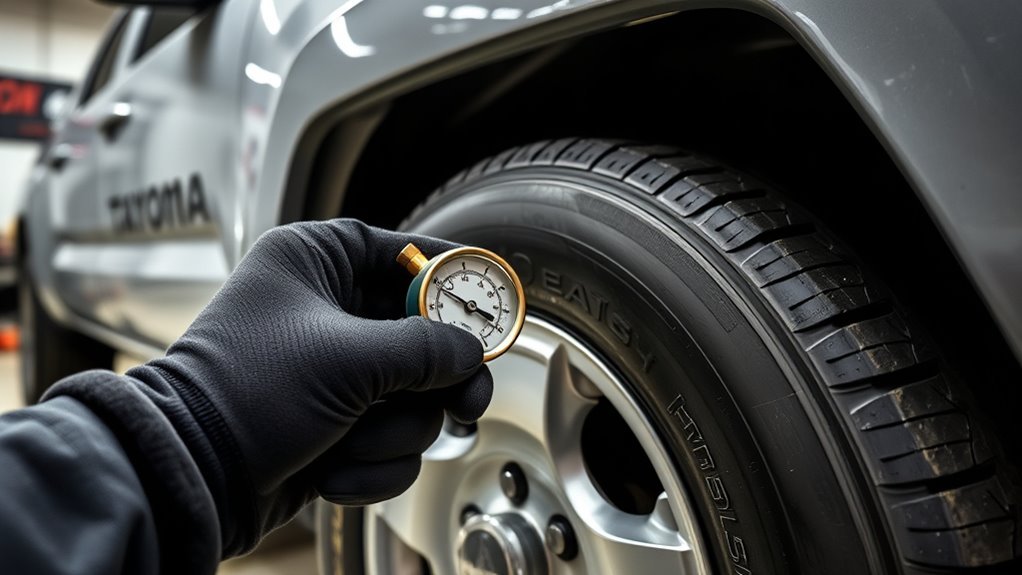
A simple, firm press of the gauge onto the valve stem will let you get an accurate PSI reading; you’ll hear a slight hiss when you’ve made proper contact and air begins to escape. Press firmly, read the dial or digital screen, and record the value. If it’s a dial, confirm the needle settles on the correct PSI. If it’s digital, wait for the digits to stabilize. Always check when tires are cold to avoid heat-inflated errors. Regular gauge calibration keeps readings honest and supports reliable pressure maintenance for safety and efficiency.
- Use steady pressure and listen for the hiss; a shaky fit leaks accuracy.
- Compare the reading to your Tacoma’s recommended PSI from the owner’s manual.
- Recheck after adding or releasing air; don’t assume one reading is final.
- Store the gauge dry and inspect valve caps to prevent contamination and false readings.
Take control: precise readings free you from guesswork and keep your truck ready.
TPMS Light for Tacoma: Immediate Steps and Safety
If your Tacoma’s TPMS light comes on, don’t ignore it—check each tire’s pressure immediately with a gauge and top up any low tires to the PSI recommended in your owner’s manual. You’re protecting yourself and claiming control: low pressure signals increased wear and a real blowout risk. Use a reliable gauge, compare all four tires to the placard PSI, and account for temperature-related fluctuations that commonly trigger the lamp.
If pressures correct the warning, you’ve resolved it; if the TPMS light stays lit, pursue TPMS troubleshooting rather than driving on a warning. A persistent light can mean a sensor fault or battery issue that demands professional diagnostics at a service center. Until it’s confirmed safe, avoid high-speed or heavy-load driving. Prioritize tire safety as an act of autonomy—regular checks and prompt action keep you mobile and free, and prevent avoidable roadside emergencies.
How to Adjust Tire Pressure Safely at Home or a Station
Before you add or release air, check the recommended PSI on your Tacoma’s door jamb and measure each tire when cold for an accurate reading. Use a reliable tire pressure gauge and add air slowly with a compressor, rechecking pressure frequently to avoid over-inflation. If pressure stays abnormal after adjustments, inspect for damage or visit a service center.
Check Pressure When Cold
When tires are cold—ideally first thing in the morning—check pressure with a reliable gauge to get an accurate reading unaffected by driving heat. You’ll practice tire maintenance and pressure monitoring to stay safe and independent. Insert the gauge firmly on the valve stem, listen for a slight hiss to confirm a seal, then read the PSI. Compare to the sticker or owner’s manual (typically 32–36 PSI for Tacomas). If low, add air gradually and recheck to avoid over‑inflation. In cold weather, expect about 1 PSI loss per 10°F drop, so check more often.
- Bring a portable compressor or use a station with steady air flow
- Recheck after small increments of added air
- Adjust to manufacturer PSI, not tire sidewall
- Inspect valve caps and tires for damage
Use Proper Gauge
Start with a reliable gauge—preferably a digital model—and check each tire while they’re cold to get precise readings. You’ll want to confirm the recommended PSI from the owner’s manual or the driver-door sticker before any change. Choose your gauge types consciously: digital for quick, repeatable readings; dial or stick if you prefer mechanical simplicity. Prioritize gauge accuracy—calibrate or replace any unit that drifts. When you use the gauge, seat it firmly on the valve to avoid leaks and read the pressure immediately. Do monthly checks and after temperature shifts, since cold drops psi and freedom on the road depends on predictable handling. A proper gauge gives you control; use it to keep your Tacoma safe and responsive.
Add Air Slowly
Now that your gauge is giving reliable readings, add air slowly to avoid overshooting the target PSI. You’ll feel empowered keeping tire pressure within the recommended 32–36 PSI range (check the owner’s manual or door jamb sticker). Use a portable air compressor at home or an air station at a gas pump, but follow air compressor safety: connect securely, add brief bursts, and pause to read the gauge. After each short fill, recheck pressure — small increments prevent overinflation and keep you in control. Proper adjustments improve fuel efficiency; even 1 PSI matters. Practice these tire maintenance tips regularly to free yourself from roadside uncertainty.
- Start with cold tires and the recommended PSI
- Attach hose firmly and add 3–5 second bursts
- Recheck with your gauge after each burst
- Release excess air if you overshoot
How Temperature and Seasons Affect Tire Pressure
Because outdoor temperature directly changes the air inside your tires, you’ll see about a 1 PSI drop for every 10°F decrease—so seasonal swings can quickly leave your tires under- or over-inflated. You own your safety and efficiency, so make tire maintenance a habit: check pressures monthly and whenever temperatures shift considerably. Cold weather lowers pressure, reducing traction and control; that risk undermines your freedom to drive confidently. Heat raises pressure, increasing blowout risk and compromising ride quality.
Set pressures to the vehicle manufacturer’s placard, not the tire sidewall, and recheck when seasons change. A 3 PSI drop can cost about 1% in fuel economy, so small losses add up. Use a quality gauge, add air slowly, and balance adjustments across all four tires. These seasonal adjustments keep performance predictable, extend tire life, and preserve your independence on the road.
Spotting Uneven Wear or Tire Damage During Checks
When you check your tires, scan for uneven tread wear, bulges, cuts, or bald spots—these signs point to improper inflation, alignment, or damage that can compromise safety. You’ll want to make a quick habit of visual checks and a penny test for tread depth; if you can see all of Lincoln’s head, replace the tire. During sidewall inspection, look for cuts, bubbles, or deep abrasions that reduce structural strength.
- Compare all four tires for consistent tread wear patterns to spot alignment or suspension faults.
- Use the penny test and a tire gauge to confirm tread wear and pressure align with specs.
- Inspect sidewalls closely after hitting debris or potholes; small damage can become catastrophic.
- Note any bulges or bald spots and remove the tire from use until assessed.
Stay decisive: address compromised tires immediately so your Tacoma stays free and safe on every road.
When to Visit Bondys/AutoNation Service for Tire Help
If your Tacoma’s TPMS light comes on or you spot uneven tread wear, bring it to Bondys or AutoNation for a professional check—technicians can diagnose TPMS faults, rotate or replace tires, and correct alignment or suspension issues. You should schedule service when the TPMS alerts you, when tread shows uneven wear, or when fuel economy drops—underinflation raises wear and lowers MPG. Use the free AutoNation 10-point Pit Stop for a quick professional inspection and tire pressure fill. If you don’t know how to check or refill pressure, let certified Bondys/AutoNation techs teach and service your tires.
| Service trigger | What they do |
|---|---|
| TPMS light on | Diagnose sensor/pressure |
| Uneven tread | Tire rotation or replacement |
| Low fuel economy | Check inflation, alignment |
Visit promptly to keep your Tacoma safe, efficient, and free—professional inspection protects your mobility and choice to roam.
Frequently Asked Questions
How Often Should You Check Tire Pressure Come On?
Check tire pressure at least once a month, and whenever seasonal temperature shifts hit; you’ll follow tire maintenance tips and ideal timing by checking cold in the morning, freeing yourself from preventable flats and inefficiency.
What PSI Should I Keep My Tacoma Tires At?
Keep your Tacoma tires at the recommended tire pressure of about 32–36 PSI; check the placard or manual for ideal settings. You’ll free yourself from inefficiency, save fuel, and prevent premature tire wear.
Is 40 PSI Good Tire Pressure for a Toyota?
No — 40 PSI’s like riding on a tightrope; you’ll risk reduced traction and uneven wear. Check tire pressure, aim for proper inflation per your manual (typically ~32–36 PSI), and adjust for load and cold tires.
Conclusion
So you’ll check your Tacoma’s tire pressure in six efficient steps, find the right PSI, and probably learn temperature tweaks—only to be surprised that the little rubber rings actually want your attention. You’ll spot uneven wear and top up at home or a station, or let a pro at Bondys/AutoNation handle it. It’s ironic: such a small chore can save money, time, and roadside embarrassment—yet most drivers still wait until the light nags them.